Year: 2019

I traveled to Guantanamo Bay, Cuba, to Monitor Hearings in the case against 5 alleged 9/11 attack masterminds.

Text Box: At GTMO airport, Guantanamo Bay, Cuba, with Chuck Dunlap, IU McKinney JD graduate
At GTMO airport, Guantanamo Bay, Cuba, with Chuck Dunlap, IU McKinney JD graduate

The Indiana University McKinney School of Lawโ€™s Military Commission Observation Program nominated me to the Pentagon for me to travel to Guantanamo Bay, Cuba, to monitor U.S. Military Commission hearings. The hearings I was assigned to were in the case against 5 alleged masterminds of the 9/11 attacks on the World Trade Center and Pentagon. The Pentagon granted me clearance to travel to Guantanamo from 21 to 28 September 2019

Before my trip, I only knew of Guantanamo from the news, documentaries, and movies. I never thought or imagined that I would have the opportunity to be personally present in Guantanamo as an NGO observer. There are so many aspects of this visit to reflect on but I will confine my discussion to the following.

This blog has 6 Parts. Part I describes my Guantanamo mission. Part II describes the substance of the hearings against the 5 alleged 9/11 masterminds. Part III are some of my personal reflections. Part IV describes the courtroom and the hearing setting. Part V discusses my personal experiences at Guantanamo. Part VI describes my last day at Guantanamo, 28 September 2019.

I included that my mission to Guantanamo was a very enriching experience, and I recommend it to any Indiana McKinney faculty or staff member, student or graduate.

  1. My Guantanamo mission
Text Box: Camp Justice, Guantanamo Bay, Cuba.
Camp Justice, Guantanamo Bay, Cuba

I have long been interested in topics related to human rights, including transparency, ensuring a fair trial, and striving to achieve justice. This is what initially sparked my interest in the Guantanamo Military Commission hearings.

My mission as a Non-Governmental Organization Observer (NGO) representing Indiana University McKinney School of Law, was to attend, observe / monitor, be seen, analyze, critique and report on the Guantanamo proceedings.

โ€œAt Guantanamo bay justice must not only be done, but must be seen to be done.โ€ Guantanamo Bay NGO Challenge Coin

โ€œWhat happens at Guantanamo Bay should not stay at Guantanamo Bay.โ€

To fulfill this mission, I acknowledged my responsibilities to be independent and objective in my observations and to try to gain a good understanding of how the Guantanamo proceedings are being held, and an understanding of whether the rights and interests of all Guantanamo stakeholders were being afforded to them.

  1. The substance of the hearings

Trial date set for the long-running case.

https://gitmoobserver.com/wp-content/uploads/2019/07/photo-masterminds-4.jpg
Note: photos are taken from Google Search, and may not be the best representation of how defendants look today.

The 9/11 case is one of the longest ongoing cases of the 21st century, having begun with an arraignment in 2012, which followed an earlier version of the case that was dismissed. 

On 5 May 2012, the five defendants; (1) Mr. Khalid Shaikh Mohammad, (2) Mr. Walid bin Attash, (3) Mr. Ramzi bin al Shibh, (4) Mr. Ammar Al Baluchi, and (5) Mr. Mustafa Al Hawsawi, were charged with war crimes. After almost eight years of pretrial hearings, Judge Cohen, the current presiding military judge who is the third military judge to be assigned to the case, set a trial date for 11 January 2021.

While we waited outside the courtroom during court breaks, there was open speculation about whether this trial date would stick. But, it seems that the prosecution and defense teams must prepare the case for trial to commence on that date.

In addition to the prosecution and defense preparing, preparations must be made by the government, that will be responsible for the logistics of a large trial that will attract hundreds of new people to a small, remote military base that was not originally designed for such a proceeding and still lacks some basics needs, such as housing for all the media who will likely be interested in covering the trial.

Motion arguments, testimony

During the week I was in Guantanamo, Judge Cohen heard arguments on several motions and heard testimonies of several witnesses. They are outlined as below:

  1. Motion to Suppress Defendantsโ€™ Coerced Testimonies.

The five defendants were captured between 2002 and 2003 and were transferred to Guantanamo in 2006. The evidence shows that between the time they were captured and the time they were taken to Guantanamo, these five men were held in secret Central Intelligence Agency (CIA) prisons known as โ€œblack sitesโ€. The CIA has invested over 81 million dollars and enlisted two psychiatrists, James Mitchell and Bruce Jessen, to design โ€œenhanced interrogation techniquesโ€ (EITs) (that defense counsel and others refer to as โ€œtortureโ€) used against these defendants and others held at the CIA black sites. Both psychiatrists have been called to testify in January 2020 in this 9/11 case.

We heard witness testimony connected to the motion to suppress alleged coerced statements (involuntary statements obtained by enhanced interrogation/torture). This week, we observed the testimony of:   

  • Special Agent Stephen McClain. He was part of the Criminal Investigative Task Force (CITF) that was tasked to get โ€œcleanโ€ testimony in 2007 from defendants to be used later in court. Agent McClainโ€™s testimony was taken via CCTV. The questions asked were about whether interrogation was conducted in a voluntary, non-hostile way, and whether Article 31 from the Uniform Code of Military Justice UCMJ (right to remain silent, be informed, right to counsel, and any statement can be used against you) was given to the defendants.
  • Judge Bernard E. Delury. He presided at the 2007 Combatant Status Review Tribunal (CSRT) tribunal hearings for each of the five defendants. The questions asked of him were focused on the competency and the demeanor of the defendants, whether the 2007 tribunal was conducted fairly, and whether any of plea deals or confessions were made involuntarily. โ€œCSRTS were not criminal proceedings,โ€ Judge Bernard E. DeLury stated that the purpose of the CSRT service in Guantanamo Bay in 2007, over which he presided for all five defendants, was not to decide guilt or innocence.  He stated that the tribunal was an administrative fact-finding tribunal. Four of the five defendants attended the CSRT. Mr. Ramzi bin al Shibh chose not to attend. Judge DeLury might be called again to the witness stand to be examined by other defense counsels (maybe via CCTV).
  • Mr. D.J. Fife, Latent Print Examiner. Mr. Fife, of the FBI, was the fingerprint examiner in the clean team and was present at the 2007 tribunal. The questions asked of him were around โ€œknown fingerprints” and “latent prints”, when and how the defendantsโ€™ fingerprints were taken, and the chain of custody.

Both the prosecution and the defense examined the witnesses. The defense presented arguments supporting the claim of torture and coerced statements. On the other hand, the prosecution presented arguments supporting that 2007 interrogations were conducted voluntarily, that defendants couldโ€™ve stopped the integrations at any time and that their demeanor was appropriate and had no sign of sociological issues. There were also classified sessions which we, the NGOs, were not permitted to observe and where more information was presented. The Judge has not made a decision yet about the motion to suppress.

  1. Motion to compel the prosecution to meet a discovery request.

The defense team asked the judge to compel the prosecution to meet a discovery request. Defense attorneys argued that they canโ€™t meet their deadlines or submit motions if the prosecution does not turn over discovery as required, and the government keeps withholding information: โ€œI donโ€™t want to spend another 10 years on this caseโ€ said Mr. Walter Ruiz, lawyer for one of the defendants, Mr. Mustafa al Hawsawi.

On the same topic, defense attorneys argued the prosecution over-redacted documents, and the classification and declassification of information with no clear guidance makes the defense job very challenging.

During the hearing, I noticed that the defense attorneys when examining witnesses would often point out they intended not to ask questions related to classified/or national security information and that the witness has the option not to answer questions that would call on them to reveal classified/ or national security information.

  1. Mustafa Al Hawsawiโ€™s medical condition.

Mr. James Harrington, Ramzi bin al Shibhโ€™s lawyer, asked Judge Cohen judge to recognize the ongoing after-effects of torture on his client. He said that Mr. al Shibh still hears noises, feels vibrations, itches, and pins and needles on his body. Mr. al Shibh believes that someone is doing this to him. Mr. Harrington also mentioned that having a psychiatrist meet with Mr. al Shibh is not an option, because Mr. al Shibh is still traumatized by the negative experiences he had in the black sites by the psychiatrists. 

The prosecution objected, saying that there is no evidence to prove what Mr. al Shibh is arguing and that there is no need to re-litigate this issue.

  1. Motion to compel Mental Health Evaluation on Ammar Al Baluchi

The prosecution submitted this motion in response to the defenseโ€™s argument that Mr. al Baluchi has developed โ€œlearned helplessnessโ€. Defense Counsel Mr. Connell objected to this request on the basis that there is no need for more mental health examinations of his client. Mr. Connell added that his client has been subjected to at least 400 psychological evaluations and there is no need to have 401 evaluations. The prosecution objected and said that none of the previous psychological evaluations were forensic.

The Judge has not decided on this motion.

  1. Other logistical and scheduling matters were presented to the judge mainly by the defense teams:
  • The defense argued about โ€œpoor conditionsโ€ where the defense lawyers meet with their clients, โ€œCamp Echo IIโ€, and that because of a recent storm, the court feed was cut off in the defendants โ€™ rooms;
  • The poor condition of defense lawyersโ€™ offices.  The prosecution responded and promised to provide a workable solution;
  • The number of days needed to examine the coming witnesses was discussed. It is expected that examining James Mitchell will take over a week because of the intensity of the documents and that all five defense lawyers and prosecution will want to ask him questions;
  • Scheduling hearing days and taking out Ramadan from the schedule;
  • The defense team asked the judge to consider the defendantsโ€™ emotional effect of staying in one room for ten hours with the person who tortured them.
  1. Personal reflections

Article 11 of the Universal Declaration of Human Rights states:

โ€œEveryone charged with a penal offense has the right to be presumed innocent until proved guilty according to the law in a public trial at which he has had all the guarantees necessary for his defense.โ€

Thus, according to international law, everyone is presumed innocent until proven otherwise in a court of law.

During the hearings on of the prosecutors argued this:  โ€œThe man on my left [pointing at Khalid Sheikh Mohammed] made a choice and he is the reason we are hereโ€.

That prosecutor was responding to an earlier statement made by Ms. Rita Radostitz, Mr. Khalid Shaikh Mohammadโ€™s lawyer:

โ€œThe US government has made some choices, they chose to put the defendants in black sites, to torture them, and to bring and trial them in Guantanamo, and they need to take responsibilityโ€.

Ms. Rita Radostitz later responded to the prosecution pointing out that the presumption of innocence is the core principle of the American judicial system.

Without going in details and pointing at who violated what, observing this case made realize that the decisions this court makes and whatever are the outcomes of these proceedings will not just affect this case, but also will influence the future prosecution of alleged war criminals in Guantanamo and around the world.

Challenges in this case

There are many challenges this case faces. One of those main challenges is the โ€œClassification of information and over redaction of documents.โ€ Just recently the government has unclassified three completely redacted pages, makes me question the basis in which information is considered classified. The redacted documents are here: https://www.mc.mil/Portals/0/pdfs/KSM2/KSM%20II%20(AE286EE(MAH)).pdf

It is expected, especially in a high level and sensitive proceedings such as the one before us, that the government may find a need to classify and redact information from the public for national security reasons. Nonetheless, it is crucial to ensure that it is not abused, especially considering that national security is defined by governments, which is not necessarily unified and may result in delay if not obstructing justice.

Torture was another vital focus of the hearing. Though prosecution did not directly deny nor agree to government torturing defendants, It was alarming to learn what the defendants endured in the black sites, according to statements made in court and government documents available to the public.   According to Mr. Gary Sowards, Khalid Sheikh Mohammadโ€™s defense attorney:

โ€œMr. Mohammed was in continuous government custody for four years, was hung naked in his cell, deprived of sleep, anally raped and was subjected to 183 mock executions, that police had kidnapped and abused his children and threatened to kill his children.โ€

I believe that nothing justifies this type of torture, where government spent millions of dollars to design what they call โ€œEnhanced interrogationโ€ and implement it on people most of whom were released after with no charge.

  1. The hearing setting
Text Box: Photo taken from New York Times journalist Carol Rosenberg twitter. You can see the viewing gallery behind the glass windows in the back of the courtroom.
Photo taken from New York Times journalist Carol Rosenberg twitter. You can see the viewing gallery behind the glass windows at the back of the courtroom.

One of the things I wanted to observe during my visit is the setting of the military commission hearings and how it is being held. And whether it is different than the setting of criminal hearings of sensitive and classified nature conducted in the United States.

The Observers were seated in a sound-proof gallery separated by a glass window at the back of the courtroom (as shown in the photo). The observing gallery room included NGOs/media observers and the victimsโ€™ family members. Both groups were separated by a divider (a curtain).  The victimsโ€™ family member are chosen based on a lottery system.

 Every morning in the gallery before the hearing starts, one of the guards read out the observersโ€™ rules which included no sleeping, no laughing, being respectful, and no doodling or drawing.

Before we entered the gallery, we went through a security check, where our bags were checked and all types of electronics (USBs, chargers, cameras, etc.) were left in a locker at the entrance. 

Through the glass window in the gallery, we could see the actual hearing room and what was happening, the judge, defendants, defense attorneys, prosecution, military personnel, and others. We had five TV monitors in the gallery which broadcast the hearing on a 40-second delay. At first, it felt strange, but I got used to it with time. It is startling how long 40 seconds can feel.

Through the glass, we could see the defendants accompanied by military guards to the courtroom. The defendants were dressed in civilian clothes.

One of the things I found interesting was seeing the female lawyers wearing hijabs (headscarf). While talking to observers and lawyers, we came to know that the reason female lawyers wore it is out of respect to their clients. Though it might not be a very compelling reason for many, I think it is a good approach to build trust and establish a relationship between a lawyer and a client.  

Hearings usually run Monday through Friday. It starts at 9:00am to 12:00pm or 1:00pm. Depending on the pace of the day, and whether there was a classified session or not, the afternoon session usually starts at 2:15pms. We took multiple recesses in between.

Because of the thunderstorms during the week, we were told that some of the court facilities experienced water leakages, which caused some delays in transporting the defendants to the courtroom. Also, the audio feeds were affected in the media room and in Camp Echo II where defendants can watch their hearings if they choose not to attend.

Not all defendants decide to be present in every hearing, and so, over time, the commission has developed a waiver form for the defendant to sign if he does not wish to be present at the hearing. It is for the judge to decide whether the defendant has voluntarily waived his right to attend the scheduled hearing. This happened several times during the week I was at Guantanamo, and every time an army major (the Staff Judge Advocate โ€“ the lawyer for Camp 7, which is the secret camp where these 5 High-Value Detainees (HVDs) are being held) will take the stand and be asked by the judge whether the absent defendant wants to attend and if defendant signed the waiver. The judge also asks the lawyer if they have any objection to the waiver.

  1. My personal experience in Guantanamo

As an individual who only knew Guantanamo from news and movies, I imagined the place to be a big, deserted land-prison, with high fences and military personnel everywhere. The place was not exactly what I imagined. You still can see the desert, high fences, and military personnel everywhere, but not necessarily in their uniforms. There is definitely another side (other than the prison) of life in Gitmo.

The moment you step out of the small Guantanamo airport, you get the vibe of a small town.

Weather and Stores.

Photo taken of Cable Beach, Guantanamo Bay, Cuba.

The weather is typical Caribbean weather, where itโ€™s hot and humid most of the time, with some rain. You can find pretty much everything you would find in a small town in another country. There is one cafรฉ that serves Starbucks coffee, one McDonald, a couple of Subway and one big grocery store (Navy Exchange NEX).

Touring

We spent the first two days in Guantanamo touring the base and exploring its facilities. We visited several beaches, including Glass Beach and Cable Beach. We also went to a place called โ€œWindmill Hillโ€ where you can see most of the Base. We were asked not to take pictures in certain places and certain directions.  We drove by Camp X-Ray (the camp where the defendants were initially brought in January 2002, wearing orange jumpsuits). It is currently closed and from the look of it, there is nothing left but the recollection of those who were detained and those who were guards there.

Photo taken of the Sunset at the Marina, Guantanamo Bay, Cuba
With Nicole E Cote, Observer from Toledo University, in front of a Refugee Haitian boat that was used in the 1990s

Foreign laborers

The more time you spend in Guantanamo, the more you start noticing a lot of laborers from third countries, e.g. the Philippines, Haiti, and Jamaica. We were told by our escorts that these third-country workers are paid very little and that tipping them is very common. This made me question labor rights and fair wages on top of everything else.

Cubans at Guantanamo

There are not many Cubans left on the base. The ones that are still there are old now and have been placed in a homecare facility.

Families

You also see families who live in GTMO with their kids. Yes, there are children in Guantanamo, along with a school that accommodates all grades up to high school.

Our living conditions at Guantanamo

The living for me and other observers/monitors at Guantanamo were decent, not great nor bad. The air conditioning is kept very cold inside the living quarters โ€“ which are big tents โ€“ so animals like iguanas and banana rats (which are very common in Guantanamo) do not come inside the tents.

Bathrooms and showers, on the other hand, were questionable. Because of the constant rain, we had during the week, one day the female bathroom tent was completely shut down.

A good tip for future observers is to shower at the Guantanamo gym, which most of our group ended up doing for the rest of the week. It is a good facility and you can join some gym classes if you have the time.

Our escorts

We had an escort with us most of the time. They helped us commute from one place to another, and also addressed our requests and answered questions.

Food

There are several food options (not many) at the base. My favorite was the food served at the Mongolian barbecue, held every Thursday night. You pick your veggies and protein and then head to the grill for the chef to cook your selection with your choice of rice or noodles.

Photo taken of inside the Chapel at Guantanamo Bay, Cuba.
Photo taken of inside the Mosque at Guantanamo Bay, Cuba.

 Religious practices

The base also has sanctuary spaces for people on the base to practice their religions. We visited the Chapel and I visited the Mosque where I observed the Friday prayer and spoke to a couple of interrupters who work at the base.

Who were the other observers/monitors with me?

The week I was at Guantanamo, NGO representatives were present from the New York City Bar Association, University of Toledo College of Law, Judicial Watch, Human Right First, National Institute for Military Justice, and Georgetown University School of Law.  I enjoyed spending time with them, as every one of them had different, very diverse backgrounds and observations on the proceedings.

Photo taken with the NGOs group. It includes myself and Ms. Nicole E Cote, Toledo University observer, Mr. Robert Sticht, Judicial Watch observer, Ms. Amanda Strayer, Human Right First observer, Mr.Ari Rubin, Georgetown University School of Law observer, and Mr. Vikram Jagadish, New York City Bar Association observer
  1. My last day in Guantanamo Bay โ€“ 28 September 2019.

It was time to say goodbye and head back to the U.S. It was only one week, but it was enough to leave me with a profound impression that I will never forget.

I landed at Guantanamo with mixed feelings, and I had mixed feelings when I returned at the end to Joint Base Andrews (Andrews Air Force Base) in Maryland.

It was good to be back home and reflect on everything that I have learned. I do not know if I will go back again to Guantanamo, but I look forward to seeing how the 9/11 case unfolds in the coming pre-trial hearings and the coming 2021 trial. 

Overall, itโ€™s been an incredibly enriching experience. It was overwhelming in parts especially when I heard about the extensive enhanced interrogation techniques/torture that the defendant endured. But also, it was promising to see so many people working tirelessly to defend the defendant sโ€™ rights and ensuring justice is served.

Today, after being held for at least 17 years without a court conviction, there is finally a trial date set for January 11, 2021.

Despite the lack of political consensus to shut down Guantanamo and the unclear future of the remaining uncharged detainees in Guantanamo, and regardless of innocence or guilt; every prisoner is entitled to basic human rights: access to justice and a fair trial, right to dignity and not to be tortured, access to legal representation.

It is unclear what the outcome of this trial will be, but it is certainly will impact current and future prosecutions involved alleged terrorists around the world.

Maitha Salem Altamimi

Master of Laws (LL.M.), International Human Rights Law Track (2019)

Military Commission Observation Project Trial Observer / Monitor

Program in International Human Rights Law

Indiana University McKinney School of Law

October 27th, 2019

Cleared to travel to Guantanamo Bay, Cuba, to observe the Pre-Trial Hearings in the case against the alleged 9/11 attack masterminds

 I was recently informed that I have been cleared to travel to Guantanamo Bay, Cuba, to observe / monitor pre-trial hearings in the U.S. Military Commission case against Khalid Sheikh Mohammad and 4 other alleged masterminds of the 9/11 attacks on the World Trade Centers and Pentagon. I am a Master of Laws (LL.M.) student at Indiana University McKinney School of Law, and I will be traveling to Guantanamo through the Indiana law schoolโ€™s Guantanamo Military Commissions Observation Project, founded by Professor George Edwards, who also founded Indianaโ€™s Program in International Human Rights Law, which houses the Guantanamo project.

My Background

I am from the United Arab Emirates and received a U.S. government Fulbright scholarship to study for my LL.M. degree at Indiana McKinney School of Law, where I am in the International Human Rights Law Track. I have taken international human rights law classroom classes, and I am currently working as an immigration intern at the International Rescue Committee (IRC) in Silver Spring, Maryland, through McKinneyโ€™s Program in International Human Rights Law.

I received my first law degree from UAE University in 2015, and a post-graduate diploma in UAE Diplomacy and International Relations from Emirates Diplomatic Academy in 2017. After earning those degrees, I worked for 2 years in the UAE Ministry of Climate Change and Environment as a legal researcher and 5 months as an analyst in a Minster of State office.

During my work and studies, I developed an interest and passion towards topics related to International Human Rights Law.

How I became interested in the Guantanamo Project

With Professor George Edwards, Founder of the Guantanamo Military Commissions Observation Project, and IU McKinney Program in International Human Rights Law.

During my LLM year at Indiana McKinney, I learned about two different Projects related to Guantanamo Bay: (a) the project related to Military Commissions (criminal trials held at Guantanamo, assessing a prisonerโ€™s possible guilt); and (b) the project related to Periodic Review Boards (PRBs) (administrative hearings assessing prisonersโ€™ perceived threat to national security and possible release from Guantanamo). Professor Edwards founded both projects, that both permit Indiana faculty, staff, students and graduates to attend, observe, be seen, analyze, critique and report on hearings either in person at Guantanamo Bay, or via CCTV at locations at the Pentagon, Ft. Meade (Maryland), or elsewhere in the U.S.  

I applied for the Guantanamo project and recently was notified by Professor Edwards that I received my first round of clearance to travel to Guantanamo, Cuba to attend the Military Commissions hearings.

My preparation for my mission to Guantanamo

After my initial round of clearance to travel to Guantanamo, while I was waiting for a secondary round of clearance for travel, I started preparing for my possible mission. I have been reading/watching different reports and articles and feeds on the topic from different resources:

Pre- Mission Reflections

As a lawyer whoโ€™s working to become a human rights advocate, I am interested in various topics related to human rights. Among those topics are prisonersโ€™ rights; the right to a fair trial, the right not be tortured, etc. Nowadays, it appears that many of these rights have been neglected or overlooked especially when these rights intersect with terrorism, politics and national security. ย In my opinion, it is worth exploring how we can strike a balance between ensuring justice and human rights while considering politics and national security. Where do we draw the line?

At this moment, my only real Guantanamo exposure has been from observing Guantanamo Periodic Review Board hearings at the Pentagon, and reading and watching the reports, news, documentaries, and movies mentioned above. I believe that by traveling to Guantanamo, I will learn more about the Guantanamo Military Commissions proceedings, and this will offer me a more practical understanding of the current situation there, as I think about how we can assess whether prisoners and other stakeholdersโ€™ rights are being fully afforded to them while assuring that justice is being served.

I am looking forward to my mission to Guantanamo Bay, and to sharing my observations on my experience there.

Maitha Salem Altamimi

Master of Laws (LL.M.), International Human Rights Law Track (2019)

Military Commission Observation Project Trial Observer / Monitor

Program in International Human Rights Law

Indiana University McKinney School of Law

October 27th, 2019


[1] https://www.nytimes.com/interactive/projects/guantanamo/detainees/current

[2] www.GitmoObserver.com

[3] https://gitmoobserver.com/wp-content/uploads/2014/07/guantanamo-bay-fair-trial-manual-vol-i-26-february-2017-draft-to-print-to-gtmo.pdf

[4] https://gitmoobserver.com/know-before-you-go/

[5] https://twitter.com/carolrosenberg

[6] https://twitter.com/GitmoWatch

Reporting my experiences in Guantanamo Bay, Cuba, to Law Schools in Brazil

I am a Master of Laws (LL.M.) student at Indiana University McKinney School of Law in the International Human Rights Law track, and I am part of the Law Schoolโ€™s Military Commission Observation Project (or the Gitmo Observer), founded by Professor George Edwards. I am also a Brazilian judge since 2005.

From July 21 to 28, 2019, I traveled to Guantanamo Bay, Cuba, to monitor U.S. Military Commission hearings against Khalid Shaikh Mohammad, Walid Muhammad Salih Mubarek Bin โ€˜Attash, Ali Abdul Aziz Ali, Ramzi Bin al Shibh, and Mustafa Ahmed Adam al Hawsawi that are charged as being masterminds / facilitators of the 9/11 attacks on the World Trade Center and the Pentagon.

Resultado de imagem para Khalid Shaikh Mohammad, Walid Muhammad Salih Mubarek Bin รขย€ย˜Attash, Ali Abdul Aziz Ali, Ramzi Bin al Shibh, and Mustafa Ahmed Adam al Hawsawi

As I mentioned in my first post to Gitmo Observer, a Monitor / Observer traveling to Guantanamo Bay, I have the role to attend, observe, be seen, analyze, critique, and report my observations, โ€œhelping to ensure transparency, the rule of law, and /helping to ensure that the promises of international human rights law protections are fulfilled.โ€* (you can read at Guantanamo Bay Fair Trial Manual).

A person posing for the camera

Description automatically generated

Besides, as a Brazilian judge, I feel obligated to share the information I learned with the legal community in Brazil and Latin America, who may benefit from learning about the Military Commissions. And this blog is about two recent experiences.

First, on September 11, 2019, I gave a lecture by videoconference to graduate students and masterโ€™s degree students of UniRitter, a Law School in Porto Alegre, Brazil, by the invitation of Professor Paulo Fayet.

Professor Fayet (Doctor in Criminal Sciences by the University Roma Tre, Italy, and a Professor of UniRitterโ€™s Master Program) mentioned that โ€œJudge Pereiraโ€™s lecture was a unique opportunity for the students of our institution to get to know the peculiarities of the Military Commissions in Guantanamo Bay.โ€ He added that the in-depth approach of Judge Pereira brought new viewpoints to the students about this important topic of International Human Rights.โ€

Second, last November 6, I gave another lecture by videoconference to students of FADERGS, which is also a Law School in Porto Alegre, Brazil.  This time I was invited by Professor Guilherme Antunes (Doctor of Laws by the University UNISINOS, Brazil and Director of the Master Program in FADERGS) and by Professor Tiago Castilhos (Master of Criminal Sciences and Doctorโ€™s degree candidate at PUC/RS). 

Professor Castilhos mentioned that โ€œJudgeโ€™s Pereira lecture was one rare opportunity for the students to get to know in detail about the reality in Guantanamo Bay.โ€ Professor Antunes said that โ€œBrazilians have insufficient knowledge about the Military Commissions. So those reports brought by Judge Pereira, as part of the IU McKinney Military Commission Observation Project lead by Professor George Edwards, are essential for the world to be aware of what is happening in Guantanamo Bay.โ€

In Both lectures I brought the students details of the observerโ€™s mission; explained how the attacks were planned based on the US Governmentโ€™s charges against the alleged masterminds; described how the Military Commissions work; mentioned the issues concerning the โ€œenhanced interrogation techniquesโ€ due process, judicial independence, and other issues related to the Commissions; and, finally, I described my week in Guantanamo Bay. The slides below are examples of what was shown to the students.

I will be finishing my LLM Program next December, and I intend to keep reporting my experiences in Guantanamo Bay in Brazil. As part of my mission, next year, I will present my experiences also to Brazilian Judges and lawyers to raise the awareness of the international community to the Military Commissions in Guantanamo Bay.

Daniel Pereira, International Human Rights LL.M. Candidate,

Military Commission Observation Project

Program in International Human Rights Law

Indiana University McKinney School of Law

* Edwards, George E., Guantanamo Bay Fair Trial Manual: An Independent & Objective Guide for Assessing Human Rights Protections and Interests of the Prosecution, the Defense, Victims & Victimsโ€™ Families, Witnesses, the Press, the Court, JTF-GTMO Detention Personnel, Other Detainees, NGO Observers and Other Military Commission Stakeholdersโ€ (by The Gitmo Observer โ€“ Principal Author George E. Edwards) ยฉ 2019., at. 10 (you can access the Manual here).

Arrived at Andrews Air Force Base Ready to Begin Monitoring Assignment in Guantanamo Bay, Cuba

My name is Claire Black and I am a law student traveling to participate in theย  Military Commission Observation Project in Guantanamo Bay, Cuba. As I am preparing to board the flight to Guantanamo Bay, I will describe my pre-departure preparation and what I expect as we board the plane to Cuba for the week. Monitors are required to arrive in Washington DC the day before a scheduled flight to Cuba because we are to report to Andrews very early in the morning on the day of the flight.

Last Minute Preparation

Since I was required to arrive by Sunday, my husband and I decided to drive in Friday night and spend a couple of days here so I could be prepared and not tired from a day of travel when I got to Andrews for my week of duties as a monitor. It was chilly in DC, but still warm enough to walk around comfortably, so we walked to several special Washington DC landmarks over the weekend including the National Portrait Gallery, the new National Museum of African American History and Culture, the National Archives, and the Washington and Lincoln Monuments.

National Museum of African American History and Culture
with Washington Monument in Background

I arrived at Andrews to meet our NGO escort, Jennifer, and the other NGO monitors at 6:30am. Our flight leaves Andrews at 11am. There are eight of us attending this weekโ€™s hearings as human rights monitors. I collected the other NGO representativeโ€™s emails and sent them PDF versions of the Know Before You Go Guantanamo and Guantanamo Bay Fair Trial Manuals. We then checked in for the flight.

The process and check-in counter were similar to checking in to a commercial flight, except that they asked me for the travel papers that the pentagon prepared and sent to us and they asked me to estimate our weight inclusive of my carry-on bags. We boarded the plane, a commercial B-767 chartered for the flight, and headed to the back three rows, which are reserved for NGOs. The plane had seven seats across, and the flight was not very full, so we all spread out for the 3.5 hour flight. When we arrived, we took a 15-minute ferry boat ride across the bay to Camp Justice, where our quarters are.

Our NGO Monitor Group Attending Hearings This Week
Made Up of Participants from Around the Country
We are standing in front of the ferry boat that brought us across the Bay

The rest of day one was spent getting our required IDs for entry into the legal complex and being briefed on rules and procedures. Particularly important were the rules about what we can and cannot photograph on the base. No photographs may be taken of the area where we attend court.

Schedule for the Week

This week, there are motions hearing scheduled in the case of U.S. v. Majid Shoukat Khan set for Tuesday, November 19 to Thursday, November 21, 2019.  Though we are prepared that schedule changes can occur any time, including after we arrive at Guantanamo Bay. Already, we were informed this evening, that there is a closed session of court in the morning that we are not invited to. We are to arrive for court tomorrow at 1pm.

We are scheduled to return to Washington DC on Friday, November 22. I will write this week about what I observe and experience both inside and outside of the courtroom.

Our home for the week, tents in “Camp Justice”
Sunset Day One

Claire Black

J.D. candidate 2020

Military Commission Observation Project

Program in International Human Rights Law

Indiana University McKinney School of Law

cbblack@iu.edu

Preparation for my mission to Guantanamo Bay to monitor pre-sentencing hearings in the U.S. military commission case against Mr. Majid Khan


In August 2019, I was selected to travel to Guantanamo Bay, Cuba, to monitor hearings as a human rights observer.

Guantanamo Bay, Cuba

How I Found Out About the Project

I am a third year Juris Doctor student at Indiana University McKinney School of Law, and I will be traveling through our law schoolโ€™s Military Commission Observation Project, which was founded by Professor George Edwards. I am pursuing a certificate in international and comparative law, and in the 2019 Spring I took a class in International Human Rights Law taught by Professor Edwards. In class, we discussed Guantanamo Bay through the lens of international human rights law. We also discussed opportunities that IU McKinney students have to travel to Guantanamo to witness first hand military commission proceedings. I became interested in traveling to Guantanamo to use the principles we learned in class while serving as a human rights monitor. 

I applied to serve as an Observer / Monitor and was quickly selected to serve at a hearing just one month later. I was excited for the opportunity to serve, but also anxious about getting all of the necessary administrative tasks.

A Last Minute Schedule Change

First, the Pentagonโ€™s Office of Military Commissions informed me that I had been cleared to monitor pre-trial hearings in the case against Mr. Hadi al-Iraqi (or, as he calls himself, Mr. Nashwan al Tamir), an alleged high ranking member of Al Qaeda Iraq who allegedly liaised with the Taliban and perpetrated war crimes. However, two days before we were scheduled to leave for Cuba in October 2019, those hearings were postponed. 

Professor Edwards had warned me about the possibility of cancelled or delayed hearings, and I was prepared. However, I still felt sad that I would not be able to participate as a monitor at Guantanamo.

The militaryโ€™s plans can change frequently when it comes to the proceedings at Guantanamo Bay. I understand that Mr. al Iraqiโ€™s / al Tamirโ€™s hearings are at times cancelled or postponed in part because he has recently undergone several surgeries for a degenerative disc disorder. 

A week after the cancelled trip, still in October 2019, I was invited to travel to Guantanamo to monitor pre-sentencing hearings for Mr. Majid Khan November 18-22 and I accepted. 

I Am Now Monitoring Mr Majid Khanโ€™s Hearings

In 2012, Mr. Khan pleaded guilty to various crimes, and agreed to provide information related to other Guantanamo prisoners, in exchange for a possible lighter sentence. His original guilty plea was for the crimes of conspiracy, murder in violation of the law of war, attempted murder in violation of the law of war, providing material support for terrorism, and spying. After a D.C. circuit court ruled in a separate case that the charge of material support for terrorism could not be appropriately tried at a military commission, the Military Commission Convening Authority later agreed to allow Khan to withdraw his guilty plea to that charge. His guilty plea on the other charges remain in place, and the upcoming hearings relate to sentencing on those charges.

My role as a Observer / Monitor

As an Observer / Monitor with the Military Commission Observation Project, my role is to attend, observe, be seen, analyze, critique, and report my observations.

I will endeavor to be as independent and objective as possible. I have been studying the Guantanamo Bay Fair Trial Manualthat Professor Edwards and previous IU McKinney observers have put authored. I am hopeful that these Manuals, coupled with my communications with other former Observers / Monitors, and my own independent study will guide me as I participate with the goal of trying to understand whether international human rights law protections are being upheld. 

I am also studying the Know Before You Go to Guantanamo Mannual, which is a guide crowdsourced from the many observers who have gone before me and an excellent primer on what one can expect on many topics varying from what to bring and where/when to eat to what the sleeping quarters are like and how to access resources while at Guantanamo. 

I have communicated with several previous participants who were very helpful and were able to give me the most up to date information possible about what things are like at Guantanamo Bay. 

โ€‹I will write again as I leave Andrews Joint Airforce Base in Washington DC and head to Guantanamo Bay, Cuba in a couple of weeks to fulfill my role as observer. 

Prepared with my Passport and Manual

Claire Black 

J.D. candidate 2020

Military Commission Observation Project

Program in International Human Rights Law

Indiana University McKinney School of Law

cbblack@iu.edu

Will I Go To Guantanamo Bay, Cuba, Tomorrow?

Professor Edwards (right) with one of his Indiana law students (Ms. Sheila Willard) at Guantanamo Bay, Cuba. (file photo)

Itโ€™s Sunday morning, and I am scheduled to fly to Guantanamo Bay, Cuba, tomorrow morning, Monday, 19 August 2019.

But, my years of traveling to Guantanamo have taught me that I could arrive at Joint Base Andrews (Andrews Air Force Base) tomorrow, and the trip could be cancelled. Iโ€™m not talking about a cancelled flight because of a plane’s mechanical issue, with everyone waiting for a replacement plane, or a possible weather delay. Instead, the 10 days of U.S. military commissions I am slated to monitor at Guantanamo could be scratched, with there being no need to fly down this week.

In the over 15 year since I first became involved with Guantanamo, I learned to expect the unexpected.

Hadi al Iraqi / Nashwan al Tamir, the alleged 2nd highest al Qaeda member in U.S. custody. Professor Edwards is scheduled to attend his hearings at Guantanamo from 19 โ€“ 29 August 2019.

This article describes what is expected to happen during the upcoming week of hearings in the case against a Guantanamo detainee the U.S. government calls Hadi al Iraqi, but who prefers to be called by what he says is his birth name, Nashwan al Tamir.

But first, Iโ€™ll explain how I got booked on this flight to Guantanamo.

My Guantanamo mission

I was a professor of law at Indiana University McKinney School of Law when in 2003 a Pentagon officer asked if I would do a project related to over 650 detainees then being held at Guantanamo. My Indiana students and I researched rights afforded to defendants at Nuremberg and Tokyo after World War II, thinking that at a minimum, rights afforded to defendants then should be afforded to any detainees facing trial by military commission at Guantanamo.

After that project ended, my Indiana students (and Stetson law students) and I worked on the cases of Australian David Hicks (whose 2007 proceedings became the first completed U.S. military commission since World War II), and Canadian Omar Khadr (who was 15 when picked up, who was then taken to Guantanamo and charged).

Fast forward, and I founded the Military Commission Observation Project at Indiana, through which we send faculty, staff, graduates and current students to Guantanamo to monitor hearings, exploring rights afforded to all Guantanamo stakeholder groups. Stakeholder groups include defendants, victims and their families, Guantanamo guards, defense and prosecution lawyers, witnesses, media, observers / monitors, and others. (For more information on different categories of Guantanamo stakeholders, see www.GuantanamoBayReader.com). ย 

Guantanamo Non-Governmental Organization (NGO) Observer Challenge Coin — with our Stated Mission —
To Attend, Monitor, Be Seen, Analyze, Critique & Report

Our Project spells out the mission of Guantanamo Observers / Monitors as follows:ย  To attend, monitor, be seen, analyze, critique and report on Guantanamo proceedings.

For our Guantanamo Bay Non-Governmental Organization (NGO) Observer / Monitor Challenge coins, see here.

We disseminate information through our blog at www.GitmoObserver.com.

Hadi / Nashwan Background

Hadi / Nashwan is an alleged high-level member of al Qaeda Iraq who allegedly liaised with the Taliban and perpetrated war crimes in Afghanistan and Pakistan in 2003 – 2004. The government claims that he is the second highest ranking al Qaeda member in U.S. custody.

He is charged with allegedly commanding al Qaeda and Taliban insurgents who attacked U.S. and allied forces in Afghanistan and Pakistan after the U.S. and coalition invaded after 9/11.

The specific war crimes charges against him include denying quarter, attacking protected property, using treachery or perfidy, and attempted use of treachery or perfidy. Also, the US alleges that he conspired to commit war crimes. Allegedly, persons under his command planted IEDs that killed coalition soldiers on roads, fired at a U.S. military medical helicopter, and attacked civilians including aid workers.

He was taken into custody in 2006, arrived in Guantanamo in April 2007, and arraigned in June 2014 on war crimes charges that carry a maximum sentence of life in prison.

For at least the last two years, he has suffered from degenerative disc disease, for which he has undergone at least 5 surgeries by military doctors at Guantanamo.

This military judge has acknowledged that the medical condition causes pain and extreme discomfort for Hadi / Nashwan, making it difficult for him to sit in a regular chair in the courtroom for extended periods. He has used a special seat in the courtroom, and has been wheeled into the courtroom in a hospital bed. Furthermore, a special cell that can fit a hospital bed has been constructed next to the courtroom, for him to use during court breaks.

His trial was scheduled to begin in February 2020. It is unclear whether it will go forward, given his health, and given that several weeks of hearings in his case were suspended during his defense counselโ€™s 12-week maternity leave (including cancelled sessions for June and July 2019).

What is expected to happen this week?

This week, the judge will likely deal with any issues related to Hadiโ€™s / Nashwanโ€™s medical condition. It is likely that the defendant will be wheeled into the courtroom on Wednesday morning, 21 August, in either a hospital bed or a modified wheelchair.

Then, the judge is scheduled to listen to defense and prosecution lawyers argue a number of motions, all of which were listed on a docket that circulated a month or two ago. These motions, which are listed below, deal with a range of issues, including defense requests for information about and access to places where Hadi / Nashwan and others were confirmed, and conflicts of interest of war court personnel.

Motions on the docket are:

  • Defense Motion to Compel Discovery of Information Related to and Access to Buildings in which the Accused or any Potential Witnesses Have Been Confined (AE 137);
  • Defense Motion to Compel Defense Examination of Accusedโ€™s Conditions of Confinement Onboard Naval Station Guantanamo Bay (AE 139);
  • Defense Motion to Compel Appointment and Funding of Defense Mitigation Specialist (AE 150);
  • Defense Motion to Compel Production of Discovery Relating to Rules of Engagement Requested in Defense 51st Supplemental Request for Discovery (AE 156); ย 
  • Defense Motion to Dismiss on the Basis that the Convening Authority has a Personal Interest in the Outcome of the Military Commission (AE 157);
  • Defense Motion to Dismiss because a Military Judge and Law Clerk Sought Employment with the DOD and DOJ (AE 150); ย 
  • Defense Motion to Compel Discovery of Information Related to Public Statements Made by RDML Ring Concerning Conditions of Confinement (AE 150); and,
  • Defense Motion for Judge Libretto to Disqualify Himself under R.M.C. 902 (AE 150).

Conclusion โ€“ What Will Happen This Week?

This coming week at Guantanamo, like all weeks at Guantanamo, is unpredictable.

We will need to wait to see how matters unfold this week.

Stay tuned to www.GitmoObserver.com for updates!

George Edwards

Professor of Law

Direct, Military Commission Observations Project (MCO)

Program in International Human Rights Law

Indiana University McKinney School of Law

www.GitmoObserver.com

www.GuantanamoBayReader.com

Also check out

https://twitter.com/IUMcKinney

https://twitter.com/anrklein

https://twitter.com/gitmoobserver

Check your eligibility to travel to Guantanamo Bay to monitor hearings through Indiana’s Guantanamo Project. Click here.

My Flight to Guantanamo Bay Leaves Today

I drove from Indianapolis, Indiana to Andrews Air Force Base (Joint Base Andrews) to catch a military flight to Guantanamo Bay, Cuba to monitor U.S. Military Commission hearings in the case against 5 alleged masterminds of the 9/11 attack on the World Trade Center and Pentagon.

I am well aware of my responsibilities, but I am also excited to witness history, in a process that I learned about as a Master of Laws (LL.M.) student at Indiana Univesity McKinney School of Law, and that I know people in my home country of Brazil, where I have been a state court judge since 2005.

I am representing the Indiana McKinney Program in International Human Rights Law, that under the direction of founding director George Edwards, sends students, faculty, staff, graduates to Guantanamo. My mission is to attend, observe, be seen, analyze, critique and report on proceedings.

In this blog post, I will talk briefly about my trip from Indianapolis to DC, and share a little about my experiences at Andrews this morning.


The week before my departure to Guantanamo Bay

Today, Sunday, 21 July 2019, is the day my flight is scheduled to depart for Guantanamo. Iโ€™ll tell you about that shortly. But first, Iโ€™ll tell you about the week leading up to today.

The last week has been very busy.

First, before I left Indiana, I received a bunch of e-mails related to my mission. Some of those emails came from the Pentagonโ€™s Office of Military Commissions and contained final instructions related to the mission, and documents containing helpful information about the trip. The Pentagon also sent various documents that I needed to print copies of to carry on the trip.

I also received e-mails from one of the 5 defense teams in this case, containing a motion hearing summary for the week.

Furthermore, I received multiple messages from Professor Edwards related to the mission, including reminders to forward all Pentagon messages to him upon receipt, to complete and turn in a checklist designed to help ensure that nothing falls through the cracks in the final days, and to have in place plans to communicate from Guantanamo.

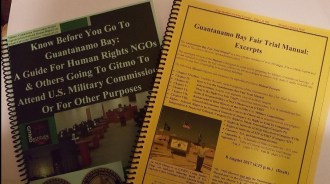
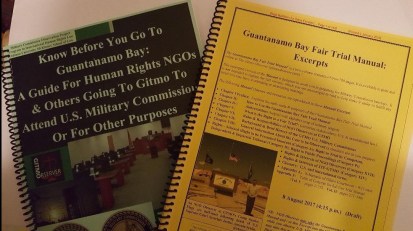
Professor Edwards is the principal author of two Guantanamo documents that Indiana observers carry to Guantanamo and distribute to observers from other programs.

Those two documents are  the  Guantanamo Bay Fair Trial Manual and the Know Before You Go to Guantanamo Bay[ge1] .

I was instructed to stop by the Law School before my trip to pick up these documents to carry to the other observers. I was scheduled to leave Indiana on 13 July 2019, several days before the 21 July 2019, since I was going to drive from Indiana to DC and spend time in DC with before my Guantanamo plane left.

I stopped by the Law School and picked up 8 copies of each of the two Manuals, since there would be a total of 8 observers on this trip. I began to drive to Washington with my family.

After I left Indiana, I received an e-mail message from Ms. LaTasha Tripplett, who is the Faculty Assistant who works with Professor Edwards on our Military Commission Observation Project.

Ms. Tripplett informed me that the printer had misprinted the Guantanamo Bay Fair Trial Excerpts Manual. She told me that the printer was reprinting them, and that she would send 8 copies to me before the plane left. I gave her the address of my hotel in Washington, DC, and she was able to send them. They arrived on time, and I got them as soon as I checked into the hotel? It is mandatory that we check our e-mails regularly. That is a good rule, and in place for good reason!

Thanks for that, Ms. Tripplett!

As mentioned, I decided to drive to D.C with my family, so we all could enjoy some time in the capital of the United States before I depart for Guantanamo Bay, and so they can enjoy the city while I am in Guantanamo.

We arrived in D.C Friday night, 19 July 2019, so we had plenty of time to visit some points of interest, such as the Washington Monument, World War II Memorial, and the Lincoln Memorial.

The view from Lincoln Memorial with the Washington Monument as a highlight

Our visit was taxing, since the weather was scorching. There is an Excessive Heat Warning for Washington D.C, with the temperatures around 100 ยบFahrenheit (almost 38 ยบC), feeling like 110 ยบF (around 44 ยบ C). We did not spend too much time outside in the heat. We had to come back to the controlled temperature in the hotel.

The day of the trip
This morning I had to get to the Joint Base Andrews, Maryland, at 6 am to begin my observation mission in Guantanamo Bay. It was a 25 minutes Uber drive from the Grand Hyatt Washington, which cost me US$ 23. To avoid delays, I left the hotel around 5am, then I got to the Joint Base at 5:25am.

When I got there, I went to the Andrews Visitor Center.

Flags over Joint Base Andrews (Andrews Air Force Base) at sunrise.
Andrews Visitor Center is where the NGO meet with the escort

I texted Cathy Nardo, the escort for all the other observers, and I found five more observers. We joined the other two observers at the terminal. Each of the 8 of us is from a different โ€œNGOโ€ โ€“ non-governmental organization. Our Indiana program founded by Professor Edwards is considered an NGO.

Ms. Nardo picked us up at the Visitor Center right after 6:00am, and we drove onto the main part of the Andrews Base, just a few hundred yards / meters from the Visitor Center. We then drove about 10 minutes us to reach the Andrews Air terminal. This is the Air Base where Air Force I is, the plane flown on by the President of the United States.

At the terminal we immediately checked in for our flight and gathered in childrenโ€™s nursery located in the terminal, where the observers could get to know each other and wait for further instructions. While there, I met Terry Rockefeller, of the Peaceful Tomorrows, whose members are family of the victims of the 9/11 attacks. She has been to Guantanamo Bay 8 times before and will have a lot to teach me during this week. Cathy took some observers for coffee and, after that the observers were briefed by the escort later about the last-minute information regarding our travel. I distributed the Indiana manuals there and the fellow observers immediately started reading them, finding them very helpful for the mission to come. ย 

Conclusion

I have mixed emotions while I wait to get on the plane.  They range from the thrill to be an eyewitness of a historic event to the most basic feeling that I havenโ€™t completed all the steps I should take to start the mission.

The Guantanamo Bay Fair Trial: Exerpts and Know Before You Go to Guantanamo Bay

My flight is scheduled to depart Andrews at 10:20am, which means that I will have enough time to write my first impressions of my mission. The plane today is a charter plane of the company Miami Air.  We are scheduled to arrive at at Guantanamo Bay at 1:30pm.

Soon I will share some information from Guantanamo Bay.

PS: Sorry for the delay. Due it the busy schedule, I could only post one day later.


 [ge1]Insert url / link

Cleared to Travel to Guantanamo Bay, Cuba, to Monitor Hearings in the Case Against the Alleged 9/11 Attack Masterminds

I am a Master of Laws (LL.M.) student at Indiana University McKinney School of Law in the International Human Rights Law track, and I have been selected to travel to Guantanamo Bay, Cuba, to monitor U.S. Military Commission hearings against five alleged masterminds of the 9/11 attacks on the World Trade Center and Pentagon. ย I am part of the Law Schoolโ€™s Military Commission Observation Project (or the Gitmo Observer), founded by Professor George Edwards.

My background

I became a judge in Brazil in 2005, working in civil and criminal courts. In this capacity, I deal with the most diverse areas of law, including human rights and prisonersโ€™ rights. Those subjects prompted me to come to the United States to join the International Human Rights LLM Program in IU McKinney, where I am studying these areas.

How I became interested in the Guantanamo Project

At the McKinney Law School, I came across the Guantanamo Bay Project of the Program in International Human Rights Law (PIRHL) following the advice of Judge Aline Fagundes, ย a law student at IU McKinney and a Brazilian judge who went to Guantanamo Bay through this project in 2016 and 2017. Judge Fagundes attended the cases against the alleged masterminds of the 9/11 attacks on the World Trade Center and the 2000 suicide bombing of the U.S.S. Cole off the coast of Yemen. Furthermore, she traveled to Ft. Meade, Maryland to monitor hearings that were broadcast live from Guantanamo into a secure room at the Maryland base. And, she traveled to the Pentagon where she observed a different type of Guantanamo proceeding โ€“ a Periodic Review Board (PRB), which are not criminal proceedings, but administrative proceedings in which Guantanamo detainees ask the U.S. government to release them.

Judge Fagundes published about her experiences in several media, such as in the GITMO Observer website, and in a Brazilian newspaper, Zero Hora (you can read the article in Portuguese here). Judge Fagundes recently gave a lecture in the School of Labor Judges in Porto Alegre, Brazil, about her Guantanamo Bay experiences.

Judge Fagundes in front of the plane to took her to Guantanamo on her first visit there

Judge Fagundes, in a recent lecture about her experience, in Porto Alegre, Brazil.

The 9/11 hearings โ€“ my travel

I was cleared by the Pentagon to travel to Guantanamo to monitor hearings that are scheduled for 21-27 July 2019, in which Khalid Shaikh Mohammad, Walid Muhammad Salih Mubarek Bin โ€˜Attash, Ali Abdul Aziz Ali, Ramzi Bin al Shibh, and Mustafa Ahmed Adam al Hawsawi are charged as being masterminds / facilitators of the 9/11 attacks on the World Trade Center and the Pentagon.

Photos obtained in Google Images (access here)

Ramzi Bin al Shibh was captured in 2002, while the other four defendants in 2003. All of them were held in secret CIA prisons (โ€œblack sitesโ€) before they were transferred to Guantanamo, between 2006 and 2007. Khalid Shaikh Mohammad and his co-defendants are charged with conspiracy, attacking civilians, attacking civilian objects, murder, destruction of property, hijacking, and terrorism.

My responsibilities as a Monitor / Observer

As a Monitor / Observer traveling to Guantanamo Bay, I have great responsibilities.

First, as an observer, my role is to attend, observe, be seen, analyze, critique, and report my observations, โ€œhelping to ensure transparency, the rule of law, and /helping to ensure that the promises of international human rights law protections are fulfilled.โ€* (you can read at Guantanamo Bay Fair Trial Manual). I pledge to be independent and objective in my observation / monitoring, and to endeavor to have and keep an open mind, with limited preconceived ideas about what I will experience at Guantanamo Bay.

Second, as a Brazilian judge, I feel obligated to share information I learn with the legal community in Brazil and Latin America, who may benefit from learning about the  Military Commissions.

Finally, as a member of Indiana McKinney Military Commission Observation Project, I have a great responsibility with all other fellow observers, current and to come, helping them to get the most out of their missions, sharing relevant information about my experiences with them, so that the goals of our Project might be realized.

Notwithstanding the responsibilities, it is important to notice that Professor George Edwards, as the director of the PIHRL, excels in his role of leader of the project. He takes care to provide the observers with all the information they need to succeed in their mission. That is why I am feeling comfortable and confident in my role as an observer.

How I am preparing for my mission to Guantanamo

While I wait for the travel to Guantanamo Bay, I have been using information from several sources to prepare for my task.

The Gitmo Observer website compiles the observers’ experiences and gives access to the Guantanamo Bay Fair Trial Manual, which is an excellent source of information for future missions.

I also have been reading all the blogs and the manuals, articles related to Guantanamo in the Foreign Affairs Magazine, The New York Times, and websites, particularly the Office of Military Commissions, where I can find information about the hearings and documents related to the cases.   I have paid attention to the Twitter Feed of journalist Carol Rosenberg, of the New York Times, and paid attention to articles she published when she worked for the Miami Herald.

Conclusion

I am looking forward to playing my role as an observer and to sharing my thoughts with the U.S. and international communities about the work of the Military Commissions in Guantanamo Bay.  

Daniel Pereira, International Human Rights LL.M. Candidate,

Military Commission Observation Project

Program in International Human Rights Law

Indiana University McKinney School of Law

* Edwards, George E., Guantanamo Bay Fair Trial Manual: An Independent & Objective Guide for Assessing Human Rights Protections and Interests of the Prosecution, the Defense, Victims & Victimsโ€™ Families, Witnesses, the Press, the Court, JTF-GTMO Detention Personnel, Other Detainees, NGO Observers and Other Military Commission Stakeholdersโ€ (by The Gitmo Observer โ€“ Principal Author George E. Edwards) ยฉ 2019., at. 10 (you can access the Manual here).


Going to Guantanamo Bay, Cuba to Monitor Military Commission Hearings in the Case against 5 Alleged Masterminds of the 9/11 Attacks

While I was a student at Indiana Universityย Robert H. McKinney School of Law, earning my Doctor of Jurisprudence (J.D.) with a Graduate Certificate in Human and Civil Rights (2017), I learned about our schoolโ€™s program related to the U.S. Military Commissions at Guantanamo Bay, Cuba. Students, faculty, staff and graduates are permitted to travel to Guantanamo Bay, Cuba to monitor military commission hearings, against alleged war criminals, while sitting in the viewing gallery live in the courtroom. We could also travel to Ft. Meade, Maryland, to monitor the hearings via CCTV.

Nicole B

I am now scheduled to travel to Guantanamo Bay, for hearings in the case against five alleged masterminds of the 9/11 attacks on the World Trade Center and the Pentagon.

Background

The Pentagon granted a number of Non Governmental Organizations permission to send โ€œNGO Observersโ€ to monitor the hearings, trials and other U.S. Military Commission proceedings held at Guantanamo Bay, Cuba.ย Professor George Edwards, of the Indiana McKinney law school, founded its Program in International Human Rights Law, to which the Pentagon granted NGO Observer status.

Professor Edwards then created the Military Commission Observation Projectย (MCOP) to implement NGO Observer responsibilities. As a selected NGO observer, my mission is to: (1) attend; (2) observe / monitor; (3) be seen; (4) analyze; (5) critique; and (6) report on the proceedings.ย 

My first Guantanamo observation was in the spring of 2018, when I traveled to Ft. Meade to monitor hearings in the Guantanamo case against Hadi al Iraqi / Nashwan al Tamir case, who is an alleged high level al Qaeda Iraq member who liaised with the Taliban.ย 

I have been cleared by theย Pentagon for travel to Guantanamo Bay, Cuba to monitor the military commission hearings in the case against Khalid Shaikh Mohammed and four other alleged masterminds of the 9/11 attacks.

NGO Observers help ensure not only transparency, but also that the rule of law isย respected and maintained. NGO Observers play a critical role as the eyes and earsย of the outside world into Guantanamo Bay.

It is important to consider the rights and interests of all stakeholders, not just the rights and interests of the accused/detainees, which may immediately come to mind. But what about the rights and interest of the prosecution? The victims and their families? The press? I believe our visibility and willingness to be seen during these proceedings holds everyone to a higher standard because our physical presence represents an extension of the public.

I am scheduled to arrive in Guantanamo Bay on Saturday, 15 June 2019 and leave on Saturday, 22 June 2019. I am anxious to see if my schedule will play out as anticipated. Participation as an NGO Observer requires significant patience and flexibility as you prepare to monitor proceedings due to the schedule changes, and sometimes cancelations.

Reflections before GITMO

As I get closer to the dates for traveling to Guantanamo Bay, I am feeling a range of emotions. I am excited, anxious, and a bit nervous. As my mission is approaching, I have had a strange feeling inย the pit of my stomach daily as it becomes a reality that I will soon be within eye view of men charged with masterminding the 9/11 attacks.ย I feel this eerie feeling lingering in the atmosphere. Even if one does not recognize any of the names of the alleged masterminds behind the 9/11 attacks, you are familiar with the tragedy that occurred on September 11, 2001. Itโ€™s been a bit surreal to know Iโ€™ll have the opportunity to observe these historical proceedings in person.

I was in the 5th grade at Sunnyside Elementary the tragic day of the 9/11 attacks. Even reflecting on that day from the perspective of a young child, the day still feels so surreal to me. Over the last few days, on my way home from work, I have taken time to stop by my elementary school to revisit the history of what that painful day felt like for me as a child. Itโ€™s been really important for me to soak up those emotions and memories again before traveling to Guantanamo. That day will always be etched in the hearts and minds of so many Americans and discussed for generations to come.

Sunnyside

Photo of Sunnyside Elementary in Indianapolis, Indiana on Tuesday, June 11, 2019.

I know as NGO observers we are being provided an extraordinary opportunity and I do not take that lightly. Although most people are aware domestically and internationally about the 9/11 attacks, few people have an understanding about the hearings, trials and other U.S. Military Commission proceedings held at Guantanamo Bay, Cuba. As observers we are provided an extraordinary opportunity and Iย consider it our duty to share as much as possible about our experiences at GITMO.

It is an honor to have been nominated to serve as an NGO Observer, and I look forward to fulfilling my NGO responsibilities.


Nicole M. Burts, J.D., Indiana University McKinney School of Law

Observer, Guantanamo Bay, Cuba, Military Commission Observation Project

Program in International Human Rights Law

Indiana University McKinney School of Law

Reflecting on Guantanamo Bay: Abdul Hadi Al-Iraqi Hearings (January 6-14, 2019)

Most of the NGOs holding the comprehensive IU PIHRL Guides to GITMO

Several months ago, from January 6th-15th, I had the opportunity to observe the U.S. Military Commission proceedings against alleged Al-Qaeda war criminal, Abdul Hadi Al-Iraqi, in Guantanamo Bay, Cuba.

I became aware of this opportunity during the fall 2018 semester while I was enrolled in Professor Edwards’s course, International Law. Professor Edwards is the director of Indiana University McKinney School of Law’s Program in International Human Rights Law. This program has a Military Commission Observation Project that sends students, graduates, faculty and staff to Guantanamo Bay to serve as independent, objective monitors of criminal proceedings.

Abdul Al-Hadi Al-Iraqi

Since April 27, 2007 Abdul Hadi Al-Iraqi has been in custody at Guantanamo Bay, Cuba. According to information provided by the Pentagon, most notably, Hadi Al-Iraqi was a key paramilitary commander in Afghanistan during the late 1990s, subsequently spear-headed attacks against US and coalition troops from 2002-2004, and touted as one of Osama bin Laden’s top global deputies.

That being said, the week or so of trials I was present to observe solely focused on the defendant’s current medical condition and the accommodations that were necessary for his cell and for his court room appearances. Since being held at Guantanamo Bay, Abdul Hadi Al-Iraqi has undergone 5 major back surgeries and suffers from chronic pain associated with the injuries.

Two especially studious NGOs reporting back to base following a long day of hearings

General Observations

I found myself a bit startled when I first saw Abdul Hadi Al-Iraqi enter the court room for the first time. It’s not everyday you see an alleged war criminal, or a member of Al-Qaeda in-person. Nonetheless, I was surprised at his seemingly relaxed demeanor. I had expected a much more serious atmosphere in the courtroom and in the surrounding area based on the barbed wire and extensive security screening process. However, at times Abdul Hadi Al-Iraqi could be seen smiling, laughing, and making small talk with his defense counsel and their staff.

Another interesting aspect of the Military Commissions was seeing JAG lawyers from different branches working together. The defense included Navy JAG, the Judge was Marine JAG, and there was Army JAG and US Department of Defense attorneys working for the prosecution team. The proceedings were painstakingly crisp, meticulous, and efficient. One thing was very clear: they were not going to compromise the quality and correctness of the proceedings in the name of saving time. For example, at one point in the hearings, to accommodate the defendant, the Judge created a protocol that called for a break every 30 minutes to give the defendant a chance to rest if he so wished.

Overall, it appeared as if the US government would be willing to accommodate whatever request the defense team asked just so long as they could progress through the trial and afford the defendant the opportunity to be present during his trial, given his deteriorating medical condition. In following this rigorously high standard for the proceedings, the US government was aiming to reduce the possibility that the defendant would have any grounds for appealing a conviction.

Defense Team Barbecue

On one of our last nights in Guantanamo Bay, the defense team invited us (NGOs) over for a cook-out. Not only were the burgers and dogs far better than anything we had eaten that week, it was an awesome experience to get an insight into the work that goes into preparing a defense for an alleged war criminal.

During the cookout I had the chance to chat with one of the staff members who discussed the difficulty of staying up-to-date with what information the defense team can and cannot use in their legal briefings. The staff member somewhat complained of the immense amount of evidence or information that cannot be used for national security reasons. By nature, being a case against an alleged war criminal, it involves a large amount of information that is deemed by the US government as too sensitive to be used in court because it would pose a risk to our nation’s security.

Anther highlight of the night was having the chance to speak with the lead litigator for the defense team. He was a Navy JAG Officer and a recent graduate of Harvard Law School. During our conversation he highlighted the difficulty of questioning an unwilling/non-cooperative witness and the high-level of responsibility given to first tour JAGs.

Camp Justice, Guantanamo Bay at sunset

Eye Opening Experience

This opportunity certainly expanded my world view and understanding of the capabilities of the United States military. Guantanamo Bay is home to at least a sliver of every branch in the US Military umbrella and seeing them operate in unison was incredible.

Also, the US relationship with Cuba is something that I feel few Americans truly understand. During my time at Guantanamo Bay we were given a tour of the border fence that marks the separation between US soil and Cuba. This tour was given by Marine soldiers and included the history between the two nations and the current relationship.

Personally, my biggest takeaway from this experience was having the opportunity to observe great legal professions practicing the law. Whether it was questioning witnesses, cross-examination, or arguments, all of the professionals involved did a great job at preserving the quality of the hearings.

Marine giving the NGOs a tour of the US-Cuba Border

Garrett Welch

Indiana University McKinney School of Law Spring 2019 Graduate

Returned from Majid Khan hearings in Guantanamo Bay.

During the week of 31 March to 3 April 2019 I traveled to Guantanamo Bay, Cuba to monitor U.S. Military Commission pre-sentencing proceedings against convicted war criminal Majid Khan.

This was my fourth trip to Guantanamo Bay representing the Program in International Human Rights Law of Indiana University McKinney School of Law. Indiana has a Military Commission Observation Project which sends law students, graduates, faculty and staff to Guantanamo to serve as independent, objective monitors of criminal proceedings. I have also monitored Guantanamo proceedings at Ft. Meade, Maryland, where cameras in the Guantanamo courtroom broadcast by secure CCTV.

In his guilty plea, Mr. Khan stated that after 9/11 he traveled from Maryland, where he had been living as a U.S. permanent resident, to Pakistan and agreed to participate in an al-Qaeda plot using suicide vests to assassinate the former President of Pakistan, Pervez Musharraf. He said that he later moved $50,000 USD to finance the 2003 J.W. Marriott bombing in Indonesia, an attack that killed 11 people. He pleaded guilty in 2012 to conspiracy, murder in violation of the law of war, attempted murder in violation of the law of war, providing material support for terrorism, and spying. The Military Commission Convening Authority agreed to allow him to withdraw his guilty plea to the charge of providing material support for terrorism after a D.C. circuit court ruled in another case that the charge could not be appropriately tried at a military commission.

img_0392.jpg

Non-governmental observers from left to right (New York Bar, Yale Law, Indiana University, Columbia University, American University, and Pacific Coast Bar) pictured in Camp Justice, Guantanamo Bay, Cuba.

A Different Dynamic for the Khan pre-sentencing hearings

During the three other proceedings I attended at Guantanamo, when the defendants entered the courtroom through a side door, they each had two soldiers, one on each side, and these soldiers sometimes held the arms of the defendants, as they walked into the courtroom. I was thrown off when Majid Khan entered the courtroom in Guantanamo Bay. Though guards were present, they followed from a greater distance than was the case with the other detainees I observed. Mr. Khan was also not dressed in the same way as the other detainees I have seen, he wore a black suit, that looked similar to the suits that his civilian defense counsel wore.ย He carried a blueish purple leak colored metallic looking water bottle.

It was hard to tell but when he came in it appeared that he opened the door himself to enter from the left side of the courtroom, of course United States serviceman provided security. He briefly turned to the back of the room and pointed towards the observation box, which sits behind triple pane sound resistant two-way glass. As he pointed, he spoke to his lawyer and it appeared he was asking who we were. We all sat calmly and did not make any motion, as communicating through the glass is forbidden.

Khan was represented by a team of attorneys who were seated to his right, on the left side of the courtroom. It surprised me how respectful Majid Khan appeared to be of the proceedings, to the judge, and of the process in general. When he spoke to Judge Watkins he addressed him as sir. This dynamic is quite different from the other hearings I have attended for those charged in connection with the events of 11 September 2001, and Hadi al Iraqi, an alleged al Qaeda Iraq member. On some occassions detainees have even worn military style fatigues into the courtroom.

IMG_0389

Observers sit under the lean-to overlooking the marina in Guantanamo Bay.

Majid Khanโ€”The Only High Value Cooperator in Guantanamo, Bay

Why is the dynamic different at the Khan hearings? I can guess that it may be because Khan is a cooperator. He is the only cooperator in Guantanamo Bay who is considered a high value detainee, and his lawyers brought this up at the beginning of the hearings and frequently throughout.

IMG_0456

An iguana sits on Glass Beach and looks on while observers cool off in the Caribbean Sea.

In his plea agreement of seven years ago, Khan agreed to serve no more than 25 years in exchange for his cooperation, 19 if the convening authority finds that Khan provides full and truthful cooperation amounting to substantial assistance. His time served began at the time of the plea agreement, which means he theoretically has 12-18 years left to serve, assuming that the agreement holds. There were concerns about this. The source of these concerns had to do with the government/prosecution being upset about the defenseโ€™s request for โ€œBrady materialโ€, material that the defense has argued might be used in the pre-sentencing hearing to mitigate the sentence he is awarded by the panel, as the military commission jury is called.

Exculpatory Evidence and Brady, Could it all Fall Apart?

There is a famous case in United States law referred to as Brady, or Brady v Maryland, which is a 1963 United States Supreme Court case that held, โ€œย Suppression by the prosecution of evidence favorable to an accused who has requested it violates due process where the evidence is material either to guilt or to punishment, irrespective of the good faith or bad faith of the prosecution.โ€ This issue of Brady material dominated the hearing. Specifically, Khan and his defense team requested Brady material that might be used as a mitigating factor during Khanโ€™s upcoming sentencing hearing. The hearing will take place before a panel (jury), that will decide Mr. Khanโ€™s sentence, 19-25 years โ€“ in accordance with the sentencing agreement.

The public does not know what the material is that the defense has requested, or how and why the defense may believe that this material might be used to mitigate his sentence. ย However, it likely has to do with the time Khan was in custody prior to arriving in Guantanamo Bay, and possibly the use of enhanced interrogation techniques. This could potentially be used to mitigate his sentence because if Khan was treated badly while in custody then under the Uniform Code of Military Justice, and possibly in the Military Commissions, this in and of itself could be used as a factor to mitigate sentencing. In other words, if someone is tortured, then a sentencing panel could decide, based on that fact, that the defendant should receive a lesser sentence. There is also an important balance between discovery and production of evidence on one hand and the protecting the national security interests of the United States on the other hand. Not to mention that a decision in this case could have further reaching implications, for instance in the 9/11 proceedings where mitigation specialists might seek to use Brady material to get the jury/panel to give a life sentence rather than the death penalty.

Meeting with Khanโ€™s Lawyers

After the hearing I met with Khanโ€™s lawyers and others on his defense team. We gathered at their living quarters and shared snacks and refreshments. At this meeting I noted they were in a unique position relative to the other defense teams I have seen in Guantanamo Bay, and I talked about the different dynamic discussed earlier in this article. A lawyer I traveled with brought up a good point that the government/prosecution appeared to threaten pulling out of the seven year old plea agreement if Khanโ€™s team continues to request Brady material, and noted that this should not be sufficient grounds to pull out of the plea agreement because the only permissible reason for the government/prosecution to unilaterally withdraw should be for material breech.

Suggestion to Improve the Viewing Experience at the Expeditionary Legal Complex

I have a suggestion to improve the viewing experience for the victimsโ€™ family members, non-governmental observers, press, and others viewing the proceedings. These groups watch from a remote viewing facility at Ft. Meade Maryland, and in person at Guantanamo Bay. The problem is that we cannot see the detainee(s) faces. The feed shows only one camera angle from the courtroom at a given time, usually of the person who is speaking.

In person viewing in Guantanamo Bay is helpful because observers and victim family members watch the defendant(s) in person throughout the entire proceeding from the observation box at the rear of the courtroom, while observers at other locations only see the defendants when defendants are portrayed on the feed, so generally only when the defendants are the ones who are speaking in court. Keep in mind that this is all on a 40 second delay. My suggestion is that at least one screen at each remote viewing station in the United States, and at Guantanamo Bay, show a camera angle of the detainee(s) at all times, preferably an angle that shows the face. Keep in mind that, as it stands today, the visual feed only shows a small portion of the courtroom in Guantanamo Bay at any given time, alternating between camera views.


Benjamin Hicks

Juris Doctor 2018

Indiana University

Program in International Human Rights Law

Traveling to Guantanamo Bay, Cuba to U.S. Monitor Military Commission Hearings

I am a second-year student at Indiana University McKinney School of Law pursuing a certificate in human rights law. I am traveling to Guantanamo Bay, Cuba, to monitor the hearings of Mr. Khalid Shaik Mohammad and 4 other alleged masterminds of the 9/11 attacks. My job will be to attend, observe, be observed, analyze, critique and report on these hearings. I am representing the Military Commission Observation Project, which is part of the Program in International Human Rights Law of our Indiana McKinney School of Law. Professor George Edwards founded the human rights program and the Guantanamo project.

Travel to Andrews Air Force Base to fly to Guantanamo

I flew to Washington DC yesterday (Friday, 26 April 2019) because our flight to Guantanamo Bay is scheduled to depart from Andrews Air Force Base (Joint Base Andrews), which is located just outside of DC, in Maryland. I stayed at a hotel right across from the base, and took a local taxi from the hotel onto the base, all the way to the Andrewโ€™s Air Passenger Terminal. My grandfather was in the Air Force for many years, so I had been on military bases before (mainly Minot AFB in North Dakota.) While no two bases are the same, I found Andrews similar to other Air Force Bases. When I am on base, I feel the need to be on my best behavior, as everything feels very official.

I arrived at Andrews around 5:30 and checked in for the flight, that was scheduled to depart at 10:00 a.m. The check in process was similar to that at a commercial airport.

Office of Military Commissions NGO Observer Escorts

I immediately met Cathy Nardo, who would be the non-governmental organization (NGO) observer escort for the week the week of hearings, scheduled for 29 to 3 April. Our Indiana program is one of a handful of NGOs that are permitted to send observers / monitors to Guantanamo.

Each time NGOs travel to Guantanamo, they are accompanied by an escort provided by the Office of Military Commissions (OMC). The escort organizes logistics for us at Andrews, on the ground at Guantanamo, and on the flight back to Andrews at the end of the week. At Guantanamo, the escort drives us to where we need to go on the base and helps us acquire the professional and personal items we need on base. The escort also keeps us informed on the schedules of the hearings, and anything else that happens around base, as well as attend the hearings with us.

The check in desk at Andrew’s terminal.

Other NGOs arrive

As 6:00 approached, other NGO observers started arriving. There are six NGO observers on this particular trip. They include, in addition to me, a law student from the University of Toledo, and representatives from the ABA, the September 9/11 Families for Peaceful Tomorrows, the Pacific Council on International Policy, and the National Institute for Military Justice. I each of the observers a copy of Know Before You Go to Guantanamo and Guantanamo Bay Fair Trial Manual: Excerpts, which are Manuals authors by Professor Edwards with the assistance of other Indiana observers. The other observers were very interested in the material contained in the Manualsand were thankful to have been provided them.

BrA fellow NGO observer reviewing her manual.

Briefing from our Escort

Once the NGOs arrived Cathy took us to the childrenโ€™s play room of the terminal. and gave us a briefing. She began by giving us the schedule for the day. NGOs would be the first to get on and last to get off the plane. She explained that when the plane arrived at Guantanamo, we would take a ferry from the Leeward side of the Guantanamo base to the Winward side where she would take us to the tents where we would live for the week, and then take us to pick up badges we would need to gain access to the courtroom. She briefed us on the areas where photography is and is not allowed and explained the protocol for the Expeditionary Legal Complex (ELC), which is where the courtroom is where the hearings occur.

Our manuals and important briefing information from the escort.

Boarding the Plane

The NGOS did not have to wait much longer to go through security, which felt much more relaxed than going through TSA at a commercial airport. We then waited a short time longer before getting on a bus which took us onto the tarmac, up to the movable stairs that led to the plane. We got off the bus, walked a short distance across the tarmac, and climbed the stairs to board the plane. This was all a new experience for me. I have never been on a tarmac or used stairs to board a plane. It is very different from at the jet bridges used on commercial flights.

As I prepare to depart Andrews, I am feeling many emotions. I am nervous, excited, happy, and a little scared. But I am very much looking forward to the hearings.

Madison Bowsher

J.D. candidate 2020

Military Commission Observation Project

Program in International Human Rights Law

Indiana University McKinney School of Law

madibowsher@gmail.com  |  madbowsh@iu.edu

My Travel to Guantanamo Bay to Monitor U.S. Military Commission Hearings

My Background

I am a second-year student at Indiana University McKinney School of Law pursuing a certificate in human rights law.

I became interested in Guantanamo Bay during my undergraduate years. I did a large amount of research on the practice of extraordinary rendition and torture of suspected terrorists. This inevitably led me to researching the Guantanamo Bay detention center. I am interested in the balance between human rights and national security I believe this opportunity will give me a first-hand look at how the United States approaches these issues.

My Mission

I will be traveling to Guantanamo Bay from 27April – through 4 May, 2019 to monitor the U.S. Military Commission hearings of Khalid Shaik Mohammad and 4 other alleged masterminds of the 9/11 attacks. My job will be to attend, observe, be observed, analyze, critique and report on these hearings. I am representing the Military Commission Observation Project, which is part of the Program in International Human Rights Law of our Indiana McKinney School of Law. Professor George Edwards founded the human rights program and the Guantanamo project.

Charges Against the Defendants

Mr. Mohammad was captured in 2003 and was held in CIA prisons (โ€œblack sitesโ€) before he was transferred to Guantanamo Bay in 2007. Charges against him and his four co-defendants include attacking civilians, hijacking an aircraft, intentionally causing serious bodily injury, and murder in violation of the law of war, and terrorism.


Khalid Shaik Mohammad. The right photo was taken by U.S. forces after his capture. The left photo was taken by the International Committee of the Red Cross at Guantanamo Bay. (https://www.motherjones.com/crime-justice/2011/04/obama-try-khalid-sheikh-mohammed-military-court/)

Preparation

In preparing for my mission I have been researching the case I will monitor. I have also read Know Before You Go to Guantanamo which has helped me know what to expect at the base, along with the Guantanamo Bay Fair Trial Manual: Excerpts. Both the Manuals are produced by Indianaโ€™s Military Commissions Observation Project and are available for download on http://www.GitmoObserver.com. I have spoken with previous observers who have been to GTMO so I can better know what to expect. I have also been exploring the website for the Office of Military Commissions to keep up to date on what has been occurring with the hearings.

Previous Guantanamo Hearings

The front gate at Ft. Meade.

A few weeks ago I traveled to Ft. Meade, Maryland to attend a U.S. Military Commission pre-sentencing hearing in the case against Mr. Majid Khan. The hearing was broadcast by CCTV into a secure room at the Ft. Meade military base.

Mr. Khan pleaded guilty to murder in violation of the law of war, attempted murder in violation of law or war, and spying. He has since been cooperative in giving information to military prosecutors regarding other Guantanamo detainees.

Madison Bowsher

J.D. candidate 2020

Military Commission Observation Project

Program in International Human Rights Law

Indiana University McKinney School of Law

madibowsher@gmail.com  |  madbowsh@iu.edu

New Military Challenge Coin for Guantanamo Bay Non-Governmental Organization (NGO) Observers / Monitors

Non-Governmental Organizations (NGOs) who travel to Guantanamo Bay, Cuba, to monitor U.S. Military Commission hearings now have a military challenge coin!

The coin reflects the NGO mission, which focuses on transparency at Guantanamo war crimes proceedings.

The Pentagon permits a limited number of NGO representatives to travel to Guantanamo to monitor proceedings. NGOs are the eyes and ears to the outside world on what happens at Guantanamo, consistent with the right to a public trial for all categories of Guantanamo stakeholders. Stakeholders include defendants, prosecution, victims and victimsโ€™ families (VFMs), guards, witnesses, media, and others โ€“ all who have rights and interests.

Other Guantanamo groups have challenge coins, including the defense, prosecution, the Office of Military Commissions, the Commissions Liaison Group, and different Guantanamo camps and other sub-groups of deployed personnel.

All the Guantanamo coins honor aspects of the military and civilian personnel involved with Guantanamo, and their contributions.

Other side of the Guantanamo Bay NGO Challenge Coin

A brief history of the challenge coin

A challenge coin is a coin or medallion typically created by an organization to demonstrate membership or participation, to honor service, or for commemorative purposes.  Challenge coins are steeped in military and public service tradition, and are often exchanged or distributed during visits, given as an award, exchanged between friends as gifts, or exchanged as collectorโ€™s items.

About the NGO Guantanamo coin

The new NGO Guantanamo coin is round, is bronze with white background, and is 3 inches in diameter, much larger than a silver dollar.

On one side, the coin reads โ€œU.S. Military Commissionsโ€ (top) and โ€œGuantanamo Bay, Cubaโ€ (bottom).  This side contains a U.S. flag in red, white, and blue, Lady Justice in bronze, and a map of Cuba with a red star placed on Guantanamo Bay.

Lady Justice holds the Scales of Justice in one hand and a sword in the other. A blindfold over her eyes represents that justice should be applied impartially.

The opposite side of the coin lists the 6-part mission of Guantanamo NGOs โ€“ to attend, monitor, be seen, analyze, critique, and report on the Guantanamo hearings.

Most aspects of the mission statement are obvious โ€“ transparency as fundamental to the right to a fair trial obviously requires monitors (or observers) to be present and to observe, and to analyze what they observe, and critique (positive / negative) and report.

The reasoning behind the โ€œbe seenโ€ portion of the NGO mission may not be so obvious, but it is very important. The Military Commission Act, the U.S. Constitution, international law, and regulations and rules related to the Guantanamo proceedings all call for a public trial. The defendants sitting in the courtroom should be able to turn around and look into the observation galley and see a slice of the public. The defense lawyers and prosecution should be able to see a slice of the public, and the judges and jury and victims and anyone else should be able to see the NGOs, who represent the public. The presence of the NGOs, and their visibility โ€“ their ability to be seen โ€“ goes to the issue of not having secret trials (with secret trials being prohibited under U.S. and international law).

The visibility of NGOs might give comfort to some trial participants who might feel heartened that if there are any improprieties, NGOs might bring such improprieties to the attention of the outside world. The visibility of some NGOs might cause other actors to be extra diligent in doing their jobs, fearing that NGOs will report improper behavior.

The background on this side is also white, with a design of the Scales of Justice in the middle.  The edge surrounding the coin reads, โ€œAt Guantanamo Bay justice must not only be done, but must be seen to be doneโ€ (top), and โ€œNon-Governmental Organizationsโ€ (bottom).

Availability of the Guantanamo Bay NGO Coin

 A limited number of Guantanamo Bay NGOI coins were produced, and are available for $15. If you are interested in acquiring a coin, please contact The Gitmo Observer at gtmo@indiana.edu or gitmo@indiana.edu. Coins can be shipped to you.

Both sides of the Guantanamo Bay NGO Challenge Coin

End Note: This NGO Challenge Coin was designed by the Military Commission Observation Project of Indiana University McKinney School of Law, directed by Professor George Edwards, with input by and consultations with numerous individuals, including many involved with other Guantanamo NGOs and other Guantanamo stakeholder groups. No coalition or union of Guantanamo NGOs exists, and there was no vote among NGOs as to the design or production of the coin. Thus the coin is not an “official” coin of the NGOs, but one that any NGO or NGO representative might use if they wish, particularly if they believe that the coin reflects their mission.

Selection for Travel to Guantanamo Bay to Observe Military Commissions

I was recently confirmed by the Pentagon to serve as a non-governmental organization (NGO) Observer for the Indiana University Robert H. McKinney School of Law Program in International Human Rights Law (PIRHL) Military Commission Observation Project (MCOP). As of now, I will be traveling to Guantanamo Bay, Cuba 23 March 2019 through 30 March 2019 to observe motions hearings related to Khalid Shaikh Mohammad, Walid Muhammad Salih Mubarek Bin ‘Attash, Ali Abdul Aziz Ali, Ramzi Bin al Shibh, and Mustafa Ahmed Adam al Hawsawi, perhaps more commonly known as the โ€œ9/11 Hearings.โ€ In short, these defendants are charged with masterminding the 9/11 attacks on the Pentagon and World Trade Center.

The Mission
I am a second-year student at McKinney and am looking forward to the opportunity to take part in such significant legal proceedings. As an observer, my role is to attend, observe, be observed, analyze, critique, and report my observations. To be best prepared to serve in this role, I have been reading blog posts from previous Observers, as well as other materials available, including the Know Before You Before You Go To Guantanamo Bay Guideย and the Guantanamo Bay Fair Trial Manual.ย  Additionally, I have spent time speaking with those who have traveled to Guantanamo Bay previously, either through this program or in other capacities. I have also received some information from the Pentagon, and the IUPUI Study Abroad Office provided helpful links to resources on the internet. Overall, there is a great amount of knowledge and information available, which enables Observers, like me, to be well prepared to head to Guantanamo Bay.

My Motivations
My motivation for applying to the program comes from a variety of sources. I have always had the intention of pursuing a legal career in the military as a member of the Judge Advocate General (JAG) Corps, so the having the opportunity to observe legal proceedings in a military environment was intriguing to me. I was also recently selected to serve as an Army JAG intern this summer, assigned to Fort Carson, CO. Being able to bring my experiences as an Observer to my internship will be invaluable.

From a different perspective, I was motivated to apply after taking the Counterterrorism Law course offered at McKinney. We discussed the Guantanamo Bay proceedings at length, and at the end I felt I had more questions than answers. I am looking forward to having the opportunity to observe the hearings in actual practice, rather than only reading about them in a textbook. Having the opportunity to then share my observations with others and assist with the documentation of the proceedings, through the work the MCOP does and through the Gitmo Observer, ensures the proceedings at Guantanamo Bay are, in some way, accessible to the public.

Looking Ahead
As I get closer to my travel dates, I know I will have to be flexible as schedules and calendars can change often. The best way to stay up to date is to check the calendar available on the Office of Military Commissions website. I will also continue researching resources to get a better understanding of the background of the hearings I have been selected to observe. Overall, I feel quite lucky to have this opportunity and am looking forward to representing the program and McKinney in the best way I can.

Natalie Gaynier, J.D. 2020
Military Commission Observation Project
Program in International Human Rights Law
Indiana University McKinney School of Law
nrgaynier@gmail.com | ngaynier@iu.edu

In Preparation to Attend, Observe, be Observed, Analyze, and Critique a Hearing at Guantanamo Bay.

By: Emily Hunter

My Background

I am currently a 3L evening division student at Indiana University Robert H. McKinney School of Law.  Prior to law school I spent ten years as a legal assistant. I am currently employed as a law clerk at the Public Defender of Indiana.  

I have been interested in what has been going on at Guantanamo Bay military prison since 2002.  My interest peaked when an attorney from my office left to work on a detaineeโ€™s case.  My interest peaked more when I was given the opportunity to be a research assistant to work on the Guantanamo Bay Reader.  This is what led me to apply to travel to Guantanamo Bay through IU McKinney School of Law PIRHL program. 

This will be my first time traveling to Guantanamo Bay.  I am excited to have this opportunity and am looking forward to my travels.

My Preparation

In preparation for my travel I have reviewed the Guantanamo Bay Fair Trial Manual, Know Before You Go to Guantanamo Bay Manual.  I also looked up Nashwan al Tamir/Hadi al Iraqiโ€™s docket on the Military Commissions website (https://www.mc.mil/CASES.aspx).  I was able to access unclassified documents filed in his case including, but not limited to, the charging information and memos filed by the Government and Defense Counsel. 

The defendant has been charged with Denying Quarter, Attacking Protected Property, Using Treachery or Perfidy, and Attempted Use of Treachery or Perfidy in attacks in Afghanistan and Pakistan between 2003 and 2004.ย  He has also been charged with Conspiracy to commit law of war offenses.ย  The defendant has been held at Guantanamo Bay since April 2007, he was arraigned in June 2014.

Abd Hadi al Iraqi (Nashwan al Tamir) (2014 photo by the International Committee of the Red Cross)

My Mission

My mission will be to attend, observe, be observed, analyze, critique, and publish materials on all stakeholders at Guantanamo Bay the week of 5 March to 7 March 2019.ย  I will have the opportunity to meet and communicate with other NGO members as well as provide them with Guantanamo Bay Fair Trial Manualโ€™s.ย  Look for more blog posts from me while I am on my travels and updates on how the hearing is going.

Emily Hunter, JD 2020, NGO Monitor, U.S. Military Commission Observation Project, Program in International Human Rights Law, Indiana University McKinney School of Law

My Privilege to Serve as an NGO Observer for the Military Commission Observation Project (MCOP).

Background Informationย 

My name is Alexandra Keller and I have been selected to become a non-governmental organization (NGO) Observer for Indiana University Robert H. McKinney School of Law Military Commission Observation Project (MCOP). My authorization has now officially been confirmed by the Pentagon and Program Director to be a first-time observer of the hearings conducted at Guantanamo Bay, Cuba during January 26 โ€“ February 2, 2019 for Khalid Sheikh Mohammed. ย Thus, I now begin my observation and documentation.

I am in my third year of law school and will be graduating in May 2019.ย  While pursuing my J.D., I have had the opportunity to extern for the Office of the Indiana Attorney General in the Consumer Protection Division, as well as an intern for the Indiana Supreme Court Disciplinary Commission.

I have interests in the federal government, federal law enforcement, and international criminal law, which has led me to taking courses such as Counterterrorism, International Human Rights and International Criminal Law.ย 

The Mission

I have a deep interest in the interaction between national and human rights issues, including the balance that must be struck between the two. For this reason, I strongly believe in the nature of our mission as NGO Observers to attend, observe, be observed, analyze, critique and report on the conditions and nature of the hearings that occur at Guantanamo Bay to ensure transparency and fair trials for the individuals there.

It is my duty as an observer to be a mechanism for transparency so that the public may better understand the practices and procedures at Guantanamo Bay, as well as to help prevent the occurrence of rights abuses through my honest and factual observations and findings.ย 

To help prepare for my time at Guantanamo Bay, I have been following our checklist, the Miami Herald for updates on past, current and upcoming hearings, reading the Gitmo Observer blog posts, the Guantanamo Bay Fair Trial Manual, the Know Before You Go To Guantanamo Manual,

and have been keeping in touch with my fellow observers past and present. I will continue to research and take notes on the hearings I plan to observe so that I may be completely prepared upon arrival, and so that I may monitor and submit my findings as accurately and clearly as possible.

ย I am greatly looking forward to this opportunity to help ensure the existence of fair trials at Guantanamo Bay and can think of no greater honor or privilege. I am especially looking forward to communicating with other NGO members about their experiences and missions, being able to communicate the importance of our mission and purpose, as well as provide our materials to them. ย Before I begin my travels to Andrews Airforce Base, I will submit a blogpost containing an overview of the background information, stakeholders and issues being discussed in the hearings I plan to attend.

Alexandra Keller, J.D. 2019

NGO Monitor, U.S. Military Commission Observation Project (MCOP)

Program in International Human Rights Law

Indiana University McKinney School of Law

kellerak@iu.edu

JOINT BASE ANDREWS TO GUANTรNAMO BAY, CUBA – MILITARY COMMISSION HEARINGS AGAINST HADI AL-IRAQI/NASHWAN AL TAMIR

I’m a 3L student at Indiana University Mckinney School of Law.ย  During my time at McKinney I have been pursuing a certificate in International and Comparative Law.ย  While pursuing the certificate, I’ve taken courses such as International Law, Counterterrorism, and National Security.ย  Observing the Hadi/Nashwan military proceedings at Guantanamo Bay from will be an excellent opportunity to gain real life experience with topics I’ve only learned about in the classroom.ย  Also, this trip is especially exciting for me because I was recently notified that I was selected to the Air Force JAG Corps. Observing the proceedings in Guantanamo will give me a chance to experience the role of a military attorney.

This mission will mark the first time that Indiana University McKinney School of Law has been authorized to send two representatives as NGO observers on the same trip. During our mission to Guantanamo Bay we will have five main responsibilities. We must attend, observe and be observed, analyze, critique, and report. As the eyes and ears of the outside world into Guantanamo Bay, we are responsible to share the truth of what we observe.


In preparation for the trip I’ve been reading the Guantanamo Bay Fair Trial Manual, the Know Before You Go To Guantanamo Bay Manual, and reading previous blog posts on The Gitmo Observer page.ย  Also, I have been researching the background information regarding Hadi Al-Iraqi/Nashwan Al-Tamir and other similar proceedings. After spending the day in Washington D.C. today, I depart to Guantanamo Bay on Sunday, January 6, 2019.ย  Tomorrow will be an exciting day as it will be my first trip on military aircraft and my first time landing in Cuba.ย  I’m very much looking forward participating in the project as an observer.ย 

Garrett Welch