Author: gedwards97

George Edwards is Professor of Law & Faculty Director, Program in International Human Rights Law at Indiana University McKinney School of Law. He is Founding Director of the Law School's Military Commission Observation Project ("MCOP" or "The Gitmo Observer"). Professor Edwards is also Special Assistant to the Dean for Intergovernmental and Non-Governmental Organizations. The Guantanamo Bay Reader will be published soon.

Wednesday’s war court hearings at Guantanamo Bay

hockey light picture-- GTMO

A “hockey light” that flashes red in the Guantanamo Bay courtroom when someone inadvertently reveals classified information. The courtroom gallery is then cleared.

This week I have been in Guantanamo Bay monitoring the war crimes case against the 5 alleged masterminds of the 9/11 World Trade Center attacks. Today, Wednesday, 17 February 2016, we had hearings all morning and most of the afternoon.


I will provide some of my general observations then I will discuss the morning and afternoon sessions.

Personal Observations:

  • There is a red flashing light, similar to those in a used in a pro hockey game when a goal is scored, near the Judge.  If a witness or attorney is speaking in court and inadvertently states classified information, the light flashes, the gallery is cleared.  Fortunately, no disclosed confidential information today.
  • Upon entering the court, the mood was not as tense as yesterday.  The four accused present for the morning session interacted with their counsel.
  • The MPs escort the prisoners to the courtroom.  The also bring a tote box with belongings, which appear to contain clothing, legal paperwork, some clothes and a prayer rug, as well as other items.
  • The accused are not handcuffed when they enter the courtroom.
  • There were more victims and family members present in court today.
  • An NYPD detective was present in the courtroom and acknowledged by the prosecution team.
  • The Chief Defense Counsel, General Baker, was not present for these sessions, but will likely be available next week.
  • We can often learn more from the body language of the participants than the words they speak.  One attorney appeared defeated after arguing a motion.  It was written all over his face and in his slumped shoulder as he returned to his seat.  This was before the Judge made a ruling.


GTMO - palestinian-arab-neck-scarf

The 9/11 defendants were wearing ornate scarves similar to this in court today. Unlike in this photo, their scarves were black and white, with the mosque in a brilliant gold. (I don’t know what the Arabic means on this scarf, and could not tell whether there was Arabic written on the scarves of the defendants.)

The Accused


Four of the accused were present in the morning.  Khalid Sheik Mohammad (“KSM”) was present.  His beard appeared to be partly black and partly dyed, almost red.  KSM and the 3 other defendants wore an ornately patterned shawl or scarf, with black shapes on white.  The scarf had a prominent gold drawing of what appeared to be the gold dome of the Al Aqsa temple on the material that hangs on the front.  The word “Palestine” was prominently embroidered in green on the scarf.

Likewise, Walid bin Attash had what looked to be the same scarf.  He laid his scarf over the computer monitor at the defense table.  Ali Aziz Ali, wore a prayer cap and wore an al aqsa scarf.  Mustafa Hawsawi wore a white cap and an Al Aqsa scarf.

Ramzi bin al Shibh was not present for the morning proceedings.  The court heard testimony from a JAG officer from Camp Delta that bin al Shibh voluntarily refused to attend the proceedings.  He would attend the afternoon session.


Morning Session:

The session began at 9:30 with Judge Pohl making his ruling on Walid bin Attash’s (“WBA”) request for new counsel.  The Judge entered the letters as evidence.  The Judge considered the letters as a request to reconsider Mr. Attash’s October motion for new counsel, which was denied.  The Court also ordered that an independent counsel be assigned by the Office of Military Commissions, to advise the court as to whether there is an attorney client issue with the Attash team.  The Order and corresponding instructions to independent counsel will be under seal.

Immediately after the ruling, WBA’s  learned counsel, Cheryl Bormann, argued an oral motion to withdraw as counsel.  She argued that she can longer be effective as counsel.  She gave some of her background working with the defendant and argued that the constraints of the Military Commission system does not allow her to effectively represent her client.

The Prosecution responded that allowing Bormann to withdraw would greatly inhibit the accused right to learned counsel, which is required by 506(b).

The Judge denied the motion.

Next, the Judge heard KSM’s learned counsel, David Nevin, argue a Rule 406 motion regarding a possbile conflict situation with an interpreter.  Mr. Levin has a smooth delivery and, unlike some of the other attorneys here, is concise with his arguments and counterarguments.  According to the defense, KSM’s interpreter (for security reasons, the interpreters are not named) has been assigned to the defense team since 2012.  He had the required Department of Justice clearance, but at some point in July 2015, he had to wait for the appropriate clearance from the Department of Defense.  Another interpreter has been assigned, but the defense prefers the initial interpreter.

The prosecution, through DOJ lawyer Clayton Trivett, contends that, 1) KSM, who attended some college in the US, and understands English (how much is in contention) does not need an interpreter, and 2) the governments duty is to provide an interpreter, which it has, not a specific interpreter.

The Judge asked questions of both counsel.  Through the questioning session, the Judge asked the prosecution to determine if the interpreter at question is only waiting for his specific clearance, and how long it would take to obtain it.

Court adjourned for lunch.

Afternoon Session

The afternoon session started at 1:30.  The Judge asked the prosecution to inform the court on the information it gathered.  Counsel was unable to answer the question directed, but was able to provide a name and contact number. The Judge was clearly perturbed.  Ultimately, the Judge ordered a recess and ordered the prosecution to determine the status of the clearance.

We reconvened at 3:35 after an almost 2 hour recess.  The prosecution stated that the clearance was in review, with no time frame on resolution.  The Judge ruled that it finds that an interpreter is necessary but a specific interpreter is not.  The Judge will allow the February proceedings to continue but that the prosecution has until March 16, 2016, to determine the status of the clearance.

The Commission also heard arguments on Motion 396, a motion dealing with the handling of classified documents. Mr. Ali’s learned counsel James Connell presented the argument.  Mr. Connell speaks with a rhythmic cadence, and he can control a courtroom.  He is one of the better oral presenters we have seen in the case.

The defense argued that they received 8,317 documents marked “classified- pending review”.  They contended that this was not a legitimate status, and that no “review” was being undertaken.  The defense frog marched through the classifications and concluded a temporary or pending review status lasts 90 days.  This has lapsed, thus these documents are no longer classified.  Other defense counsel contended that the government is over-classifying documents.

Prosecutor Clayton Trivett argued that this information has been classified by the appropriate authority and remains classified.

The Judge did not rule on the motion.

Tomorrow’s session

Tomorrow’s Commission schedule includes the 397 motion, a motion filed by the government to consolidate 14 defense motions seeking information on the CIA’s former Rendition, Detention and Interrogation Program (a/k/a torture program).  Due to the size, scope and importance of this motion, it should be an interesting day.

Friday

Friday’s session will be a closed session. The NGOs will not be permitted to attend. This gives us an opportunity to catch up on our research and blogging.

Evening Meeting – Wednesday

GTMO - NGO lounge

Paul Schilling in the foreground, and fellow NGO Observer in the back, working in the “NGO Lounge” set up at GTMO for NGOs to work.

ngo lounge - mcop materials

Some of the materials that the Indiana McKinney Law School has provided for the all NGO Observers to use while on mission to GTMO.

In the evening, we had the opportunity to go to the NGO lounge and get some work done.  At 5:30, we had a meeting with the attorneys of the Hawsawi defense team.  We met with learned counsel, Walter Ruiz, two assigned JAGs, civilian defense attorney (and former JAG) Suzanne Lachelier, and some of their staff.  They explained their roles, some of the challenges attorneys face in death penalty litigation and some of the unique challenges in this case. Of particular interest were some of the challenges faced by the female attorneys on the team.  They were down to earth and we were grateful for their insight.


Paul Schilling, J.D., Indiana University McKinney School of Law

Indiana Deputy Attorney General

NGO Observer, Military Commission Observation Project (MCOP), Indiana University McKinney School of Law

(Posted by G. Edwards on behalf of P. Schilling)

Guantanamo hearings begin in 9/11 case

GTMO - Paul Schilling and 3 flags

Paul Schilling at Camp Justice. The U.S. flag is flying at 1/2 mast to honor the memory of U.S. Supreme Court Associate Justice Antonin Scalia. (Photo taken 16 February 2016)

Our Guantanamo Bay tents are about 50 yards from the entrance to the war crimes courtroom complex that we walked to at 8:15 a.m. today, Tuesday, 16 February 2016.  We had to pass through airport-like security to get into the courtroom. Today’s hearings are in the case against the 5 alleged masterminds of the 9/11 attacks on the World Trade Center and Pentagon.

The Observers sit in the gallery, with a thick protective glass separating our seating area from the defendants, counsel, judge and others in the main part of the courtroom. We stare through the glass at the backs of most of those of the courtroom, facing the judge.

We can see all that happens in the courtroom, as we peer through the thick glass. But our room is soundproof, and we can only hear what’s happening in court when TV screens with speakers are turned on, hanging in front of the glass gallery wall, piping in the audio.

Different sections of the gallery are reserved for the media, NGO Observers, and victims and their families (whose section can be cordoned off by a curtain should they wish). Military personnel may also take some of the gallery seats.

After we were all seated, the 5 accused entered the courtroom.

Each of these 5 accused has a civilian legal counsel and military counsel (Judge Adjutant General (“JAG”) attorneys).  Since this is a death penalty case, the Military Commission Act requires that the accused have an attorney that has previous death penalty case experience.  Civilian counsel for these 5 defendants have death penalty experience, and they are referred to as “Learned counsel”.

Courtroom Layout

Facing the judge on the left hand side of the courtroom are 5 tables, one for each of the accused, their civilian and military counsel, an interpreter and others on the defense team.  In the front and center of the courtroom is the military judge, Judge Pohl.  Judge Pohl sits elevated on the bench with a court security officer to his right (the left front of the courtroom), the witness stand to his left (the right front of the courtroom) with the court reporters located below, in front of the judge.  A speakers’ podium sits front and center of the judge and courtroom. The prosecution sits on the right side of the courtroom.  General Mark Martins is the Chief Prosecutor for all the U.S. Military Commissions.  We was present in court today and was seated with and assisted by attorneys from the Department of Justice and the Department of Defense, interpreters and 3 JAG officers.  To the far right of the courtroom is the jury box.  Since these hearings are for pre-trial discovery motions, there is no panel present.  Military Police (“MP”) personnel are located to the far left of the courtroom, along the left wall, and are seated there after escorting the defendants into the courtroom.   The are approximately 2-3 MPs for each defendant.  Paralegals, interpreters, MPs and other court personnel are located in the courtroom and may move about freely.

My general observations

As Observers, behind the glass, one of the ways we can best observe the proceedings is by closely observing the interactions of the players.  Here are some of my observations.

  • All 5 accused wore glasses entering the court and removed them as the proceeding went on
  • Kalid Sheikh Mohammad’s beard was partly black, partly white and partly orange.  It looked like it was dyed.
  • All of the accused interacted with their attorneys.  They shook hands, smiled and appeared to listen to their attorneys.  In fact, the interaction was similar to what you would expect to see between a defendant and his attorney in a criminal trial in a regular U.S. courtroom.
  • Two of the accused, Ali Aziz Ali and Mustafa al Hawsawi, spent much of today’s short court session talking to one another.
  • I thought Judge Pohl did an excellent job maintaining courtroom order and decorum.  He set out to explain things to the accused, and apparently sought to understand any concerns raised by the accused or counsel. He appeared to ask pertinent, difficult questions.  It seemed clear to me that he was in control of the hearing and has respect of counsel on both sides.
  • The Observers are viewing the hearing in real-time, through the glass.  However, the audio is delayed 40 seconds, for security reasons we were told.  This can make for awkward viewing.  For instance, we can see the personnel in the court stand up when the Judge enters.  However, we do not hear the “all rise” command until almost a minute has passed.  It can also make it difficult to determine when someone has finished speaking.  We can see them depart the podium, but we are still hearing their final remarks on the audio feed.

Proceedings

Today’s hearing did not begin until 9:15, about 15 minutes behind schedule.  Once the Judge was seated, he took the appearance of the parties and advised the accused of certain rights that they have.  He explained that the accused had a right to be present and it was their personal choice to attend or leave.  Most of the gallery was waiting in anticipation to hear the accused speak.  Each of the accused affirmed orally that they understood their rights as explained by the judge.  As Observers, we realized this is one of the few occasions that we may have to actually hear the accused speak, since during most hearings traditionally the lawyers and the judge do the talking.  The Judge explained what motions were going to be heard and asked defense counsel if there were any issues.

One of the defendants, Walid bin-Attash, expressed his desire to dismiss his learned counsel and military counsel.  From the testimony received and the judge’s statements, it appears that bin-Attash sent a letter (in arabic) to the Judge.  When questioned about the letter, bin-Attash stated that he did not trust his attorney and wished for new counsel.  It is my understanding that his lead attorney, Cheryl Bormann has been on the case since the beginning.  bin-Attash also expressed his intent to dismiss his other counsel, Michael Schwartz.  Schwartz was his previous military attorney.  Based on the testimony of his new military attorney, US Army Major Michael Seeger and bin-Attash, Seeger has only been on the case a very short period of time.  The Judge questioned counsel regarding an attorney’s duties to his/her client.  The Judge also questioned the accused regarding his intentions and whether he wished to retain Seeger. bin-Attash also provided the court with a second hand-written letter at the hearings, expressing his desire for new counsel.

The court allowed for input from other defense counsel and the prosecution.

After about an hour and a half, the court went into recess until tomorrow.  The Judge decided to have the letters translated and he would reconsider the request to dismiss counsel tomorrow.

For now, we are scheduled for a full day of hearings tomorrow, with the total hearing time today being only about 90 minutes.

Paul Schilling, JD graduate, Indiana University McKinney School of Law

(Published by Professor George Edwards on behalf of Mr. Shilling.)


Arrival at Guantanamo Bay Today

gitmo6-lemmerdsc-0185-15col

Camp Justice — Where we are staying during our week at GTMO. Photo by Catherine Lemmer, IU McKinney School of Law)

Our flight to Guantanamo Bay was delayed leaving Andrews Air Force Base. We arrived at Guantanamo after a 3 hour flight. We were processed through the arrival gates and loaded a ferry to the main post. I found it interesting that all of the victims’ families, defense counsel, prosecutors, media, court stenographers and NGOs traveled on the same flight.


Our group of NGO Observers is staying at Camp Justice. Camp Justice is essentially rows of Quanset hut type tents. Our tents are air conditioned, with a 6-8 small bunks. We have a refrigerator, lights and electricity in all of the tents. Bathroom (latrine) tents and shower tents are located nearby. We were given a short period of time to get settled in. We then headed to the security office to obtain our badges. Badges are required for all NGO Observers, media, and others when occupying Camp Justice. We were given a short briefing regarding some of the rules and conditions. Our cell phones will not work (phone calling cards are available). Wi-Fi is very limited and available on some hotspots on the main post. We can, however, buy internet access through an Ethernet connection. It is slow, but it works.

DSC00646

One of our Camp Justice tents.

We later took a tour of the main base. And, as the highlight of the evening, we were invited to a barbeque with some of the defense counsel. When asked about the volume of filings in the case, one attorney remarked that the 9/11 hearings have over 11,000 pages of transcript and over 20,000 pages of motions. We also learned that the public transcripts are usually available online within 24 hours. It was an opportunity for us to talk to the counsel, as attorneys, and get their input on some of the questions we had.

On a sad note, we learned of the passing of Supreme Court Justice Antonin Scalia, when one of our NGO attorneys drew our attention to the CNN headline.

There are no hearings scheduled for tomorrow. Sunday is Valentine’s Day. The dining facility will host a Valentine’s Day brunch. We are scheduled to tour the lighthouse and receive a briefing from Brigadier General Martins, the Chief Prosecutor of the US Military Commissions.

I recognize that I am the eyes and ears into Guantanamo Bay and the Military Commissions for many people in Indiana and elsewhere who will not have the opportunity to visit this base. In upcoming blogs I will report more on the substance of our monitoring work, as well as my other experiences here in Cuba.

Paul Schilling

Indiana University McKinney School of Law, JD Graduate

Indiana Deputy Attorney Geberal (posting in personal capacity)

(Posted by G. Edwards on behalf of P. Schillng)


At Andrews Air Force Base Traveling to Guantanamo Bay

AAFB - Paul Schilling - 13 Feb 2016

Paul Schilling reading the Guantanamo Bay Fair Trial Manual, published by Indiana’s Military Commission Observation Project. The Manual, which comes in 2 Volumes, provides insights into rights and interests of all stakeholders in the Guantanamo Bay U.S. Military Commission process.

Paul Schilling is traveling to Guantanamo Bay, Cuba, today (13 February 2016) to monitor U.S. Military Commission hearings in the case against the 5 alleged masterminds of the 9/11 attacks on the World Trade Center and the Pentagon.

Schilling is representing the Military Commission Observation Project (MCOP) of the Indiana University McKinney School of Law’s Program in International Human Rights Law. I am the founding faculty director of this program, and because Paul had technical issues in posting from Andrews, I am posting a few photos on his behalf.

Schilling was selected from Indiana McKinney Law School affiliates, which includes faculty, staff, current students and alumni. Our Program has sent dozens of Affiliates to Guantanamo Bay, Cuba to monitor Military Commissions live, and to Ft. Meade, Maryland, where Affiliates can monitor hearings broadcast via a secure videolink into a theater on the Ft. Meade base.

AAFB - Air Terminal - 13 Feb 2016 - Paul Schilling

View of Andrews Air Terminal from the tarmac.

Schilling currently serves as Deputy Attorney General of Indiana, and is a veteran of Afghanistan. You can read his posts on this page:   GitmoObserver Blog. Schilling is blogging in his personal capacity and not on behalf of his employer or his law school, with his opinions being his own.

More information about the Military Commission Observations Project can be found at this link:   MCOP Link

AAFB Barracks- 13 Feb 2016 - Paul Schilling

Bunkers at Andrews Air Force Base that house Air Force One.

To download a free copy of Volume I and Volume II of the Guantanamo Bay Fair Trial Manualclick here:  Manual

George Edwards


9/11 Hearings In Morning Recess

Law Professor posts from Guantanamo Bay about 9/11 hearings.

My first 24 Hours at Guantanamo Bay, Cuba

gettyimages_171562448

This is a Getty image photo. I plan to swap out this photo for one that I took at GTMO today, as soon as I can get a better internet connection.

I have been to Guantanamo Bay, Cuba several times, but only when U.S. Military Commission hearings were scheduled involving alleged war criminals charged with heinous crimes.

This time my visit is focusing on the Joint Task Force Guantanamo (JTF-GTMO) side, dealing with the detention of “detainees” (rather than dealing with trials of “defendants” or “accused” persons).

My goal on this trip is to gather information useful for my new book, The Guantanamo Bay Reader, set to be published by Indiana University Press.

Please watch this space for more on the detention side of what happens at Gitmo. My first 24 hours at Gitmo have been busy, and I have an even busier next 24 hours scheduled.

Stay tuned.

George Edwards

Going Back to Guantanamo 

I’ve been to Guantanamo Bay in multiple capacities. Today I go to conduct research on my new book, The Guantanamo Bay Reader (Indiana University Press, 2016). 

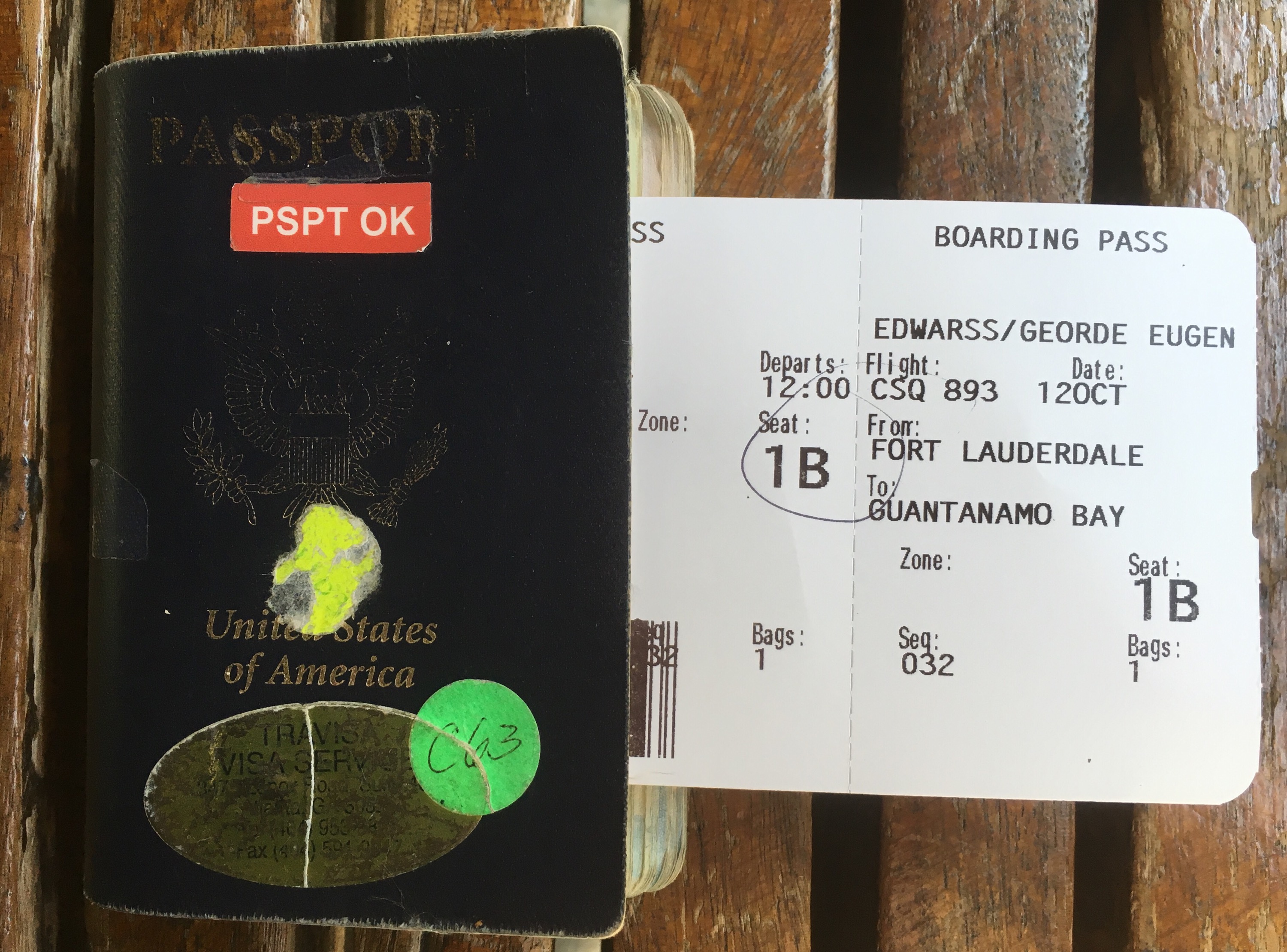
I’m flying on my own today, not attached to a specific US Military Commission.  That’s why my flight check-in to Guantanamo was at a discreet counter, on the lowest floor of the Ft. Lauderdale International  Airport, next to the baggage claim. In the past I’ve flown with a group from Andrews Air Firce Base. 
I’ll check in later after touching down in Cuba. 


Indiana law students and faculty at Ft. Meade’s Guantanamo hearings

Ft. Meade # 1 of 4

Right to left — Mr. Tex Boonjue, Ms. Hee Jong Choi, and me. We’re standing in front of the Post Theater at Ft. Meade.

I was at Ft. Meade, Maryland today to monitor hearings in the Guantanamo Bay Military Commission case against an alleged high-ranking al Qaeda member, Hadi al Iraqi. Hadi faces war crimes charges in the court, located in a remote area of Cuba. The U.S. military broadcasts the hearings live to a Ft. Meade base movie theater (the Post Theater) via a secure video-link.

Indiana students at Ft. Meade

I was joined by two Indiana University McKinney School of Law students, both of whom have strong interests in human rights and international criminal law. They are both representatives of Indiana’s Military Commission Observation Project (MCOP).

Ms. Hee Jong Choi is a rising third year student who is an intern in Indiana’s Program in International Human Rights Law. She has been working on North Korean human rights issues, while she was based in South Korea for the first half of the summer, and while based in Washington, DC at an NGO (HRNK – The Committee for Human Rights in North Korea) for the second half of the summer.

Mr. Tex Boonjue is a rising 2nd year Indiana student, who is working for the Court of Appeals for the Armed Forces (CAAF) at the Washington, DC Naval Yard.

Fort Meade's Post Theater is screening Guantanamo Bay war crimes hearings during the day, and San Andreas in the evenings.

Fort Meade’s Post Theater is screening Guantanamo Bay war crimes hearings during the day, and San Andreas in the evenings.

Defendant’s opportunity to speak today – Conflict of interest

Today’s hearings were notable, in that the defendant had an opportunity to speak more than defendants typically speak at military commission hearings. Typically, at the beginning of a hearing week, the military judge will ask the defendant whether the defendant understands his rights. The judge lists our numerous rights, and the defendant is given a chance to answer as to his understanding of those rights. Generally, after that, the lawyers do the rest of the talking, along with the judge.

Today, an issue was presented regarding the possibility that the lawyer who represented Hadi for a year may have a conflict of interest that could have a negative impact on Hadi. The judge asked Hadi series of questions, in open court on the record, and Hadi replied. Hadi and the judge entered into a discussion about these issues.

Hearings suspended, again

Ultimately, due to questions concerning the possible conflict, the judge suspended the hearings, indefinitely.

The hearings for July 2015 had been scheduled for two weeks, beginning Monday, 20 July. The night before, this conflict issue was raised in special conference, and the judge postponed the hearings until today, Wednesday the 22nd. Today, we had about 3 hours of court time, including the time that the defendant and the judge conversed, and including pauses and a long break.

The two weeks of hearings could be over as of lunch time today.

In the meantime, many dozens of people associated with the hearings boarded a plane this past Sunday at Andrews Air Force Base, bound for 2 weeks at Guantanamo Bay. The plane may be forced to return to Andrews more than a week early, with only 3 hours of court.

At the Ft. Meade Commissary today

At the Ft. Meade Commissary today

Who else was at Ft. Meade today?

Also in the Post Theater observing today’s hearings were 7 law student interns from the Office of the Chief Prosecutor of the Military Commissions, along with one of their supervisors, Major Chris Hartley (Army JAG, International Law Advisor). Two law student interns from the Human Rights First National Security section were present, as was another gentleman who did not identify himself. A DoD contractor was there to help ensure that no one brought cell phones into the Theater. And a technician and another administrator popped in from time to time to check up on things.

It was an early lunch day at Ft. Meade.

Greg Loyd, our Indiana McKinney representative who is in Guantanamo Bay this week, reported that there is plenty to keep him and observers busy down there, even with the hearings being suspended. He, and the rest of us, are spending time working on the Guantanamo Bay Fair Trial Manual.

George Edwards – Ft. Meade, Maryland

Hadi’s Guantanamo hearings delayed two days

We are 6 NGO Observers on this trip to Guantanamo Bay, along with our Military Commission escort. Next time we wont stand in the shade for our photos!)

We are 6 NGO Observers on this trip to Guantanamo Bay, along with our Military Commission escort. Next time we wont stand in the shade for our photos!)

The Hadi al Iraqi Guantanamo Bay hearings begin tomorrow (Wednesday, 22 July), two days late due to an issue that apparently arose on Sunday the 19th, our first day in Cuba.

I came to Cuba to observe these war crimes hearings, and though the hearings were postponed, I and the other Observers had a very full two days.

On Monday I went for a 4:00 a.m. run with a fellow Observer. We ran early to avoid the daylight heat and humidity. As required, we carried our base identification card and wore reflective gear.

We then met with the other Observers and our escorts for breakfast at the base dining hall. This gave us a chance to get to know each other and learn about the different non-governmental organizations we represent. At the dining hall we saw members from every branch of the U.S. armed forces. As for the food, well, it was pretty decent.

I'm sharing this tent with the two other male Observers. the 4 female Observers are sharing their own tent.

I’m sharing this tent with the two other male Observers. the 4 female Observers are sharing their own tent.

Who are the Guantanamo Observers this week?

I am representing the Military Commission Observation Project of the Indiana University IU McKinney School of Law (MCOP), founded by Professor George Edwards. Five other NGO’s sent representatives to attend this round of Hadi hearings. NGOs generally are tasked with attending, observing, analyzing, critiqueing and reporting on the military commission proceedings. Our Indiana project, which is also known a the “Gitmo Observer”, is specifically looking at the rights and interests of the full range of Guantanamo Bay military commission stakeholders, including, for example, the defendants, the prosecution, the victims and their families, the witnesses, the media, and the military personnel who guard the prisoners and run the detention facilities.

My 3rd of the men's tent.

My third of the men’s tent.

Our group of Observers consists of two attorneys, four law school students from four different law schools, and one representative from an NGO that focuses on human rights. The diverse backgrounds of this group will help provide different points of view from which to observe the proceedings and, thus, hopefully lead to a fuller review of the hearings.

Internet Access

After breakfast, I met with the other Observers for an informal discussion. We met outside near a particular restaurant so that several of the Observers could use the free wifi available at that particular location.

Internet access is quite an issue at the base. Internet access through a wired ethernet connection costs $150/week. This cost is prohibitive to some NGO’s and to some Observers. The Observers who cannot afford to pay for the wired connection must rely upon free wifi. This service, which is only available at select locations is both slow and unreliable due. This, in turn, runs the risk of limiting timely reporting from Observers.

The NGO Library

I then went to the NGO library to learn what resources were present to aid us in our observations. A number of NGO’s, including the Military Commission Observation Project through Indiana’s IU McKinney School of Law, stocked the library with helpful written material.

The MCOP most notably included two resources (1) a briefing book that includes the Manual for Military Commissions and (2) a copy of the 500 page Executive Summary from the Senate Select Committee on Intelligence’s Committee Study of the Central Intelligence Agency’s Detention and Interrogation Program.

To understand the rights of stakeholders, it is important to understand the legal framework in which stakeholders exercise their rights. As such, the Manual for Military Commissions is a great resource as it sets forth how military commissions, such as the one handling the al-Hadi al-Iraqi case operate, both in and outside of court hearings. This includes, for example, discovery issues, trial rules, and sentencing procedures.

The second document will be helpful as the Hadi defense team has made numerous references to this study through many of its pleadings. This document is important as it is referenced by the defense in many of its pleadings.

Big Day Tomorrow

It is hard to believe that the hearings begin tomorrow. I’m excited about this opportunity to watch the hearings, analyze the proceedings, and then report to you.

I and other Observers have been using the Guantanamo Bay Fair Trial Manual, that provides insights as to what we might wish to look for as we assess whether stakeholders are receiving a fair hearing.

Greg Loyd – Guantanamo Bay, Cuba

My arrival at Guantanamo Bay, Cuba

Greg Loyd - At Camp Justice - 21 July 2015

I’m standing at the front of Camp Justice, my home for the next two weeks at Guantanamo Bay. I am facing the makeshift complex that houses the courtroom where hearing are scheduled to begin tomorrow, Monday, 20 July 2015.

I arrived at Guantanamo Bay Naval Station yesterday, on a sunny Sunday July afternoon. I am scheduled to be here from tomorrow (the 20th) through 31 July to monitor hearings in the case against alleged al Qaeda official Hadi al-Iraqi.

I flew from Andrews Air Force Base – along with the judge, prosecution and defense attorneys, media, and other NGO Observers – on an air force flight. Check-in was similar to check-in for a regular commercial flight. I presented my ID card at the Andrews ticketing counter, confirmed my destination, and the attendant gave me a boarding pass.

Greg Loyd - Sunrise at Andrews Air Force Base - 19 July 2015

Sunrise at Andrews Air Force Base, Sunday, 19 July 2015

 Waiting to Board

In the Andrews terminal, I had the opportunity to meet fellow NGO Observers and other people involved in the military commission. Many people traveling with us appeared to have formed strong bonds, as they quite happily greeted one another with wide smiles, a change in the tone of their voice, and a strong handshake or hug.

When did friends and Colleagues last see each other?

Watching the men and women at Andrews greet each other so warmly made a lot of sense to me, since the different groups of people may not have seen each other in a while. I’m not sure when the last hearings were in the Hadi case, but there have been no military commission hearings at all for many months.

Unlike many courts, the Military Commission doesn’t conduct court hearings each and every day. Instead, the court only conducts hearings on the days or weeks designated by the judge in light of pending motions, the status of the parties’ trial preparations, and other considerations. Weeks and months can go by with no hearings in the Hadi case, or in any of the other few pending Guantanamo Bay cases.

The judge and others involved with the hearings (excluding the defendants) do not stay at Guantanamo Bay when there are no hearings. Instead, everybody (again, except the defendants) travel to the base only for the scheduled hearings.

Hearings have indeed been scheduled in multiple cases over the last several months, but most of those hearings were cancelled.

We are 6 NGO Observers on this trip to Guantanamo Bay, along with our Military Commission escort. Next time we wont stand in the shade for our photos!)

We are 6 NGO Observers on this trip to Guantanamo Bay, along with our Military Commission escort. Next time we wont stand in the shade for our photos!)

NGO Impact: A Cost – Benefit Analysis

The repeat cancellations present a potential problem for NGO’s, among other stakeholders. Such cancellations (particularly those that occur shortly before a hearing date) create a degree of uncertainty for NGO’s representatives regarding the cost of planning on attending hearings. This cost notably includes time reviewing relevant motions, statutes, and human rights treaties, and that time could instead be invested in other valuable projects. If hearings are rescheduled too often, there is a risk that NGO’s will elect to invest their time in other worthy goals that may have a more certain application, rather than preparing for a hearing that may be cancelled. Should this occur, then fewer NGO’s may send Observers, which could negatively impact the quantity and quality of Observer reporting.

A personal example

On three prior occasions, I was selected to travel to observe the proceedings as a representative of the Military Commission Observation Project of Indiana University School of Law.

Each previous time the hearings were cancelled. Each time I prepared for the hearing, purchased flight tickets, paid for my ground transportation, and coordinated work schedules and assignments with co-workers. While I am fortunate to work in a very team oriented office, such cancellations (and subsequent rescheduling) put pressure on my co-workers.
As a trial attorney, I understand the need to continue court hearings, sometimes at the last minute. I also understand that the complexity of these issues often necessitates a fair amount of work by all parties to properly prepare for the hearings. Nonetheless, the potential danger to NGO’s remains as they work to balance their limited time, manpower, and other resources.

While these cancellations can be frustrating, I hope that Observers can use this time beneficially to review and re-review the law, commentary, and analysis. Perhaps this additional analysis under multiple deadlines will lead to creative ideas to contribute to the discussion.

Breaking News

Just moments ago, my fellow NGO Obsevers met for Sunday dinner to discuss the hearings set to begin tomorrow morning. While at the restaurant, we were notified that the hearings scheduled for Monday, July 20 and Tuesday, July 21 were postponed until Wednesday.

That’s not a big problem for us, as our Guantanamo Bay tents are only a few feet away from the courtroom, and it is not a logistical nightmare to have Monday and Tuesday without hearings. But, Indiana’s Military Commission Observation Project is sending 4 people to Ft. Meade, Maryland, to monitor these same Guantanamo hearings via a secure simultaneous video-feed. It must be more challenging for the Ft. Meade Observers to change their hearings schedule to get to Ft. Meade.

Its time now to re-read some material I brought along.

Greg Loyd – Guantanamo Bay, Cuba


Guantanamo Bay case against Hadi al Iraqi case – July hearings

Guantnaamo Bay - Military Commission Seal

Seal of the Office of Military Commissions, U.S. Department of Defense.

The hearings I am scheduled to observe at Guantanamo in the case against alleged al Qaeda leader Hadi al-Iraqi are set for 10 days, 20 to 31 July 2015. Many issues are set to be litigated. This blog will introduce some of these topics:

  1. Defense motion to dismiss

The defense is asking the judge to dismiss the case as a whole, or, alternatively, to dismiss just on charge (Count V, Conspiracy).

  1. Motion to suppress defendant’s statements.

The defense is asking the court to prohibit the Government from admitting at trial many statements made by the defendant.

  1. Government motions on admissibility of certain evidence

The prosecution wants the court to determine whether the judge will permit particular pieces of evidence to be admitted at trial.

  1. Personal jurisdiction

This motion asks to judge to rule whether the court has personal jurisdiction over the defendant. The Government will have the burden to establish that the court has the authority over this particular defendant so that the court can conduct his trial. If the court does not have jurisdiction, then the trial cannot go forward.

A busy 10 days.

The prosecution and defense have submitted hundreds of pages of briefs and other documents related to these and other motions. It looks like it can be a busy 10 days for us at Guantanamo Bay.

I am excited about the opportunity to observe these proceedings. I will work hard to help keep you posted. In the meantime, please keep reading about the case!

By Greg Loyd – Guantanamo Bay, Cuba


Traveling to Guantanamo Bay for Hearings Tomorrow

George Edwards & Greg Loyd - Pre-Gitmo - DC - 18 July 2015

Mr. Greg Loyd (left) & Professor in Washington, DC on the eve of Mr. Loyd’s departure for Guantanamo Bay hearings in the case against Hadi al Iraqi. Professor Edwards will monitor the same hearings at a secure location at Ft. Meade, Maryland, beginning Monday, 20 July 2015.

Greg Loyd will fly to Guantanamo Bay, Cuba to monitor hearings in the military commission case again Hadi al Iraqi. Professor George Edwards will monitor those same hearings via a secure video-link at Ft. Meade, Maryland.

Mr. Loyd, who is a graduate of the Indiana University McKinney School of Law, is representing the law school’s Military Commission Observation Project (MCOP), founded by Professor Edwards. Three Indiana students and graduates will join Professor Edwards at Ft. Meade for the hearings, that commence Monday, 20 July 2015.

Abd al Hadi al-Iraqi

Hadi al-Iraqi

Who is the defendant?

The pre-trial hearings are in the case against Hadi al Iraqi, who is an alleged high ranking member of al Qaeda. He is charged with being an al Qaeda liaison to the Taliban, to al Qaeda in Iraq, and to other affiliated groups. Professor Edwards was in the courtroom at Guantanamo Bay in the 2014 summer when Hadi al Iraqi was arraigned on these charges.

The flight to Guantanamo Bay & drive to Ft. Meade

Mr. Loyd is scheduled to report to Andrews Air Force Base on Sunday, 19 July 2015, for his flight to Guantanamo Bay. Professor Edwards and the other Indiana monitors are scheduled to drive to Ft. Meade early Monday morning for the hearings. While Mr. Loyd will be in the Guantanamo courtroom, the Ft. Meade viewers will witness the proceedings live by video.

Blogging

All Indiana monitors will be posting blog entries about their observations. They are all using the Guantanamo Bay Fair Trial Manual to help them assess whether in their opinion, all stakeholders are receiving the fair trial to which they are entitled. The defendants are entitled to a fair trial, and so too is the prosecution. Other stakeholders with rights and interests include the media, the U.S. an international public, and the victims and victims’ families.


Human Rights Commission Addresses Guantanamo Secrecy

Building of the Inter-American Commission on Human Rights (Organization of American States), Washington, DC

Building of the Inter-American Commission on Human Rights (Organization of American States), Washington, DC

Lawyers for 9-11 Guantanamo Bay defendants issued this media alert Monday, 16 March 2015:

FOR IMMEDIATE RELEASE

Media Contact: James Connell (703) 588-0407 / (703) 623-8410

WASHINGTON, DC-Today, the Inter-American Commission on Human Rights will hear from attorneys for Guantanamo prisoners at 2:00 pm Eastern time.  Attorneys for Ammar al Baluchi and Mustafa al Hawsawi will address the impact of secrecy on the military commissions and ongoing detention.

“A state crime cannot be a state secret,” said James Connell, civilian attorney for al Baluchi.  “The secrecy at Guantanamo prevents accountability for torture and interferes with the administration of justice.”

The Inter-American Commission on Human Rights (Organization of American States).

Building of the Inter-American Commission on Human Rights (Organization of American States), Washington, DC

The hearing will include testimony from Special Rapporteur on Torture Juan Mendez, Dr. Stephen Xenakis, and Melina Milazzo of the Center for Victims of Torture.

The IACHR hearing is available streaming at http://www.livestream.com/oasenglish.

###

Guantanamo USS Cole Case Day 2 — Hearings To Resume April

USS Cole on 1st deployment after 2000 suicide bomb killed 17 US sailors and wounded dozens more

USS Cole on 1st deployment after 2000 suicide bomb killed 17 US sailors and wounded dozens more

Yesterday, Monday (March 2) was a very interesting day at the court dealing with Unlawful Influence and hearsay evidence in the al Nashiri case against the alleged mastermind of the 2000 U.S.S. Cole bombing in Yemen. Judge Spath ruled that a pentagon official (General Ary, retired) had exercised the Unlawful Influence over the case, and disqualified Ary from acting as “Convening Authority”, who is the person who organizes resources for the Military Commission case. The USS Cole case no longer has a Convening Authority, and Judge Spath declared that there  would be no further evidentiary hearings this week and that court will reconvene in first week of April 2015.

End of March USS Cole Session

Judge Spath addressed the next set of hearings, which happen to be scheduled to fall on the Easter holidays (first week of April). This was initially scheduled to be for two weeks but will be a one-week hearing after the Unlawful Influence “debacle”. The judge stated that in order to show that there was no pressure on him, he would truncate this April session. There is a possibility that travel to Guantanamo may be delayed to allow people to celebrate Easter, with the hearings possibly beginning on Monday or Tuesday, and extend into Saturday.

Al Nashiri’s “grooming”

There were several motions heard today, and I mention them in a separate post. I will discuss one here, related to the defendant’s “grooming”.

Mr. Rick Kammen, who is al Nashiri’s “Learned Counsel”, brought to the attention of the court the issue of al  Nashiri’s grooming. Mr. Kammen said the issue had still not been resolved and within the last 10 days, the policy had changed three times.

The prosecution said that the Joint Task Force – Guantanamo Bay (JTF-GTMO), which is responsible for the detention facilities, has endeavored to amend their Standard Operating Procedures to address this and the accused will have access to grooming before court and attorney-client meetings.

The judge added (emphasizing that this was not a ruling) that he expects that no prisoners will be in shackles in court if they don’t have to be, or in prison uniform before the members of the court, regardless of who the accused is.

It is not clear what falls into the category of “grooming”. It seems to deal with issues such as what clothes al Nashiri is able to wear to court, access to bathing facilities, haircuts, and the like. And, shackles in court also was mentioned in the context of this grooming discussion. I find myself wondering what exactly what “grooming” involves.

Whereas I am certain they must have very stringent rules on the Base, grooming  to me seems a basic right, entrenched in the right to humane treatment as espoused in domestic and international law.  The Guantanamo Fair Trial Manual considers the right to humane treatment and humane conditions of detention on page 114.

Furthermore, grooming ties in with the right to be presumed innocent, which is also covered in the Guantanamo Fair Trial Manual. The defendant’s physical appearance in the courtroom may affect the impressions of the jury, the press, the NGO Observers, the victims and their families, and others who may see the defendant. If he is dressed in “prison clothes”, appears to be unclean or unkempt, or is shackled at his hands and feet, an impression might be formed that is different than if he appeared clean and tidy wearing a 3-piece business suit.

Sunset at Girls Cout Beach,  Guantanamo Bay, Cuba

Sunset at Girls Cout Beach, Guantanamo Bay, Cuba

After hearings – The Beach & a Jamaican Dinner

The NGO Observers were taken on a short tour of several beaches on the island by a logistics specialist, Petty Officer Second Class Archie, and then had dinner at the Jerk House. I had authentic Jamaican Jerk Chicken served by a Jamaican (I think), with Jamaican reggae music playing in the background. The only thing that could have made this better is if I had saved room for dessert.

Meeting with the Prosecution; Departure for GTMO

Tomorrow (Wednesday, March 4) we will meet with the prosecution team at 2:00 p.m. and the defense team at 4:30 p.m.

We will depart Guantanamo Bay for Andrews Air Force Base at 10 a.m. Thursday.

It certainly feels like we have been here longer than three days.

The next blog will be list more motions from today, and the blog after that will deal with the life of an NGO Observer at GTMO’s Camp Justice.

(Avril Rua Pitt, NGO Observer Lounge, Camp Justice, Guantanamo Bay, Cuba, Wednesday, 4 March 2015)


USS Cole Case Day 1 Wrap Up: Guantanamo Bay

From the ferry crossing Guantanamo Bay, the GTMO airport where we arrived in the background.

View from the ferry crossing Guantanamo Bay, the GTMO airport where we arrived in the background.

Touch Down at GTMO

The first day we arrived at Guantanamo Bay was sobering. This side of the island is beautiful, and everyone at the Base who met us is very friendly. We arrived, went through security and got on vans to head to the Ferry. It is a short ferry ride to Camp Justice, and we had interesting conversations with other observers and different people going to Guantanamo for different purposes unrelated to the pretrial hearings. Our luggage was waiting for us when we arrived. We have all been set up in two tents; one for the men and one for women.

On Sunday, we went for dinner at an Irish restaurant. The food was everything but Irish, but I cannot judge seeing as I ordered tilapia! I found it interesting that we could not all sit together as we had not made a reservation 24 hours in advance. Yesterday (Monday, the 2nd) we switched things u and went next door the Irish place, the Windjammer, which has the exact same menu as the Irish place. Sigh.

Guantanamo Bay Courtroom from the viewing gallery, behind  the thick, bulletproof glass.

Guantanamo Bay Courtroom from the viewing gallery, behind the thick, bulletproof glass. (Photo credit: CBS News. Photo by Joe Raedle/Getty Images)

Courtroom Tour

Day 1 at Gitmo started with a tour of the Court. We were not able to go inside the actual courtroom as they had already prepared it for the session. We sat in the gallery, which is behind glass windows that have TV monitors transmitting with a 40-second delay to allow for time to censure any classified information that may be said in court.

We talked about the trial process in Military Commissions, Convening authorities and their roles, especially in light of the Unlawful Influence motion that was set to be ruled on., how juries and selected,  and went over some court rules and structure.

Court Session Begins – Victims & Family Join

We reconvened at the court at 10:30 a.m. This time we were joined by Victims and Family who sat on the opposite end of the room. In the room, we had our NGO escorts as well as some military personnel to escort us if we needed to leave the room, or if we needed anything else. One of them was actually from Indiana. Always great to meet “fellow Hoosiers”. Our escorts have been wonderful the entire time, and drive us anywhere we wish to go, including to the court a few yards away sometimes.

We were given assigned seats even though the gallery was half-empty.

Courtroom sketch of al Nashiri by artist Janet Hamlin. Today in court he was wearing a similar white jumpsuit.

File courtroom sketch of al Nashiri by artist Janet Hamlin. Today in court he was wearing a similar white jumpsuit.

From where I was in the back row, I did not see the bring al Nashiri in, but I did see him during our “comfort break”. He was in a white jumpsuit and was chatting with his team, looking very calm. At 50 years old, he certainly looks a lot younger in my opinion

Judge’s Ruling on Unlawful Influence by Marine Major General Vaughn Ary (retired)

First order of business, Judge Spath delivered his ruling on the Unlawful Influence Motion (AE 332, Defense Motion to Dismiss for Unlawful Influence and Denial of Due Process for Failure to Provide an Independent Judiciary). The Guantanamo Fair Trial Manual addresses the relevant laws on Unlawful Influence on page 63.

The judge ruled that there was an appearance of Unlawful Influence by retired Marine Major General Vaughn Ary, the Convening Authority (CA) but that because he found Ary did not act in bad faith he did not allow the defense remedies of dismissing the case (See pg. 5896 Unofficial Unauthenticated Transcript, al Nashiri, A March 2015). He further ordered that the CA and his legal advisors be disqualified from taking any further action and making any further recommendations in the case. He called for the appointment of a new CA.

There will be no further evidentiary hearings this week, and several people have mentioned that we may wrap up the sessions as early as today (Tuesday).

The judge mentioned that a ruling on a Motion 205 would be out soon, but that he had denied 205 BB (a motion to reargue) and 205 EE (a motion to supplement additional pleadings). I later learned during a briefing with General Martins that these were defense motions to seal some of al Nashiri’s medical records for privacy reasons.

More Motions

At the 1300hrs (1:00 p.m.) session, the court heard spirited arguments from both the defense and prosecution on the following motions:

  • AE 331 A – Government Motion To Amend the Docketing Order (February 2015 Hearing) To Allow The Government To Determine The Manner In Which It Presents Its Evidence Relating To The Admissibility Of Government-Noticed Hearsay And Evidence Identified In AE 207;
  • AE 319J – Defense Motion to Continue Further Hearings on the Government’s Motion to Admit Hearsay Until the Court of Military Commissions Review Renders a Final Judgment on Appeal;
  • AE 256D, Defense Motion to Strike AE 256C: Government Notice of Bill of Particulars (Defining Civilian Population as Used in Aggravating Factor #5);
  • AE 257D, Defense Motion to Strike AE 257C: Government Notice of Bill of Particulars (Defining Civilian Population as Used in Aggravating Factor #5).

Meeting with Chief Prosecutor General Martins

The session ended at about 3:30 p.m. to the public, and continued to discuss a classified Motion 505 in chambers. We met about an hour (for about an hour) later with Army Brig. General Mark Martins, the Chief Prosecutor in the Office of Military Commissions.

We went over some of the hearsay rules under the Military Commissions Act relating to some of the motions discussed in the afternoon session, and answered our questions relating not just to the USS Cole.

Meeting Carol Rosenberg

Before this meeting however, I bumped into Ms. Carol Rosenberg, a notable reporter from the Miami Herald who is known as the Dean of the GTMO Press Corps and has been reporting on Guantanamo since 2002. She said she had read my tweet, and that she knew how to adjust the air conditioning in the tents! Who knew! She later came back and showed us how to do just that. We made very minimal adjustments so as not to let any rodents in or get the tent moist and moldy. Thanks to that, night 2 was a sleeping-bag-only affair.

Tuesday’s Court Schedule

Today (Tuesday) the court session begins at 9:00 am.

Avril Rua Pitt, Camp Justice, Guantanamo Bay, Cuba, Tuesday, 3 March 2015

First Night at Guantanamo Bay, Cuba

IMG_1307We arrived at Guantanamo Bay safely. It took a while to get settled in.

One of my first tasks was to set up the Gitmo Observer Resource Center, which is a compilation of Military Commission documents, Geneva Conventions, Briefing Books, and office supplies for all of the NGO Observers to use. It is set up in a room called the “NGO Lounge”. All of our Gitmo Observer materials were in a big black trunk, presumably placed there by the last Indiana University McKinney Law School Observer who was down here at GTMO last week.

On the plane to GTMO and while here, several NGO Observers have been reading Gitmo Observer’s Guantanamo Bay Fair Trial Manual. They seem to be very intrigued. This 400-page document written by IU McKinney affiliates looks at rights and interests of all stakeholders, including defendants, prosecution, victims, the press and others.

It was freakishly cold last night in our tent. IU McKinney’s GTMO sleeping bag AND electric blanket came in very very handy!

In the morning we are taking a tour of the GTMO courtroom.

(Avril Rua Pitt, Guantanamo Bay, Cuba, 2 March 2015)

Guantanamo NGO Observers from IU McKinney Law School Featured in Indiana Lawyer

Military tribunals for some accused of terrorist attacks on the United States are held at Camp Justice at Guantanamo Bay. (Photo by Catherine Lemmer, IU McKinney School of Law)

Military tribunals for some accused of terrorist attacks on the United States are held at Camp Justice at Guantanamo Bay. (Photo by Catherine Lemmer, IU McKinney School of Law)

The Indiana Lawyer published the following article by Marilyn Odendahl on 25 February 2015. Text and photos are in the original article.

IU McKinney Gitmo Observers Illuminate Murky Proceedings in Gitmo Trials

by. Marilyn Odendahl (25 February 2015)

      The U.S. Military Commission Observation Project overseen by Indiana University Robert H. McKinney School of Law is continuing to send individuals to watch and report on the accused terrorists’ trials being held at Guantanamo Bay. Blog posts and articles from the observers chronicle the glacial pace of the proceedings, the unexpected courtroom twists and the nagging constitutional questions.

Professor George Edwards

Professor George Edwards

The project regularly sends faculty, students and alumni to either Guantanamo Bay or Fort Meade in Maryland to observe the tribunals. Professor George Edwards, founder and director of the project, explained the work of the observers is not to address the political issues or comment on the substance of the military commissions.

“We’re interested in seeking to assess whether the stakeholders are receiving the rights and interests that are afforded to them,” Edwards said. “(Those rights) include the right to a fair hearing, the right to an independent tribunal, the right to trial without undue delay.”

He pointed out the observers also are looking at the stakes that the victims of the terrorists attacks and their families have in the proceedings. What about their rights to have access to the trials, to make statements, to confront and to have closure?

Professor Catherine Lemmer

Professor Catherine Lemmer

IU McKinney librarian Catherine Lemmer, who Edwards described as instrumental in helping to build the observation program, heard some victims’ voices when she traveled to Guantanamo Bay for the hearings of the alleged co-conspirators of the Sept. 11, 2001, attacks.

One man said he was attending the proceedings to remind the judge and attorneys that planes had flown into the twin towers of the World Trade Center and the Pentagon. A mother of a fallen firefighter said she was struggling to hang on to her opposition to the death penalty, but she believed the trials had to be fair because the United States would be judged by how it handles the detainees.

The project drew praise from panelists who participated in a recent forum at the law school examining the tribunals. Hosted by the Indiana International & Comparative Law Review, the symposium brought together legal scholars from IU McKinney and around the country to discuss whether the end is coming for Guantanamo Bay or if the practice of international criminal law has reached a turning point.

An IU McKinney symposium examined trials at Guantanamo Bay. Panelists included (from left): Richard Kammen, Kammen & Moudy; Shahram Dana, The John Marshall Law School; George Edwards, IU McKinney; and Paul Babcock, editor-in-chief of the Indiana International & Comparative Law Review. Chris Jenks of Southern Methodist University Dedman School of Law participated via video link. (Photo by Dave Jaynes, courtesy of IU McKinney Law)

An IU McKinney symposium examined trials at Guantanamo Bay. Panelists included (from left): Richard Kammen, Kammen & Moudy; Shahram Dana, The John Marshall Law School; George Edwards, IU McKinney; and Paul Babcock, editor-in-chief of the Indiana International & Comparative Law Review. Chris Jenks of Southern Methodist University Dedman School of Law participated via video link. (Photo by Dave Jaynes, courtesy of IU McKinney Law)

Two participants – Shahram Dana, associate professor at The John Marshall Law School and Chris Jenks, assistant professor at Southern Methodist University Dedman School of Law – on the second panel discussion both noted IU McKinney’s effort in documenting the proceedings at Guantanamo Bay is shining a light on America’s response to terrorism and will be an invaluable resource for history.

Lemmer advocates for the proceedings to be shown on C-SPAN. The American public should see for themselves, she said, so they form their own opinions. By seeing what is happening in that courtroom, she said it is easy to realize how things could go wrong.

“The role of the attorneys, our role (as citizens) is to hold fast to the Constitution when really bad things happen and everybody wants to step over it,” Lemmer said. “Ultimately, the price we pay for not doing it right is incredible. This is our Constitution and it is getting overwhelmed, which should not happen.”

Lemmer took her first trip to Guantanamo Bay in December 2014. However, the proceedings were derailed by the ongoing revelations that the Federal Bureau of Investigation may have infiltrated the defense teams. The FBI is accused of listening to defense attorneys’ meetings with their clients and reviewing their correspondence as well as attempting to turn legal team members into informants.

When she returned in early February 2015, the FBI conflict-of-interest issue was still being argued. Then unexpectedly, Ramzi Bin al-Shibh, one of the defendants in the courtroom, said he recognized his interpreter as someone he encountered during the period he was held at one of the Central Intelligence Agency’s secret prisons. Another defendant told his attorney he also remembered the interpreter from the black site.

“It became very surreal,” she said.

To Indianapolis defense attorney Richard Kammen, the confusion and conundrums that swirl around Guantanamo Bay could be resolved by moving the proceedings to federal court. Kammen, lead counsel for USS Cole bombing suspect Abd al-Rahmin al-Nashiri, pointed to the hearings of accused Boston Marathon bomber Dzhokhar Tsarnaev as an example that U.S. courts can handle high-profile terrorism cases.

“There’re so many more moving parts down there than there would be in federal court, so things just get more messed up,” he said.

Currently, Kammen and his defense team are tangling with the federal government to release the details of the treatment of al-Nashiri while he was kept in a black site. The release of the CIA Torture Report publicly confirmed that the defendant had been physically, psychologically and sexually tortured, but Kammen said the defense still needs details of what was done and when.

Professor Tom Wilson

Professor Tom Wilson

IU McKinney professor Lloyd “Tom” Wilson is scheduled to observe the al-Nashiri proceedings during his first trip to Guantanamo Bay. The task of watching and relaying what is happening will be difficult, he said, because he will be seeing just a snapshot of a long, complex and secretive process.

Wilson was careful in his preparation for the trip, not wanting to form any preconceived ideas or prejudices before he arrived in the courtroom. He is going out of a sense of civic duty and to understand the situation better than he does now.

Still, the proceedings are not easy to comprehend and continue to spark debate many miles away from the detention camp.

As part of his remarks during the IU McKinney symposium, Kammen described Guantanamo Bay as a “law-free zone.”

Co-panelist Jenks countered that characterization, arguing traditional rules governing the treatment of prisoners of war have been upended by terrorism. In previous conflicts, nation states battled each other but now the United States is fighting against groups that are unconnected with any organized government or country. Even so, he continued, the detainees at Guantanamo Bay have a right to counsel and are being given a trial.

Kammen responded that even if his client is acquitted, he will not be released.

“That,” Kammen said, “is a law-free zone.”

_______

The original Indiana Lawyer article can be found here:  http://www.theindianalawyer.com/iu-mckinney-gitmo-observers-illuminate-murky-proceedings-in-gitmo-trials/PARAMS/article/36436