Author: gedwards97

George Edwards is Professor of Law & Faculty Director, Program in International Human Rights Law at Indiana University McKinney School of Law. He is Founding Director of the Law School's Military Commission Observation Project ("MCOP" or "The Gitmo Observer"). Professor Edwards is also Special Assistant to the Dean for Intergovernmental and Non-Governmental Organizations. The Guantanamo Bay Reader will be published soon.

Another Guantanamo Detainee permitted to plead for release

omar al rammah - yemen

Omar Mohammed Ali al Rammah

The Pentagon posted on their website a hearing date for another detainee to be permitted to plead for his release.

On 21 July 2016, Omar Mohammed Ali Al-Rammah, will be given an opportunity formally to request repatriation to his home country (Yemen — which would almost certainly not be granted) or transfer to a third country. The hearing is called a “Periodic Review Board” or “PRB“.

al Rammah, who is alleged to be a member of al Qaeda, is suspected to have played a major role in “al-Qaida linked plans to conduct explosives operations in Georgia and Chechnya”  in the Republic of Georgia. (Per a JTF-GTMO memorandum from 2008). That 2008 memorandum noted that al Rammah was at that time a high risk (as he was “likely to pose a threat to the US, its interests, and allies”), a medium threat from a detention perspective, and of medium intelligence value.

It was previously reported that the 14 July 2016 was the last scheduled PRB. And that was true at the time. The al Rammah hearing was just added to the public schedule.

It is hoped that the Pentagon will permit me to observe the al-Rammah hearing.


Guantanamo Detainee Seeks Release; Legal Observer Not Permitted to Attend

Abdul Rabbani

Abdul Rabbani set to plead for release from Guantanamo Bay

On the morning of Thursday, 7 July 2016, a Pakistani detainee imprisoned at Guantanamo Bay since 2004 was scheduled to formally plead for his freedom. Such hearings are held at Guantanamo Bay, but are piped in by live video at a secure location near the Pentagon.

I have for many months sought to observe these hearings — called Periodic Review Boards (PRBs) — but have not been granted permission. Members of the human rights community, media, and others routinely attend and observe these hearings. I am awaiting a letter from the Director of the Office in charge, telling me “yes” or “no”, officially, whether I will be able to observe the last scheduled of the “initial review” PRBs. The last in this initial series is scheduled for Thursday, 14 July 2016 — one week from today.

Abdul Rabbani, born in Saudi Arabia but claiming Pakistani citizenship, is alleged, among other things, to have operated safe houses in Karachi, Pakistan that housed high level al Qaeda members, and to have had links with Osama bin Laden, Khalid Shaik Mohammad, and 11 of the 9/11 hijackers.

Today’s hearing is not a criminal in nature (unlike all the other Guantanamo Bay hearings I have observer) — today there are no charges, judge, or jury.

Today’s hearing was prompted by a 2011 Presidential Executive Order through which detainees are periodically reviewed on whether they maintain a threat to U.S. national security. If they do not pose a threat, they could in theory be set free from Guantanamo Bay (as many hundreds have been released since 2002, and have many dozens have been released recently).

These PRB hearings are incredibly important for many reasons, and it is important for observers to be able to observe them, live, in progress, at least from the remote security DC-area facility.

Instead of a bona fide judge and jury, this morning Rabbani would have made his case for release to a a cross-section of representatives of the US national security community that he is not a threat to the national security of the US, and that he should be repatriated to his home country or transferred to a third country. They would likely render a decision within a month from today.

If they find that he is not a significant threat, that might be another step in the direction of Guantanamo Bay closing, if Rabbani could be freed from Guantanamo. The Guantanamo Bay population is below 70 detainees, from a high of 780.

Did Rabanni’s hearing happen this morning?

I do not yet know if the hearing went forward this morning. Though I timely requested to observe, and submitted significant materials in support of my request, I was not granted permission to attend and observe.

I posted earlier about the published standards for clearing observers for PRB hearings, and linked to the Pentagon website that lists the standards.

We at the Periodic Review Board (PRB) Project are very much looking forward to receiving an official letter either officially granting permission to attend next week’s final “initial review” PRB, or officially denying permission to attend and observer next week’s final “initial review” PRB.

We will keep you posted!

PS:  I will plan to post some of the materials I submitted to the Pentagon as credentials to gain PRB observer status.

George Gedwards

Guantanamo Detainee To Plead for Freedom at Special Hearing

Abdul Rabbani

Abdul Rabbani’s PRB is set for 7 July 2016

On Thursday, 7 July 2017, Guantanamo Bay detainee Abdul Rabbani is scheduled to have a chance officially to plead that he poses no threat to U.S. national security and should be released from Guantanamo.

He may speak at a hearing, called a Periodic Review Board (PRB), authorized by a 2011 Executive Order issued by President Obama. Detainees may argue for their freedom before a panel representing a cross-section of the U.S. national security community.

Rabbani is expected to appear in a small room at Guantanamo Bay, with a U.S. government provided military “special representative” at his side. He and the special representative may make statements, call witnesses, or invoke other rights. The review panel consists of representatives of the Departments of Defense, State and Homeland Security; the Chairman of the Joint Chiefs of Staff; and the Office of the Director of National Security – all viewing remotely, presumably via secure video-link from their Washington, DC area offices.

Over 50 PRB “initial reviews” have been held since 2013. After Rabbani’s PRB tomorrow, the last scheduled PRB is set for Thursday, 14 July 2016, for Ismael Ali Faraj Ali Bakush (ISN 708), of Libya, who has been held at Guantanamo since 2002. For a chart of scheduled PRBs (past and future), please see the bottom of this link.

If after the “initial review”, a detainee is deemed not to be a significant threat to the US, arrangements may be sought for repatriating him to his home country or releasing him to a third country. If he is deemed a significant threat, he will have a “file review” every 6 months, and a “full review” every 3 years (“triennial review”).

Denial of me to observe PRBs at remote DC-area location

PRBs are also video-cast live from Guantanamo to a remote facility near the Pentagon, where specially approved media, non-governmental organization (NGO) representatives, and individuals may view the public portion of the proceedings.

One would expect the PRBs to be transparent, with reasonable access for media, human rights observers and individual experts to view from the remote DC-area facility. It has proved difficult to gain permission to observe a PRB.

The Pentagon has denied multiple NGOs permission to observe, including NGOs with longstanding work in Guantanamo Bay detainee related issues. Also, the Pentagon has denied access to at least one individual with longstanding work in the areas of wartime detention, international law, and human rights – me!

I have been seeking permission to attend PRBs for many months, submitting significant materials in support of this request. I have been denied permission to observe PRBs multiple times, for multiple unofficial reasons. I await an official letter from the Periodic Review Secretariat (PRS) either expressly granting permission to observe, or expressly denying permission.

Since over 50 detainees have had their “initial review” PRBs, and only a couple are left, the last opportunity to observe an “initial review” will likely be within the next week.

Criteria for approving media and non-media observers for PRBs

The Periodic Review Secretariat lists criteria for selecting PRB observers as follows:

In selecting applicants for observer status, the following criteria will be considered:

  • Reach of the applicant organization or individual (e.g., audience size, readership, subscriptions, circulation, viewers, listeners, website hits, writings, broadcasts, professional standing, diversity of audience, etc.).
  • Nexus of the applicant’s organizational mission to Periodic Review Board proceedings, wartime detention, international law, and/or human rights.  If the applicant is an individual, the nexus of the individual’s writings, commentaries, and/or broadcasts on the same topics may be considered.
  • Extent to which applicant has provided longstanding and frequent coverage of issues relating to Periodic Review Board proceedings, wartime detention, international law and/or human rights.

All groups, organizations and individuals (if not affiliated with a group or organization) will be evaluated under these procedures.  Applicants are asked to provide documentation and examples of how the organization or the individual meets the above criteria.

http://www.prs.mil/Press-Releases/Observers/http://www.prs.mil/Press-Releases/Observers/

I have applied for observer status under the various prongs, including the second prong (second bullet point) — the “nexus standard” — which calls upon the Pentagon to consider the following when selecting PRB Observers:


(1)  For organizations, the nexus of the organizational mission to:

(a) Periodic Review Board proceedings;

(b) wartime detention;

(c)  international law; and/or

(d) human rights. 


(2)  For individuals, the nexus of the individual’s writings, commentaries, and/or broadcasts to

(a) Periodic Review Board proceedings;

(b) wartime detention;

(c)  international law; and/or

(d) human rights.


We look forward to learning from the Pentagon whether this standard is met and I will be able to observe PRBs, or whether the standard is not met and I will be officially denied (following multiple other denials). It is particularly important to be able to observe PRBs, not only because of the role they may play in the debate regarding closing Guantanamo Bay, but also because these hearings are very important in discussions regarding rights and interests of all Guantanamo Bay stakeholders.

Who is Rabbani?

Rabbani was born in Saudi Arabia, claims citizenship of Pakistan, and is about 46 or 47 years of age. It is alleged that among other things, he operated safe houses in Karachi, Pakistan that housed high level al Qaeda members, and had links with Osama bin Laden, Khalid Shaik Mohammad, and 11 of the 9/11 hijackers.

Gulam Rabbani

Rabbani’s brother — Gulam Rabbani

He was captured in September 2002 in Pakistan in a raid that netted several others since taken to Guantanamo Bay. He and others were held at various prisons, including in CIA custody (black sites), before being transferred to Guantanamo Bay in 2004.

Rabanni’s brother – Gulam Rabbani – is also being held at Guantanamo Bay.

Is Rabbani a risk?                  

In previous years, through different, non-PRB processes, Rabbani was considered a risk.

For example, 9 June 2008, Rear Admiral DAM. Thomas, Jr (US Navy, Commanding) wrote a memo to the Commander of the US Southern Command, recommending Rabbani’s continued detention. He contended that Rabbani’s risk assessment was as follows (bold & all caps in the original):

“A HIGH risk, as he is likely to pose a threat to the US, its interests, and allies”

“A MEDIUM threat from a detention perspective”–

“Of HIGH intelligence value”

The PRB panel is expected to render a decision within a few weeks after the hearing as to whether Rabbani currently poses a significant national security risk to the U.S. A decision is not set to be made until the panel hears directly from the personal representative, and quite possibly from the detainee himself, from witnesses, and from the Government.

The overwhelming majority of each PRB is conducted in secret (closed / classified) proceedings. Most of the PRBs I have reviewed transcripts of list the public sessions as lasting around 19 to 21 minutes on average (again, with that figure being an estimate). The open session would typically consist of the special representative speaking and the detainee making a statement.

Please look forward a future post on the actual Rabbani hearing. Unfortunately, at this point, I will not be able to post based on personal observations in the closed DC-area hearing. I will need to wait until the public transcripts are posted online.

I will be able to gain some insights into the Rabanni proceedings from reading the posts of NGOs and media who have been cleared to attend. Individuals who have witnessed PRBs at DC location have been able to observe the demeanor of the detainee, hear him read his personal statement in his own voice, study his body language, and witness interaction between the detainee and his special representative. Much is missed when one is prohibited from observing PRBs with one’s own eyes in real time.

George Edwards


Detainee Rights at Guantanamo Periodic Review Boards (PRBs)

Guantnaamo Bay - Military Commission Seal

Gitmo trials are handled through the Office of Military Commissions (OMC) —- http://www.mc.mil. PRBs are handled through the Periodic Review Secretariat (PRS) — http://www.prs.mil)

When many people think of Guantanamo Bay proceedings, they think of the U.S. Military Commissions that are set to try some detainees for war crimes. Not many think about a special type of administrative hearing through which detainees can plead for their release.

These hearings are called Periodic Review Boards (PRBs), and are rooted in an Executive Order issued by President Obama in 2011. In PRBs, detainees are permitted to argue that they do not threaten U.S. national security, and should be released from Guantanamo Bay, with either repatriation to their home countries or resettlement in a 3rd country. More about PRBs can be found here.

Detainee PRB rights

Certain detainees (not all) have rights to up to 3 “types” of PRBs, including an “initial review” (within a year of the Executive Order), a file review (every 6 months after a final determination of an initial review), and a triennial full review (every 3 years). Either the detainee will remain at GTMO following reviews, be transferred to a 3rd country, or be repatriated to his home country. Following are a list of rights to be afforded to detainees at different phases (initial review, file review, triennial review, transfer or repatriation, or remaining at GTMO:

  1. The right to a PRB (“initial review”) within one year of the Executive Order (though the first initial review was conducted 2 years after the 2011 act, with one of the last initial reviews scheduled for July 2016)
  2. The right to advance notice of the PRB, in writing and in a language the detainee understands, of the PRB
  3. The right to attend his PRBs
  4. The right to be assisted in PRB proceedings by a U.S. Government-provided personal representative who possesses the security clearances necessary for access to the information [It appears as though this representative is a “uniformed military officer” – see http://www.prs.mil.] [I have not yet attended a PRB, so I do not know whether the representative in fact wears a U.S. military uniform.]
  5. The right to have the Government-provided personal representative advocate on the detainee’s behalf before the PRB
  6. The right to have the Government-provided personal representative challenge the Government’s information and introduce information on behalf of the detainee.
  7. The right to retain private counsel to assist him (though at no expense to the United States)
  8. The right to have the U.S. provide him an unclassified summary of the factors and information the PRB will consider in evaluating whether the detainee meets the Executive Order standard, and this must include a summary of or substitute for classified information that is sufficient to assure a meaningful opportunity for the detainee to participate in PRB. The written summary shall be sufficiently comprehensive to provide adequate notice to the detainee of the reasons for continued detention. If a sufficient unclassified summary of classified information cannot be created, that information may not be considered by the PRB in its determination.
  9. The right to call witnesses who are reasonably available and willing to provide information that is relevant and material.
  10. The right to answer questions posed by the PRB (and presumably the right to refrain from answering questions)
  11. The right to present a written or oral statement for the PRB to consider
  12. The right to an interpreter (and presumably the right to have documents translated into a language he understands)
  13. The right to introduce relevant information, including written declarations
  14. The right to have the government provide mitigating information
  15. The right to have a PRB consisting of representatives of each of the Departments of Defense, State, Justice and Homeland Security; the Chairman of the Joint Chiefs of Staff; and the Office of the Director of National Intelligence.
  16. The right to the PRB’s prompt determination, by consensus and in writing, as to whether the detainee’s continued detention is warranted under the Executive Order’s standard, in a language the detainee understands, within 30 days of the determination when practicable.
  17. The right to a full review every three years if the initial review is negative
  18. The right to a file review every 6 months if the initial review is negative.
  19. In “lieu of” a right to appeal a determination of the any PRB, the right to 6 month file review and 3 year full review (see above)
  20. If the detainee is determined to be no longer a threat per the Executive Order, the right to have the Secretaries of State and Defense to ensure that vigorous efforts are undertaken to identify a suitable transfer location for any such detainee, outside of the U.S.
  21. The right to have the Secretary of State, in consultation with the Secretary of Defense, obtain security and humane treatment assurances regarding any detainee to be transferred to another country, and for determining, after consultation with members of the Committee, that it is appropriate to proceed with the transfer.
  22. The right to have the Secretary of State evaluate humane treatment assurances.

For more on PRBs, please click this link.

Periodic Review Board (PRB) Project of The Gitmo Observer

Screenshot 2016-07-04 14.11.56The Periodic Review Board (PRB) Project of The Gitmo Observer is discussed on this page:  https://gitmoobserver.com/prbs/.

This project details a critically important process at Guantanamo Bay in which detainees are given an opportunity formally to plead to the U.S. Government that the detainees should be set free from Guantanamo Bay. Detainees may argue that they are not a significant security threat to the national security interests of the U.S., thus possibly paving the way for the detainees to be repatriated to their home countries or transferred to third countries. Many of the detainees have been held at Guantanamo Bay since soon after the prison site was opened in January 2002, with some of them approaching their 15th year being at the remote Caribbean Island prison.

Below is a Chart of Periodic Review Boards that were provided for in 2011 but commenced in 2013. The final 2 “initial reviews” that may occur appear to be set for 7 and 14 July 2016. This chart was prepared by The Gitmo Observer, with information gathered primarily from the Pentagon’s PRB Secretariat website (www.prs.mil), with consultation of publicly available information from new sources and NGOs.


[office src=”https://onedrive.live.com/embed?cid=AA02978A4AC8C787&resid=AA02978A4AC8C787%21137&authkey=ABdMvFS9AHCkUT8&em=2″ width=”876″ height=”688″]


Screenshot 2016-07-04 14.11.56

PRB Chart – 3 July 2016

_______

Lawyers Korolev and Kubal Join Guantanamo Observer Advisory Council

Edwards, Korolev & Kubal Join MCOP Advisory Council

Left to right: Professor Edwards (Gitmo Observer Founder); Mr. Leontiy Korolev; Mr. Matt Kubal. Korolev & Kubal are new members of the Gitmo Observer Advisory Council. Professor Edwards is an ex oficio member. The photo was taken in the International Human Rights Law Academic Center at Indiana University McKinney School of Law.

Two Indiana lawyers, Leontiy Korolev and Matt Kubal, were recently appointed as members of the Advisory Council of the U.S. Military Commission Observation Project (MCOP), also known as the Gitmo Observer. The Project, which focuses on U.S. tribunals established at Guantanamo Bay, Cuba, is housed at the Program in International Human Rights Law of Indiana University McKinney School of Law.

Professor George Edwards, who founded the project, said “our Gitmo Observer Advisory Council is a very important part of our overall Project, as it helps us carry out our mandates.”

Regarding the project missions, Professor Edwards said: “Our Military Commission Observation Project’s missions include sending our members to Guantanamo Ba, Cuba (Gitmo) to attend, observe, analyze, critique and report on war crimes tribunals held there. Our Indiana University McKinney School of Law students, faculty, staff and graduates travel to Guantanamo Bay, Cuba, and play important roles related to rights and interests of all stakeholders in the process.”

The Advisory Council guides the Gitmo Observer in fulfilling the project’s responsibilities under the Pentagon’s Convening Authority grant of NGO Observation Status for the Guantanamo Bay U.S. Military Commission hearings. The Advisory Council helps manage The Gitmo Observer site and related social media, screens and selects observers for travel to hearings at Guantanamo Bay & Ft. Meade, and develops resources to educate and train selected observers and others.

Professor Edwards, Mr. Korolev, and Mr. Kubal each recently traveled to Guantanamo Bay, Cuba to monitor hearings. Edwards and Korolev each also recently traveled to Ft. Meade, Maryland to monitor Guantanamo Bay hearings that were simultaneously video-cast by secure link from the Guantanamo Bay courtroom to the Post Theater at Ft. Meade.

In addition to work related to the Guantanamo Bay Military Commissions, Professor Edwards has also undertaken an examination of the Periodic Review Boards (PRBs), through which assessments are made regarding whether specific detainees are subjected to justifiable continued detention when no charges have been or will be filed against them in a U.S. Military Commission.  More about PRBs can be found on the Pentagon’s Periodic Review Secretariat website, and at the Human Rights First website. Professor Edwards’ forthcoming book — The Guantanamo Bay Reader — also examines PRBs, as does the Guantanamo Bay Fair Trial Manual.

Somali Detainee Guleed Testifies at Guantanamo Bay in 9/11 Case

Hassan Guleed - Somalia

Hassan Guleed, a detainee since 2006, testified today about “vibrations” and “noises” purportedly used to harass detainees in Guantanamo Bay’s secret Camp VII that houses “high value detainees” (HVDs)

On Thursday, 2 June 2016, I was in the courtroom at Guantanamo when an unusual rare event occurred. I was there when a detainee, named Hassan Guleed, was called to testify in open court. Guleed, who is a Somali detained at Guantanamo since 2006, testified about “vibrations”, “noises” and “smells” that allegedly have been used to harass detainee Mr. Bin al Shibh, who is one of 5 men charged with masterminding the 9/11 attacks on the World Trade Center and Pentagon.

Below I provide some background on today’s hearings, details of the hearing, and some of my personal observations.  I am writing this entry soon after court ended today, in the middle of other activities in store for me and the other observers that the Pentagon permitted to travel to Guantanamo for this week’s hearings. I will seek to fix any misspellings or other errors later.

Background

On 21 June 2013, the U.S. Military Commission hearing the case against the 5 9/11 defendants ordered the Government not to disrupt Mr. Bin al Shibhs’s cell. On 2 November 2015 the Military Commission again issued a” Do Not Subject Mr. bin al Shibh to Disruptive and Harassing Noises and Vibrations Order”.    Counsel for bin al Shibh filed a motion to hold the government in contempt because, according to bin al Shibh, the disruptions have not stopped.

Two witnesses were scheduled to testify today in support of bin al Shibh – Abu Zubaydah and Hassan Guleed.  Both witnesses are high value detainees (HVDs) who are detained in Canp VII, where bin al Shibh is detained, and which is a secret, isolated detention facility at Guantanamo Bay.  The two witnesses were purportedly fact witnesses with knowledge of the alleged continuous vibrations and noises “which are an extension of the traumatization of the torture he has experienced at the hands of the United States Government, especially during the nights leading up to a schedule hearing.”  (AE 152 LL (RBS), Emergency Motion for Show Cause why the Government, JTF Camp Commander And JTF Guard Force Members Should Not Be Held in Contempt filed 11 December 2015)

Witness Testimony

SPOILER ALERT: Abu Zubaydah did not testify.  There was only one witness, which is still more than most observers have been able to experience in-person.

The witnesses were to testify about the conditions at Camp 7, again where the witnesses and bin al Shibh are housed.  bin al Shibh has stated that he is being subjected to external sounds and vibrations while detained, even after Judge Pohl Ordered such activity, if occurring, to cease.   Hassan testified beginning at approximately 10 am. Zubaydah was scheduled to testify at 2:15 pm.

Guleed:

Hassan Guleed was the first witness.  The guards made a line, shoulder to shoulder, facing in opposite directions between the defendants and the witness as the witness walked in. I was told that the distance walked by Guleed from the entry to the witness stand is the longest he has walked without shackles since being detained in 2004. The defendants did not look around as the witness was walking in, however there appeared to be some “interaction” between the witness and the defendants when the witness was on the stand and the defendants were seated at their respective defense tables.

Mr. Harrington, Learned Counsel for bin al Shibh, conducted direct examination on Guleed.

Here is a link to a DOD Detainee Assessment on Guleed. The document, that was released in 2008,  contains some background information on Hassan Guleed.

Guleed, who has never testified in court and has never been charged with any Guantanamo Bay crimes, does not have an attorney and did not have an attorney in court with him today. Guleed refused services of an interpreter, and wanted to speak only in English.  In my opinion, language was a bit of a barrier in only a few specific instances, but overall Guleed appeared to have a good command of the English language.  Guleed noted the defendants were his “brothers”, and he called them “brothers” during his testimony.

The transcript of the testimony has been released on the Military Commission’s website.

Mr. Guleed testified that he heard noises and felt vibrations like those purportedly heard / felt by bin al Shibh.

Mr. Edward Ryan, for the government, cross-examined Guleed. It was interesting to watch.  Mr. Ryan started off on an aggressive tone which he carried throughout the cross examination.  He tried to establish that the witness was biased by asking questions which explicitly or implicitly point to the idea that Mr. Guleed considers the United States his enemy.  For example, Mr. Ryan asked if Mr. Guleed’s Kunya is his Al-Qaeda or Jihadi name.  He also specifically asked if America was Mr. Guleed’s enemy.

Red Light - GTMO

This “red light” in the Guantanamo Bay courtroom flashed twice when the witness Mr. Guleed purportedly referred to classified information about the secret Camp VII where he is housed.

During the testimonay, the court’s “Red Light” went off twice signaling that the court security officer was cutting the audio and video feed from the courtroom to the gallery where we observer were, with the cut presumably because classified information was being discussed during the testimony. The audio / video feed was turned back on after only a couple / few minutes.

A few quotes I jotted down during the hearing, copied here from the transcript on the Military Commission’s website:

Guleed: They didn’t charge nothing for me, I’m staying, only staying in the camp.  They didn’t charge anything for me against.  So I’m just waiting charge or whatever it is.  … No charge.  They don’t have nothing to charge me.  I did nothing.

Guleed on why he is testifying: There’s two things:  Helping brother, and same thing that I got a problem.  So there’s nowhere else that I can tell them.  So the people outside here…so that’s the chance for me to testify at the same time and tell my problem.
—-
Mr. Ryan: All right.  I’m going to start with vibrations.  What does that mean?

Guleen: What means vibration?

Mr. Ryan: Yeah.

Guleen: Vibration is vibration.

Mr. Ryan: Thank you.  That helps me.
—-
Mr. Ryan: Mr. Gouled, I don’t want to cut you off.  If I cut you off, please tell me so.  Okay?

Guleed: You did already.

(I have seen the last name spelled differently on several government documents)
——
Mr. Ryan: Is America your enemy?

Mr. Guleed: I’m not in Guantanamo if it’s not my enemy.

Mr. Ryan: Thank you for that, but now my question is, is America your enemy? Do you believe America is your enemy?

Mr. Guleed: No, I’m not believing.  I think they’re my friend.

Mr. Ryan: You think they’re your friends?

Mr. Guleed: Yeah.

Mr. Ryan: Are you kidding right now?

Mr. Guleed: No, they give me food in my Camp VII.
—–
Mr. Ryan: Is it true that under your version of Islamic law, it’s acceptable to lie to infidels?

Mr. Guleed: My Sharia tells me that I have to tell the truth.

Mr. Ryan: To whoever is asking the questions?

Mr. Guleed: Depends.

Mr. Ryan: Okay.  Sir, in the course of your testimony today, am I correct to say that you’ve like to us many times.

Mr. Guleed: I’m not lying.

Mr. Ryan: That’s all I have, Judge.

Abu Zubaydah:

Abu Zubaydah, a high value detainee, who has not been charged and has not been seen by the “public” (press, observers) since his capture in 2002, was scheduled to testify at 2:15.  Mr. Zubaydah was transported to Camp Justice from Camp 7 over lunch and was waiting outside the courtroom.  He never entered the room, and no one in the gallery ever saw him.

Mr. Zubaydah is also being held at Camp 7 and was going to testify in support of allegations made by bin al Shibh regarding the continuous noise and vibrations at the facility.

Zubaydah was represented by counsel, Commander Patrick Flor.  Commander Flor was present in the courtroom during the hearing.  The afternoon session started with a conversation among the Military Judge, Commander Flor, Mr. Harrington, and Mr. Ryan.  The conversation ended with a decision that Zubaydah would not testify today.

An issue concerns whether any testimony by Zubaydah might incriminate him, and whether immunity could be granted so that he could testify fully without his testimony being able to be used against him should charges be filed against him.

During the discussion among the Military Judge and the lawyers, the prosecution (Mr. Ryan) noted that he would ask questions attempting to show bias in favor of the bin al Shibh.  Mr. Ryan planned on showing bias by asking questions about alleged illegal activities as well as asking about any bias against the United States, shared values with the accused, and relationships with the accused. Harrington and Flor suggested that the Judge provide immunity for the questions asked.  The Military Judge did not believe he had the authority to provide immunity, and the parties were not sure at what point the immunity would kick in.  There was also a question of what information would get struck if immunity was not given, but instead if objections were raised during cross examination.  The parties could not determine if, in that situation, both the cross and direct examination would be struck from the record, or just the cross.  It was decided that his testimony would be postponed until the next hearing. The parties were requested to file briefs with the court.

Personal Observations

All five of the 9/11 defendants were present for today’s hearing.  Today KSM, bin ‘Attash, and bin al Shibh wore cameo jackets. All of the defendants had their heads covered. al Baluchi wore a Pashtun hat. KSM and al Baluchi had “scarves” draped over their shoulders with a golden dome and the word “Palestine”.

It seems the laweyrs involved in the Zubaydah fiasco could have worked out any issues before Zubaydah arrived at the court today.  I have no experience with the substantive issues, but it does seem that bin al Shibh’s defense counsel or counsel for Zubaydah could have known the sort of questions that the prosecution was going to ask, and could have been prepared on the self-incrimination / immunity issues.  If the witness is testifying in support of a motion made by the defense, wouldn’t it only make sense that the prosecution would attack the witness’s credibility by trying to show bias?  Hindsight is 20/20 but it is possible that the parties were well aware that the immunity issue would come up and for whatever reason decided to not work out the issue prior to testimony.

There was disappointment in the gallery when the Military Judge stated Zubaydah would not testify today. I was disappointed.  However, those in the courtroom seemed un-phased.  Although I was disappointed to not have a chance to see Zubaydah in person, I am glad I was able to see and hear Guleed’s testimony live.  It is very rare to be able to see an in-person testimony during these proceedings, let alone an in-person testimony from a high value detainee.  His testimony was surprisingly entertaining, which feels odd to write given the context.  Parts of the testimony caused laughter to break out in the gallery, while other parts led to tears.

There is a book which touches on Zubaydah called Black Banners, by Ali Soufan.  I hope to listen to it on the drive to Indianapolis from Andrews Air Force Base on Saturday.

I have had some time to explore the Guantanamo Bay Naval base and will be posting about my down time experience here at Guantanamo Bay as time permits.

20160601_170134Many of the notes above are based on my memory and understanding of the 30 May 2016 hearing and related motions and transcripts. The foregoing is my opinion in my own personal capacity, and my blog posts and other comments are my own and do not necessarily reflect those of the Indiana University McKinney School of Law or anyone else, for that matter.

Leontiy Korolev, J.D., Indiana University McKinney School of Law

Participant, Military Commission Observation Project (MCOP), Program in International Human Rights Law (PIHRL), Indiana University McKinney School of Law


31 May 2016 Hearing in 9/11 Case — Tuesday At Camp Justice, Guantanamo Bay, Cuba


9/11 lead defendant Khalid Shaik Mohammad, in the Guantanamo Bay courtroom. (Sketch by Janet Hamlin)

9/11 lead defendant Khalid Shaik Mohammad, in the Guantanamo Bay courtroom. (Sketch by Janet Hamlin)

Today’s hearings in the 9/11 case started on time in the Guantanamo Bay courtroom.

Defendants KSM, Ramzi bin al Shibh, and Ali Abdul Axis Ali (aka Ammar al Baluchi or “Triple A” or “AAA”) were present when I walked into the Gallery.  The other two defendants chose not to appear, which is not uncommon.

The Gallery is a small room with soundproof clear glass through which NGO Observers, Victim’s Family Members, Media, and other visitors are able to watch the hearings.  The Gallery has several televisions that show the hearings, with audio on a 40 second delay.  We can see what is happening live through the Gallery glass, and 40 seconds later see what we just saw on the TV.  It is only through the TV that we can hear what happened in the courtroom, 40 seconds after it actually happened.  The purpose of the delay is to prevent the release of classified/confidential information.

There is a curtain in the Gallery separating separating the media and Non Governmental Organization (“NGO”) observers from the victims and victims’ families.  The curtain is usually not in use. I have already written about the selection and approval process which allowed me to attend these hearings as an NGO observer. Victims and Victims’ family are chosen based on a lottery system.

Today’s Motions

The day’s hearing touched on three sets of motions:

  1. AE 018: The hearings on these motions deal with how certain information is treated and released to either the parties or nonparty actors.  I believe there were a total of 13 AE 018 motions on the docket for the week’s hearings.
  1. AE 422: The 422 motion was filed by the Government. The Government seeks the deposition of family members of the victims of September 11, 2001 during public pre-trial hearings scheduled for 4-14 October 2016.
  1. AE 133: This motion was filed by the Defense. It is an Emergency Motion to Remove Sustained Barrier to Attorney-Client Communication and Prohibit any Electronic Monitoring and Recording of Attorney-Client Communication in any Location, including Commission Proceedings, Holding Cells, and Meeting Facilities and to Abate Proceedings.

All the filings related to each motion can be found on the military commission website. Howeve,r not all will be public. http://www.mc.mil/CASES/MilitaryCommissions.aspx

 AE 018

I will not discuss each motion that falls under AE 018, but generally they deal with how communications and information can be released, how those communications are reviewed by the various security processes, and the format and timeliness of prosecution’s discovery responses.  There are processes in place for the how various communications are to be reviewed and delivered, however the processes continue to evolve as the litigation continues.  The discussions on these motions appear to be good examples of the types of issues that have delayed the 9/11 trial.  A few of the specific AE 018 motions are:

  1. AE 018 BB: Government Emergency Motion for Interim Order and Clarification that the Commission’s Order in AE 018U Does Not Create a Means for Non-Privileged Communications to Circumvent the Joint Task Force Mail System.
  2. AE 018EE: Defense Motion to Compel Discovery Responsive to Mr. Mohammad’s Request for Discovery Dated 14 March 2014. (emphasis added)
  3. AE 018 KK: Defense Motion to Invalidate Non-Legal Mai Restrictions Unrelated to Legitimate Penological Interests.
  4. AE 018MM: Defense Motion to Compel Reasonable Privilege Review Team Hours of Operation.

AE 422

This motion was filed by the prosecution to conduct depositions of certain witnesses. Specifically, the prosecution seeks to depose 10 victims’ family members during the October 2016 hearing. The prosecution wants the depositions conducted in open session at Guantanamo Bay, during the October 2016 hearing.  The prosecution cited ages and health concerns, the uncertain posture of the case, and the logistical difficulties for potential witnesses to travel during the actual trial.

The defense generally agreed with the need for depositions but expressed expected concerns about holding the depositions in open court and the proposed dates.  The defense teams were not all on the same page with respect to the deposition issue, but some of the arguments expressed by the defense were:

  • public hearing will taint potential panel members (jury)
  • there is no need to preserve the testimony because there are so many witnesses
  • the age and health of potential witnesses is not a factor
  • there is no need to have the depositions in open court if the evidence may never be admitted
  • if the prosecution wants to preserve evidence for the elderly and those in poor health, bringing them to Guantanamo Bay would be counterproductive
  • it does not make sense to have public depositions so close to the election
  • there is a difference between having the victims’ voice heard and presented vs. creating a public spectacle

I tend to side with the defense, and if I were to bet, I would bet that depositions will take place, but not in open session and not during the proposed dates. A very recent article by Carol Rosenberg on this issue.

AE 133

This is an ongoing motion dealing with allegations that the government has been trying to pierce the attorney – client privilege.  The defense is concerned that they are subject to monitoring which prevents frank exchanges between the attorney and the client.  The motion stems from the finding of microphones in fire detectors in rooms that were used for attorney/client meetings.

I suggest reading the AE 133 motions on the military commission website.  The discovery of these microphones is documented.

The prosecution stated that while the recording capabilities were present, they were not used during attorney/client meetings. The prosecution stated that while the microphones were used for other law enforcement purposes in the past, they have not been used to monitor attorney/client meetings related to these trials.

Mustafa_al-Hawsawi_2012My Personal Observations

One issue that stood out for me was the AE 018MM Motion.  This motion was filed by the defense to compel the Privilege Review Team (“PRT”) to have reasonable hours of operation.  The Privilege Review Team, among other duties, reviews all documents that are taken to a detainee, including any notes attorneys may bring to an attorney client meeting.  If the PRT is not operating, then the team of attorneys cannot take any notes into the meeting.  Counsel for Hawsawi told the Judge that the PRT was not “open” on the Saturday and Sunday before Monday’s (Memorial Day) hearing, so they had to meet with their client without being able to bring any notes.  To me, this sounds outrageous.  How is it possible that a team of attorneys who are only able to see their client during very limited hours, after chartering a military flight that flies infrequently, are not able to bring in notes to a client a day before the hearing just because staff of the Period Review Team did not want to work?

I was initially “convinced” by the defense arguments. However, the prosecution presented a different side to the story.

The prosecution argued that PRT staff are like any other employees and it is not unreasonable for them to have the weekend off, especially a holiday weekend.  Additionally, the prosecution stated that the PRT is available as long as appointments are made in advance.  Prosecution also stated that it is not uncommon for the defense team to not show up to scheduled appointments.  After the prosecution presented their argument I was less outraged, and more confused.

I noticed this sway in many of the arguments I have seen in my limited experience with the Military Commission: the movant pulls on emotional strings and presents facts that help their case, the opposing party presents facts in a way that appear to be unemotional and paint a fuller picture.  In the end, I am happy I don’t have the burden of having to make a decision.  Having only been at Guantanamo Bay for a few days, and only being able to see what I am allowed to see, I find it very difficult to have a strong opinion one way or the other.  It is difficult to gather unbiased information because of the emotions and passions tied to the subject matter.  Information I receive could be driven by agendas that I do or do not understand.  I have made an effort to keep a neutral point of view in order to allow me to gather as much information as possible before I start to lose impartiality.

AE 422

The hearing on AE 422 was understandably emotional.  The curtain separating the media and NGOs from the victims’ family members was drawn shut.  The parties argued about the prosecution’s motion to depose, in public court, family members of the 9/11 victims.  One particular testimony would revolve around a telephone conversation occurring as a plane hijacking was taking place, just before United 175 flew into the South Tower.  The arguments went into additional details, which I will not do here, but the hearing’s transcript is available on the website of the Military Commission.

KSM was also emotional.  He, without the Judge’s permission, expressed his feelings regarding the proceedings.  I could not make out everything that was said but part of it dealt with the fact that his attorney is an American person and is representing American interest, which is not neutral.  Judge Pohl responded with, “one more word and you’re leaving”.   Later, Mr. Nevin (Lead Counsel for KSM) explained that his client was upset because an objection was overruled and that a lack of an interpreter prevented the defendant from understanding the meaning of “deposition”.

Wednesday

On Wednesday the Commission held hearings open to NGOs, Media, and Victims’ of Family Members in the morning session; the Commission held closed session in the afternoon.  I will write about these later, but I need to get some rest before the hearings tomorrow.  The hearings tomorrow are scheduled to include two witnesses.  Both of the witnesses are high value detainees who have not been charged with a crime.  They will testify during the hearing on AE 152 which is the Emergency Motion for Show Cause Why the Government, JTF Camp Commander and JTF Guard Force Members Should Not Be Held in Contempt.  The motion’s allegation is that Mr. Bin al Shibh continues to be subjected to external sounds and vibrations while detained.  Hassan Guleed is expected to testify at 10 in the morning and Abu Zubaydah is expected to testify at the start of the afternoon session.

Leontiy Korolev, J.D., Indiana University McKinney School of Law

Participant, Military Commission Observation Project (MCOP), Program in International Human Rights Law (PIHRL), Indiana University McKinney School of Law

30 May 2016 Hearing in 9/11 case — Monday at Camp Justice, Guantanamo Bay, Cuba

Leontiy Korolev at Guantanamo Bay, Cuba on Memorial Day, 30 May 2016

Leontiy Korolev at Guantanamo Bay, Cuba on Memorial Day, 30 May 2016

On Monday, 30 May 2016, the U.S. Military Commission held the first day of this week’s pre-trial hearings in the case against the 5 alleged masterminds of the 9/11 attack on the World Trade Center and Pentagon. I was sitting in the Guantanamo Bay courtroom during today’s hearings, which were fascinating.

This post will share about the substance of today’s hearings. Near the end of this post I will share some of my personal observations and opinions about the proceedings and process.

May 30 2016 9/11 Hearing

Yes, it is Memorial Day, but the Judge made it a while ago clear that today’s hearings would take place.

The hearings started with a discussion of the schedule of motions to be argued this week.  The following is a list of some of the motions that will be argued, in the order they will be argued, at least as of the end of Monday’s public hearing. Each motion is assigned an “AE number”.

AE 380:   Whether or not Walid bin ‘Attash can remove his counsel.

AE 161: Defendants motion for release of unredacted copies of unclassified information.

AE 400: Defense motion for the release of full transcript of the open hearing which government redacted after the fact.

AE 018W: Defense motion to correct problems with the legal mail regime.

AE 018Y: Prosecution motion to block communications between defendants and other except through JTF-GTMO Protocol.

AE 152: bin al Shibh motion for Contempt of the Government for not stopping the “harassing noises and vibrations”.

AE 422: Prosecution motion to depose victim’s family members during October 2016 hearing.


Witnesses

As of now both the defense and prosecution will present witnesses for the 152 motion.  The defense will present two current detainees, one on Thursday morning, and one on Thursday evening.

I have no doubt that both detainees will present captivating testimony, but the potential presence of one of the detainees is is particularly noteworthy.

Abu Zubaydah

Abu Zubaydah

Abu Zubaydah has not been seen since his 2002 capture by the CIAhttp://www.miamiherald.com/news/nation-world/world/americas/guantanamo/article80052562.html

The Prosecution will present a former Camp commander on Friday morning.


Late start to hearings

There was a bit of a late start to the hearings today, in part because there were new guards assigned to secure the proceedings.  This fact was brought up several times during the hearings today, most notably after the lunch break when counsel for Khalid Shaik Mohammad (“KSM”) stated that the guards would turn down the A/C in KSM’s holding cell.  [Side note, I was able to go into one of the holding cells as part of the tour of Camp Justice on Sunday (he was not there).]  Bin ‘Attash actually jumped into the conversation twice expressing his displeasure with the situation.  This lead to a “that’s enough Mr. bin ‘Attash”, from Judge Pohl.

A Brief Overview of Some of the Hearings on the Motions

AE 380: bin ‘Attash audibly confirmed that he would like to remove his counsel and later followed up by saying that in 2013 he was able to remove an assistant D.A.G. from his team.  He argued that he should be able to remove the current assistant attorney, Mr. Schwartz as well.  The issue is whether or not the defendant can remove non-statutorily required counsel.  The Judge gave defense 2 weeks to file a brief showing why such counsel cannot be removed from the defense team up request from bin ‘Attash.

AE 161: There are laws that allow the government to redact certain information from disclosure.  The defense argues that the prosecution is overstepping its bounds because information is being withheld improperly and the redacted information makes it impossible for the defense to use some of the documents they receive.  For example, in one discovery response the prosecution redacted administrative information from the provided documents, which made difficult to match up the documents with their respective attachments.

AE 400: This was a continuation of oral arguments on a motion that I heard argued when I travelled to Ft. Meade in February, 2016.  The controversy revolves around an open hearing held on 30 October 2015.  After the 30 October 2016 hearing, a redacted transcript was released.  The Defense and media companies filed a motion to release the entire unredacted transcript.  I published an earlier blog on the motion on 22 February 2016. I found it interesting that this motion may be one of the few times when news outlets such as Fox, MSNBC, and New York Times are all on the same side of an issue.  In today’s hearing the parties argued weather or not the discussion of the redacted information can be had in an open session.  The defense argued that it could, the prosecution argued the opposite.  The Judge stated they will meet in a closed session (505 hearing) to determine if the substantive hearing (806 hearing) can be held in open session.

David Nevin and KSM

David Nevin and KSM

David Nevin, Learned Counsel for KSM, requested that KSM be present at both, the hearing to determine if there should be a closed hearing, and at the closed hearing if one is held.  The Judge ruled that KSM cannot be present at the 505 hearing, but withheld a ruling regarding the 806.  He later denied the request for KSM to be present at the 806 hearing as well.

AE 428: The defense filed a motion for a continuance because various members of the different defense teams have not received proper clearance from the government to view certain evidence.   The prosecution argued that a continuance is not necessary because some of the necessary clearance forms were not filed properly.  The Judge did not grant a continuance but did bring up a point worth discussing – judicial economy.  If clearance is given after many issues have been litigated to conclusion, motions to reconsider will be filed for each such issue since the granted clearance would create new evidence.  New evidence bolsters the case for reconsideration of a previously litigated issue.

Backs of tents where NGOs live at Camp Justice.

Tents in Camp Justice where NGOs live at Guantanamo Bay. The Defense had ordered that its lawyers and staff not live at Camp Justice due to concerns about possible carcinogens.  The order was lifted prior to this week’s hearings.

AE 426: This motion dealt with the habitability of facilities at Guantanamo Bay.  Specifically, this motion dealt with the presence of toxins at Camp Justice, which happens to be the place where I will be living for for the next week.  Here is a Link to an article discussing various carcinogens found in the soil at Camp Justice as well as an Order forbidding defense staff from sleeping at Camp Justice.

AE 018W and AE 018Y: The hearings on these motions dealt with the transmission of communications by defendants to third parties through the defendants’ counsel.  Defense argued that it should be able to transmit any unclassified documents to third parties, or alternatively there should be a specific process they can follow to determine what communications can be cleared for release.

Mustafa al-Hasawi, defendant # 5 in the 9/11 case

Mustafa al-Hasawi, defendant # 5 in the 9/11 case

However, Counsel for Hawsawi (defendant # 5 in the 9/11 case) made it clear Hawsawi would not agree to any such process, they would especially not agree to any such process unless the process was transparent and those involved in any review were identified. Counsel for Hawsawi argued that the government is not releasing certain communications because it does not like the message, not because the communications are a threat to national security.  The AE 018 motions dealt with a handful of communications that were provided to third parties including a defendant’s family and the White House.

AE 183: Defense argued that defendants should be able to call their attorney from Camp Justice whenever necessary, and vice versa.  Currently there is no efficient way for the defense counsel to communicate with their client without being in the same location.  Prosecution argued that there is no way to establish a secure connection between the detainees and their counsel. Some research into the current logistics, including any security hurdles, of the communication between defendant and counsel both in person and from the U.S. would likely lead to interesting findings.

My Personal Observations

There just is not enough time to process and report in a meaningful way my experience so soon after the end of the first day’s hearings. I feel very grateful to finally be here and have the opportunity to observe these hearings and interact with the other people here.

All five defendants were present on the first day of hearings.  KSM wore his cameo jacket as a statement to show that he is a combatant.  There does not seem to be a simple explanation here for anything, while KSM’s attire at first seems to be just a statement in support of the actions he has allegedly committed, there are deeper issues at play.  For example, since KSM is a combatant, he, based on precedent, should be able to wear his uniform in a military trial.  Denying his request to do so, may impinge on his right to a fair trial. This article briefly touches on the KSM’s attire choice.  I also noticed that Hawsawi sat on his pillow, presumably to minimize discomfort caused by events occurring during his detention.

Our NGO group was able to return from lunch in time to catch the end of the defendants’ and one defense counsel’s prayer session.  During the prayer, each defendant had two guards standing back to back.  One in the direction of the defendant, and another facing the opposite way.  My first thought was that the guards were there to protect everyone from the defendants.  I quickly realized how insane that thought was.  Given the circumstances, the detainees are very powerless.  The main reason for the guards, in my mind, is to protect the detainees.

Unrelated Personal Observation

We have had some issues with connectivity which partly explains the reason for not posting more about my travel and arrival.  There are 8 ethernet jacks in the NGO lounge for NGO observers to use to hook up to the internet.  Only two of them worked over the weekend, and even those two are still very slow.  There are many rights and interests that come into play with what may seem like an “inconvenience”.  For example, NGOs have an interest to report the ongoings at Guantanamo Bay to the outside world.  The public has an interest to know the ongoings at Guantanamo Bay.  The defendants have a right to a public trial. Both the Government and the prosecution have an interest in allowing the public to be aware of the ongoings at Guantanamo Bay.  All of these rights and interests are effected by a slow and inconsistent internet connection.  Additional unrelated point — there is an active bee hive a few feet away from the entry to the NGO Lounge.  The NGO Lounge is the only place where internet connection is available to NGO Observers at Camp Justice.  Other than the internet, the experience here has been excellent.  Everyone we have encountered has been pleasant including our escort, drivers, members of the media, and the attorneys for both sides.

Many of the ideas above are based on my memory and understanding of the 30 May 2016 hearing and related motions and transcripts. The foregoing is my opinion in my own personal capacity, and my blog posts and other comments are my own and do not necessarily reflect those of the Indiana University McKinney School of Law or anyone else, for that matter.

Leontiy Korolev, J.D., Indiana University McKinney School of Law

Participant, Military Commission Observation Project (MCOP), Program in International Human Rights Law (PIHRL), Indiana University McKinney School of Law


Memorial Day at Guantanamo Bay, Cuba — 9/11 Hearings

Leontiy Korolev at Guantanamo Bay, Cuba on Memorial Day, 30 May 2016

Leontiy Korolev at Guantanamo Bay, Cuba on Memorial Day, 30 May 2016

Leontiy Korolev,  a graduate of Indiana University McKinney School of Law, traveled to Guantanamo Bay, Cuba on Memorial Day weekend to observe hearings in the U.S. Military Commission case against 5 alleged masterminds of the 9/11 attacks on the World Trade Center and the Pentagon. He is representing the Indiana McKinney Military Commission Observation Project, which is part of the school’s Program in International Human Rights Law.

Mr. Korolev will be posting blogs on what he observes at Guantanamo Bay.

Pictured here is a photo taken of Mr. Korolev at Camp Justice, which is where Observers such as Mr. Korolev live while at the U.S. Naval base.


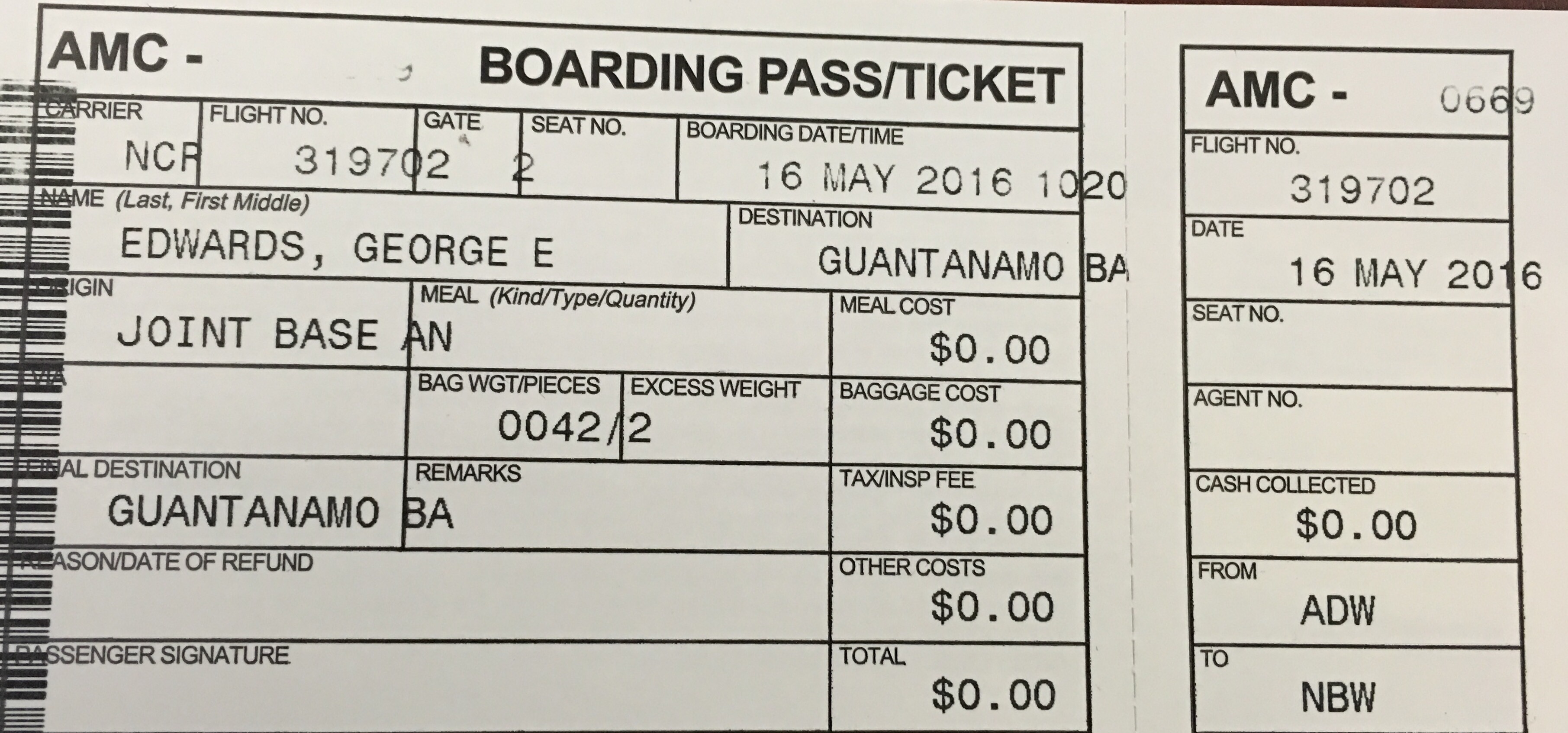
My GITMO Boarding Pass

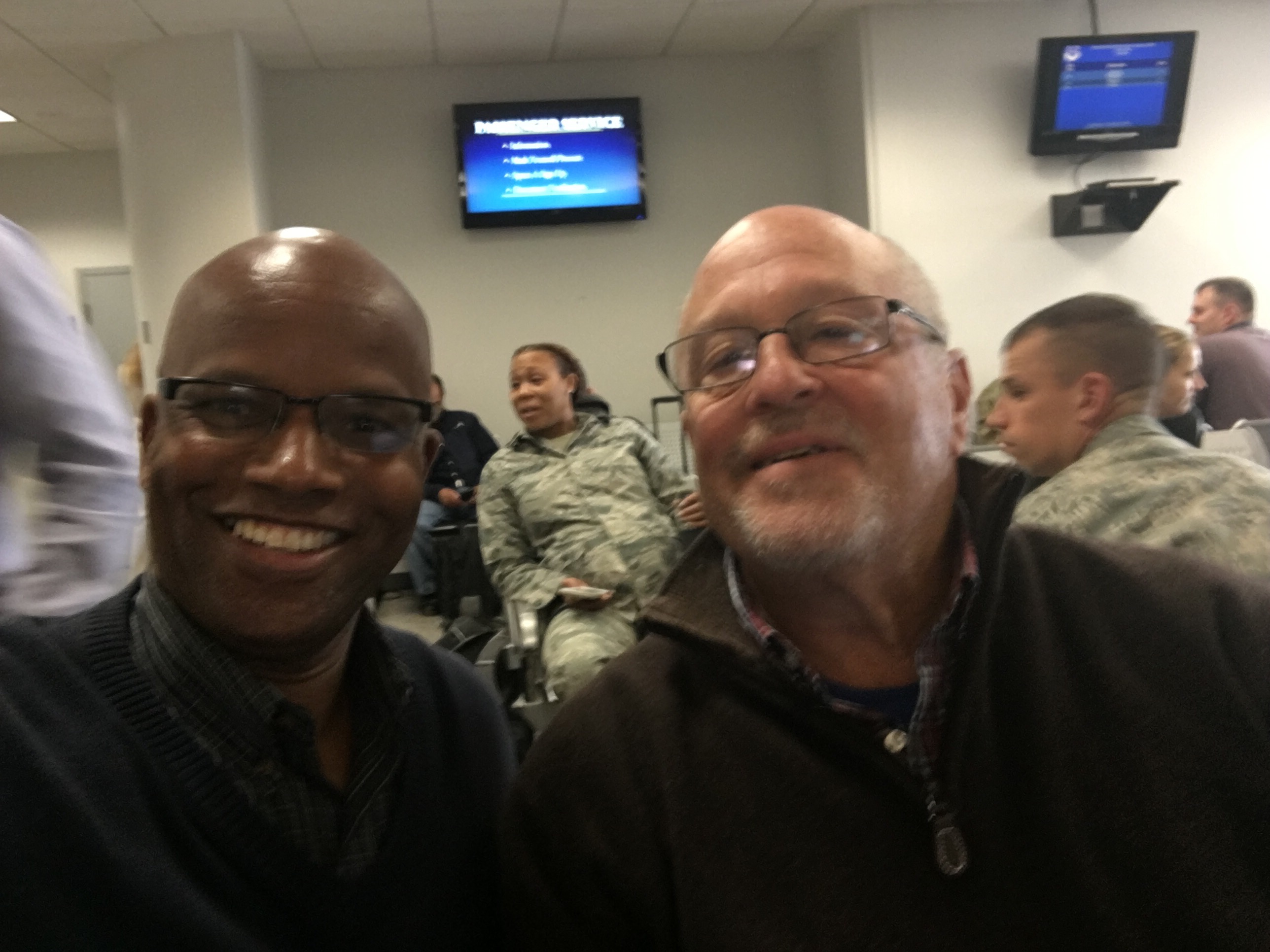
About to board the plane to Guantanamo. 

Rick Kammen–GITMO Lawyer

Guess who I bumped into boarding the plane to Guantanamo Bay with me today? Richard Kammen, of Indianapolis. He is Learned Counsel in one of the GITMO Military Commission cases.

Apparently he’s hitching a ride to Guantanamo to visit his client–al Nashiri — who allegedly masterminded the USS Cole attack in Yemen. He has no links with the Hadi case I’m monitoring this week. 
We thank Rick for coming to Indiana University McKinney School of Law to talk with us about his GITMO case.

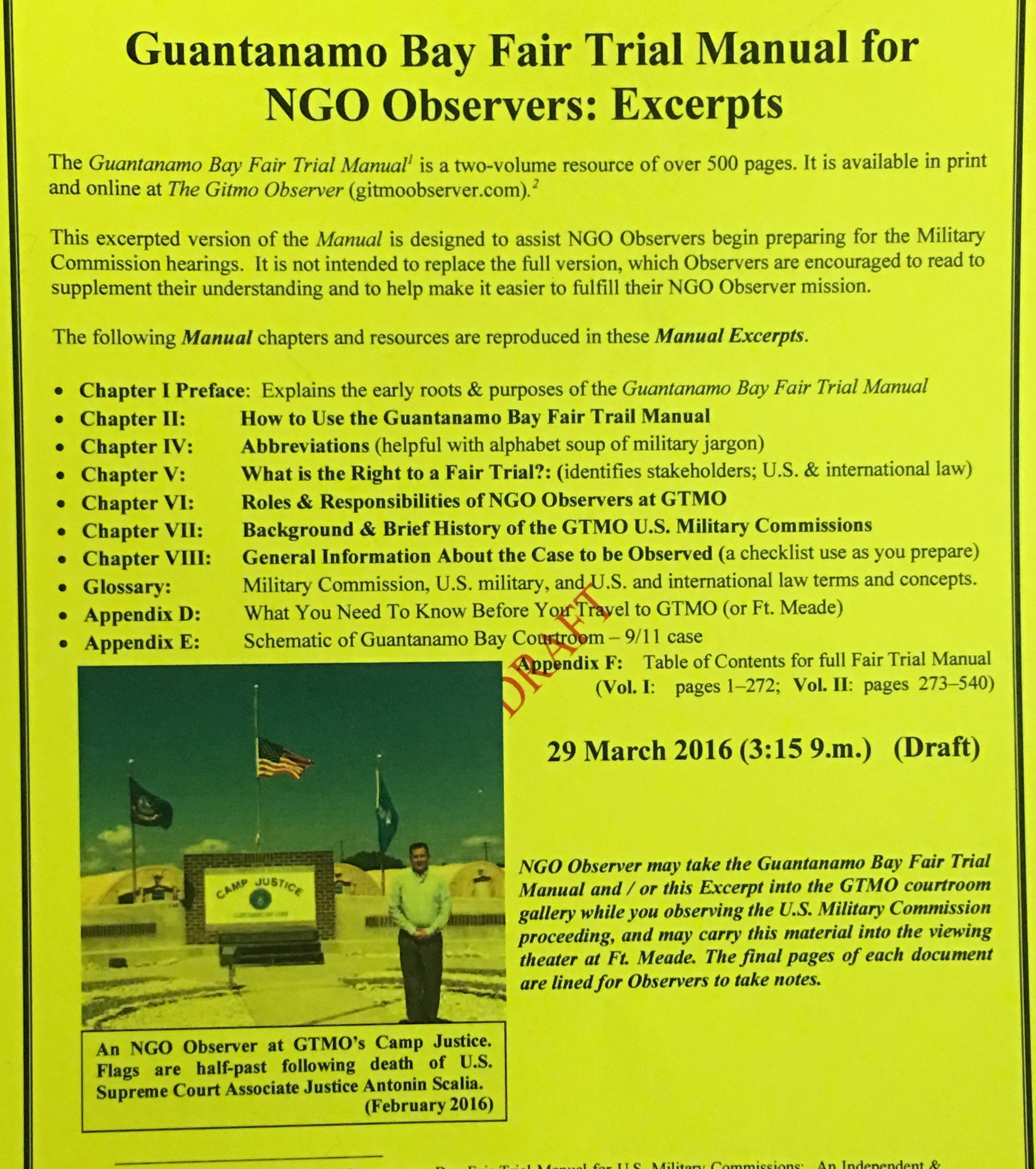
GITMO Fair Trial Manual

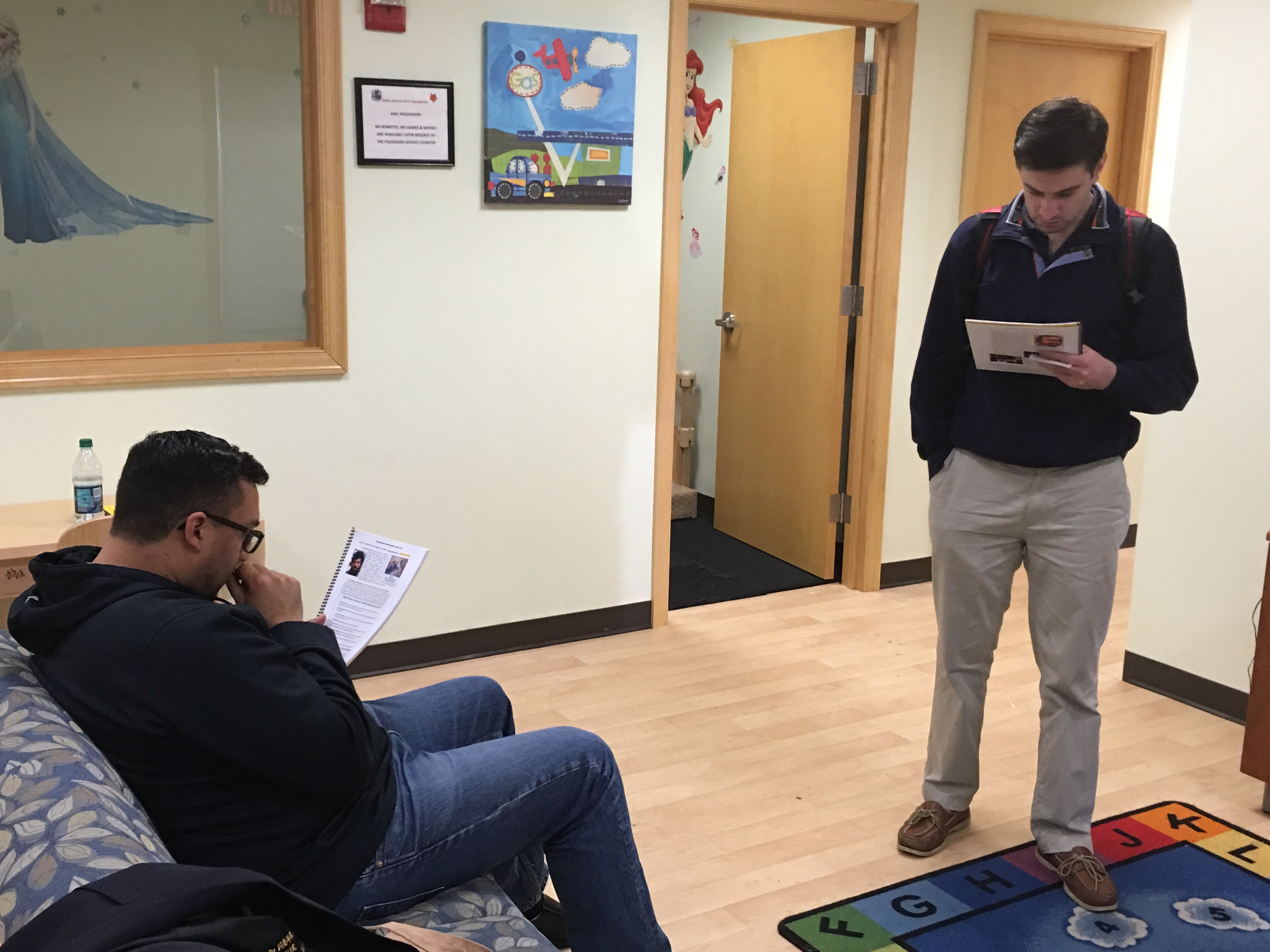
NGOs reading the Guantanamo Bay Fair Trial Manual we produced Indiana University McKinney School of Law as we wait for our GITMO flight.

We’re at Andrews Air Force Base.  

Andrews Air Force Base to Guantanamo Bay

I just arrived at Andrews Air Force Base, just outside of Washington, DC, for my military flight to Guantanamo Bay, Cuba. This time I’m traveling as a non-governmental organization (NGO) observer on proceedings in the U.S. Military Commission case. I’ve been to Guantanamo Bay (also known as Gitmo) as an expert witness, on a media / research trip for my upcoming book (The Guantanamo Bay Reader), and as an NGO Observer. The rules on the ground have been different each time, in part based on category of travel. But I’ve also learned that rules change even for people in the same category. It’s always interesting to compare notes with other repeat Guantanamo Bay visitors.
I’ve had a chance to meet some of the other 6 NGO representatives who will be with us on this trip. They come from Human Rights First, the American Bar Association, Judicial Watch, the Pacific Council on International Policy, and Georgetown and Seton Hall Law Schools. Several of the Observers have deep knowledge on Guantanamo Bay issues, which will make the trip all the more interesting for us.

I’ve also looking forward to caching up with our Military Commission NGO escort, who will be with us most waking moments between now and when we return to Andrews late Thursday afternoon. Fortunately, our escort this trip is one of the escorts from my first NGO trip, a couple of years ago. It should be a good trip.

Who is here? What are we doing?

There are dozens of non-NGO representatives set to board our flight to Guantanamo. They are / could be Hadi’s defense counsel, prosecutors, the judge and the court staff, victims or family members of victims, media, and others associated with the Military Commission generally or associated with the case against Hadi. Passengers could also include people who are permanently stationed at Gitmo, returning from temporary duty or returning from vacation. 

The Andrews air terminal is much like an air terminal in any small US city, with check in counters where you get your boarding pass, scales to weigh your check-in luggage, bus station like seating where you sit and way – and wait, x-ray machines to scan carry-ones and metal detectors to walk through, and vending machines with soft drinks and junk food. One difference is that the air ticket cost is zero for NGO Observers, who travel as part of the Pentagon’s stated desire to be transparent with the U.S. Military Commissions.

Traveling to Guantanamo Bay for Hadi War Crimes Hearings

AbdulHadiRFJ

Hadi al-Iraqi

I’m scheduled to fly to Guantanamo Bay, Cuba on Monday, 16 May 2016, as a non-governmental organization (NGO) observer of proceedings in the U.S. Military Commission case against detainee Hadi al Iraqi.

Hadi is a high-value detainee who is an alleged high-ranking member of al Qaeda who served as liaison between al Qaeda in Iraq and the Taliban. He is charged under the Military Commissions Act with a series of war crimes, including attacking protected property, perfidy / treachery, denying quarter, and targeting noncombatants such as medical workers and civilians. Among other things, he is alleged to have helped the Taliban blow up the monument-sized Bamiyan Valley Buddha Statues, which were a UNESCO World Heritage site.

Hadi was officially charged in the equivalent of an arraignment in a Guantanamo Bay courtroom in June 2014. I happened to be present in the Guantanamo courtroom for that proceeding.

Unlike most of the other detainees currently facing trial, Hadi is facing a maximum sentence of life imprisonment, rather than a death sentence faced by, for example, the five men charged with masterminding the 9/11 attacks on the World Trade Center and the Pentagon.

Delays

For the last 2 years, since formal charging, Hadi’s pre-trial hearings that have been plagued with disruptions related to, for example, conflict of interest issues, and his “releasing” his counsel.

Recently, Hadi’s defense counsel made a motion to continue (postpone) the 17 – 18 May hearings. The Military Commission website (mc.mil) indicates that the Military Judge has ruled on this motion to continue, but the contents of the ruling have not yet been posted because the ruling must be cleared before posting for public view. Apparently the Judge denied the motion, as all systems appear to be go for the proceedings this week.

Two Days of Hearings Scheduled for This Week

My flight to Guantanamo is set to leave from Andrews Air Force Base, just outside of Washington, DC. I’m due at Andrews at 6:00 a.m. on Monday the 16th, along with defense counsel, the prosecution, the judge and the court staff, the media, other NGOs, and others associated with the case against Hadi. We are all set to fly on the same plane.

We travel down on Monday, get situated, with court scheduled to begin Tuesday morning and run through Wednesday. Then, everyone who flew down to Guantanamo on Monday gets back on a plane to fly back to Andrews.

Unfortunately, details of the nature of the 2 days of hearings are not readily available to observers such as myself, since many of the motion papers are not released yet. At times it takes many days for unclassified motion papers to be made available for public view on the Military Commission website.

Papers that were recently filed that may perhaps be covered on Tuesday and Wednesday include a Trial Counsel Detailing Memorandum (filed 13 May 2016), a Supplemental Defense Notice to Commission IAW Order (filed 27 April 2016), and the Defense Notice of Excusal of Detailed Defense Counsel (filed 20 April 2016). All of these papers are listed on the website, but the contents of these papers have not been made available for public view.

Brigadier General Mark Martins, who is the U.S. Military Commission’s Chief Prosecutor, is typically great about briefing NGOs upon arrival at Guantanamo Bay. papers. That will be very helpful, particularly for Observers who are not familiar with intricacies of each Guantanamo Bay case.

More to come

Please stay tuned for more reports from Guantanamo Bay. Among other things, I plan to talk about the Guantanamo Bay Fair Trial Manual, produced by the Guantanamo Bay Military Commission Observation Project of the Indiana University McKinney School of Law, and share information about the 6 other NGO representatives scheduled to observe this week’s proceedings with me. I will also talk about my new book, The Guantanamo Bay Reader.

George Edwards (Washington, DC)

Correction, Clarification, Missing Transcript, and Expectations for Guantanamo’s 9/11 Case

camp justice

Camp Justice where we live in tents next to the Guantanamo Bay courtroom complex

This evening (23 February) I have for you a correction from my last post, a few notes about the hearing in the 9/11 case today, some thoughts regarding a missing transcript from today (perhaps temporarily), a clarification of a comment I made in my last post and a preview of what we have to look forward to tomorrow and the rest of the week.

A Correction

I mentioned in my last post that I believed that Mr. David Schulz’s oral argument on behalf of members of the press was the first time a third party movant (the Press in this case) had filed a motion and presented oral argument before the court. I was advised this evening that this was not the first time that Mr. Schulz has argued on behalf of he press. You can read about one of the previous times in 2012 when Mr. Schulz argued before the judge in the Nashiri case here.

A Missing Transcript?

Also of note is that, as of 11:30 pm on February 23rd, the daily unofficial/unauthenticated transcript from the hearings today have not been posted. This is interesting as the transcript is usually posted very soon after the hearings are completed for the day. The AE 400 motion filed by the press and argued on Monday was in response to a similar scenario on October 30, 2015,  where the government failed to immediately provide the unofficial/unauthenticated transcript and, when they did provide it, redacted a significant portion of the transcript from the hearing that, on the day of the hearing, had been heard by observers, members of the press, victims family members, others in the gallery at the court room and by those watching via the video feed at Ft. Meade. This very well may be a technical error of some kind, but if the transcript for the hearing today (February 23rd) is posted in a redacted form at a later date, I suspect the press would file another motion objecting to the redactions making the similar argument as they made for AE 400. The judge has not yet ruled on AE 400. You can read the arguments made in support of AE 400 made Monday morning by Mr. Schulz on behalf of the press (February 22nd) here

A Clarification and al Shibh’s Expected to Testify

Ramzibinalshibh

Ramzi Bin al Shibh, a 9/11 case defendant, is scheduled to testify about the his detention conditions at Guantanamo

My clarification from my last post is that, if Ramzi Bin al Shibh (al Shibh) testifies tomorrow (and i suggest that is still an if), it will be the first time a defendant has taken the stand to testify in this case. At the end of the hearing today the judge advised the court that al Shibh would not be shackled or physically restrained while testifying and his testimony would be limited to the issue of external sounds and vibrations while detained pertaining to AE 152LL only. The reason why I say if he testifies is because at the end of the hearing al Shibh’s attorney requested that he be able to testify from the chair where he normally sits, next to his counsel, during the proceedings. Judge Pohl denied the request and said he will be required to take the stand like any witness. If the request to speak at his usual seat in the courtroom is based on any hesitance by al Shibh to testify, then it is possible that he will have cold feet and will not take the stand.

You can read AE 152 here.

Here is the summary for AE 152LL from the public Motions Hearing Summary:

AE 152LL; Filed by the Defense
Title: Emergency Motion for Show Cause Why The Government, JTF Camp Commander and JTF Guard Force Members Should Not Be Held In Contempt

Brief Summary: Mr. Bin al Shibh continues to be subject to external sounds and vibrations while detained, despite order from the Military Judge prohibiting such actions by Joint Detention Group and Joint Task Force staff. As a result, Mr. Bin al Shibh requests the Military Judge order the relevant staff to show cause why they should not be held in contempt.

After Bin al Shibh’s Testimony Tomorrow (Wednesday, February 24th)

The remainder of the day tomorrow, February 24th, will likely be spent continuing the AE 018 series of motions which we started at the end of today with arguments on AE 018Y. The judge indicated that after Mr. Bin al Shibh’s testimony tomorrow, the court would continue with AE 018Y and then move to AE 018W.

Towards the end of the hearing today Chief Prosecutor General Martins,  Mr. Connell (attorney for Mr. Ali Abd Al-Aziz) and Mr. Nevin (attorney for Khalid Sheikh Mohammed) presented oral argument on AE 018Y,  Government Emergency Motion for Interim Order and Clarification that the Commission’s Order in AE018U Does Not Create a Means for Non-Privileged Communications to Circumvent the Joint Task Force Mail System. Here is the brief summary from the Motions Hearing Summary document we were provided:

The Government seeks an Emergency Motion for an Interim Order following accusations of unauthorized distribution of materials that did not receive sanctioned review by JTF-GTMO.

On AE 018Y today, the Government claimed the defense facilitated unauthorized distribution of materials that did not receive sanctioned review by prison officials (Joint Task Force – Guantanamo). The defense argued that the Government’s characterization is incorrect,  that the mail was reviewed and determined not classified prior to being sent, that they were not restricted from sending it.

Up third tomorrow will be AE 018W. Here’s the summary from the Motions Hearing Summary document we were provided:

AE 018W
Filed by: Defense
Brief Summary: Joint Defense Motion to Amend AE 18U, Privileged Written Communications Order
The Defense seeks an order from the Military Commission amending the Privileged Written Communications Order (AE018U), which governs how defense counsel and the accused can communicate in writing.

There are several other motions outstanding in the AE018 series (11 total in the Motions Hearing Summary document we were provided). Per Judge Pohl at the end of the day on Monday, next up in open session after the AE 018 series of motions is AE 391:

Here’s the summary from the Motions Hearing Summary document were provided

AE 391
Filed by: Government
Brief Sumary: Government Motion For the Admission of Death Certificates Into Evidence
The Government requests the admission in evidence now, in advance of the as yet unscheduled trial, of the death certificates of the victims listed in the charge sheet.

Thursday, February 25th, remains scheduled as a closed hearing, so if the court either doesn’t finish AE 018 and/or get to AE 391 tomorrow, I expect those motions will be addressed on Friday.

Options Other Than The Military Commission?

Finally, I have had a few people e-mail me asking what judicial forum might be preferable to the Military Commissions. I would preface my opinion with a caveat that the it is clear from watching the attorneys, judge and court staff operating in the Military Commission in this case are incredibly talented and dedicated professionals. I and my fellow observers have been nothing but impressed with their ability to excel in a very difficult situation.

I touched on some of the theories for what causes delays and challenges in the Military Commission hearings in a previous post. To answer the question, my personal opinion would be to move the hearings to a federal criminal court or a military court in the USA. Another alternative would be for the USA set up a military or special US District court down here. Capital cases take a long time in the USA as well, but trying this case in a judicial system with more established rules, legal precedents and procedures without the need to transplant all of the members of the court to Cuba for each hearing should be significantly faster and more efficient than trying the case in the Military Commission at Guantanamo Bay. This is also the suggestion that several of the attorneys practicing in the Military Commissions attorneys offered when asked a similar question.

I briefly summarized some of the sources of delays in one of my previous blog posts.

Personal notes

On a personal note, I enjoyed some tasty jerk jerk chicken from a little outdoor restaurant by the water. It was ~75 degrees this evening with a nice breeze. Before I returned to the NGO lounge to write this post, several of my fellow observers and I spent the rest of the evening enjoying the lovely weather at a picnic bench in front of our tents in Camp Justice.

By Matt Kubal, JD, Indiana University McKinney School of Law

Posted by G. Edwards on behalf of Mr. Kubal

Guantanamo Bay Hearings Day 1 — 9/11 Case

ksm - in court
9/11 lead defendant Khalid Shaik Mohammad, in the Guantanamo Bay courtroom. He was not present for the morning session, but was present for the afternoon session (Sketch by Janet Hamlin)

I rolled out of bed at 5:30 am this morning, and was driven from my Guantanamo Bay tent to breakfast at 6:30 am at the Gold Hill Galley. At 8:15 am, the other observers, our escort and I walked, as a group, the 100 yards or so over at from our camp to the courtroom to arrive at the first day of the hearings plenty of time prior to the scheduled 9am start time.  We made our way through security (similar to taking a flight, but with no electronics allowed) and into the viewing gallery in the courtroom.

We viewed the hearings live behind a sound-proof glass, but the audio is on a 40 second delay to allow the government to cut the audio if any confidential information is revealed. There are video screens hanging down from the ceiling that show a video feed that matches the 40 second audio delay. There is a red light in the courtroom next to the judge (similar to the light that illuminates when a goal is made) that lights up if confidential information is revealed. If that occurs, the hearing is stopped and the viewing gallery is cleared.  The 40 second delay can lead to somewhat  as, for example, we hear the all rise from a guard in the viewing room with us in real time when the judge rises to leave at the end of a session when the judge is leaving the room, but via the video and audio feed, we are still hearing the judge or counsel speak.hockey light picture-- GTMO

At one point Mr. Schulz, who was at the hearing to argue on behalf of the press movants regarding AE400 left the courtroom to return to join us in the gallery after addressing the court (he did not have a security clearance to stay in the court room), but, because of the delay, the judge was still addressing him via our feed (despite that being 40 seconds earlier). He heard this and started rushing back out of the gallery only to realize what had happened before he re-entered the courtroom. He smiled sheepishly and muttered that he thought the judge was addressing him as he made his way back to his seat.

A Brief Summary of Substance

Khalid Sheikh Mohammed (KSM) was not present at the morning hearing, but he did come in the afternoon. We were not told any particular reason why KSM was not present. Walid Muhammad Salih Bin Attash was not present either and stated that he would not come to the hearing because Ms. Bormann and Mr. Schwartz were still his attorneys.

I was able to witness what I believe is a first at the Military Commissions: a motion filed by a third party (the press) from outside the Military Commission system. On Wednesday, I will witness another rare event; one of the 9/11 defendants, Mr. Bin al Shibh, will testify regarding to external sounds and vibrations he claims has been subjected to despite an order from the Military Judge prohibiting such actions.

At this point it’s hard to imagine this case making it to trial anytime soon. The current schedule for the hearings are in two week blocks every two months and there are many issues to litigate.  The case is still in discovery and, for example, we spent about half the day today listening to the defense argue that the prosecution gave their clients broken laptops and this is an issue in which both parties are in relative agreement. Both parties agree that the defendants should have laptops to assist them in understanding and to expedite the case. The disagreement lied in whether or not certain restrictions such as disabling the CD/DVD drive placed on the laptop violate the Judge’s prior order to return the laptops to the defendants or whether Government can and/or should provide the laptops with restrictions decided on by the Joint Task Force. In addition, the Government’s AE 397 motion would delay production of discovery by the Government until October 2016. Once that discovery is received, the defense will need ample time to review it. That discovery will undoubtedly lead to more discovery and/or motions related to the new information obtained and the process continues. The closure of Guantanamo Bay’s detainee detention facility is not out of the question as just today the Pentagon committed that they would send Congress their plan to close the Guantanamo Bay Prison Facility.


Judge Pohl

Chief Judge Pohl originally presided over both the al Nashiri case and the 9/11 case.

The unofficial, unauthenticated transcript for the day is available on the military commmissions website, but, generally, the day was spent discussing:

– AE400 (the motion filed by members of the press moving to unseal a transcript of a

public hearing of the Military Commission which was held on the 30th of October, 2015),

– a request for reconsideration regarding bringing in an expert witness to testify on the issue of female guards touching the defendants in the normal course of their job in motion AE 254YYY,

– AE 254Y, a request for the judge to order that the defendants not be subjected to physical contact by female guards as such physical contact is a violation of their rights under the Religious Freedom Restoration Act.

and

– AE 182, a request for an order that the government comply with a previous order to return laptops to the defendant.  Defense alleges that the government failed to return the computers that the defendants previously had as they were returned with certain restrictions on their functionality that make them useless.

Plans for the Remainder of the Week

The judged ended the hearing laying out he plan for the week accordingly (summaries are taken from:

1. AE 112 defense motion for discovery & related AE 397 (also discussed last week) filed by the Government to consolidate several motions related to discovery of information related to the CIA’s Torture program. Approval of the consolidation would delay production of Government discovery to October 2016.

2. AE386 Defense Defense Motion to Invalidate Touhy Requirements as Non Reciprocal Discovery (to include filings in the AE 350 series of motions addressing Touhy) Mr. al Baluchi requests the Military Commission determine that Touhy regulation (which governs whether and how a government agency witness, from an agency that is not a party to the litigation, may be subpoenaed to testify) does not apply here since the regulation amounts to a requirement on the defense that does not apply to the Prosecution, and therefore violates the Due Process Clause and the Detainee Treatment Act.

3. AE018 Series: 11 motions on the docket under the AE018 umbrella:

AE018EE Defense Defense Motion to Compel Discovery Responsive to Mr. Mohammad’s Request for Discovery Dated 14 March 2014; The Defense requests the Military Commission compel the production of all documents contained in Mr. Mohammad’s Request for Discovery on 14 March 2014.

AE018FFF Defense Defense Motion to Compel Production of Witnesses for Evidentiary Hearing on Motions in the AE018PP Series; Mr. al Hawsawi requests the Military Commission require that the Government produce witnesses in the AE 018PP series of motions, which includes the relevant JTF personnel involved with the seizure of privileged legal materials.

AE018W Defense Joint Defense Motion to Amend AE 18U, Privileged Written Communications Order The Defense seeks an order from the Military Commission amending the Privileged Written Communications Order (AE018U), which governs how defense counsel and the accused can communicate in writing.

AE018EE Defense Defense Motion to Compel Discovery Responsive to Mr. Mohammad’s Request for Discovery Dated 14 March 2014 The Defense requests the Military Commission compel the production of all documents contained in Mr. Mohammad’s Request for Discovery on 14 March 2014.

AE018FFF Defense Defense Motion to Compel Production of Witnesses for Evidentiary Hearing on Motions in the AE018PP Series Mr. al Hawsawi requests the Military Commission require that the Government produce witnesses in the AE 018PP series of motions, which includes the relevant JTF personnel involved with the seizure of privileged legal materials.

AE018W Defense Joint Defense Motion to Amend AE 18U, Privileged Written Communications Order The Defense seeks an order from the Military Commission amending the Privileged Written Communications Order (AE018U), which governs how defense counsel and the accused can communicate in writing.

AE018Y Government Government Emergency Motion for Interim Order and Clarification that the Commission’s Order in AE018U Does Not Create a Means for Non-Privileged Communications to Circumvent the Joint Task Force Mail System The Government seeks an Emergency Motion for an Interim Order following accusations of unauthorized distribution of materials that did not receive sanctioned review by JTF-GTMO.
AE018BB Defense Defense Motion to Compel Paper Discovery in Accordance with Privileged Written Communications Order Mr. bin ‘Atash requests the Military Commission to order the Government to provide a copy of all paper discovery materials releasable to Mr. bin ‘Atash, and for the Privilege Team to deliver that to Mr. bin ‘Atash directly.
AE018KK Defense Defense Motion to Invalidate Non-Legal Mail Restrictions Unrelated to Legitimate Penological Interests The Defense requests that the Military Commission order JTF-GTMO to stop refusing to deliver written materials from counsel to Mr. bin ‘Atash on the ground that such non-legal materials are written in Arabic or are too voluminous. Refusing on that basis requires the defense to translate every page of Arabic material.

AE018MM Defense Defense Motion to Compel Reasonable Privilege Review Team Hours of Operation Mr. bin ‘Atash seeks an order from the Military Commission requiring the Privilege Review Team (which reviews legal and non-legal written materials sent to the accused from defense counsel) maintain reasonable weekend hours for the immediate processing of deliverable materials.

AE018PP Defense Defense Motion for Government to Show Cause For Its Violation of AE018U The Defense requests the Military Judge Order the Government to show cause for its violation of AE 018U and thoroughly review a new breach of attorney-client privilege by JTF-GTMO in February 2015.

4. AE 391: AE 391 Government Government Motion For the Admission of Death Certificates
Into Evidence The Government requests the admission in evidence now, in advance of the as yet unscheduled trial, of the death certificates of the victims listed in the charge sheet.

Also, for Wednesday morning: AE 152LL: Ramzi bin al Shibh can testify on noises/vibrations this Wednesday (AE 152LL)


matt kubal - iguana

I made a friend outside our tent after returning from the hearings. We’ve seen lots of iguanas around Guantanamo Bay.

A few hours ago we ate dinner as a group at an Irish Pub here on the base. I spent most of the evening writing reports on the happenings of the day.

By:  Matt Kubal (JD, Indiana University McKinney School of Law); Monitor, Military Commission Observation Project

Posted by G. Edwards

Zero Dark Thirty Reaches Guantanamo Bay

img_3440Any seasoned litigator knows that there is usually nothing exciting or sexy about arguing pre-trial discovery motions. These motions and the corresponding rulings are vitally important to trial strategy. For instance, a Court’s ruling on a Motion to Supress or Motion for a Protective Order can determine if a key piece of evidence is “in or out” at trial. On rare occasions, these motions can provide drama, tension and excitement. Thursday’s afternoon Guantanamo Bay  session was one of those rare occasions.

Today was a full day in the war court pre-trial hearings in the military commission case against the five alleged masterminds of the 9/11 attacks on the Workd Trade Center and the Pentagon.

Today’s hearings were by far much more intriguing than the previous days of hearings I monitored earlier this week in Cuba. The afternoon session was captivating, as we heard argument on the so called “Zero Dark Thirty” motion, motion AE 195. I will begin with some personal observations then cover the morning and afternoon sessions.

Personal Observations
We entered the courtroom at 8:30. The accused were just finishing up their prayers.

Ramzi bin al Shibh (“RBA”) and Ali Aziz Ali (a/k/a al Baluchi) (“Al Baluchi”) talk frequently during the proceedings. On a few occasions, RBA turned his chair almost all the way around to converse with Al Baluchi.

Al Baluchi places his prayer rug over the back of his chair prior to being seated.

Interesting side note, Walid bin Attash, who was not present for the morning or evening sessions, is missing his right leg. He lost his right leg in 1997, in Afghanistan, while allegedly fighting with the Taliban against the Northern Alliance. He wore a prosthesis in court on Tuesday.

Mustafa Al Hawsawi spent much of the morning session reading a document in what appeared to be Arabic.

The Accused

Kalid Sheikh Mohammad: wore a white headwrap and adorned the same, or a similar, ornate scarf he wore yesterday, with what appeared to be the gold dome of the Al Aqsa temple and the word “Palestine” emblazoned in English.

Walid bin Attash: was not present for the morning or afternoon session.

Ramzi bin al Shibh: wore a brown head wrap and an Al Aqsa scarf.

Ali Aziz Ali (a/k/s Al Baluchi): donned a white cap and an Al Aqsa scarf.

Mustafa Hawsawi: wore a white headwrap and an Al Aqsa scarf.
Morning Session:

The morning session began at 9:03 am and continued the motion 396 hearing by asking questions of Ali Aziz Ali (“Al Baluchi”) counsel James Connell, on which entity should review classified privileged documents. Connell responded that when defense counsel has these documents they submit them to the agencies with interests in the document for review. The agency should review the document, highlight the classified portion, so that it may be redacted and return it to the defense team.

DOJ attorney Clayton Trivett provided the prosecution’s response. Trivett argued that the document must be treated at the highest classification level listed on the document. Judge Pohl questioned Trivett about overclassification and whether it was the government’s duty to properly classify documents. Trivett asserted that if the defense felt a document was may request a classification review.
Trivett also asserted that the government may be able to further support its response at Friday’s closed session, which has been set aside to discuss classified documents.
The Judge then heard arguments on the prosecution’s Motion to Consolidate, AE 397. Essentially, the prosecution has moved to consolidate 14 separate defense discovery motions which request classified documents. 

General Martins 

General Mark Martins presented the government’s case. General Martins is a tall (roughly 6’5″) man with a large presence and a deliberate speaking style. Simply put, he sounds like a prosecutor. General Martins outlined the prosecution’s plan to provide discovery to the defense teams. General Martins proposed that the prosecution would provide classified documents in accordance with the 10 point construct used in a discovery order in a different Commission case. The prosecution will adhere to the federal standards in the Brady and Yunis cases. In short, the prosecution would provide documents 1) material to the defense, 2) relevant, non-cumulative & helpful, 3) material and exculpatory, and 4) documents used by the prosecution.
Martins planned on providing the following information for each of the accused regarding the CIA’s Rendition, Detention and Interrogation (“RDI”) commonly referred to as the “torture” program:

A. Timeline of sites held;

B. Description of transport(s);

C. Photos showing conditions of confinement;

D. Medical, guard force and interrogator information;

E. Standard Operating Procedures (“SOPs”) for handling High Value Detainees (“HVDs”);

F. Employment and training records for guards and staff;

G. All statements obtained from interrogations;

H. Legal reviews and requests to use enhanced interrogation techniques (“EIT”);

I. Copies of documents memorializing EIT requests.

The prosecution set time lines for providing the documents. Further, the prosecution sought to be able to provide summaries of documents, if possible. In such an instance, the original documents would be provided to the Judge to review along with the proposed summary. If the Judge deemed the summary suitable, the summary would replace the classified document. General Martins also emphasized that the prosecution is still reviewing and identifying documents to turn over in discovery. 

Defense Responds

Al Baluchi’s counsel, Mr. Connell responded first. Connell asserted that the defense is disadvantaged here more so than in a normal trial since the government decides what it produces, and whether that document is material to the defense. Connell and other defense counsel argued that the prosecution should submit cumulative evidence to the judge to determine if that evidence is relevant. On an aside, the defense provided its theories of defense to the Judge in a sealed motion previously in the litigation. The prosecution is not privy to those theories of defense. Thus, the defense contends that the Judge is in a better position to determine what is cumulative or material to a defense than the prosecution is.
The Judge agreed to hear further arguments on the consolidation motion after lunch.

Afternoon Session:

img_3439The session began at 1:30. After hearing some additional oral arguments from the defense regarding the proposed discovery plan, the Judge turned his attention to a motion included in the consolidation plan, Motion AE 195. Motion AE 195 is officially titled the “Motion to Compel Communication Between the Government and the Zero Dark Thirty Filmmakers”. This motion has been nicknamed the “Zero Dark Thirty” motion and the information and arguments we heard regarding the motion are unclassified.
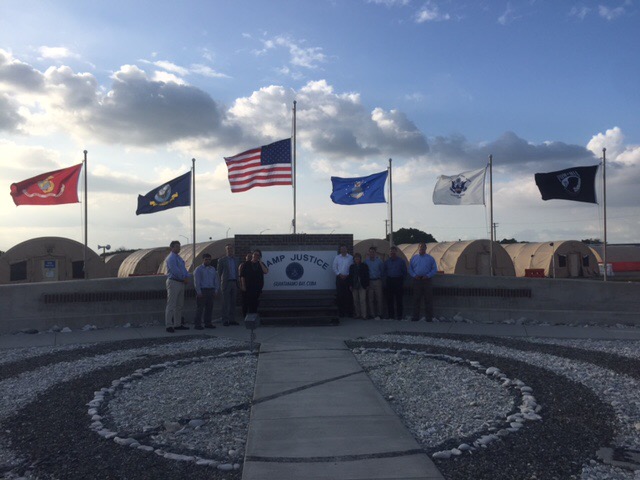
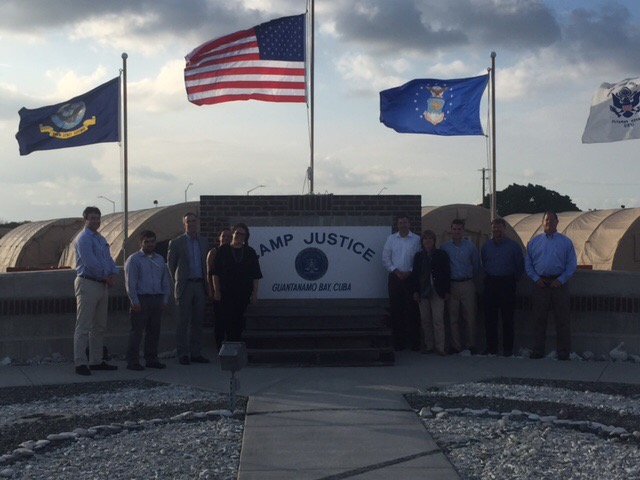
Al Baluchi’s counsel, James Connell argued the motion. Connell asserted that the CIA provided access to at least 2 CIA agents, one male, one female, to the writer, Mark Boals and director, Kathryn Bigelow, of the movie Zero Dark Thirty. Access to these agents was granted, despite the fact that the writer and director did not posess security clearances. In fact, at an awards ceremony, the filmakers thanked the CIA Connell argued that the first twenty five minutes or so of the movie show a character based on the events that occurred to Al Baluchi. Connell played clips from the movie showing a character named “Ammar” being placed in a box, strung up by his arms, forced to stand on a small mat for hours at a time and doused with ice water in a mock waterboarding. The courtroom was captivated by the scenes played on the screen. The 4 accused in the courtroom looked away from the screen. Al Baluchi, in particular, stared at a blank courtroom laptop and did not watch the movie scenes.

Department of Justice Attorney Jeffrey Groharing objected that this “was a film, not real life” during the playing of one of the clips, but was overruled. Groharing admitted, when asked by Judge Pohl, that neither the writer nor director had appropriate security clearances.

Many of these details remained classified and, Connell contended, could only have been provided to the filmmakers by the CIA. The movie was released in 2012 and shortly thereafter Justice Watch filed freedom of information act requests for documents linking the CIA and the film. From those information requests, the defense team learned of the existence of several key communications.

First, approximately 150 redacted emails were sent to / from the CIA and the filmmakers. Second, two Inspector General reports were released on the matter. One of these reports included the CIA agents statements to filmmakers. Third, an un-redacted CIA memo described a meeting between the CIA and filmmakers. Connell argued that filmmakers were granted access to these documents and, to date, had not received responsive documents to Motion 195.

It was a gripping and intense day in the courtroom today. While the movie clips were from a fictional Hollywood drama, knowing that one of the principals on whom the events were based made the torture scenes seem much more powerful.

NGO Photos

After the hearings, the NGO Observers took a few group photos. We headed to dinner and reflected on the events that transpired in the courtroom.

By Paul Schilling, JD, Indiana University McKinney School of Law; Indiana Deputy Attorney General