Guantanamo Bay

Are you going to Guantanamo? New Manual Excerpts for NGO Observers & Others

asdf

Click this link for the full Manual — over 500 pages. Below you can download the Manual Excerpts!

If you’re going to Guantanamo Bay in January 2017, you might be interested in our new Guantanamo Bay Fair Trial Manual: Excerpts that offers insights into:

  • what the right to a fair trial is and how a fair trial should look
  • how to assess whether a fair trial is being afforded to all Guantanamo stakeholders
  • roles & responsibilities of independent Observers sent to monitor Guantanamo hearings
  • background info on Guantanamo the military commissions
  • a schematic of the courtroom (so you can know who is who)
  • and a 76 page “Know Before You Go To Guantanamo” insert that will tell you what to expect on your flight to Cuba, the ferry ride across Guantanamo Bay from the landing strip to your Quonset Hut accommodations, base security, food (which can be quite good!), beach, boating, and of course the courtroom, the hearings, and briefings by the prosecution and defense.

In the past, the Gitmo Observer (of Indiana University McKinney School of Law) distributed Manual Excerpts to Observers after we arrived at Andrews Air Force on the morning of our flight to Cuba (or distributed at Ft. Meade, Maryland, for Observers monitoring live by secure video-link from Cuba). Observers said they wish they had had it earlier.

So, we started to e-mail the Manual Excerpts to Observers as soon as we were sent e-mail addresses of Observers scheduled to travel, and we would receive those e-mails 3 – 6 days before the scheduled departure. Observers said that they wish they had it even earlier than that, that 3 – 6 days in advance wasn’t enough time.

So now we are posting the Manual Excerpts on this site, for access by anyone interested, whether or note traveling to Guantanamo Bay (or Ft. Meade or elsewhere), but especially for those traveling to Guantanamo Bay to monitor 3 weeks of January 2017 hearings. Ideally, about 40 independent observers would travel to Gitmo this month, to fill all the slots allocated to observers.

The Defense Department has stated that it favors strong and robust transparency. Having full complements of Observers for each hearing week would help promote transparency, human rights, and the rule of law for all military commission stakeholders (with stakeholders including the defense, the prosecution, victims and their families, witnesses, the media, observers, observer escorts / minders, the public, the U.S. soldiers and others who operate the detention facilities, the military commission court staff, and others).

Here are the Excerpts! Please let us know if you have any suggestions for improving our Excerpts, our full Guantanamo Bay Fair Trial Manual (over 500 pages in 2 volumes!) and our Know Before You Go To Guantanamo Guide (76 pages). Send to GitmoObserver@yahoo.com

[office src=”https://onedrive.live.com/embed?cid=AA02978A4AC8C787&resid=AA02978A4AC8C787%21170&authkey=AHjg1WC29jVzNPY&em=2″ width=”876″ height=”688″]

Arrival at Guantanamo Bay to Monitor the 9/11 Pre-trial Hearings

I have been nominated and confirmed to monitor the 9/11 pre-trial hearings against the five alleged masterminds of the 9/11 attack on the World Trade Center and the Pentagon. The hearings are scheduled to take place at the Guantanamo Naval Station, at Guantanamo Bay, Cuba from December 5-9. I am participating as an affiliate of the Indiana University McKinney School of Law Program in International Human Rights Law (PIHRL), which is a non-governmental organization (NGO). You can see my previous blog posts regarding this mission here and here.

Arriving at Guantanamo Bay

I left Joint Base Andrews (JBA) at 8:00a on Saturday, December 3rd, my pre-departure blog post can be seen here. I flew over on a Boeing 767-200ER operated by Omni Air International. As an NGO observer, there was no cost to me for the flight. The flight was about half full and had approximately 110 passengers. I previously heard that the plane is usually divided into sections for different stakeholders. However, there was never any mention of sitting in a specific area and it appeared that everyone sat wherever they wanted to. It may have been different because the flight was so empty.

After arriving on base at about noon, the NGOs gathered in a group with our escort. There are eight NGO observers in my group, including myself. Our mission is to be the eyes and ears for the outside world. We are responsible for attending, observing, analyzing, critiquing, and reporting our experiences at the pre-trial hearings and Guantanamo Bay in general. We have an escort that helps us move around the base. Our escort also facilitates various needs that we have throughout our time at GTMO. The escort also ensures that we get to court and other places on time. This was our escort’s first time working as an NGO escort, although the escort has been to Guantanamo Bay multiple times.

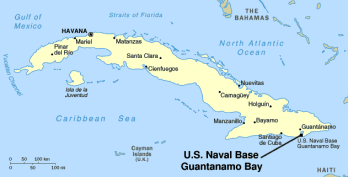
After departing the plane, the NGOs went into a building where military personnel checked our passports and paperwork. The military personnel inspected our paperwork then sent us to a lobby in the building. Our escort made a phone call to see if we had a vehicle coming to pick us up. After about fifteen minutes, two vans arrived to take us and our luggage to Camp Justice. The main portion of the Naval Base is across Guantanamo Bay from the airport where the plane arrived. I, along with the other seven NGOs, were taken across Guantanamo Bay via ferry. It took about 20 minutes to get across Guantanamo Bay.

Arriving at Camp Justicedsc_0068After exiting the ferry, we were then driven to Camp Justice and had an opportunity to unpack and settle in. The accommodations have been surprisingly comfortable. We have had access to free internet (via Ethernet cord) in the MWR (morale, welfare, and recreation) tent, which is only 50 feet from the housing tents.

After we settled into camp, we were taken to have our badges made. We also received a short briefing from the head of security. A lot of the discussion focused on where we were allowed to take pictures. Within the Expeditionary Legal Center (ELC), we were informed that we could only take pictures in three areas. The head of security provided us a map that showed the areas that we could take pictures. I folded the map and took it with me when we were finished with the security briefing. After I walked outside the head of security came out and told me that he needed the map back. Without the map it was unclear where pictures were allowed to be taken in the ELC. The general rule at GTMO is to not take any pictures of structures that are inside a fence. Some areas also have signs that say “no photography.”dsc_0112

Around the island

Since we arrived on Saturday, and hearings do not start until Monday, we had the weekend to explore the base with our escort. On Saturday, we had a meeting lined up with the defense team for al Baluchi. The meeting was a great opportunity to speak with the defense team in an informal setting. They were very candid in their responses, and they answered all of the questions asked. It was nice to get their perspective, but I will reserve any judgment until I have had an opportunity to listen to the prosecution and see the hearings this week.

On Sunday, we went on a driving tour of the base. We started by drivindsc_0036g to Camp X-Ray. I had requested a foot tour of Camp X-Ray but our escort said that it takes at least a month to get approval to do a foot tour. We stopped on the road and were able to look at the camp. It was probably 150 yards from the road and was very overgrown with weeds and trees. We were not allowed to take photographs of Camp X-Ray. We were then taken to Windmill Hill, which provided excellent views of the island. We could also see the detention facilities from there. There were no pictures allowed there either. Next, we drove by Radio GTMO, which was closed. We then drove to Cable beach. Finally, we made our way back to Camp Justice.

A portion of our group then decided to go to the beach. We were informed that Girl Scout Beach would be the best beach for swimming. Hurricane

dsc_0009

Justin at Girl Scout Beach

Matthew caused some damage to the stairs that lead down to the beach, but it had been repaired recently. The beach was nice but sandals or beach shoes would have been helpful because it is very rocky. The water temperature was great and the water was very clear.img_4973


Part of the group finished the day at O’Kelly’s Irish Pub and the other half of our group watched Hacksaw Ridge at the Lyceum outdoor movie theater. I was happy to see that the base had many of the same amenities as home, although, it often creates a strange dichotomy. One minute you are driving by a football field and McDonalds, then the next minute you are driving by buildings and tents surrounds by fencing and razor wire.

The base also had a lot of holiday activities and decorations. There was a Christmas parade on Sunday, with decorated floats. The NEX (similar to a supermarket) had a bunch of decorated Christmas trees outside. Near the marina, there was a very large decorated tree and a bunch of outdoor Christmas decorations. When we are traveling through the base, it very much felt like any other town.

20161204_180951

Justin and two other NGOs.

I look forward to posting about the upcoming pre-trial hearings.

DSC_0035.JPG

dsc_0006

Justin at Girl Scout Beach


dsc_0034

Iguana at Girl Scout Beach

dsc_0003

Justin’s room at Camp Justice

dsc_0024

Girl Scout Beach

dsc_0021

Girl Scout Beach

dsc_0022

Girl Scout Beach

dsc_0011

Justin W. Jones (J.D. Candidate, ’18)
NGO Monitor, U.S. Military Commission Observation Project (MCOP)
Program in International Human Rights Law
Indiana University McKinney School of Law

Awaiting Departure to Guantanamo Bay, Cuba

I am now at Joint Base Andrews Naval Air Facility Washington, known as JBA – Joint Base

dsc_0002

Reading the Guantanamo Bay Fair Trial Manual the night before departure.

Andrews – awaiting my departure at 08:00. I was picked up, along with three other NGO Observers, at 04:00, at a hotel just outside of JBA. The check-in process was quick and very similar to checking into a civilian airport.

gitmo1

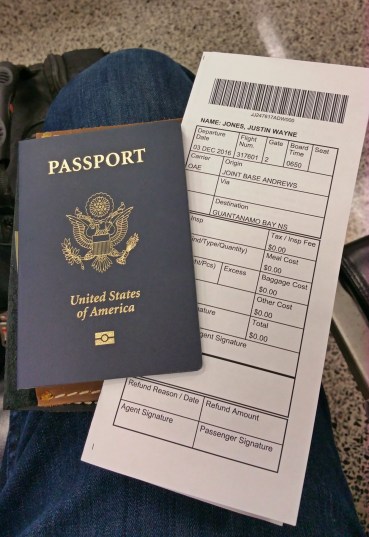
Boarding ticket

We are fly to Guantanamo Bay to monitor hearings in the case against Khalid Shaik Mohammad and four other alleged masterminds of the September 11 attack on the World Trade Center and the Pentagon. The flight is scheduled to depart at 08:00. The original departure time was 10:00. I heard that the flight was moved up two hours because the pilot would have been over hours for the day if the flight departed at 10:00.

The hearings are scheduled to run from December 5 – 9. I will be returning to JBA on December 1o.

I have met the other NGO’s Observers and distributed excerpts from the Guantanamo Bay Fair Trial Manual.

I will be departing soon, and my next post will be from Cuba.

Justin W. Jones (J.D. Candidate, ’18)
NGO Monitor, U.S. Military Commission Observation Project (MCOP)
Program in International Human Rights Law
Indiana University McKinney School of Law

Preparing to travel to Guantanamo Bay to monitor 9/11 hearings

I was selected to travel to Guantanamo Bay, Cuba to monitor the U.S. Military Commission in the case against the alleged masterminds of 9/11. I was approached just over a week ago by Professor Edwards when he was inquiring into my availability to travel to Guantanamo Bay either the first or second week of December. He informed me that there was no guarantee of nomination or acceptance, but I was very excited to even have the possibility of traveling to Guantanamo Bay to monitor the 9/11 hearings. I quickly responded that I was available to monitor the hearing during the first week of December. Less than 24 hours later I was on a video conference with Professor Edwards regarding my interest in traveling to Guantanamo Bay to monitor the 9/11 pre-trial hearing. I was nominated by the Program a few hours later and my information was sent to the Pentagon for selection approval. To my surprise, less than three hours after being nominated by the Program, I received the following email from the Office of Military Commissions (OMC) – Convening Authority:

Good afternoon Justin,

You have been CONFIRMED to observe the December 5-9 9/11 military commission in-person at Guantanamo Bay, Cuba. We are scheduled to depart Andrews Air Force Base at 1000 on Saturday, December 3, 2016, and will return on Saturday, December 10, 2016, around 1330.

I was very excited to have received the confirmation, and I was incredibly surprised that it occurred so quickly. I was concerned that the process might be slowed down by the upcoming holiday, so I was very happy to have received the confirmation the same day.

The Logistics

On the evening of December 2nd, I will be arriving at Ronald Reagan Washington National Airport, Arlington, VA. That night I will be staying at a hotel at Joint Base Andrews in Maryland. Joint Base Andrews was formed when Andrews Air Force base and Naval Air Facility Washington merged in 2009. I am scheduled to deparusbaset Joint Base Andrews at 10:00 a.m. on Saturday, December 3rd. I plan to arrive at Guantanamo Bay from December 3rd until December 10th. Travel plans have frequently changed during other NGOs’ missions, so I am trying to book refundable tickets in case anything changes in the next week. I currently do not have any information on the type of plane or the estimated time of arrival in Guantanamo Bay.

Paperwork

In the email that I received from the OMC – Convening Authority, I was informed that I would need to complete and return four documents: (1) a hold harmless agreement, (2) an invitational travel worksheet, (3) a Department of Navy base access pass registration, and (4) the NGO ground rules. Aline Fagundes was kind enough to provide me with copies of

photo-oct-13-4-04-43-pm

Aline at Guantanamo Bay

her paperwork so that I could use them as a guide to properly fill out my forms. The forms are generally self-explanatory; however, there are some parts of the forms that would be difficult to accurately fill out without having a sample. I am currently working on creating a pdf with sample forms and instructions for completing the four documents required by the OMC.

I did run into an issue with sending the documents back to the OMC. I sent the four documents as .pdf attachments. Three of them went through fine, but the OMC told me that one of the documents was too dark. I opened the document up and it looked great on my end. I resent the document but again the OMC stated that the document was too dark. I rescanned the document into individual pictures (not .pdf). Then I sent the document in two individual attachments, with one page in each attachment. This time the OMC was able to clearly read the document. I used the same scanner both times and both times the document was clear and legible on my end.

NOTE: If the OMC is having issues reading your document, try to send the document in .jpeg format instead of .pdf.

Preparing for the Hearing

                I still have a lot of work to do in the next week. First, I will

manual

Guantanamo Bay Fair Trial Manual

continue to review the Guantanamo Bay Fair Trial Manual. I will also be checking mc.mil to review the pleadings and filing that are currently available. Hopefully, by early next week, mc.mil will have more up-to-date postings. I will also be speaking with Aline because she was the last IU Affiliate to attend a 9/11 hearing. I was at Ft. Meade in October to observe the al Nashiri pre-trial hearing, see the blog post here, but I am not up-to-date on the 9/11 hearings yet.


20161019_130554

Justin at Ft. Meade

Conclusion

I am honored to have been selected to travel to Guantanamo Bay to monitor the 9/11 hearing. I look forward to documenting my experience and providing my analysis of the proceedings.

Justin W. Jones, J.D. Candidate (2018)
NGO Monitor, U.S. Military Commission Observation Project (MCOP)
Program in International Human Rights Law
Indiana University Robert H. McKinney School of Law

My Week in Guantanamo Bay, Cuba


For a week in October 2016, I had the most extraordinary experience of my academic life, certainly one of the most extraordinary experiences of my whole life. I traveled to the Guantanamo Naval Station, at Guantanamo Bay, Cuba, to monitor the U.S. Military Commission case against five alleged masterminds of the 9-11 attack on the World Trade Center and the Pentagon. I was nominated to represent the Military Commission Observation Project of the Indiana University McKinney School of Law. Our Indiana program, sponsored by the McKinney Program in International Human Rights Law, is a non-governmental organization (NGO) that is permitted to send law students, faculty, staff and graduates to Guantanamo to monitor hearings.

photo-oct-10-12-49-35-pm


Flying to the island

Our flight from Andrews Joint Base, near Washington DC, to Guantanamo Bay, Cuba, was originally scheduled to depart on Saturday, October 8. For reasons that are not very clear to me (click here for more details), a large plane flew for Guantanamo Bay but left at least two groups of people behind – member of the media and 13 NGO representatives, including me. The NGOs flight was postponed until Monday, October 10. That meant that we had to spend two nights in hotels near Andrews, at our own expense.

The original Saturday flight was supposed to be operated as a charter by a regular commercial airline (like United, or American Airlines). Usually, the regular flights carry virtually all Guantanamo Bay participants, including the defense counsel, the prosecution, the judge and the judge’s staff, the media, victims and victims’ family members, interpreters and translators, IT personnel, and other personnel. Everybody travels together on the same plane, arrives at Guantanamo Bay at the same time, and have an equal amount of time on the ground at Guantanamo Bay to prepare for the hearings.

The Pentagon hired a  Jetstream 31, 15 seat private jet to transport the NGOs on Monday morning. The trip from Andrews to Guantanamo on Saturday’s commercial flight took around 3 hours. Our trip on Monday on the Jetstream took over 9 hours, including one layover in Georgetown, SC and one in Opa-Locka, FL. The last leg on the Jetstream, which had no toilet on board, lasted 3 hours. Tough.

We arrived at Guantanamo (“on island”, as they call it) around 8 pm on Monday, and had to hurry to catch the ferry from the landing strip to the main part of the Guantanamo base, otherwise we would need to wait another full hour – until 9 pm – for the next ferry.

We finally made it to Camp Justice, our “tent city” where we would live for the next week. We NGOs left all our stuff in the tents we were housed and went directly to the security area where they made our security badges. After that, it was so late that the only place open for food on island was the Guantanamo Bay MacDonald’s. The tiredness and hunger prevented any complaints. After we ate, the military escorts took us to our tents.  I knew we would be housed in tents, but I confess I underestimated what this entailed. The tent and other facilities were extremely simple.

photo-oct-10-9-55-39-pm IMG_9317.JPG

The tents were simple and, to keep iguanas and banana rats away,  extremely cold.


The first full day

Those who wanted to have breakfast at the Galley, which is the cafeteria where soldiers on base eat, should be ready standing outside the tents at 6:15 am. Worth it. Excellent breakfast for $ 3.45.

The hearings were scheduled to start at 9 am.  So, after breakfast, our Pentagon escorts met the NGOs at 8:00. Even though the walk to the courtroom takes only about 5 minutes, we had to go early so we could go through several security checks, much more extensive than security at any U.S. airport.

After we entered the courtroom, I went to my assigned seat in the Courtroom Viewing Gallery, which is in the back of the courtroom. Between the gallery and the actual courtroom there is a double-pained bullet proof glass. The NGOs, media, victims and victim’s family members watch it from the gallery, where the sound from the courtroom is transmitted with 40 seconds delay, in case any classified information is mentioned. My seat was directly behind the five alleged masterminds of the 9-11 attack. Unbelievable. We were seated only a few feet behind 5 men who allegedly perpetrated one of the greatest crimes in history – the bombing of the World Trade Center and the Pentagon.

The hearings

The hearing lasts from Tuesday to Friday, though some of the hearings contained classified information and those portions were closed to NGOs, media, and victims and their families. Memories of this week in courtroom include arguments about torture, debates about a joint defense agreement (the 5 defense teams agreeing on some points), documents seized by jailers, depositions by closed-circuit transmission, one accused acting in his own defense, the defendants’ prayer ritual in the courtroom, extraordinary arguments on novel topics, and even a few jokes between the judge and the counsels. The hearings are still in the pre-trial phase, though the World Trade Center attack happened over 15 years ago (11 September 2001), and these 5 defendants were arraigned 5 years ago (2011).

To be able to write faster I made all my annotations in Portuguese, my first language. I brought around thirty pages of written records, which I am willing to organize and publish. Thanks to the Indiana University McKinney School of Law’s Guantanamo Bay Fair Trial Manual I was able to follow more appropriately all the procedures.

At the end of the hearings on the first day of the week, the family members of victim’s, who were seated on the right side of the gallery, walked to the left side and stopped right behind the defendants, just in front of my seat. A family member held the picture of her youngest sister against the glass, pointing in the direction of the defendants, who would walk towards us as they were escorted out of the courtroom. This was a very sad and tense moment.

photo-oct-13-4-04-43-pm       Imagem1.png


Conclusion

I left the Guantanamo Bay feeling conflicted. That beautiful place facing the Caribbean blue sea carries sadness and shame. Much needs to be done to reach justice, fair trial, and transparency. My mission is not done. I realized it has just begun. I consider myself a fortunate person to be afforded an opportunity to be the eyes and the ears of the outside world in Guantanamo Bay. Keep tuned! I will publish more!

Our 2-day delayed flight to Guantanamo Bay’s War Crime Court

A few weeks ago I was confirmed as an NGO Observer to monitor the hearings in the 9/11 case at Guantanamo Bay (click here to see my previous posts). It was finally the day to fly from Indianapolis, where I currently live, to Washington DC, where I would catch a military flight at Andrews Air Force Base to take me to Guantanamo Bay. The flight from Andrews to Guantanamo Bay was scheduled for Saturday, October 8, morning, and I was supposed to be at Andrews at 5:30 am.

I was at Atlanta Airport, half way to DC, when I opened my emails and received this message, sent Friday, October 7, at 4:42 pm:

“There has been a change in the flight schedule and you will all now be flying down on island on Monday at 1000. Unfortunately, the number of passengers for tomorrow’s flight exceeded the number of seats available on the aircraft (primarily due to additional personnel that needed to fly down to assess the infrastructure post-storm).”

I was already on my way, so I had to book two extra nights at the DC hotel, and spend the whole weekend in DC.

On Saturday, October 8, Carol Rosenberg (link), a Miami Herald correspondent and one of the passengers of our original Saturday morning flight – that was taking judges, defense councils, prosecution, interpreters, victims and family members, media and others to Guantanamo – tweeted she had to leave the airplane and was not able to go to Guantanamo Bay that day. Apparently information was circulated that the issue was the overweight of the aircraft and the Pentagon needed to solve it to be able to fly around the Hurricane Mathew.

I'm being ejected 11:47am.png

captura-de-tela-2016-10-09-as-14-13-04


Until that moment, it appears that those on this plane thought only the NGO Observers would be left behind in DC for 2 days. As it turns out, media may have been bumped out the plane, but media’s luggage stayed on board. How would that help effectively resolve overweight issues?

Captura de Tela 2016-10-09 às 13.50.00.png

Carol Rosenberg then reported that she noticed the IT support techies were likewise bumped from the flight.


captura-de-tela-2016-10-09-as-14-14-49

(see more here)

So, I am thinking what kind of additional personnel instead of NGO Observers and media needed to fly down to assess the infrastructure post-storm, if IT techies were not essential.

The transparency we are pursuing seems to be blurred.


Aline Fagundes (LL.M. Candidate, ’17)

NGO Monitor, U.S. Military Commission Observation Project (MCOP)

Program in International Human Rights Law

Indiana University McKinney School of Law


All of my comments above are mine and mine alone, written in my personal capacity, and not in the capacity as a Judge, and do not necessarily reflect the opinions of Indiana McKinney’s MCOP, the PIHRL, or any other individual or group.

The NGO’s Flight to Guantanamo Bay is Postponed for 2 days

“There has been a change in the flight schedule, and you will all now be flying down on island on Monday at 10:00.”

I received this message from the Pentagon when I was at the Atlanta Airport yesterday (Friday), on the way from Indianapolis to Andrews Air Force Base near Washington DC.

I am an observer from Indiana University McKinney School of Law’s Program in International Human Rights Law, confirmed to attend and monitor hearings at Guantanamo Bay from 11 to 14 October, 2016 (please read my previous posts here). The hearings are in the case against Khalid Shaik Mohammad and 4 other defendants who allegedly masterminded the 9/11 attacks on the World Trade Center and the Pentagon.

The flight to Guantanamo was originally scheduled to depart from DC on Saturday, October 8, and I was supposed to be at the Joint Base Andrews Terminal at 5:30 am.

We were informed, “the number of passengers for tomorrow’s flight exceeded the number of seats available on the aircraft (primarily due to additional personnel that needed to fly down to assess the infrastructure post-storm).”


My role as NGO Observer in the 9/11 case

I would have to spend 3 nights in DC before flying to Cuba, and the other 11 NGOs and I would miss almost 3 days of observation. This delay undermines part of my job as a monitor, since the whole purpose of this mission in not solely to watch the hearings. For instance, we will be missing a gathering on Sunday we were invited to by one of the defense teams, miss opportunities to meet with other defense counsel and media, miss possibly meeting the prosecution, and miss other valuable interactions. As observers, our responsibilities include to attend, observe, analyze, critique and report on the Military Commissions. The observer’s job begins at the moment of the confirmation to attend the hearings, and includes paying attention to communications with the Pentagon, defense counsel, and other NGOs, and otherwise observing and interacting with other stakeholders.

IMG_9054.JPG

Rather than being at Guantanamo and meeting with defense counsels, other NGO’s, media and observing the situation on the ground, I am stuck in a hotel, near Washington DC.


I just learned on Twitter that there may have been issues about the media and their equipment on the plane this morning (Saturday). I will monitor and report about it later. See @GitmoWatch, @carolrosenberg and @GitmoObserver.


Aline Fagundes (LL.M. Candidate, ’17)

NGO Monitor, U.S. Military Commission Observation Project (MCOP)

Program in International Human Rights Law

Indiana University McKinney School of Law


All of my comments above are mine and mine alone, written in my personal capacity, and not in the capacity as a Judge, and do not necessarily reflect the opinions of Indiana McKinney’s MCOP, the PIHRL, or any other individual or group.

Preparing to Travel to Guantanamo Bay


Since the Pentagon has authorized me to be an MCOP Observer (click here), I have been involved with preparing my travel to Guantanamo Bay. In this case, preparing means concrete steps and psychological preparation.

Hurricane Matthew

To add more emotion to all ongoings, the hurricane Matthew crossed that area. Around 700 people and 65 pets were evacuated from the U.S. Naval Base in Cuba. The hurricane is heading the east coast of the United States, so we are following the weather forecast to see if the flight from Andrews Air Force Base will be able to depart on Saturday to Guantanamo Bay.

161004-hurricane-matthew-cr-0517_1090abcfc45fe31e5b9f0e73c31f9a90-nbcnews-ux-2880-1000

Hurricane Matthew path on Tuesday, October 4, 2016.


A lot to do before

While the travel is confirmed, I have to keep working on my project. Besides studying the Manual, many, many forms needed to be filled.

The first set of forms is from the Pentagon. It consists of Ground Rules, Invitational Traveler Worksheet, Release, Indemnification and Hold Harmless Agreement, and ID Card/Base Pass Registration. After we fill this set, it has to be submitted to IU Lawyers, who need to approve it before we send back to the Pentagon. Sure, it all also pass through IU McKinney PIHRL, by the personal and close assistance of Professor George Edwards, who has a large experience in this process and always have a sharp look to avoid any minimal mistakes. There is one form from PIHRL, which is basically an agreement including obligations for each participant. This form serves as a basic but good guidance to MCOP Observers, once we have to share all we see, writing this blog, updating the Manual, posting information and working as the eyes and the ears of the outside world.

The third set of forms comes from the Office of International Affairs Study Abroad of IUPUI, and it is split into two phases. The first step, mostly related to data (passport, address, ID etc.), has around half dozen forms all online, and once it is approved it opens the second online phase with thirteen forms. The purpose of those forms are safety, including travel registration, health insurance, medical information, housing information, emergency contacts, and rules about what you can or cannot do abroad.


To be a good observer

But as I mentioned before, the preparation involves study the Manual. I can say it is the most important and helpful thing to do. The Manual helps the Observer to improve its role. A long time ago, I heard from a professor that “if you do not know what you are looking for, when you find it you may not realize.” Well, this is entirely true, and the Manual will not let you miss anything.

manualThe main purpose of the MCOP is to pursue a fair trial. A right to a fair trial has many perspectives, and I would say the most important task is to be able to be aware of the rights of all stakeholders.

The hearing I am about to attend is related to the September 11 Attack on the World Trade Center and the Pentagon. The whole world was shocked after that episode. For sure many people might be thinking of why an NGO is worried in ensuring any rights to someone who committed such a horrible crime? Many reasons. For instance, the NGO Gitmo Observer is not interested solely in the defendant’s rights, but also the rights of the victims and their families, the prosecution, the witnesses, the media, men and women who guard the detainees, and the domestic U.S. and international communities. Also, the rights of the defendants, ultimately, belong to everybody, because everybody can be suited and need to be sure a fair trial will be perceived, especially to be able to prove its innocence, or if not innocent, to be punished proportionally to what have been done.


Psychological Preparation

Finally, there is the psychological preparation. My eyes cannot blink. This is a unique opportunity. The biggest challenge is to avoid any bias, preconception, prejudice, prejudgment. I will have to keep my mind open to absorb as much as I can, and then start to settle it to be able to analyze what I saw. Being myself a judge it is unavoidable to compare what I do to what the U.S. Military Commission does, and maybe it can be useful, for me or others.

And this is all about to start. In two days, if the Hurricane Matthew allows me, I will be flying to Washington DC and, then, to Guantanamo Bay.

Next post will be the first in transit or the first after cancellation.

Wish me luck!


Aline Fagundes (LL.M. Candidate, ’17)

NGO Monitor, U.S. Military Commission Observation Project (MCOP)

Program in International Human Rights Law

Indiana University McKinney School of Law


All of my comments above are mine and mine alone, written in my personal capacity, and not in the capacity as a Judge, and do not necessarily reflect the opinions of Indiana McKinney’s MCOP, the PIHRL, or any other individual or group.