Hadi al Iraqi

My Scheduled Trip to Guantanamo Bay

My name is Leontiy Korolev and I am very excited by the possibility of traveling to Guantanamo Bay to observe hearings in the U.S. Military Commission case against Hadi al Iraqi on 26 and 27 January 2016.

I graduated from Indiana University McKinney School of Law a few years ago, and now work as an attorney for the State of Indiana.  In Law School, I was president of the International Human Rights Law Society and had the honor of receiving a scholarship to travel to Geneva, Switzerland as an extern for the Program in International Human Rights Law. For a while after Law School I was a research assistant for the Program in International Human Rights Law, and assisted with drafting and researching parts of GuanFT Manualtanamo Bay Fair Trial Manual.

Case Background

The Office of the Military Commission provides background information on the Guantanamo Bay Trials including any official documents that have been released to the public. The Charge Sheet is an interesting read and lays out the U.S. Government’s charges against Hadi al Iraqi.  The specific charges are found on pages 10-12 of the Charge Sheet dated 02/10/2014. The five charges allege that Hadi al Iraqi committed the following crimes: (1) denying quarter, (2) attacking protected property, (3) using treachery or perfidy, (4) attempted use of treachery or perfidy, and (5) conspiracy. It is important to note that there are numerous news sources available online and elsewhere about the allegations and Hadi al Iraqi; the Charge Sheet only provides the Governments allegations.

But learning about Hadi is only part of my preparation. I also have to learn about what my responsibilities are as an “observer” or “monitor”.

The Guantanamo Bay Fair Trial Manual contains a chapter about the Role of the Observer / Monitor. I understand that I am to attend, observer, analyze, critique and report on U.S. Military Commission hearings.  I am looking forward to digging into the Manual and learning more about the role of the Observer/Monitor. Professor Edwards provided the following summary of the role of the Observer/Monitor: “We are observers, and have an opportunity to see, hear and learn things that other stakeholders are not privy to. We are the eyes and ears into the Commissions for the outside world. If we do not post information, outsiders will not know. We have undertaken to send people to Ft. Meade & GTMO in great part to provide insights for those who cannot go. So, if we do not post, stakeholders and others of interest do not find out.”

Approval Process

There are a handful of blogs below that provide some background on the Hadi al Iraqi trials, however I do think that think there may be at least a few people interested in reading about how one is able to travel to Guantanamo Bay and the steps that were taken to apply as well as the steps that needed to be taken to “finalize” travel.  Finalize is in quotes because I write this, unfortunately knowing that the hearing could be continued at any moment, perhaps even during my drive to Andrews Airforce Base.  Of course it could also be continued as I fly on a military jet to Cuba, but I think that alone would be an experience, so it wouldn’t be the end of the world.  The trial could also be continued after I land, which would then leave me with a few days in Cuba, which is not the worst thing in the world either! UPDATE: the hearing was actually cancelled the day before I was set to travel, but I will cover the cancellation in a future post.

I have scoured my inbox to see the exact date of my application and it looks like my first application to participate as an observer in the Military Commission Observation Project of the Indiana University McKinney School of Law’s Program in International Human Rights Law was in March 2015.  I remember waiting and hoping for the opportunity but as time went by, I was convinced the opportunity would escape me.  It had been months since I thought I may yet have the chance to observe the Guantanamo Bay Trials in person, at Camp Justice.

The process has been a practice in managing expectation and curbing my enthusiasm.  I waited to hear back after applying the second time, but did not hold my breath.  Shortly after submitting the application I was informed that I had been nominated to travel to Guantanamo Bay for the Hadi hearings. There was a caveat, the nomination did not mean anything unless I was approved to go by the Pentagon.  I don’t know about most of the readers, but I have never had to obtain approval from the Pentagon to do anything before.  Perhaps Pentagon approval should have been a given, but in my mind it certainly was not.

It seems like time stood still for the next 12 days.  The approval email finally arrived and I was given two weeks to submit a handful of additional documents to the Pentagon.  This may seem like plenty of time, but the approval came on December 23.  Not only were the holidays here but there was a very specific submission process.  The documents followed a complicated path.  The Pentagon sent them to me, I had to fill them out, scan them and send them to Indiana University McKinney School of Law’s Program in International Human Rights Law (“PIHRL”).  Those documents were then reviewed by PIHRL and sent to IU Counsel on the IUPUI campus who reviewed and sent them to lawyers in Bloomington.  The lawyers in Bloomington reviewed the documents and sent them to the Indiana University Treasurer.  The Treasurer has the authority to execute the documents.  Once executed they were sent back to Bloomington Lawyers, the IUPUI lawyers, PIHRL, back to me and finally to the Pentagon.  I received the documents back from PIHRL on January 4th, one day before the submission deadline given to me by the Pentagon. A few more email exchanges followed and I was able to submit the documents to the Pentagon before the deadline.  I’m sure this all seems more dramatic to me than to the reader (hopefully readers), but given my excitement to attend the hearings, I think it is understandable.

Conclusion

Although the hearings were cancelled the day I was set to begin travel, this has been a learning experience and I hope to receive another opportunity to observe and report in the future.

Indiana law students and faculty at Ft. Meade’s Guantanamo hearings

Ft. Meade # 1 of 4

Right to left — Mr. Tex Boonjue, Ms. Hee Jong Choi, and me. We’re standing in front of the Post Theater at Ft. Meade.

I was at Ft. Meade, Maryland today to monitor hearings in the Guantanamo Bay Military Commission case against an alleged high-ranking al Qaeda member, Hadi al Iraqi. Hadi faces war crimes charges in the court, located in a remote area of Cuba. The U.S. military broadcasts the hearings live to a Ft. Meade base movie theater (the Post Theater) via a secure video-link.

Indiana students at Ft. Meade

I was joined by two Indiana University McKinney School of Law students, both of whom have strong interests in human rights and international criminal law. They are both representatives of Indiana’s Military Commission Observation Project (MCOP).

Ms. Hee Jong Choi is a rising third year student who is an intern in Indiana’s Program in International Human Rights Law. She has been working on North Korean human rights issues, while she was based in South Korea for the first half of the summer, and while based in Washington, DC at an NGO (HRNK – The Committee for Human Rights in North Korea) for the second half of the summer.

Mr. Tex Boonjue is a rising 2nd year Indiana student, who is working for the Court of Appeals for the Armed Forces (CAAF) at the Washington, DC Naval Yard.

Fort Meade's Post Theater is screening Guantanamo Bay war crimes hearings during the day, and San Andreas in the evenings.

Fort Meade’s Post Theater is screening Guantanamo Bay war crimes hearings during the day, and San Andreas in the evenings.

Defendant’s opportunity to speak today – Conflict of interest

Today’s hearings were notable, in that the defendant had an opportunity to speak more than defendants typically speak at military commission hearings. Typically, at the beginning of a hearing week, the military judge will ask the defendant whether the defendant understands his rights. The judge lists our numerous rights, and the defendant is given a chance to answer as to his understanding of those rights. Generally, after that, the lawyers do the rest of the talking, along with the judge.

Today, an issue was presented regarding the possibility that the lawyer who represented Hadi for a year may have a conflict of interest that could have a negative impact on Hadi. The judge asked Hadi series of questions, in open court on the record, and Hadi replied. Hadi and the judge entered into a discussion about these issues.

Hearings suspended, again

Ultimately, due to questions concerning the possible conflict, the judge suspended the hearings, indefinitely.

The hearings for July 2015 had been scheduled for two weeks, beginning Monday, 20 July. The night before, this conflict issue was raised in special conference, and the judge postponed the hearings until today, Wednesday the 22nd. Today, we had about 3 hours of court time, including the time that the defendant and the judge conversed, and including pauses and a long break.

The two weeks of hearings could be over as of lunch time today.

In the meantime, many dozens of people associated with the hearings boarded a plane this past Sunday at Andrews Air Force Base, bound for 2 weeks at Guantanamo Bay. The plane may be forced to return to Andrews more than a week early, with only 3 hours of court.

At the Ft. Meade Commissary today

At the Ft. Meade Commissary today

Who else was at Ft. Meade today?

Also in the Post Theater observing today’s hearings were 7 law student interns from the Office of the Chief Prosecutor of the Military Commissions, along with one of their supervisors, Major Chris Hartley (Army JAG, International Law Advisor). Two law student interns from the Human Rights First National Security section were present, as was another gentleman who did not identify himself. A DoD contractor was there to help ensure that no one brought cell phones into the Theater. And a technician and another administrator popped in from time to time to check up on things.

It was an early lunch day at Ft. Meade.

Greg Loyd, our Indiana McKinney representative who is in Guantanamo Bay this week, reported that there is plenty to keep him and observers busy down there, even with the hearings being suspended. He, and the rest of us, are spending time working on the Guantanamo Bay Fair Trial Manual.

George Edwards – Ft. Meade, Maryland

My arrival at Guantanamo Bay, Cuba

Greg Loyd - At Camp Justice - 21 July 2015

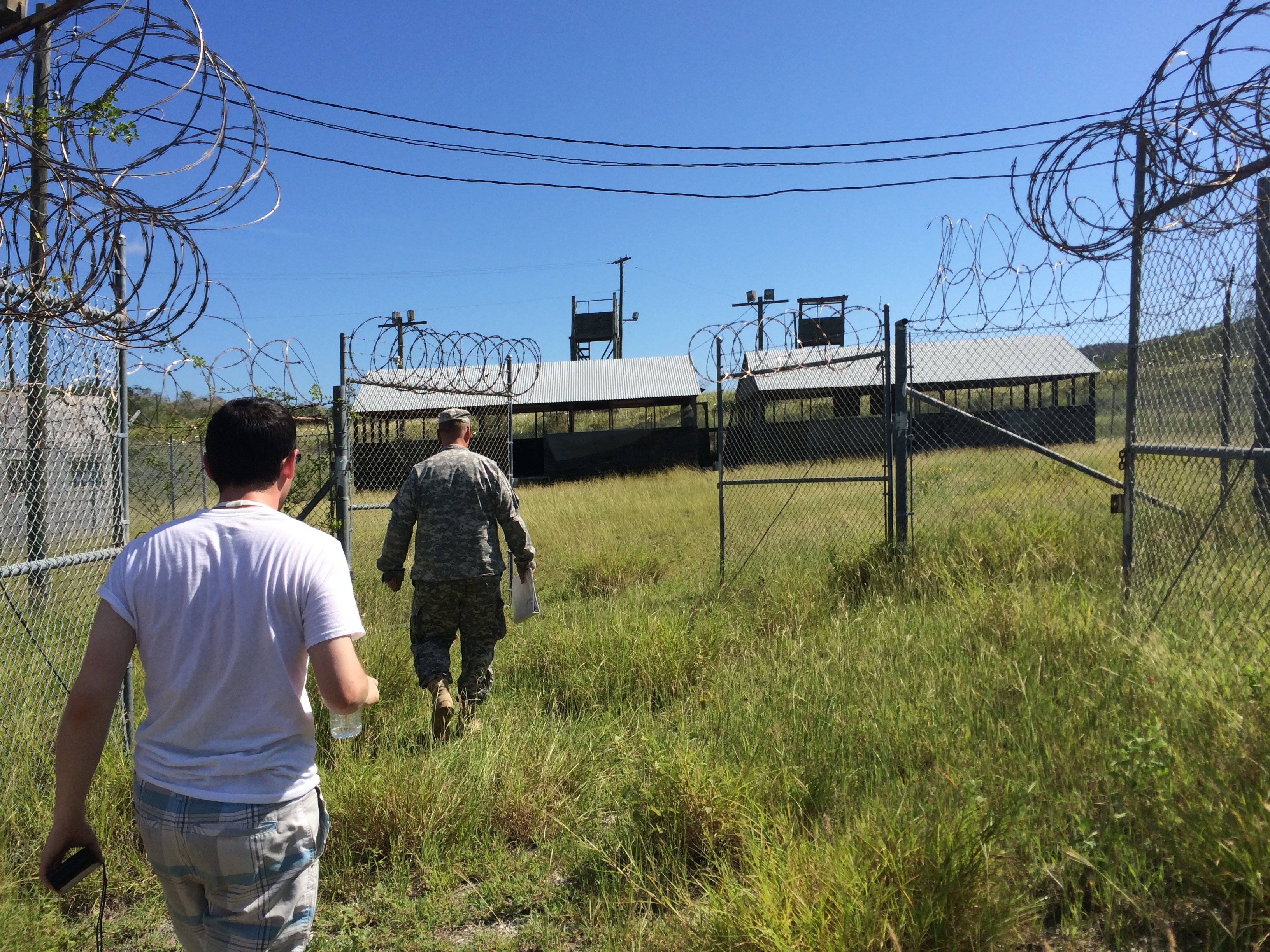
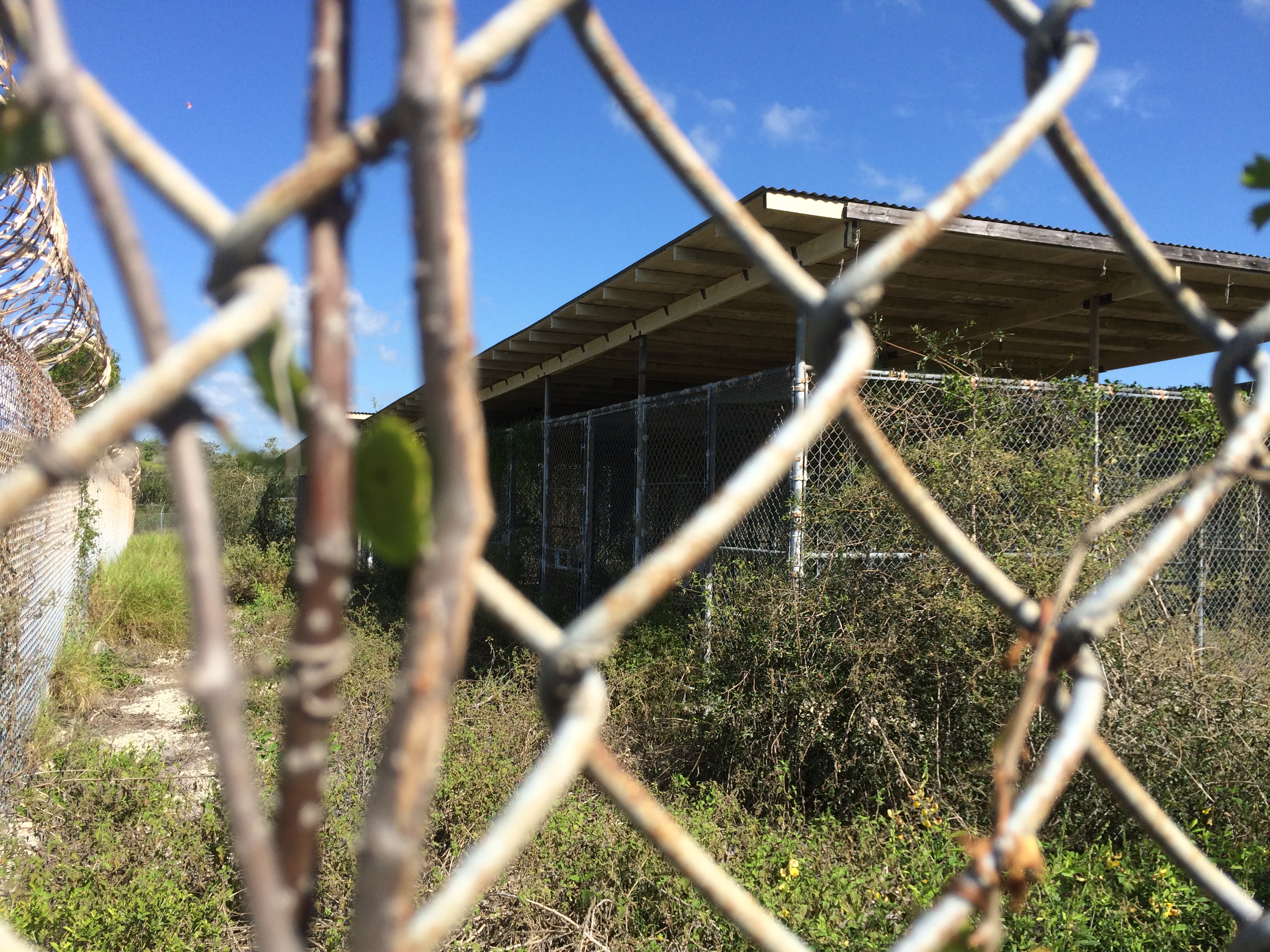
I’m standing at the front of Camp Justice, my home for the next two weeks at Guantanamo Bay. I am facing the makeshift complex that houses the courtroom where hearing are scheduled to begin tomorrow, Monday, 20 July 2015.

I arrived at Guantanamo Bay Naval Station yesterday, on a sunny Sunday July afternoon. I am scheduled to be here from tomorrow (the 20th) through 31 July to monitor hearings in the case against alleged al Qaeda official Hadi al-Iraqi.

I flew from Andrews Air Force Base – along with the judge, prosecution and defense attorneys, media, and other NGO Observers – on an air force flight. Check-in was similar to check-in for a regular commercial flight. I presented my ID card at the Andrews ticketing counter, confirmed my destination, and the attendant gave me a boarding pass.

Greg Loyd - Sunrise at Andrews Air Force Base - 19 July 2015

Sunrise at Andrews Air Force Base, Sunday, 19 July 2015

 Waiting to Board

In the Andrews terminal, I had the opportunity to meet fellow NGO Observers and other people involved in the military commission. Many people traveling with us appeared to have formed strong bonds, as they quite happily greeted one another with wide smiles, a change in the tone of their voice, and a strong handshake or hug.

When did friends and Colleagues last see each other?

Watching the men and women at Andrews greet each other so warmly made a lot of sense to me, since the different groups of people may not have seen each other in a while. I’m not sure when the last hearings were in the Hadi case, but there have been no military commission hearings at all for many months.

Unlike many courts, the Military Commission doesn’t conduct court hearings each and every day. Instead, the court only conducts hearings on the days or weeks designated by the judge in light of pending motions, the status of the parties’ trial preparations, and other considerations. Weeks and months can go by with no hearings in the Hadi case, or in any of the other few pending Guantanamo Bay cases.

The judge and others involved with the hearings (excluding the defendants) do not stay at Guantanamo Bay when there are no hearings. Instead, everybody (again, except the defendants) travel to the base only for the scheduled hearings.

Hearings have indeed been scheduled in multiple cases over the last several months, but most of those hearings were cancelled.

We are 6 NGO Observers on this trip to Guantanamo Bay, along with our Military Commission escort. Next time we wont stand in the shade for our photos!)

We are 6 NGO Observers on this trip to Guantanamo Bay, along with our Military Commission escort. Next time we wont stand in the shade for our photos!)

NGO Impact: A Cost – Benefit Analysis

The repeat cancellations present a potential problem for NGO’s, among other stakeholders. Such cancellations (particularly those that occur shortly before a hearing date) create a degree of uncertainty for NGO’s representatives regarding the cost of planning on attending hearings. This cost notably includes time reviewing relevant motions, statutes, and human rights treaties, and that time could instead be invested in other valuable projects. If hearings are rescheduled too often, there is a risk that NGO’s will elect to invest their time in other worthy goals that may have a more certain application, rather than preparing for a hearing that may be cancelled. Should this occur, then fewer NGO’s may send Observers, which could negatively impact the quantity and quality of Observer reporting.

A personal example

On three prior occasions, I was selected to travel to observe the proceedings as a representative of the Military Commission Observation Project of Indiana University School of Law.

Each previous time the hearings were cancelled. Each time I prepared for the hearing, purchased flight tickets, paid for my ground transportation, and coordinated work schedules and assignments with co-workers. While I am fortunate to work in a very team oriented office, such cancellations (and subsequent rescheduling) put pressure on my co-workers.

As a trial attorney, I understand the need to continue court hearings, sometimes at the last minute. I also understand that the complexity of these issues often necessitates a fair amount of work by all parties to properly prepare for the hearings. Nonetheless, the potential danger to NGO’s remains as they work to balance their limited time, manpower, and other resources.

While these cancellations can be frustrating, I hope that Observers can use this time beneficially to review and re-review the law, commentary, and analysis. Perhaps this additional analysis under multiple deadlines will lead to creative ideas to contribute to the discussion.

Breaking News

Just moments ago, my fellow NGO Obsevers met for Sunday dinner to discuss the hearings set to begin tomorrow morning. While at the restaurant, we were notified that the hearings scheduled for Monday, July 20 and Tuesday, July 21 were postponed until Wednesday.

That’s not a big problem for us, as our Guantanamo Bay tents are only a few feet away from the courtroom, and it is not a logistical nightmare to have Monday and Tuesday without hearings. But, Indiana’s Military Commission Observation Project is sending 4 people to Ft. Meade, Maryland, to monitor these same Guantanamo hearings via a secure simultaneous video-feed. It must be more challenging for the Ft. Meade Observers to change their hearings schedule to get to Ft. Meade.

Its time now to re-read some material I brought along.

Greg Loyd – Guantanamo Bay, Cuba


Guantanamo Bay case against Hadi al Iraqi case – July hearings

Guantnaamo Bay - Military Commission Seal

Seal of the Office of Military Commissions, U.S. Department of Defense.

The hearings I am scheduled to observe at Guantanamo in the case against alleged al Qaeda leader Hadi al-Iraqi are set for 10 days, 20 to 31 July 2015. Many issues are set to be litigated. This blog will introduce some of these topics:

  1. Defense motion to dismiss

The defense is asking the judge to dismiss the case as a whole, or, alternatively, to dismiss just on charge (Count V, Conspiracy).

  1. Motion to suppress defendant’s statements.

The defense is asking the court to prohibit the Government from admitting at trial many statements made by the defendant.

  1. Government motions on admissibility of certain evidence

The prosecution wants the court to determine whether the judge will permit particular pieces of evidence to be admitted at trial.

  1. Personal jurisdiction

This motion asks to judge to rule whether the court has personal jurisdiction over the defendant. The Government will have the burden to establish that the court has the authority over this particular defendant so that the court can conduct his trial. If the court does not have jurisdiction, then the trial cannot go forward.

A busy 10 days.

The prosecution and defense have submitted hundreds of pages of briefs and other documents related to these and other motions. It looks like it can be a busy 10 days for us at Guantanamo Bay.

I am excited about the opportunity to observe these proceedings. I will work hard to help keep you posted. In the meantime, please keep reading about the case!

By Greg Loyd – Guantanamo Bay, Cuba


My flight to Guantanamo Bay – by Greg Loyd

On my way to Guantanamo Bay: a quick meeting with George Edwards

I’m on the left, with Professor George Edwards who founded the Military Commission Observation Project at Indiana. This photo was taken in Washington, DC the day before my departure for Guantanamo.

I’m set this morning to go to Guantanamo Bay to monitor Military Commission hearings. On my plane, which leaves from Andrews Air Force Base, will be the judge, prosecution and defense lawyers, victims’ families, press, court reporters and interpreters, and other hearing observers. For 10 days we will be involved in pre-trial hearing in a case against alleged war criminal al-Hadi al-Iraqi, an alleged high-ranking al Qaeda member.

I appreciate the opportunity to represent the Military Commission Observation Project (MCOP) of the Indiana University McKinney School of Law.

 My Background

I graduated from Indiana’s law school over a decade ago, and I have worked as both a defense attorney and a Deputy Prosecuting Attorney. I have worked with many categories of individuals emotionally vested in cases – criminal defendants scared for their future due to charges against them, detectives who sink their nights and days investigating a case, family members who grieve for a loved one, and fellow attorneys who spend sleepless nights worrying upcoming hearings. I hope this balanced lense will aid me in better understanding each Guantanamo Bay stakeholder’s point of view and lead to reporting that readers find helpful.

 My Role

As an Observer, I will watch, listen, and ask questions about the rights of stakeholders in the al-Hadi al-Iraqi case. Obviously, one such stakeholder is the defendant who has significant rights and interests in the matter. Yet, so too do the families of victims. The press. NGO’s. Yes, even the prosecution. When evaluating the military commissions, it is important to consider not just the rights of any one stakeholder, regardless of who or what this stakeholder is, but rather, the analysis must be global in nature. Given that much has been written about the defendant’s rights, I will try to pay close attention to another stakeholder — the rights of the Guantanamo Bay prosecution — in an effort to contribute to a full discussion.

A helpful starting point is to ensure an understanding of the charges filed against a defendant.

Abd al-Hadi al-Iraqi

Abd al-Hadi al-Iraqi

What are “Charges”?

Charges are the formal method that the government uses to accuse an individual (the defendant) with having committed a crime. The charges are not evidence and the filing of a charge does not mean that the defendant is guilty. Rather, it is the Government’s responsibility to prove at trial that the defendant is guilty. The Government filed fives charges against Hadi al-Iraqi.

Charges Against Hadi al Iraqi

Here is a brief explanation of the charges filed against the defendant.

  1. Denying Quarter

In short, the Government alleges that Hadi al Iraqi ordered his combat forces in Afghanistan and Pakistan that when they engaged in combat, they were to take no prisoners, even if the opposing forces attempted to surrender.

  1. Attacking Protected Property

Here, the Government alleges that the defendant attacked a military medical helicopter as it attempted to evacuate a U.S. military member from a battlefield and that the defendant knew the helicopter was a medical helicopter.

  1. Using Treachery or Perfidy

The Government asserts that the defendant detonated explosives in a vehicles that killed and injured German, Canadian, British, and Estonian military personnel.

  1. Attempted Use of Treachery or Perfidy

Hadi al-Iraqi is charged in this count with attempting to detonate explosives in a vehicle to kill or injure U.S. military members.

  1. Conspiracy

The Government contends that the defendant entered into an agreement with Usama bin Laden and others to commit terrorism, denying quarter, and murder (among other acts), and that he took at least one step to accomplish the purpose of the agreement.

Conclusion

I’m looking forward to monitoring the upcoming hearings. In applying my experiences, I hope to share a thoughtful analysis regarding my observations at Guantanamo Bay that contributes to the exploration of the rights of all stakeholders.

By Greg Loyd

Guantanamo NGO Observers from IU McKinney Law School Featured in Indiana Lawyer

Military tribunals for some accused of terrorist attacks on the United States are held at Camp Justice at Guantanamo Bay. (Photo by Catherine Lemmer, IU McKinney School of Law)

Military tribunals for some accused of terrorist attacks on the United States are held at Camp Justice at Guantanamo Bay. (Photo by Catherine Lemmer, IU McKinney School of Law)

The Indiana Lawyer published the following article by Marilyn Odendahl on 25 February 2015. Text and photos are in the original article.

IU McKinney Gitmo Observers Illuminate Murky Proceedings in Gitmo Trials

by. Marilyn Odendahl (25 February 2015)

      The U.S. Military Commission Observation Project overseen by Indiana University Robert H. McKinney School of Law is continuing to send individuals to watch and report on the accused terrorists’ trials being held at Guantanamo Bay. Blog posts and articles from the observers chronicle the glacial pace of the proceedings, the unexpected courtroom twists and the nagging constitutional questions.

Professor George Edwards

Professor George Edwards

The project regularly sends faculty, students and alumni to either Guantanamo Bay or Fort Meade in Maryland to observe the tribunals. Professor George Edwards, founder and director of the project, explained the work of the observers is not to address the political issues or comment on the substance of the military commissions.

“We’re interested in seeking to assess whether the stakeholders are receiving the rights and interests that are afforded to them,” Edwards said. “(Those rights) include the right to a fair hearing, the right to an independent tribunal, the right to trial without undue delay.”

He pointed out the observers also are looking at the stakes that the victims of the terrorists attacks and their families have in the proceedings. What about their rights to have access to the trials, to make statements, to confront and to have closure?

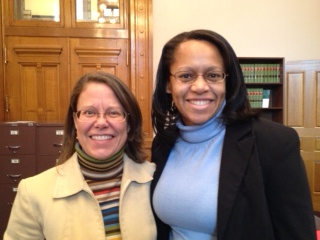
Professor Catherine Lemmer

Professor Catherine Lemmer

IU McKinney librarian Catherine Lemmer, who Edwards described as instrumental in helping to build the observation program, heard some victims’ voices when she traveled to Guantanamo Bay for the hearings of the alleged co-conspirators of the Sept. 11, 2001, attacks.

One man said he was attending the proceedings to remind the judge and attorneys that planes had flown into the twin towers of the World Trade Center and the Pentagon. A mother of a fallen firefighter said she was struggling to hang on to her opposition to the death penalty, but she believed the trials had to be fair because the United States would be judged by how it handles the detainees.

The project drew praise from panelists who participated in a recent forum at the law school examining the tribunals. Hosted by the Indiana International & Comparative Law Review, the symposium brought together legal scholars from IU McKinney and around the country to discuss whether the end is coming for Guantanamo Bay or if the practice of international criminal law has reached a turning point.

An IU McKinney symposium examined trials at Guantanamo Bay. Panelists included (from left): Richard Kammen, Kammen & Moudy; Shahram Dana, The John Marshall Law School; George Edwards, IU McKinney; and Paul Babcock, editor-in-chief of the Indiana International & Comparative Law Review. Chris Jenks of Southern Methodist University Dedman School of Law participated via video link. (Photo by Dave Jaynes, courtesy of IU McKinney Law)

An IU McKinney symposium examined trials at Guantanamo Bay. Panelists included (from left): Richard Kammen, Kammen & Moudy; Shahram Dana, The John Marshall Law School; George Edwards, IU McKinney; and Paul Babcock, editor-in-chief of the Indiana International & Comparative Law Review. Chris Jenks of Southern Methodist University Dedman School of Law participated via video link. (Photo by Dave Jaynes, courtesy of IU McKinney Law)

Two participants – Shahram Dana, associate professor at The John Marshall Law School and Chris Jenks, assistant professor at Southern Methodist University Dedman School of Law – on the second panel discussion both noted IU McKinney’s effort in documenting the proceedings at Guantanamo Bay is shining a light on America’s response to terrorism and will be an invaluable resource for history.

Lemmer advocates for the proceedings to be shown on C-SPAN. The American public should see for themselves, she said, so they form their own opinions. By seeing what is happening in that courtroom, she said it is easy to realize how things could go wrong.

“The role of the attorneys, our role (as citizens) is to hold fast to the Constitution when really bad things happen and everybody wants to step over it,” Lemmer said. “Ultimately, the price we pay for not doing it right is incredible. This is our Constitution and it is getting overwhelmed, which should not happen.”

Lemmer took her first trip to Guantanamo Bay in December 2014. However, the proceedings were derailed by the ongoing revelations that the Federal Bureau of Investigation may have infiltrated the defense teams. The FBI is accused of listening to defense attorneys’ meetings with their clients and reviewing their correspondence as well as attempting to turn legal team members into informants.

When she returned in early February 2015, the FBI conflict-of-interest issue was still being argued. Then unexpectedly, Ramzi Bin al-Shibh, one of the defendants in the courtroom, said he recognized his interpreter as someone he encountered during the period he was held at one of the Central Intelligence Agency’s secret prisons. Another defendant told his attorney he also remembered the interpreter from the black site.

“It became very surreal,” she said.

To Indianapolis defense attorney Richard Kammen, the confusion and conundrums that swirl around Guantanamo Bay could be resolved by moving the proceedings to federal court. Kammen, lead counsel for USS Cole bombing suspect Abd al-Rahmin al-Nashiri, pointed to the hearings of accused Boston Marathon bomber Dzhokhar Tsarnaev as an example that U.S. courts can handle high-profile terrorism cases.

“There’re so many more moving parts down there than there would be in federal court, so things just get more messed up,” he said.

Currently, Kammen and his defense team are tangling with the federal government to release the details of the treatment of al-Nashiri while he was kept in a black site. The release of the CIA Torture Report publicly confirmed that the defendant had been physically, psychologically and sexually tortured, but Kammen said the defense still needs details of what was done and when.

Professor Tom Wilson

Professor Tom Wilson

IU McKinney professor Lloyd “Tom” Wilson is scheduled to observe the al-Nashiri proceedings during his first trip to Guantanamo Bay. The task of watching and relaying what is happening will be difficult, he said, because he will be seeing just a snapshot of a long, complex and secretive process.

Wilson was careful in his preparation for the trip, not wanting to form any preconceived ideas or prejudices before he arrived in the courtroom. He is going out of a sense of civic duty and to understand the situation better than he does now.

Still, the proceedings are not easy to comprehend and continue to spark debate many miles away from the detention camp.

As part of his remarks during the IU McKinney symposium, Kammen described Guantanamo Bay as a “law-free zone.”

Co-panelist Jenks countered that characterization, arguing traditional rules governing the treatment of prisoners of war have been upended by terrorism. In previous conflicts, nation states battled each other but now the United States is fighting against groups that are unconnected with any organized government or country. Even so, he continued, the detainees at Guantanamo Bay have a right to counsel and are being given a trial.

Kammen responded that even if his client is acquitted, he will not be released.

“That,” Kammen said, “is a law-free zone.”

_______

The original Indiana Lawyer article can be found here:  http://www.theindianalawyer.com/iu-mckinney-gitmo-observers-illuminate-murky-proceedings-in-gitmo-trials/PARAMS/article/36436

Thoughts on My 23-27 March Mission to Guantanamo Bay

Abd al Hadi al-Iraqi

Abd al Hadi al-Iraqi

During the last full week of March 2015, I will travel to Guantanamo Bay (GTMO), Cuba as a member of the Military Commission Observation Project (MCOP) at the Indiana University Robert H. McKinney School of Law. It’s an honor to have been selected. I will observe military commission proceedings for Abd al Hadi-al Iraqi, who arrived from CIA custody to GTMO in 2007.


In 2013, the United States government charged him with denying quarter, attacking protected property, using treachery or perfidy, and attempted use of treachery or perfidy in a series of attacks in Afghanistan and Pakistan between about 2003 and 2004, and conspiracy to commit law of war offenses.

General Preparation for the Project and my Guantanamo Bay travel

Whirlwind is a term I have seen associated with the process of becoming a fair trial observer as a part of the Military Commission Observation Project (MCOP). I didn’t really have any previously determined thoughts on GTMO that were fully fleshed out by thorough law school level research. Prior to conducting research, I think my level of knowledge was comparable to that of the average American. Though, maybe slightly than more than average, given that I have known several members of the military who served there.

Nevertheless, I have begun the process of researching and learning as much as possible about the project itself, the circumstances surrounding the operation of GTMO and military commissions, and the specific case I will observe. Absent a background in international law, the Guantanamo Fair Trial Manual has been a great resource in becoming familiar with the various sources of law that are implicated in the military commission system.

In addition, I’ve had to explore my thoughts and feelings about what the overarching principles of justice really mean as applied to GTMO. As is with any person, my life experiences have shaped my perspectives on the ethical components of domestic and global issues.

My Indiana McKinney Law School Career

Despite my penchant for world travel, becoming a member of MCOP is admittedly my first law school experience dealing with any area of international law. During my second year of law school I worked as a part-time law clerk for the Marion County Public Defender Agency. Following that, I volunteered with the Neighborhood Christian Legal Clinic’s Expungement Help Desk, where I informed members of the community about Indiana’s expungement law. In July 2014, I began working full-time for the Indiana Bureau of Motor Vehicles, and next month I will begin as a part-time law clerk for the Indiana State Personnel Department. This semester I have been fortunate enough to extern for Justice Steven H. David of the Indiana Supreme Court. From July 2007 to August 2008, Justice David (at the time Colonel David) was the Chief Defense Counsel for the Military Commissions at Guantanamo Bay.

My Military Service

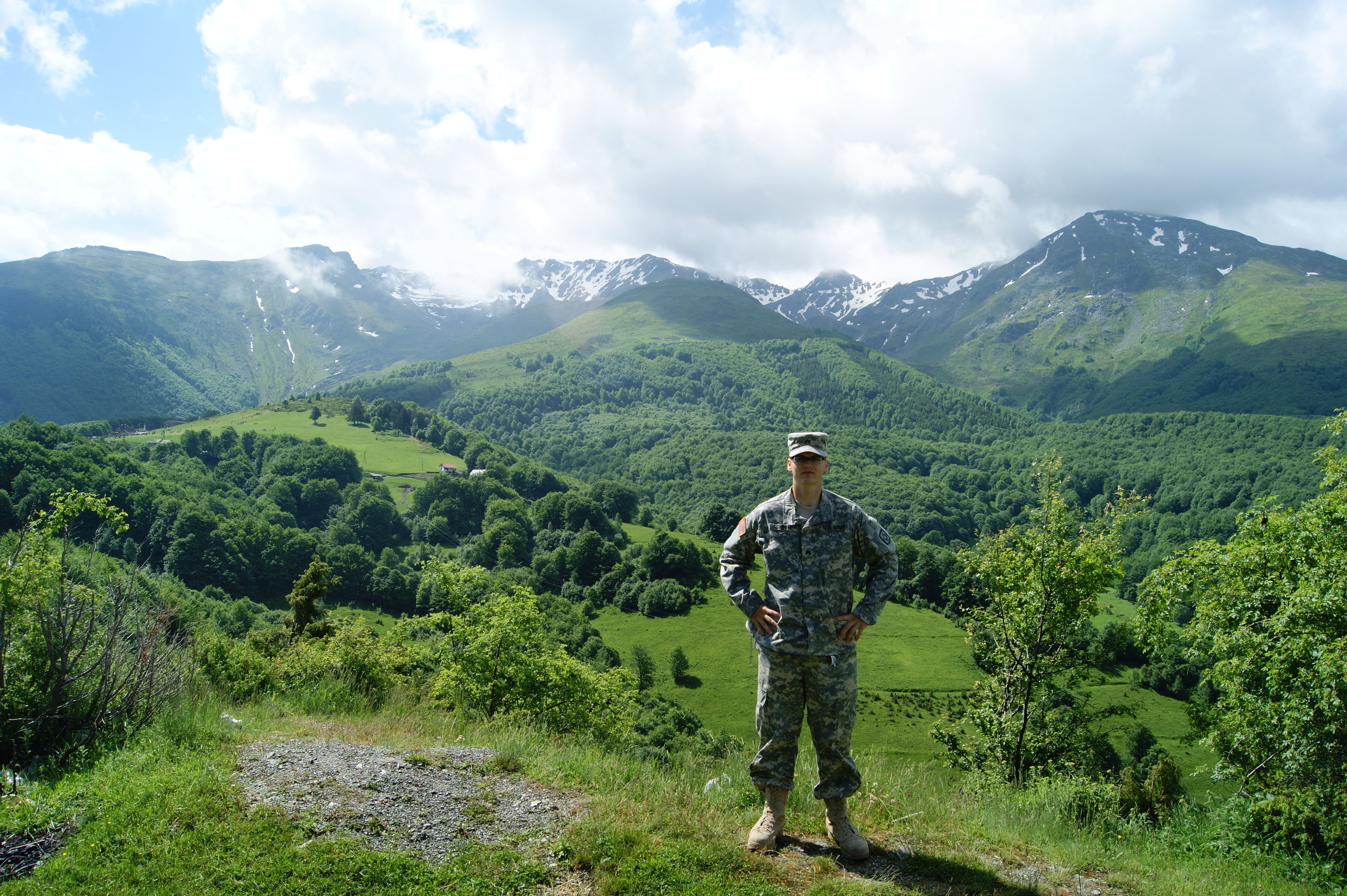
As a member of the Army National Guard for over 10 years, I deployed once in 2011 to Kosovo as a part of Kosovo Force (KFOR) 14. KFOR has been a part of the larger multinational presence in Kosovo since 1999.

Myself in the Shar Mountains National Park in southern Kosovo in 2011.

In addition, I have personally participated in the military funeral honors ceremonies for 323 veterans, a handful of which have been Iraq and Afghanistan war casualties. In no way does this fuel personal anger or hatred towards the detainees held in GTMO. Those servicemen were honored for their sacrifices for democracy that implores fairness in the service of justice. On the contrary, it is all the more reason for me to ensure I am doing everything within my power to help the MCOP fulfill its missions (attend, observe, analyze, critique, and report).

As stated in the Guantanamo Bay Fair Trial Manual, “NGO Observers are the eyes and ears of the outside world as to what happens at Guantanamo Bay. NGO Observers have a unique responsibility to share their experiences, insights and conclusions with the outside world. NGOs should not bow to pressure. What happens at Guantanamo Bay should not stay at Guantanamo Bay.”

As a part of that mission, I have been tasked with expanding the portion of the Guantanamo Fair Trial Manual covering the rights and interests of the men and women in Joint Task Force Guantanamo (JFT-GTMO).

What’s Really at Issue with Female Guards touching #Guantanamo Bay Detainees

Camp signThe main issue that was argued the last week of January was whether or not a female guard should be permitted to have contact with a detainee.  Practical concerns were raised in regards to religion.  With Islam, it is taboo to be touched by a female that a man is not related to or married to.  Several witnesses were called, including the female guard at issue.  Steps were taken to preserve her anonymity and there was no personally identifiable information that was given about her.  She testified as to how her job required her to handle the detainee.  Arguments were made that went to whether or not allowing females to touch detainees would hinder that females’ advancement in her career, whether or not the defendant’s religious views were being violated, whether or not suitable male replacements could easily be found, etc.

I think the real issue, that was never broached, is whether the commission actually has the jurisdiction to rule on this matter with regards to general handling while in custody down at Gitmo.  This hinges on how broadly the court interprets the defense’s request for touching to cease.  Defense tried to argue for all touching, period, to cease.  The judge cannot rule on what happens outside of court related proceedings, and even then, how far does his authority reach?  Does it apply to court related medical exams?  Transfers from the detention facility to the court holding facilities prior to coming into the court room?  Anything further is speculation and a ruling has not been handed down yet by the judge, but I will definitely be interested to see how this comes out.

(Margaret Baumgartner, Hadi al Iraqi Hearings, January 25-31, 2015) 

Travel to GTMO Notification & Initial Thoughts on Hadi al Iraqi, 26 – 30 January 2015 – Margaret Baumgartner

Me (Margaret Baumgartner) and one of my favorite members of our armed services.

Me (Margaret Baumgartner) and one of my favorite members of our armed services.

Notification of Travel

Wow.  I am thrilled to be a part of this opportunity. I think all of my co-workers are also just as excited to hear about the experience, as well as read about it, on this blog.  In fact, one of my Dutch co-workers happened to stop by my office and he was very interested in hearing about this project in general.  A word of caution to the over-achievers (like me), the process for travel is NOT as clear-cut at it seems (is it ever?).  There is a fair amount of paperwork that needs to be filled out precisely and reviewed by other parties.  Luckily, Professor Edwards has a lot of patience and experience!

About Me

By trade, I am a Patent Attorney with a tech company in Indianapolis.  I graduated from the McKinney School of Law in 2010 and have been practicing in a corporate setting since.  My family is heavily involved with the military which has affected me and my interest in the events that have shaped their lives.  I also travel extensively and am incredibly fascinated with foreign policy and history.  I also am fascinated with how people in other countries in the world view the U.S.  This opportunity allows me to help inform people about our country, GTMO, and the ongoing proceedings (or lack thereof) of the detainees. (more…)

MCOP Observer Returns from Guantanamo Bay – Hattie Harman

NGO Observers with General Martins.  From left: Abburi Harshavardhan (Univ. of Toledo law student), Robert Kerrigan (Human Rights First), Gina Moon (American Bar Assoc.), Emily Finsterwald (U. of New Mexico law student), Sean Murphy (Duke Univ. law student), Adam Adler (Yale law student/Nat'l Institute for Military Justice), General Mark Martins, Anna Kent (Georgetown Univ. law student), Eva Nudd (NYC Bar Assoc.), Charles Gillig (Pacific Council on Int'l Policy), Justin McCarthy (Judicial Watch), Hattie Harman (Indiana Univ. Law School MCOP), Bendan Kelly (Nat'l District Attorneys Assoc.), Ghalib Mahmoud (Seton Hall Law School)

NGO Observers with General Martins. From left: Abburi Harshavardhan (Univ. of Toledo law student), Robert Kerrigan (Human Rights First), Gina Moon (American Bar Assoc.), Emily Finsterwald (U. of New Mexico law student), Sean Murphy (Duke Univ. law student), Adam Adler (Yale law student/Nat’l Institute for Military Justice), General Mark Martins, Anna Kent (Georgetown Univ. law student), Eva Nudd (NYC Bar Assoc.), Charles Gillig (Pacific Council on Int’l Policy), Justin McCarthy (Judicial Watch), Hattie Harman (Indiana Univ. Law School MCOP), Brendan Kelly (Nat’l District Attorneys Assoc.), Ghalib Mahmoud (Seton Hall law student)

As part of a group of non-governmental organization (NGO) observers from across the United States, I spent the past five days, November 16-20, at the U.S. Naval Station in Guantanamo Bay, Cuba (GTMO). My mission as an NGO observer was to attend, observe, analyze, critique, and report on the week’s pretrial proceedings in the government’s case against Abd al Hadi al-Iraqi. Hadi is accused of several crimes arising out of his alleged role as an al Qaeda commander in Afghanistan during the post-9/11 period. I returned home late last night (Thursday, Nov. 20) to Indianapolis via Andrews Air Force Base.

Wonderful  Hosts

I cannot say enough about the wonderful reception the NGOs received from everyone we came into contact with at GTMO. All of them — including General Mark Martins and his staff, Hadi al-Iraqi’s defense team, our NGO escorts Mark Gordon and Darryl Roberson, the numerous members of the JTF Public Affairs Office, and many more — were exceptionally gracious and accommodating of our questions and requests to see and learn as much as possible about GTMO and the Commissions during our trip.  (more…)

18 and 19 November Military Commissions Events at Guantanamo Bay – Hattie Harman

17 November Hadi al-Iraqi Hearings at Guantanamo Bay – Hattie Harman

Hattie Harman - at GTMO - Camp Justice - 17 June 2014 - IMG_1097

Hattie Harman at Camp Justice, Guantanamo Bay, Cuba.

This morning proceedings commenced in the pre-trial hearings in the government’s case against accused war criminal Hadi al-Iraqi.  Hadi is charged in a non-capital case with several crimes arising out of his alleged involvement as an al-Qaeda commander in Afghanistan.

Courtroom Facility/Personnel and Rights Implications

Hadi entered the courtroom unassisted and unrestrained and greeted his counsel in what appeared to be a congenial, even warm, exchange.  At Hadi’s defense table sat Hadi, his interpreter, and two military defense counsel.  Hadi was escorted by three uniformed (in fatigues) guards.  These guards sat within 12 feet of Hadi through the entirety of the proceedings.  There were from two to four other guards in the courtroom during the proceedings.  A fellow observer who had worked on the  UN International Criminal Tribunal for the former Yugoslavia (ICTY) case of Radovan Karadžić (an alleged genocidaire) told me that there was not near the security presence around the defendant in that case as there was in the Hadi al Iraqi case. [Eds. The Guantanamo Bay Fair Trial Manual addresses security personnel in the court and the issue of a defendant’s presumption of innocence.*]

I watched the proceedings from an observation gallery at the rear of the courtroom which was separate from the main courtroom, but allowed clear visual observation of the entire courtroom through thick glass windows.   Audio speakers in the observation gallery conveyed the sound of the proceedings to the observers, with a 40-second delay to allow for censorship of any unintentionally disclosed classified information in the courtroom.  No such censorship occurred today.   But we thirteen NGO observers were “joined” in the gallery by six uniformed military security persons.

Courtroom Proceedings and Rights Implications

Today’s hearing focused on three defense motions.  These motions implicated issues of

  1. Whether the executive branch or the DoD exerted any “unlawful command influence” regarding the timing of the referral of charges against Hadi.  Curiously, in the view of the defense, Hadi was charged on the Monday after the Friday, May 31, 2014 media coverage of the release of Bowe Bergdahl in exchange for five Guantanamo detainees.
  2. Whether Hadi’s charging document properly included numerous “common allegations” preceding the charges themselves.  These allegations, the defense argues, are simply another mechanism to try to get unproven “facts” before the Commission (MCA equivalent of a jury) before the commencement of proceedings which could prejudice Hadi’s right to be presumed innocent until proven guilty.
  3. Whether Hadi is entitled to a status determination pursuant to Article 5 of the 3rd Geneva Convention as to whether he is actually an “unlawful enemy belligerent” to whom the MCA applies.  If Hadi were determined to be a POW rather an unlawful enemy belligerent, the MCA would not provide personal jurisdiction over him, which in theory would mean he would have to be tried in a different tribunal which presumably would afford him more expansive procedural rights.

[Eds.] *The Guantanamo Bay Fair Trial Manual identifies the right to be presumed innocent as a fundamental right that should be afforded to all criminal defendants at Guantanamo Bay and elsewhere. The Guantanamo Bay Fair Trial Manual suggests that when assessing whether the defendant is being afforded a fair trial, NGO observers might consider whether, among other things, the level security personnel surrounding the defendant might be more in line with a presumption of guilt rather than a presumption of innocence.]

Arrival at Guantanamo Bay Naval Station (GTMO) – Hattie Harman

GTMO - Air Miami - IMG_1085 - Hattie Harman - 16 November 2014

My Air Miami plane parked at Guantanamo Bay air field after arriving from Andrews Air Force Base.

[Gitmo Observer staff posted this item for Ms. Hattie Harman because she had no internet access at Guantanamo Bay to post this herself.]

After a very pleasant flight, I arrived at GTMO a little after 1:00 p.m. today (Sunday).  In addition to the contingent of NGO observers, press, and defense, prosecution, and judicial personnel, passengers on the flight included several “regular” military travelers to the Naval Station (i.e., military personnel with no involvement in the legal proceedings against the detainees but traveling to GTMO on other military business).  The flight included a movie (Spiderman 2), a hot meal (choice of lasagna or chicken), and hot towel service.  It was reminiscent of air travel in the 1980s!

After Arrival

We were busy all afternoon getting badges for access to the court areas, obtaining supplies at the Naval Exchange, and doing a lot of waiting.  Despite the warnings of recent Gitmo Observer travelers, I expected more from the Internet here.  My attempt to purchase (at the cost of $150.00) wired Internet access from the NGO “internet cafe” was foiled for my lack of a proper adapter.

I was able to make it into “town” at 7:00 p.m. to a location that reportedly had wireless Internet access only to find it was not functioning.  Not only am I presently unable to post to the Gitmo Observer Blog, I am without any access to email or any other Internet-dependent mode of communication.  There is of course no cell phone service either.   We’ll see what tomorrow brings on the communication front.

 Hearings Commence Tomorrow, Monday, November 17

 In the morning, I expect to be escorted along with the other NGO observers to the courtroom in advance of the 9:00 a.m. commencement of this set of pretrial hearings in the United States’ prosecution of abd al Hadi al-Iraqi.  Hadi is accused of several crimes arising out of his alleged role as an al Qaeda commander in Afghanistan during the post-9/11 period.  Four motions are scheduled to be heard in this three-day session.

PS:  For access to the Guantanamo Bay Fair Trial Manual, click here.

Departure for Guantanamo Bay Naval Station (GTMO) – Hattie Harman

NGOs with the Fair Trial Manual

NGO Observers studying the Guantanamo Bay Fair Trial Manual. At Andrews Air Force Base waiting for our flight to Guantanamo Bay.

I flew from Indianapolis to Washington National Airport yesterday afternoon, in preparation for this morning’s departure to GTMO. Through the gracious hospitality of old friends, I had a lovely place to stay for the night and was driven to the Andrews Air Force Base Visitor’s Center at 5:30 A.M. Non-governmental organizations (NGOs) such as the Gitmo Observer (of Indiana University McKinney School of Law) tend to have very meager budgets, thus most ­– if not all – of our representatives’ travel expenses are borne by the individual observer. I must thank Spike Bradford, Jill Keesbury, and their son Angus for picking me up at National Airport, putting me up for the night, and driving me to Andrews at the crack of dawn. They are true friends indeed.

Pre-departure Discussions

In addition, my hosts provided very stimulating pre-trip conversation. Spike works for the D.C. area-based Pretrial Justice Institute, a nonprofit organization promoting safe, fair, and effective pretrial practices nationwide.

As the proceedings I will be observing this week at GTMO – those of Abd al Hadi al-Iraqi – are in the early pretrial stages, Spike offered me some perspective for comparison to U.S. domestic criminal courts. To me, the most stark comparison was between the different lengths of pretrial detention. In typical domestic United States criminal jurisdictions, the accused must be charged with a crime within 48-72 hours of arrest or detention, and then has the right (which he or she may choose to waive) to be brought to trial within a particular time limit.  See, e.g., Ind. Rule Crim. Procedure 4(B) (affording accused the right to move for a trial within 70 days). In addition, the U.S. Constitution guarantees the right of the accused “to be informed of the nature and cause of the accusation” and importantly provides that “the accused shall enjoy the right to a speedy and public trial.” U.S. Const. amd. VI (emphasis added). The accused al Qaeda commander Hadi al Iraqi, whose proceedings I will observe next week, was first brought to GTMO in 2007 after being held by the CIA. Hadi was first charged with a crime in 2013.

Andrews Air Force Base

Arrival at Andrews

Arrival at Andrews

When I arrvied this morning at Andrews Air Force Base, I met several other NGO observers who will be attending this week’s hearings. One, a representative of the American Bar Association Criminal Justice Section, was already familiar with the work of The Gitmo Observer. I distributed copies of the Guantanamo Bay Fair Trial Manual to the NGOs and it was well received. Many other passengers continue to arrive at the Andrews terminal and are checking in for today’s flight, which is scheduled to depart for GTMO at 10:00 a.m.

Departing Indianapolis for Guantanamo Hearings – Hattie Harman

IMG_1079

The things I CAN’T forget to take to GTMO!

Tomorrow (Sunday) I will fly from Andrews Air Force Base to Guantanamo Bay Naval Station, Cuba to observer next week’s pretrial hearings in the U.S. prosecution of alleged al Qaeda commander Abd al Hadi al-Iraqi (17 – 20 November 2014). I will be transporting several updated draft copies of the Guantanamo Bay Fair Trial Manual to distribute to other non-governmental observers (NGOs).

Visit to International Criminal Law Class

Last evening, I had the good fortune to be a guest in Professor George Edwards’ class in International Criminal Law at the Indiana University McKinney School of Law. Professor Edwards, with help from students and others, has drafted the Guantanamo Bay Fair Trial Manual for use NGO observers and anyone else interested in determining whether stakeholders are getting a fair trial. I cannot thank Professor Edwards and his students enough for preparing the Manual and for welcoming me to their class. The Manual has been an indispensible part of my preparation, as it contains a trove of information about the treaties, U.S. laws, and regulations governing proceedings under the law of war,  and international human rights law, and it also identifies the various stakeholder groups in these proceedings, all of whom have rights under these laws, treaties, and regulations.

Making Connections – Theory to Practice

I am an attorney by profession, and my work involves primarily appellate review of both criminal and civil substantive law issues. Issues of procedure and particular rights arise from time to time but are by far most of my work involves more substantive questions such as, “Was a particular piece of evidence properly admitted?” and “Did the trial court properly apply the existing case law in instructing the jury?”. The rights issues I deal with are typically secondary to the substantive law questions.   Further, to the extent I deal with rights issues in practice, these issues relate almost invariably to the rights of the criminal defendant. Therefore, participation in this MCOP project requires me to shift my legal mindset and approach the proceedings from a very different perspective.

I have no previous experience in international law so of course the Guantanamo Bay Fair Trial Manual is extremely informative. But I found my visit to last night’s class was absolutely essential in helping me to make connections between the Manual’s exposition of human rights law procedures and the application of these rights to the stakeholders in practice. The students and Professor Edwards were able to help me focus on my role to assess whether the proceedings are delivering the rights to which each stakeholder is entitled, not what substantive law is at issue in the particular case.

Next Week’s Guantanamo Hearings – Hattie Harman

Abd al Hadi al Iraqi

Defendant Abd al Hadi al Iraqi

Today is Veteran’s Day and I am spending my day off from work preparing to attend next week’s pretrial hearings at Guantanamo Bay, Cuba. Next Monday, Tuesday and Wednesday (November 17, 18, and 19, 2014) proceedings will resume in the case United States v. Abd al Hadi al-Iraqi. Abd al Hadi was brought to Guantanamo in 2007 after detention by the CIA. Abd al Hadi is charged with several war crimes arising out of his alleged role as an al Qaeda commander in Afghanistan during the years following the September 11th attacks.

Hearing Agenda

The military judge’s order AE022 (corrected) enumerates the pretrial motions on the agenda for next week’s hearings.   Prior to the hearings, the parties and judge will meet for a pretrial conference on Sunday afternoon, November 16 at 5:00 p.m. The hearings are scheduled to begin at 9:00 a.m. on Monday and will include discussion and argument regarding four pending motions:

  • AE 018 – Defense Motion to Compel Discovery
  • AE 019 – Defense Motion to Strike Common Allegations
  • AE 020 – Defense Motion to Dismiss for Lack of Subject Matter Jurisdiction and to Compel a Status Determination pursuant to Article 5 of the Geneva Convention
  • AE 021 – Emergency Defense Motion for Appropriate Relief to Cease Physical Contact with [Female] Guards

With regard to the last item, the judge issued an order on November 7 (AE021B) which has been reported to temporarily grant Abd al Hadi’s request for cessation of physical contact with female guards.

My Role at the Proceedings

As a non-governmental observer (NGO) attending the hearings under the auspices of the Military Commissions Observation Project (MCOP) of the Indiana University McKinney School of Law Program in International Human Rights Law (PIHRL), I am tasked with the following duties:

  • Attend the hearings each day as an informed observer.
    • This requires a substantial commitment in terms of personal time and resources, including arranging for travel to Andrews Air Force Base, completing numerous government and MCOP documents, researching the status of the case and the motions to be heard next week, and reading and studying the Guantanamo Bay Fair Trial Manual prepared by MCOP.
  • Objectively and with an open mind observe the proceedings and interact with stakeholders present on site (including prosecutors, defense counsel, press, and other NGOs) to glean as much information as possible about the experiences of all stakeholders holding rights to fair proceedings at Guantanamo.
  • Analyze the hearings.
    • My observer’s role on behalf of MCOP is to analyze to proceedings not so much from a substantive legal perspective, but rather to focus on the various fair trial rights of all stakeholders to the proceedings.
  • Critique the hearings.
    • This includes identifying both positive and negative aspects of the process, both in the abstract (e.g., as compared to other judicial processes) and in practice at the hearing site. Where possible, assess the fairness of the proceedings with regard to the various stakeholders.
  • Report on the hearings.
    • Disseminate, through the Gitmo Observer and otherwise, information about the hearing process and the fairness of the proceedings. Prepare a report for MCOP upon my return.

Pre-Departure Tasks

I will depart Indianapolis for Washington, D.C. on Saturday and am ordered to arrive at Andrews Air Force Base (more…)

It’s a Small World – by Hattie Harman

Preliminary Preparations

Hattie Harman and Traci Cosby -- Both going to Cuba this month

Hattie Harman and Traci Cosby — Both going to Cuba this month

As I read Chuck Dunlap’s blog posts this week, I find myself looking more and more forward to my upcoming trip to Guantanamo for the next round of hearings (Nov. 17-19, 2014). Chuck is an Indiana University McKinney School of Law graduate who works at the Indiana Bar Foundation, and he is at Guantanamo Bay this week monitoring the hearings in the case of al Nashiri, who allegedly masterminded the 2000 attack on the USS Cole that killed 17 sailors off the coast of Yemen.

I will be monitoring a different case, that of Hadi al Iraqi, who was alleged to have run al Qaeda’s army in Afghanistan, was arraigned this past summer, and his pre-trial hearings are at an early stage.

Yesterday I received instructions from the Pentagon to help me prepare for my mission, including information about the logistics of eating, sleeping, and – most importantly – viewing the proceedings.  Reading Chuck’s posts and seeing his photos makes it seem more real all the time!

And I have been especially fortunate this past week to have had short conversation with Indiana Supreme Court Justice Steven David about the Naval Station itself and his experiences there.  Justice David, is his position as an Army Colonel, previously served as chief defense counsel. Of course, our conversation was quite limited due to the nature of the subject but it was nonetheless very helpful and exciting to meet with someone who has had his “boots on the ground” at Guantanamo.

Two Views of Cuba

Although I won’t be leaving for Cuba for another week, my good friend and co-worker Traci Cosby is leaving tomorrow for Havana. Traci will be part of a delegation from the American Bar Association Section of Dispute Resolution spending several days in Havana meeting Cuban dignitaries and learning about the Cuban legal system.

ABA itinHow strange it is that two friends and close co-workers would end up – entirely independently – traveling to Cuba in the same month!  Obviously, Traci’s and my experiences of Cuba will be very different.  But I look forward to swapping stories with her when we both return.

Stakeholders may vary across Guantanamo Bay proceedings – Hattie Harman

My upcoming mission to Guantanamo Bay

Late last week I was honored to learn I have been nominated by Indiana’s Military Commission Observation Project (MCOP) and approved by the Office of Military Commissions to travel to Guantanamo Bay to observe the November 17-21 pretrial hearings in the case against Hadi al Iraqi.   I had the good fortune to travel to Fort Meade in April of this year to observe via secure video link a set of hearings in the case against Khalid Shaikh Mohammad (KSM) and his co-conspirators in the planning and execution of the 9/11 attacks.   I am very much looking forward to observing more hearings in person at Guantanamo Bay.

Guantanamo Bay Fair Trial Manual

In preparation for my upcoming trip to GTMO I have begun studying MCOP’s indispensible Guantanamo Bay Fair Trial Manual.  The Fair Trial Manual focuses on assisting observers in assessing whether the rights of all stakeholders in the Military Commission proceedings are adequately protected. And while one frequently thinks of the right to a “fair trial” as belonging only to the accused person, I recognize now that this is too narrow an understanding of the concept. As the Fair Trial Manual makes apparent, a somewhat disparate set of individuals and organizations have an interest in the outcome of Military Commission proceedings, and, concomitantly, in their fairness. Just as in traditional criminal trials, the crime victims and their families have an interest in a fair proceeding with a just outcome. A conviction which is later reversed due to a faulty proceeding serves no one, including (and perhaps especially) the victims. (more…)