NGO Observers

Yemeni Detainee asks Obama Administration to release him from Guantanamo

gtmo-prb-6-december-2016-mohammad-ahmad-abdallah-al-ansi

al Ansi in a Department of Defense photo.

Today, after 14 years imprisonment at Guantanamo Bay, Cuba, a Yemeni detainee named Mohammad Ahmad Abdallah al Ansi asked the U.S. Government to transfer him from Cuba to a third country. If released, 58 detainees would remain at Guantanamo, down from a record high of 780 detainees.

This parole board like hearing is called a Periodic Review Board (PRB), and was convened pursuant to President Obama’s 2011 Executive Order calling for PRBs to ascertain whether detainees pose a continuing threat to the national security of the U.S. If a detainee does not pose such a threat, he may be repatriated to his home country or transferred to a third country. It is unknown whether the next President will rescind this Executive Order and cease Period Reviews, and whether any of the 5 dozen remaining detainees will be released after January 2017.

President Obama’s 2011 Executive Order calls for three types of PRBs: (a) an Initial PRB for all detainees, involving a hearing at which the detainee may appear and speak on his own behalf; (b) a file PRB, held 6 months after a detainee is denied release following an initial PRB and which detainees are prohibited from attending; and (c) a full PRB, held if after a file review the Board finds that the detainee is a “continuing” risk to US national security.

Al Ansi, who is also known as prisoner number YM – 029, had his initial PRB in February 2016, a file PRB in September 2016, and a full PRB today. This article discusses the initial, file and full reviews.

al Ansi’s initial PRB

At al Ansi’s initial PRB on 23 February 2016, he appeared in person. On 23 March 2016, a month after the initial PRB, the Board made its final determination as follows:

The Periodic Review Board, by consensus, determined that continued law of war detention of the detainee remains necessary to protect against a continuing significant threat to the security of the United States.

In making this determination, the Board considered the significant derogatory information regarding the detainee’s past activities in Afghanistan. Further, the Board noted the detainee’s lack of candor resulting in an inability to assess the detainee’s credibility and therefore his future intentions.

The Board looks forward to reviewing the detainee’s file in six months and encourages the detainee to continue to be compliant, continue taking advantage of educational opportunities and continue working with the doctors to maintain his health. The Board encourages the detainee to be increasingly forthcoming in communications with the Board.

al Ansi’s file review PRB

After his initial PRB, al Ansi had a file review PRB, which he was not permitted to appear, with a Board determination based only on his written “file”.  His file review was held on 13 or 14 September 2016 (according to http://www.prs.mil), and on 14 September 2016 (according to the written file review final determination) the Board ruled as follows:

MEMORANDUM FOR THE RECORD

SUBJECT: Periodic Review Board File Review – Muhammad Ahmad Abdalla al-Ansi (YM- 029)

On 14 September 2016, the PRB conducted a file review for Muhammad Ahmad Abdalla al­ Ansi (YM-029) in accordance with Executive Order (E.O.) 13567, “Periodic Review of Individuals detained at Guantanamo Bay Naval Station Pursuant to the Authorization for Use of Military Force.”  The PRB previously conducted a full review of the detainee and on 23 March 2016 determined that continued detention was necessary to protect against a continuing significant threat to the security of the United States.  After reviewing relevant new information related to the detainee as well as information considered during the full review, the Board, by consensus, determined that a significant question is raised as to whether the detainee’s continued detention is warranted and therefore an additional full review should be conducted in accordance with section 3(c) of E.0.  13567.

I watched al Ansi's PRB broadcast live from Guantanamo Bay into a nondescript Pentagon conference room this morning, with a handful of human rights advocates and one member of the media.

I watched al Ansi’s PRB broadcast live from Guantanamo Bay into a nondescript Pentagon conference room this morning, with a handful of human rights advocates and one member of the media.

al Ansi’s Full PRB

Today’s PRB (6 December 2016) as Ansi had a “full” PRB review.

Today’s full PRB, like all the other PRBs, was held at Guantanamo Bay. Today’s session was broadcast by live close circuit TV (CCTV) to a secure location at the Pentagon for viewing by non-governmental organizations and the media.

I observed the hearing in a modest Pentagon conference room, joined by representatives of non-governmental organizations (Judicial Watch, Heritage Foundation, ACLU, and Human Rights First) and the media (Courthouse News). When we watched these proceedings piped in from Guantanamo, we also had 2 to 3 military or civilian escorts or technicians in the room with us, but I will not reveal further information about the identities, ranks or affiliations of these individuals (all of whom are always very friendly and nice!).

Members of the PRB Board – which comprises one representative each from the Departments of Homeland Security, State, Justice and Defense; the Joint Chiefs of Staff; and the Office of the Director of National Security – were not physically at Guantanamo Bay, but watched the proceedings from the D.C. area, presumably from their respective offices.

It is unclear when the Board is expected to make a final determination on this full PRB, and whether that determination will be made before the Obama Administration ends on 20 January 2017.

Some of the words spoken during the hearing were in Arabic, and were spoken by an on-camera interpreter.

An off camera voice, presumably from but not necessarily from Guantanamo, advised in English on the nature of the hearing, the format, and the short agenda.

Another off camera voice read aloud the government’s “unclassified summary statement”, in English, of behavior that al Ansi allegedly engaged in, both before he arrived at Guantanamo and after he arrived.

After the government’s unclassified summary statement, the personal representative read an opening statement in English.

Then, al Ansi’s private counsel read a statement, also in English.

After the statements, an off camera voice asked if anyone had any questions. There were none.

The unclassified portion of hearing ended roughly 15 minutes after it started. Observers were invited to leave the conference room, since Observers are not permitted to observe classified portions of the PRB hearings.

Who is Mohammad Ahmad Abdallah al Ansi?

He is 40 or 41 years of age, born in Yemen. The government paints a picture of him as an avowed war criminal member of al Qaeda, as being loyal to Osama bin Laden, and as a person slated for an aborted hijacking in Asia meant to coincide with 9/11. The government has kept al Ansi in prison at Guantanamo Bay for over 14 years, and has on multiple occasions affirmatively ruled that he posed a threat to the national security of the U.S. Indeed, this same PRB ruled twice this year (February and September 2016) that al Ansi should not be released.

al Ansi’s personal representative and private counsel painted a different picture of al Ansi. The private counsel spoke about al Ansi’s suitability for release, and what he might do constructively upon release. Though the personal representative did not directly speak to the issue of whether he thought al Ansi posed a continuing threat to U.S. national security, the personal representative did not speak against release.

Today’s hearing itself

Today’s full PRB hearing commenced about 9:06 and ended 15 minutes later at about 9:21.

al Ansi sat at the head of a small white rectangular table that appeared to be in a Guantanamo Bay “trailer” (and not in a Guantanamo Bay courtroom). On the long side of the table to his left sat his personal representative in a U.S. military uniform. Directly across from him, to al Ansi right, sat the linguist. Next to the linguist was the private counsel, sitting closest to the camera.

Throughout much of the hearing, al Ansi, who was dressed in white non-descript attire, sat with his elbows resting on the table, hunched a little forward, flipping through documents in front of him, possibly reading through the documents. It was impossible for us to see on the screen what the nature was of the pages in front of al Ansi, or in what language the pages were written. At times he would rest his forearms on the table, with his hand clasped, eyes cast downward.

Government’s unclassified statement

An off-camera woman’s voice read aloud the Government’s “unclassified statement” in which the Pentagon contended that al-Ansi

traveled to Afghanistan in 1999, where he joined al-Qa’ida, swore bayat to Usama Bin Ladin, and served as Bin Ladin’s bodyguard. Judging from other detainee statements and corroborating information [al-Ansi] may have been selected to participate in an aborted hijacking plot in Asia intended to coincide with the 9/11 attacks. He was captured by Pakistani authorities after the battle of Tora Bora in 2001. [al-Ansi] has been mostly compliant with the detention staff at Guantanamo, and his last disciplinary infraction was in June 2014. He has not expressed support for extremist causes or maintained contact with terrorists at large.”

Private Counsel Arguments supporting al Ansi’s request for transfer

al-Ansi’s was represented at this PRB by private counsel Beth Jacob who is a partner at the New York law firm Kelley Drye & Warren, where she represents generic pharmaceutical companies.  Before she joined Kelley Drye & Warren, she represented the Port Authority of New York & New Jersey in litigation arising out of the 9/11 attacks, representing 9/11 victims who sought compensation. She had previously been an assistant district attorney i n New York, prosecuting fraud and official corruption.

She only began representing al Ansi since after his initial PRB ruling finding that he continued to pose a threat to national security of the United States.

She pointed out that al Ansi showed her some of the artwork created at Guantanamo Bay, and she showed it to a New York-based artist, who “was struck by his ability and innate talent , as she has written in her letter to this Board”.

In arguing that al Ansi should be released from Guantanamo Bay, she noted that the New York artist and Reprieve said that. “Mr. al Ansi’s art will stand him in good stead if he is deemed transferrable” for several reasons, including: (a) ‘it will give him something to do and a means of expression, in the first days and weeks after his transfer”; (b) “he will be part of the community of artists, which will provide stability and social contacts; and (c) “there i s the possibility of earnings from his art.” She went further to state that “Mr. al Ansi is planning for more practical ways to make a living – he told me he would like a construction job, and among the many classes that he is taking here at GTMO is one about small business.”

In support of her arguments supporting al Ansi’s transfer, his private counsel argued that his: “family still has resources which they are completely willing to use to help their brother start a new life after Guantanamo , as shown by the statements the family submitted to the first board and this panel. His family will be a stabilizing force when he is transferred.

Further, she argued that his health situation supported transfer, though the details of his health situation were not revealed, as a portion of her letter was redacted. She wrote:

The second factor [supporting transfer] is his health. [Redacted] [Redacted] [Redacted] [Redacted] He knows that managing these chronic conditions takes much time, effort and attention, and that he must follow a strict diet and exercise regimen , in addition to his medications.

She argued that if released, he will also have support of the Carter Center, founded by President Carter, and Reprieve’s Life After Guantanamo project, which has helped over three dozen former detainees.

Personal Representative Statement

al Ansi’s personal representative, who was a military officer in fatigues, read a simple, prepared 1-page statement that noted that

al-Ansi has intensely participated in the PRB process”,  has “maintained a record of perfect attendance for meetings with his Personal Representative (PR) and Private Counsel (PC) despite the constant change in schedulling”, and that his “professional manner throughout all engagements with his PC and PR has not wavered.

The personal representative noted that:

He continues to enthusiastically maintain his compliant behavior with the Joint Task Force (JTF) Guard Force and continues to engage with the JTF Medical Staff in order to deal with chronic health issues.  In addition, Mr. Al-Ansi has not ceased to passionately take advantage of the educational opportunities to include courses in Mathematics , Science, English, Spanish, Life Skills, Computers, Art, and recently started the Arab British Academy for higher education studies.  Since July of 2016, he has created an additional 150 quality works of art.  Seven additional works of art are included in his case submission.  Recently, he has enrolled i n Small Project Management , Business Administration, Accounting and Ledgers classes.

Unlike other personal representatives in other cases, this Personal Representative did not say whether or not he believed that al Ansi is or is not a threat to the security of the United States”.

By George Edwards,

Professor of Law, Indiana University McKinney School of Law

Faculty Director (Founding), Guantanamo Bay Periodic Review Board (PRB) Project

Faculty Director (Founding), U.S. Military Commission Observation Project

Arrival at Guantanamo Bay to Monitor the 9/11 Pre-trial Hearings

I have been nominated and confirmed to monitor the 9/11 pre-trial hearings against the five alleged masterminds of the 9/11 attack on the World Trade Center and the Pentagon. The hearings are scheduled to take place at the Guantanamo Naval Station, at Guantanamo Bay, Cuba from December 5-9. I am participating as an affiliate of the Indiana University McKinney School of Law Program in International Human Rights Law (PIHRL), which is a non-governmental organization (NGO). You can see my previous blog posts regarding this mission here and here.

Arriving at Guantanamo Bay

I left Joint Base Andrews (JBA) at 8:00a on Saturday, December 3rd, my pre-departure blog post can be seen here. I flew over on a Boeing 767-200ER operated by Omni Air International. As an NGO observer, there was no cost to me for the flight. The flight was about half full and had approximately 110 passengers. I previously heard that the plane is usually divided into sections for different stakeholders. However, there was never any mention of sitting in a specific area and it appeared that everyone sat wherever they wanted to. It may have been different because the flight was so empty.

After arriving on base at about noon, the NGOs gathered in a group with our escort. There are eight NGO observers in my group, including myself. Our mission is to be the eyes and ears for the outside world. We are responsible for attending, observing, analyzing, critiquing, and reporting our experiences at the pre-trial hearings and Guantanamo Bay in general. We have an escort that helps us move around the base. Our escort also facilitates various needs that we have throughout our time at GTMO. The escort also ensures that we get to court and other places on time. This was our escort’s first time working as an NGO escort, although the escort has been to Guantanamo Bay multiple times.

After departing the plane, the NGOs went into a building where military personnel checked our passports and paperwork. The military personnel inspected our paperwork then sent us to a lobby in the building. Our escort made a phone call to see if we had a vehicle coming to pick us up. After about fifteen minutes, two vans arrived to take us and our luggage to Camp Justice. The main portion of the Naval Base is across Guantanamo Bay from the airport where the plane arrived. I, along with the other seven NGOs, were taken across Guantanamo Bay via ferry. It took about 20 minutes to get across Guantanamo Bay.

Arriving at Camp Justicedsc_0068After exiting the ferry, we were then driven to Camp Justice and had an opportunity to unpack and settle in. The accommodations have been surprisingly comfortable. We have had access to free internet (via Ethernet cord) in the MWR (morale, welfare, and recreation) tent, which is only 50 feet from the housing tents.

After we settled into camp, we were taken to have our badges made. We also received a short briefing from the head of security. A lot of the discussion focused on where we were allowed to take pictures. Within the Expeditionary Legal Center (ELC), we were informed that we could only take pictures in three areas. The head of security provided us a map that showed the areas that we could take pictures. I folded the map and took it with me when we were finished with the security briefing. After I walked outside the head of security came out and told me that he needed the map back. Without the map it was unclear where pictures were allowed to be taken in the ELC. The general rule at GTMO is to not take any pictures of structures that are inside a fence. Some areas also have signs that say “no photography.”dsc_0112

Around the island

Since we arrived on Saturday, and hearings do not start until Monday, we had the weekend to explore the base with our escort. On Saturday, we had a meeting lined up with the defense team for al Baluchi. The meeting was a great opportunity to speak with the defense team in an informal setting. They were very candid in their responses, and they answered all of the questions asked. It was nice to get their perspective, but I will reserve any judgment until I have had an opportunity to listen to the prosecution and see the hearings this week.

On Sunday, we went on a driving tour of the base. We started by drivindsc_0036g to Camp X-Ray. I had requested a foot tour of Camp X-Ray but our escort said that it takes at least a month to get approval to do a foot tour. We stopped on the road and were able to look at the camp. It was probably 150 yards from the road and was very overgrown with weeds and trees. We were not allowed to take photographs of Camp X-Ray. We were then taken to Windmill Hill, which provided excellent views of the island. We could also see the detention facilities from there. There were no pictures allowed there either. Next, we drove by Radio GTMO, which was closed. We then drove to Cable beach. Finally, we made our way back to Camp Justice.

A portion of our group then decided to go to the beach. We were informed that Girl Scout Beach would be the best beach for swimming. Hurricane

dsc_0009

Justin at Girl Scout Beach

Matthew caused some damage to the stairs that lead down to the beach, but it had been repaired recently. The beach was nice but sandals or beach shoes would have been helpful because it is very rocky. The water temperature was great and the water was very clear.img_4973


Part of the group finished the day at O’Kelly’s Irish Pub and the other half of our group watched Hacksaw Ridge at the Lyceum outdoor movie theater. I was happy to see that the base had many of the same amenities as home, although, it often creates a strange dichotomy. One minute you are driving by a football field and McDonalds, then the next minute you are driving by buildings and tents surrounds by fencing and razor wire.

The base also had a lot of holiday activities and decorations. There was a Christmas parade on Sunday, with decorated floats. The NEX (similar to a supermarket) had a bunch of decorated Christmas trees outside. Near the marina, there was a very large decorated tree and a bunch of outdoor Christmas decorations. When we are traveling through the base, it very much felt like any other town.

20161204_180951

Justin and two other NGOs.

I look forward to posting about the upcoming pre-trial hearings.

DSC_0035.JPG

dsc_0006

Justin at Girl Scout Beach


dsc_0034

Iguana at Girl Scout Beach

dsc_0003

Justin’s room at Camp Justice

dsc_0024

Girl Scout Beach

dsc_0021

Girl Scout Beach

dsc_0022

Girl Scout Beach

dsc_0011

Justin W. Jones (J.D. Candidate, ’18)
NGO Monitor, U.S. Military Commission Observation Project (MCOP)
Program in International Human Rights Law
Indiana University McKinney School of Law

Awaiting Departure to Guantanamo Bay, Cuba

I am now at Joint Base Andrews Naval Air Facility Washington, known as JBA – Joint Base

dsc_0002

Reading the Guantanamo Bay Fair Trial Manual the night before departure.

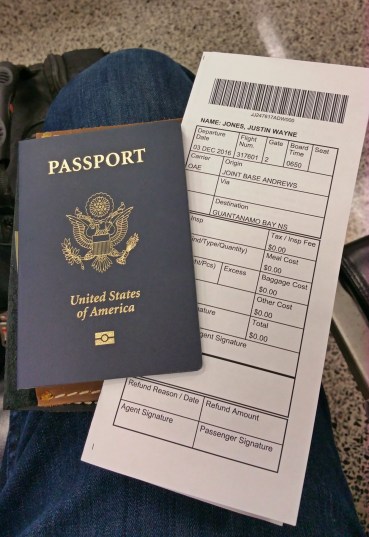
Andrews – awaiting my departure at 08:00. I was picked up, along with three other NGO Observers, at 04:00, at a hotel just outside of JBA. The check-in process was quick and very similar to checking into a civilian airport.

gitmo1

Boarding ticket

We are fly to Guantanamo Bay to monitor hearings in the case against Khalid Shaik Mohammad and four other alleged masterminds of the September 11 attack on the World Trade Center and the Pentagon. The flight is scheduled to depart at 08:00. The original departure time was 10:00. I heard that the flight was moved up two hours because the pilot would have been over hours for the day if the flight departed at 10:00.

The hearings are scheduled to run from December 5 – 9. I will be returning to JBA on December 1o.

I have met the other NGO’s Observers and distributed excerpts from the Guantanamo Bay Fair Trial Manual.

I will be departing soon, and my next post will be from Cuba.

Justin W. Jones (J.D. Candidate, ’18)
NGO Monitor, U.S. Military Commission Observation Project (MCOP)
Program in International Human Rights Law
Indiana University McKinney School of Law

Guantanamo Bay Hearing for USS Cole Bombing Suspect

Courtroom sketch of al Nashiri by artist Janet Hamlin. Today in court he was wearing a similar white jumpsuit.

Guantanamo Bay courtroom sketch of al Nashiri by artist Janet Hamlin. (copyright Janet Hamlin)

A U.S. Military Commission at Guantanamo Bay, Cuba has scheduled pre-trial hearings next week in the case against Abd al-Rahim al-Nashiri, who allegedly masterminded the 2000 USS Cole bombing that killed 17 U.S. sailors off the coast of Yemen.

At pre-trial hearings defense and prosecution lawyers routinely debate evidentiary, jurisdictional, logistical and other issues, and deal with matters such as what evidence will be admissible at trial, which witnesses will be called and when, whether the court possesses jurisdiction to hear the case, and what date to set for the trial to commence.

What is typical (or atypical) about the al Nashiri pre-trial hearings, about his case itself, or about his plight before other tribunals that have or could exercise jurisdiction? Is his case more complex than others?

Multiple courts have either resolved issues related to charges against al Nashiri or have sought to resolve such issue, or to exercise such jurisdiction. These proceedings appear to have extended beyond routine evidentiary, jurisdictional or logistical issues.

Though the military commission judge identified issues to be debated next week (see his 12 August 2016 docketing order below), it is unclear what will be heard. Indeed it is unclear whether the hearings will go forward. al Nashiri hearings were stayed for almost a year, and when they were set to resume in April, they were abruptly postponed until now. Though many dozens of us are gathered in Washington, DC for a post-Labor Day flight from Andrews Air Force Base to Guantanamo, the hearings can be cancelled at any moment, even after we touch down at Guantanamo Tuesday afternoon.

The stakes are high, as proceedings in different courts could result in one, more or all the charges against al Nashiri being permanently dismissed.

The USS Cole after it was attacked by suicide bombers in October 2000 in Yemen. (Photo courtesy of United States Marine Corps)

The USS Cole after it was attacked by suicide bombers in October 2000 in Yemen. (Photo courtesy of United States Marine Corps)

al-Nashiri is charged with multiple war crimes, including perfidy, murder in violation of the law of war, attempted murder in violation of the law of war, attacking civilians, and attacking civilian objects. He faces the death penalty.

Courts’ jurisdiction

Several courts have exercised or sought to exercise jurisdiction over al Nashiri, that is, the courts have or have sought to resolve matters related to his detention or his alleged crimes.

First is the military commission itself at Guantanamo Bay. al Nashiri was picked up in 2002, held in secret CIA camps for about 4 years, taken to Guantanamo Bay in 2006, and arraigned in 2001 in a military commission. In that commission, he is charged with war crimes associated with the U.S.S. Cole and other ships. This commission is the primary court exercising jurisdiction over al Nashiri.

The D.C. Circuit Court of Appeals has also exercised jurisdiction, ruling on 30 August 2016 that it would not halt the Guantanamo commission against him. The defense had asked the appeals court stop the commission because the commission was not lawfully able to exercise jurisdiction. The appeals court chose not to decide the merits of the matter unless al Nashiri is convicted, at which time the appeals court would decide whether the commission had conducted a trial without jurisdiction.

The Court of Military Commissions Review (CMCR) issued a ruling in his Military Commission case in June 2016, and one in July.

The U.S. District Court for the Southern District of New York also has had a stake, as al Nashiri was indicted in that district but the case has not moved forward because Congress prohibited moving detainees to the U.S. for trial.

The European Court of Human Rights ruled that the government of Poland breached international human rights law when it permitted the U.S. to detain al Nashiri on Polish soil, where he was tortured. The court ordered Poland to pay al Nashiri over $250,000.

At the pre-trial hearings this week, the issue of jurisdiction will certainly arise.

al Nashiri

al Nashiri

Pre-trial Issues in his case

al Nashiri’s pre-trial hearings have touched on many issues.

Front and center recently have been jurisdictional issues, such as those discussed above handled by the DC Circuit and the CMCR, and also raised in the commissions.

Pre-trial issues have related to his treatment while in CIA black sites beginning in 2002 for 4 years, where the Senate Torture Report and other sources (including al Nashiri himself) have identified the following practices against al Nashiri – waterboarding (admitted by the government), mock executions, stress positions, and threats of sexual violence against his mother. Should a person be tried on criminal charges after being subjected to this treatment? Can any statements made by al Nashiri after such treatment be allowed as evidence in the trial against him?

Other pre-trial issues in his case or that may be raised include:

  • whether the U.S. can use as evidence the testimony of a man the U.S. killed (alleged co-conspirator Fahd al-Quso);
  • whether and to what extent the U.S. Constitution applies to al Nashiri’s military commission;
  • whether the right to a speedy trial was violated (over 13 years since al Nashiri was taken into custody and over 9 years since arriving at Guantanamo Bay — with the trial itself not commencing as of 2016 and no trial date set);
  • whether his right to humane treatment was violated (even regarding his Guantanamo housing situation – during these proceedings);
  • his right to have access to classified and other information that might be used against him at trial;
  • whether high-ranking military members engaged in undue influence;
  • the timely acquisition of defense lawyers’ security clearances; and
  • al Nashiri’s physical and mental health.

Much remains to be resolved before any actual trial is held.

At Camp X-Ray, Guantanamo Bay

At Camp X-Ray, Guantanamo Bay — George Edwards

My four 2016 summer trips to Cuba

This will be my fourth visit to Cuba in as many months, with three visits to Guantanamo Bay and one to Havana.

My first visit to Guantanamo Bay in this cycle was to monitor U.S. Military Commission pre-trial hearings in the case against Hadi al Iraqi, who is alleged to have been a high-ranking al Qaeda Iraq member, and to have liaised between al Qaeda Iraq and the Taliban. Hs is charged with various war crimes.

My Hadi al Iraqi monitoring mission was through the Military Commission Observation Project of the Program in International Human Rights Law of Indiana University McKinney School of Law. Our project seeks to attend, observe, analyze, critique and report on U.S. Military Commissions. We are producing the Guantanamo Bay Fair Trial Manual, which is used and usable by any person interested in assessing whether the rights and interests of all military commission stakeholders are being afforded to them. We are interested in the rights of the defendants. We are also interested in the rights and interests of the prosecution, the victims and their families, the media, the guards and other prison personnel, witnesses, and others.

Edwards on U Boat Crossing Guantanamo Bay - 14 August 2016 - the morning that 15 detainees were released to the UAE, bring the total GTMO population down 20 from 76 to 61

Edwards on U Boat Crossing Guantanamo Bay – 14 August 2016 – the morning that 15 detainees were released to the UAE, bringing the total GTMO detainee population down 20 percent from 76 to 61

On my second trip to Cuba this summer I was part of a delegation from the National Bar Association (NBA), which is the organization principally for African American lawyers, judges, law professors, and other legal professionals. An NBA conference was held jointly with the Cuban bar association, focusing on a wide range of U.S. interests and Cuban interests, and interests affecting both countries. The topic of Guantanamo Bay came up repeatedly in our discussions with Cuban judges, lawyers and law professors. I also gave a lecture at the U.S. Embassy – Havana.

NBA - Ambassador's Residence - law profs and deputy ambassador

NBA law professors at Residence of U.S. Ambassador to Cuba, with Deputy Ambassador

My third trip to Cuba this summer was in August for a Guantanamo media tour. When I arrived on Guantanamo at noon on Saturday, 13 August 2016, 76 detainees were imprisoned there. When I left Guantanamo at noon the next day, Sunday the 14th, only 61 detainees remained. During the darkness of night, 15 detainees were released to the United Arab Emirates (UAE). That resettlement marked a 20% drop in the Guantanamo Bay detention population over night.

NBA - Group of law professors at end

NBA law professors at Cuban lawyers collective.

Writing projects of mine I was researching at Guantanamo on that third trip include The Guantanamo Bay Reader and a contributions to The Indiana Lawyer.

This fourth trip to Cuba is to monitor the al Nashiri hearings pursuant to our Indiana McKinney School of Law observation program.

More about all of the above (and below) is available on http://www.GitmoObserver.com.

Docketing Order – Motions on the schedule to be heard

The Military Judge in the al Nashiri case on 12 August 2016 issues a Revised Docketing order, outlining the proposed program for the 3 days of scheduled hearings this week (7 – 9 September 2016). Here is that order.

[office src=”https://onedrive.live.com/embed?cid=AA02978A4AC8C787&resid=AA02978A4AC8C787%21167&authkey=AFSd734PKQgcS9U&em=2″ width=”876″]

My travel to observe Guantanamo Bay hearings in the case against alleged 9/11 plotters

Klein & Edwards at Ft. Meade Commisary -- 18 July 2016

At the Ft. Meade Commissary.

 Today I traveled to Ft. Meade, Maryland to observe pre-trial hearings in the criminal case against 5 alleged masterminds of the 9/11 attacks on the World Trade Center and Pentagon. The hearings are being broadcast live from Guantanamo Bay, Cuba, into the Post Theater at the Fort Meade Army Base, and can be viewed there by media, human rights non-governmental organizations (NGOs), victims and victims’ families, and other stakeholders.

I traveled there as an official NGO Observer sponsored by the Military Commission Observation Project (MCOP), which Professor George Edwards founded at Indiana University McKinney School of Law. Our Project, which is also referred to as the Gitmo Observer, has sent dozens of IU McKinney Affiliates — faculty, staff, students and graduates  — to Guantanamo Bay, Cuba and Ft. Meade to attend, observe, analyze, critique and report on these hearings.

My trip to Maryland – Sunday

I flew to Maryland last night, and had time to re-review the wealth of background material the Project provided.  One important resource is the Guantanamo Bay Fair Trial Manual – with lead author Professor Edwards, and whose researchers have included many IU McKinney affiliates. The Manual provides significant information — general and basic, as well as highly specialized information — about the military commissions. It summarizes the applicable law, explains the charges, identifies the individuals and entities who have rights and interests associated with the tribunal, describes a plan that Observes might follow as they carry out their observation mission, and even provides a chart of a who’s who in the courtroom. The Manual is a must read for anyone interested in Guantanamo Bay hearings.

Dean Klein & Professor Edwards in front of the McGill Training Center, the new site for Guantanamo video viewing.

We are in front of the McGill Training Center, the new site for Guantanamo video viewing.

Closed hearing – Monday morning

Early this morning I met Professor Edwards at the hotel, and discussed final details before we went to the army base, which happens to be the home of the National Security Agency (NSA) and other intelligence entities.

We were forced to modify our plans to observe hearings of Khalid Shaikh Mohammad (who was waterboarded 183 times) and the other 4 defendants accused of planning the September 11th attacks. We learned that the military judge decided that today’s hearings would be “closed”, meaning that Observers were not permitted to observe. I was disappointed that I would not have a chance to witness today’s hearings. But, it was still a very worthwhile trip.

 What we did at Ft. Meade – hurdles & highlights

The day had highlights and hurdles.  I’ll mention some below.

First, Fort Meade recently instituted security procedures that require new visitors to stop at the Visitor Center at the base’s Main Gate (Reece Road Gate) and collect a hard plastic badge. Ordinarily Observers would submit their personal information 10 days before they arrive for a hearing, and can pick up their sturdy badges quickly at the Visitor Center.  These procedures apply not only to military commission observers, but also to anyone with business on the base, and includes civilians visiting family.

We arrived at the Visitor Center to pick up my badge. We had quite a wait. There were dozens of other people also seeking to get badges. I was grateful that Professor Edwards had a permanent Ft. Meade badge, which made it easier for me to get processed in.  The good news is that once you get cleared, you can swipe your badge at any of the gates and drive onto the base, directly to the viewing site.

A word to the wise for IU  McKinney Affiliates who plan to observe Guantanamo Bay hearings at Fort Meade:  Bring your drivers’ license and passport, and arrive early.

Dean Klein reading a copy of the Guantanamo Bay Fair Trial Manual -- Volume I.

The Guantanamo Bay Fair Trial Manual is an invaluable tool to help prepare for an Observation mission.

Second, after I gained clearance to enter the base, Professor Edwards and I went to the McGill Training Center, which will soon be the new permanent site for video observations of Guantanamo proceedings.  (Until now, all the video hearings were broadcast into a large auditorium at the Post Theater, where they show feature films in the evenings and on weekends.)  A staff member escorted Professor Edwards and me through the training center, and explained that the site change had been made for several reasons, including the ability to move hearings to a variety of different rooms to enhance security by keeping exact screening locations unknown until the hearings take place.  Most of the rooms at the training center are also much smaller than the Post Theater auditorium, which may make sense since at times only a small number of Observers attend hearings on the base.

Outside the Post Theater, where "Central Intelligence" was being screened -- $6.00 for adults, and $3.50 for children.

Outside the Post Theater, where “Central Intelligence” was being screened — $6.00 for adults, and $3.50 for children.

Third, Professor Edwards and I went by the Post Theater, where many IU McKinney Affiliates have viewed Guantanamo proceedings. Unfortunately, the doors were locked and we couldn’t go inside. But, based on what I have heard about the actual theater – that happens to be showing the PG film “Central Intelligence” now (see photo) – it’s very much like a Broadway theater with a big screen set up on the stage to show the Guantanamo Bay feed.

Fourth, Professor Edwards was able to brief me on the status of the Khalid Shaikh Mohammad 9/11 hearings, the substance of some of the upcoming motion hearings that I had hoped to observe today, other cases pending for trial, and the one convicted detainee who is awaiting sentencing.  He also briefed me on the Periodic Review Board (PRB) that he observed at the Pentagon on Thursday the 14th, in which a Libyan detainee asked the Board to send him back to Libya or to a third country for resettlement. That PRB observation is through the IU McKinney Periodic Review Board Project.

Fifth, it was good to tour the facilities mentioned above. It was also interesting to drive around the base, appreciate its size and the breadth of work performed there.

Klein at Ft. Meade - in front of Post Theater sign - 18 July 2016

Another shot in front of the Post Theater

Conclusion

Although I was disappointed that I could not observe a hearing today, I am glad that I made the trip, and I am proud that the McKinney School of Law and our Military Commission Observation Project provides this very special opportunity to members of our community.

Every IU McKinney Affiliate – faculty, staff, student, graduate — is invited to register for the possibility of undertaking an Observer mission to Ft. Meade, or to Guantanamo Bay, Cuba, itself.  Details about this process can be found here.

By Andrew (Andy) Klein

Dean & Beam Professor of Law

Indiana University McKinney School of Law

Posted by George Edwards on behalf of Dean Klein

_______

Indiana Law Dean Travels to Ft. Meade for Guantanamo Bay, Cuba Hearings

Klein & Edwards at Ft. Meade Commisary -- 18 July 2016

Dean Klein (right) and Professor Edwards at the Ft. Meade Commissary.

Andy Klein, dean of the Indiana University McKinney School of Law, traveled to Ft. Meade, Maryland to observe war crimes hearings broadcast live from Guantanamo Bay, Cuba. Dean Klein was an official Non-Governmental Organization (NGO) Observer, sponsored by IU McKinney’s Military Commission Observation Project (MCOP), that was founded by Professor George Edwards, who joined Dean Klein on this observation mission.

The Pentagon granted the IU McKinney project permission to send IU McKinney Affiliates — students, faculty, staff, and graduates — to Guantanamo Bay to view proceedings live and to Ft. Meade to view via secure video feed. Dean Klein is the most recent of the dozens of IU McKinney Affiliates selected for observation missions, during which they attend, observe, analyze, critique and report on these hearings.

Klein & Edwards at Ft. Meade Post Theater -- 18 July 2016

Dean Klein & Professor Edwards at Ft. Meade’s Post Theater, where war crimes hearings from Guantanamo Bay are viewed during the day, and “Central Intelligence” and other movies are viewed at night.

This week’s pre-trial hearings, scheduled for 18 – 22 July, are in the criminal case against five alleged masterminds of and participants in the 9/11 attacks on the World Trade Center and Pentagon. They include Khalid Shaik Mohammed, who is the alleged chief architect of the 9/11 attacks, along with four others including alleged would-be hijackers who were prevented from participating due to visa denials and other reasons, men who allegedly transferred money for the flight training for hijackers, and men who otherwise assisted in the plot that resulted in almost 3,000 dead. Their charges include murder in violation of the laws of war and hijacking.

Typically, first time NGO Observers, such as Dean Klein, stop at the Ft. Meade Visitor Center to gain clearance and then pick up a badge to enter the base.

Dean Klein noted that though they arrived early to pick up his badge they had “quite a wait, made longer because they didn’t have my original paperwork submitted weeks ago and I had to re-register on the spot. Also, there were dozens of other people also seeking to get badges. Fortunately Professor Edwards already had his permanent Ft. Meade badge, which made it easier for me to get processed in.”

Dean Klein & Professor Edwards in front of the McGill Training Center, the new site for Guantanamo video viewing.

Dean Klein & Professor Edwards in front of the McGill Training Center, the new site for Guantanamo video viewing.

After the badging process, NGO Observers then travel to the base’s secure viewing site, which has been the Post Theater (that also shows feature films on weekends), but is shifting to the McGill Training Center, also on the base.

When Dean Klein and Professor Edwards arrived at the viewing center, it was confirmed that the military judge presiding over the 9/11 case had decided that today’s hearings would be “closed”, meaning that NGOs Observers were not permitted to observe.  Both Dean Klein and Professor Edwards noted that despite the absence of an open hearing, the pair had a productive morning at Ft. Meade.

Dean Klein said “I was disappointed that today’s hearings were closed. But, coming to Ft. Meade has offered great insights into our Military Commission Observation Project, and the contributions of IU McKinney on the topic of rights and interests of all Guantanamo Bay stakeholders. Our trip to Ft. Meade was very worthwhile.”

Professor Edwards said “If the hearings had been open, Dean Klein and I would not have been able to tour facilities that would have been unavailable during an open session, and we would not have been able to talk with people who would have been otherwise engaged during an open hearing. Our behind-the-scenes experience at Ft. Meade was enlightening, and would not have been possible had we been watching video feed from Guantanamo that day”.

All IU McKinney Observers contribute to the Guantanamo Bay Fair Trial Manual, of which Professor Edwards is the main author, that provides significant information — general and basic, as well as highly specialized information — about the military commissions. The Manual also contains information about Guantanamo Bay Periodic Review Boards, special proceedings held at Guantanamo Bay and viewable on video at the Pentagon, during which Guantanamo detainees may request repatriation to their home country or resettlement in a third country.

Dean Klein reading a copy of the Guantanamo Bay Fair Trial Manual -- Volume I.

Dean Klein reading a copy of the Guantanamo Bay Fair Trial Manual — Volume I.

The Manual summarizes the applicable law, explains the charges, identifies the individuals and entities who have rights and interests associated with the tribunal, describes a plan that Observes might follow as they carry out their observation mission, and even provides a chart of a who’s who in the courtroom.

Dean Klein said: The Manual is a must read for anyone interested in Guantanamo Bay hearings, and a special must read for anyone doing an Observation mission to Ft. Meade or Guantanamo Bay.”

Dean Klein summarized his Ft. Meade experience, and his recognition of Professor Edwards and his Guantanamo Bay work:

Although I was disappointed that I could not observe a hearing today, I am glad that I made the trip, and I am proud that the McKinney School of Law and our Military Commission Observation Project provides this very special opportunity to members of our community.

Professor Edwards noted that “every IU McKinney Affiliate – faculty, staff, student, graduate — is invited to register for the possibility of undertaking an Observer mission to Ft. Meade, or to Guantanamo Bay, Cuba, itself.  Details about this process can be found on the IU McKinney website. We hope that our Affiliates may also be able to observe Periodic Review Boards at the Pentagon, and we will post notices if Pentagon observation opportunities become available to assist out Periodic Review Board Project”.

_______

Libyan Detainee Requests Release from Guantanamo

GTMO - ismael-ali-farag-al-bakush - ISN 708 -- 1

Ismael Ali Faraj Ali Bakush, Guantanamo Prision # ISN 708, asked Board to release him

This morning, Ismael Ali Faraj Ali Bakush (ISN 708), who is a Guantanamo Bay detainee from Libya, pleaded to a group of U.S. officials that he is not a threat to U.S. national security, and he should be repatriated to Libya or resettled in a 3rd country. Bakush is around 47 or 48 years of age, and has been held at Guantanamo Bay for a month shy of 14 years. Today he argued for his freedom from the prison, where he has lived for almost a third of his life.

This hearing, which is called a Periodic Review Board (PRB), was conducted pursuant to a 2011 Executive Order which has required most detainees to have a “periodic review” of their detention status. Though Bakush has had similar reviews under now defunct processes, this is his “initial review” (or “initial PRB”) under the 2011 procedure.

If a detainee is cleared for release after his initial review, he would have no additional hearings. If he is not cleared for release he would have a “file review” every six months. If he remains uncleared, he would have a “full review” every three years.

About 60 the 76 men remaining captive at Guantanamo are entitled to PRBs per the rules, and about 55 have had an initial review. Many who have had initial reviews were subsequently cleared for release, and many of those have actually been released post-initial review.

PRBs do not assess the defendant’s guilt or innocence, and are not criminal proceedings.

Getting to the PRB hearing; the other observers

Bakush’s initial review today was likely similar to the 55 or so initial reviews held since the 2011 Executive Order was implemented in 2013. Today’s PRB was my first, having multiple times been denied permission to observe. I had some sense of what to expect, having read reports from media and non-media representatives who had viewed earlier PRBs, but I also believe that the more qualified people who observe the proceedings first hand, the greater the transparency.

I was up early to take the Metro from DC to the Pentagon, which is where PRB observation takes place now, rather than its earlier viewing location at a Virginia building near the Pentagon. It was suggested that we arrive at the Pentagon not long after 7:00 a.m., to be certain that all security and other formalities would be completed so we could adjourn to a special conference room before the 9:00 scheduled PRB start.

When I was at the Pentagon a few months ago, the new Visitor Entrance was under construction, and it was cramped and unwieldy to gain access to the mammoth facility. The new Visitor Entrance is markedly updated and spacious, with significantly more x-ray machines and other security measures in place. Though no clear signage instructed visitors to the appropriate queues (e.g., no sign for the uniformed military personnel line or the “other” line), it was still quite easy and quick to be processed – at least at that hour on a Thursday morning.

After clearing security, I entered into the Visitor Waiting Area (after another guard made certain that I still had the Visitors Badge that had been handed to me just a few yards before I passed through the airport-like metal detectors), where I was soon joined by what appeared to be contractors, uniformed military personnel, a high school group, an ROTC group, a group of dozens of Japanese military personnel clad in crisp white uniforms, and others – waiting to be escorted into the Pentagon proper.

Two representatives from the Periodic Review Secretariat (PRS) came to collect the 5 non-media observers, and we all processed into the main complex and walked down multiple hallways in the Pentagon maze. Though I know the names of our escorts, and the name of the offices that housed the conference room where we observed, out of an abundance of caution, I will not provide details of them.

The 4 other observers consisted of a an undergraduate intern from a different DC-based organization, a person who had graduated from law school a year or so ago and was working for a DC-based organization, an investigator from a DC-based organization along with that person’s undergraduate intern. I did ask myself about the observer selection process, taking into account the rounds of application submission / denial / application supplements I went through to get cleared for 2 specific hearings only.

Coincidentally, I knew one of the other observers from another organization with which she had been previously affiliated.

pentagonReaching the Pentagon hearing room

We observers and our military escorts snaked our way down multiple, high-ceilinged corridors in the complex, passing pale nondescript doorways and archways that led to seemingly reinforced entry points into high-security areas. We arrived at the door of an office that looked like a typical government office like those I had seen in any number of other Departments or Agencies – standard desks and chairs, file cabinets and computers, and clutter.

no-electronic-devices-clipart-1Off to the side of that office was a door leading into what I would learn was the conference room where we would observe the hearings. Before reaching that conference room door, we had to relieve ourselves of our electronic devices – phones, laptops, iPad, Fitbit – anything with an on / off switch. We placed all of our items on a table.

Several of us went on a Starbucks run, down to the Pentagon’s expansive restaurant area. It was like any other Starbucks, except that while standing in line our group could not fiddle with our mobile phones, as we had already been liberated of them. It gave me a chance to become reacquainted with the young lawyer observer whom I had met before.

Getting situated in the hearing room

After refreshments, we winded our way back to the nondescript office. It was almost 9:00, the time for the PRB to begin.

We filed past the table that held our electronics, and entered the conference room. We sat around a conference room table that seemed to have just enough seats for the 5 observers, our escorts and a couple of other Department of Defense people who joined us, both uniformed and non-uniformed.

The observers all were required to sign another document (in addition to the Ground Rules we previously signed), this one swearing that we knew the rules related to SCIFs — sensitive compartmented information facilities – and that we were complying with those rules, including not having recording devices in our possession. Another reminder to us to double-check our pockets for extra mobile phones, etc.

This conference room was very small, packed with the conference table and chairs, and lots of other equipment occupying almost every square inch of the room’s real estate, including, as I recall, the walls.

There was a big screen on one wall, positioned such that almost no one in the room had a natural, straightforward view of it. I chose a seat from which at least I didn’t have to turn my body to see the screen.

As 9:00 got closer, the Observers shared small talk. Others in the room sat quietly doing their jobs related to the technical aspects of the hearing, or maybe perhaps observing the observers–I’m not sure.

The Guantanamo side of the camera – the PRB begins

Initially I sought to absorb the environment of the room, but I also focused on signing the SCIF form and exchanging pleasantries with fellow observers (Have you attended a PRB before? You’re a college junior – do you plan to go to law school? What issues are you working on as a summer intern at your organization?)

All of a sudden, we began to hear distant voices over the web-shaped speaker nestled in the center of the conference room table. Audio checks.

Almost precisely on time, the screen came to life. We could see a small, barren-walled claustrophobic room in which sat a very small rectangular table with 3 chairs, which was surrounded by 3 men.

For all PRBs the detainee is physically in Guantanamo Bay. During the hearing, he sits at the head of the rectangular table on the Guantanamo Base, flanked by a linguist who sat at a place setting on one side of the table. The linguist sits directly across from the detainee’s Government-appointed personal representative. Seated on 3 sides at the end of a rectangular table, the arrangements would have been suitable for a shared meal among the 3, or board games. Had Bakush had private counsel, perhaps that person would also have sat at the table.

A video camera is pointed towards the three sitting at the Guantanamo table. The camera faced Bakush head on, and captured the right side of the face of the linguist’s and the left side of the face of the personal representative. The linguist and the personal representative had to turn their heads slightly to see and speak directly into the camera.

At 9:08, a few minutes past the appointed hour, the hearing began.

Eyes naturally gravitated to the focus of the hearings – on Bakush. He appeared hunched forward over the stack of white papers on the table, dressed in white gown flannel-like top that may have been local to Libya. His full, long, seemingly dark beard appeared to touch the table as he leaned forward. The screen appeared to be a little fuzzy, so I cleaned my glasses. The screen was still fuzzy, with the faces a bit blurred.

Bakush’s facial expressions appeared not to change dramatically throughout the 13-minute hearing. It was impossible to know whether he understood what was being said or read, as virtually the entire hearing was conducted in English, and I do not know if he understands English. He waived reading of the unclassified government document in Arabic.

Was Bakush emotionless during the PRB? Was he detached or interested? It is impossible to know what was going on in his mind, and it does not do justice to try to read what could be made out of his expressions, his mannerisms, or his posture.

As documents were being read into the record in English, Bakush from time to time would flip through white papers sitting in front of him on the table. I do now know what, if anything, was written on those sheets, or what language any text might have been. Perhaps those pages contained his own personal statement that he would read into the record later? The observers were not permitted to stay in the room while he, through his own mouth, made his personal plea for release from Guantanamo.

A distant voice was heard listing out the titles / roles of various people who were present at the hearing, either at Guantanamo in the hearing room, or elsewhere.

Others present for the hearings included members of the “Board” itself that conducts the PRBs, and that consisted of one representative each from the Departments of Defense, State and Homeland Security; the Joint Chiefs of Staff; and the Office of the Director of National Intelligence. Presumably each of those representatives watched remotely in his or her office in the DC area. Also present for the hearing were the Legal Advisor to the Board; the Case Administrator; a Hearing Clerk; and a Security Officer, though it is not clear where these individuals were located at Guantanamo Bay or elsewhere.

The PRB hearing itself

The PRB hearing itself lasted a total of about 13 minutes. The clock on the wall had a time different from the time announced by the distant voice piped in through the speakers, and those times were different from the time on my watch. I didn’t catch the precise number of minutes. I thought I would be able to see the time on the transcript, but the Pentagon posted a notice indicating that Bakush requested that the public transcript of his hearing not be posted online.

Suffice it to say that the hearing was very short.

After the roll call of attendees that began the hearing, a voice said something like this — “This board is called to order. This board is convened to determine whether continued law of war detention is warranted for detainee [Ismael] in order to protect against a continuing significant threat to the security of the United States.” [Quote based on notes and was not verified as the transcript was not available on the PRS website online after the hearing.]

The first document read into the record, in English, was the Government’s Unclassified Statement. It was read by a woman who did not appear on camera. It answer the question of who does the U.S. Government believe Bakush is and what does the U.S. Government believe Bakush did. Essentially, the Statement summarized reasons that the U.S. believed that Bakush poses a continuing threat to U.S. National Security.

Government views on “Who is Bakush”?

First, it should be noted that the allegations that the government made against Bakush in its unclassified summary are not criminal charges. That is, the government has not levied any criminal charges against him in the Guantanamo Bay U.S. Military Commissions. These allegations related to the Government’s assessment as to whether Bakush is a threat to US national security and whether he should be released from detention.

The unclassified summary document alleges that Bakush alleges in definite terms that Bakush “was a Libyan Islamic Fighting Group (LIFG) explosives expert who trained al-Qaida members”, and he “developed close relationships with several al Qaida leaders and provided explosives training to LIFG and al Qaida operatives, including some who later conducted attacks in Kuwait and Morocco”.

A number of other allegations against Bakush were couched in more tentative terms, such as “probably” – he “probably” “associated with and provided operational support to” key al Qaida figures. He “probably” was in Afghanistan from 1991 – 1994, and again starting in 1998.. He “probably helped” al Qaida, and “communicated regularly with prominent” al Qaida figures, including “possibly” Abu Zubaydah and “probably” senior al Qaida leader Abu Faraj al-Libi. However, using stronger language, one allegation was that he “almost certainly” “plotted to kill Libyan leader Moammar Qadhafi”

The full text of the Government’s Unclassified Statement follows:

[office src=”https://onedrive.live.com/embed?cid=AA02978A4AC8C787&resid=AA02978A4AC8C787%21151&authkey=AGBmMjobHPhhryo&em=2″ width=”876″ height=”688″]


Bakush’s Government Appointed Opening Personal Statement

Bakush’s U.S. Government-Appointed Personal Representative, dressed in fatigues, said in his Opening Statement that he was “presenting “Bakush’s case this morning”. He said that Bakush had “been cooperative and receptive while meeting with me”, and that Bakush “is eager and excited to begin a new chapter in his life.” He said that Bakush “has learned to be more opened minded [sic], tolerant and accepting to others while living in a communal living setting”, and that Bakush “believes that his communal living arrangement allows him more opportunities to gain exposure for himself to other detainees’ cultural and religious backgrounds”, and as a result, Bakush “now respects and values the opinions of others from various cultural backgrounds”.

The Personal Representative said that he “was not able to contact [Bakush’s] family, but understand from our discussions that his mother has properties that would enable her to offer [Bakush] financial support. His cousin is employed and is also willing to help [Bakush] financially”. It was not mentioned why the Personal Representative was unable to contact Bakush’s mother, to find out firsthand about the “properties that would enable her to offer [Bakush] financial support”, or could not contact the employed cousin who “is also willing to help [Bakush] financially. Would it be practicable to release Bakush based on his being able to receive family assistance, if the Personal Representative is unable to contact these family members?

The Personal Representative spoke about how Bakush “enjoys watching and playing many sports such as soccer and swimming”, has taken classis in health and life skills, and enjoys cooking for others. Bakush “would like to work in the restaurant industry”. He looks forward to having his own family, and to raising children of his own. He would prefer to live in an Arabic speaking country, but “is willing to relocate to a country that provides him opportunities for a successful future”. He is “willing to participate in a rehabilitation or reintegration program as well”.

Then, the Bakush’s US Government-Appointed Personal Representative of Bakush read the Personal Representative’s Opening Statement, the full text of which follows:

[office src=”https://onedrive.live.com/embed?cid=AA02978A4AC8C787&resid=AA02978A4AC8C787%21148&authkey=AIRpgxkmHfAsWkY&em=2″ width=”876″ height=”688″]


The following document appeared on the PRS website following the hearing, and indicates that Bakush requested to not have his own written PRB statement published to the website:

[office src=”https://onedrive.live.com/embed?cid=AA02978A4AC8C787&resid=AA02978A4AC8C787%21150&authkey=AOOGj3FqDg3mxgw&em=2″ width=”876″ height=”688″]


The following document appeared on the PRS website following the hearing, and indicates that Bakush requested to not have the transcript of his PRB published to the website.

[office src=”https://onedrive.live.com/embed?cid=AA02978A4AC8C787&resid=AA02978A4AC8C787%21149&authkey=AOVSb2TjxjzeO_c&em=2″ width=”876″ height=”688″]


FYI, the New York Times has posted http://projects.nytimes.com/guantanamo/detainees/708-ismael-ali-farag-al-bakush/documents/115 documents related to this detainee, and prior reviews for possible release:

  1. Combat Status Review Tribunal (CSRT) Summary
  2. Administrative Review Board (ARBs) (3 documents)
  3. Joint Task Force – Guantanamo (JTF-GTMO) Assessment

George Edwards

_______

31 May 2016 Hearing in 9/11 Case — Tuesday At Camp Justice, Guantanamo Bay, Cuba


9/11 lead defendant Khalid Shaik Mohammad, in the Guantanamo Bay courtroom. (Sketch by Janet Hamlin)

9/11 lead defendant Khalid Shaik Mohammad, in the Guantanamo Bay courtroom. (Sketch by Janet Hamlin)

Today’s hearings in the 9/11 case started on time in the Guantanamo Bay courtroom.

Defendants KSM, Ramzi bin al Shibh, and Ali Abdul Axis Ali (aka Ammar al Baluchi or “Triple A” or “AAA”) were present when I walked into the Gallery.  The other two defendants chose not to appear, which is not uncommon.

The Gallery is a small room with soundproof clear glass through which NGO Observers, Victim’s Family Members, Media, and other visitors are able to watch the hearings.  The Gallery has several televisions that show the hearings, with audio on a 40 second delay.  We can see what is happening live through the Gallery glass, and 40 seconds later see what we just saw on the TV.  It is only through the TV that we can hear what happened in the courtroom, 40 seconds after it actually happened.  The purpose of the delay is to prevent the release of classified/confidential information.

There is a curtain in the Gallery separating separating the media and Non Governmental Organization (“NGO”) observers from the victims and victims’ families.  The curtain is usually not in use. I have already written about the selection and approval process which allowed me to attend these hearings as an NGO observer. Victims and Victims’ family are chosen based on a lottery system.

Today’s Motions

The day’s hearing touched on three sets of motions:

  1. AE 018: The hearings on these motions deal with how certain information is treated and released to either the parties or nonparty actors.  I believe there were a total of 13 AE 018 motions on the docket for the week’s hearings.
  1. AE 422: The 422 motion was filed by the Government. The Government seeks the deposition of family members of the victims of September 11, 2001 during public pre-trial hearings scheduled for 4-14 October 2016.
  1. AE 133: This motion was filed by the Defense. It is an Emergency Motion to Remove Sustained Barrier to Attorney-Client Communication and Prohibit any Electronic Monitoring and Recording of Attorney-Client Communication in any Location, including Commission Proceedings, Holding Cells, and Meeting Facilities and to Abate Proceedings.

All the filings related to each motion can be found on the military commission website. Howeve,r not all will be public. http://www.mc.mil/CASES/MilitaryCommissions.aspx

 AE 018

I will not discuss each motion that falls under AE 018, but generally they deal with how communications and information can be released, how those communications are reviewed by the various security processes, and the format and timeliness of prosecution’s discovery responses.  There are processes in place for the how various communications are to be reviewed and delivered, however the processes continue to evolve as the litigation continues.  The discussions on these motions appear to be good examples of the types of issues that have delayed the 9/11 trial.  A few of the specific AE 018 motions are:

  1. AE 018 BB: Government Emergency Motion for Interim Order and Clarification that the Commission’s Order in AE 018U Does Not Create a Means for Non-Privileged Communications to Circumvent the Joint Task Force Mail System.
  2. AE 018EE: Defense Motion to Compel Discovery Responsive to Mr. Mohammad’s Request for Discovery Dated 14 March 2014. (emphasis added)
  3. AE 018 KK: Defense Motion to Invalidate Non-Legal Mai Restrictions Unrelated to Legitimate Penological Interests.
  4. AE 018MM: Defense Motion to Compel Reasonable Privilege Review Team Hours of Operation.

AE 422

This motion was filed by the prosecution to conduct depositions of certain witnesses. Specifically, the prosecution seeks to depose 10 victims’ family members during the October 2016 hearing. The prosecution wants the depositions conducted in open session at Guantanamo Bay, during the October 2016 hearing.  The prosecution cited ages and health concerns, the uncertain posture of the case, and the logistical difficulties for potential witnesses to travel during the actual trial.

The defense generally agreed with the need for depositions but expressed expected concerns about holding the depositions in open court and the proposed dates.  The defense teams were not all on the same page with respect to the deposition issue, but some of the arguments expressed by the defense were:

  • public hearing will taint potential panel members (jury)
  • there is no need to preserve the testimony because there are so many witnesses
  • the age and health of potential witnesses is not a factor
  • there is no need to have the depositions in open court if the evidence may never be admitted
  • if the prosecution wants to preserve evidence for the elderly and those in poor health, bringing them to Guantanamo Bay would be counterproductive
  • it does not make sense to have public depositions so close to the election
  • there is a difference between having the victims’ voice heard and presented vs. creating a public spectacle

I tend to side with the defense, and if I were to bet, I would bet that depositions will take place, but not in open session and not during the proposed dates. A very recent article by Carol Rosenberg on this issue.

AE 133

This is an ongoing motion dealing with allegations that the government has been trying to pierce the attorney – client privilege.  The defense is concerned that they are subject to monitoring which prevents frank exchanges between the attorney and the client.  The motion stems from the finding of microphones in fire detectors in rooms that were used for attorney/client meetings.

I suggest reading the AE 133 motions on the military commission website.  The discovery of these microphones is documented.

The prosecution stated that while the recording capabilities were present, they were not used during attorney/client meetings. The prosecution stated that while the microphones were used for other law enforcement purposes in the past, they have not been used to monitor attorney/client meetings related to these trials.

Mustafa_al-Hawsawi_2012My Personal Observations

One issue that stood out for me was the AE 018MM Motion.  This motion was filed by the defense to compel the Privilege Review Team (“PRT”) to have reasonable hours of operation.  The Privilege Review Team, among other duties, reviews all documents that are taken to a detainee, including any notes attorneys may bring to an attorney client meeting.  If the PRT is not operating, then the team of attorneys cannot take any notes into the meeting.  Counsel for Hawsawi told the Judge that the PRT was not “open” on the Saturday and Sunday before Monday’s (Memorial Day) hearing, so they had to meet with their client without being able to bring any notes.  To me, this sounds outrageous.  How is it possible that a team of attorneys who are only able to see their client during very limited hours, after chartering a military flight that flies infrequently, are not able to bring in notes to a client a day before the hearing just because staff of the Period Review Team did not want to work?

I was initially “convinced” by the defense arguments. However, the prosecution presented a different side to the story.

The prosecution argued that PRT staff are like any other employees and it is not unreasonable for them to have the weekend off, especially a holiday weekend.  Additionally, the prosecution stated that the PRT is available as long as appointments are made in advance.  Prosecution also stated that it is not uncommon for the defense team to not show up to scheduled appointments.  After the prosecution presented their argument I was less outraged, and more confused.

I noticed this sway in many of the arguments I have seen in my limited experience with the Military Commission: the movant pulls on emotional strings and presents facts that help their case, the opposing party presents facts in a way that appear to be unemotional and paint a fuller picture.  In the end, I am happy I don’t have the burden of having to make a decision.  Having only been at Guantanamo Bay for a few days, and only being able to see what I am allowed to see, I find it very difficult to have a strong opinion one way or the other.  It is difficult to gather unbiased information because of the emotions and passions tied to the subject matter.  Information I receive could be driven by agendas that I do or do not understand.  I have made an effort to keep a neutral point of view in order to allow me to gather as much information as possible before I start to lose impartiality.

AE 422

The hearing on AE 422 was understandably emotional.  The curtain separating the media and NGOs from the victims’ family members was drawn shut.  The parties argued about the prosecution’s motion to depose, in public court, family members of the 9/11 victims.  One particular testimony would revolve around a telephone conversation occurring as a plane hijacking was taking place, just before United 175 flew into the South Tower.  The arguments went into additional details, which I will not do here, but the hearing’s transcript is available on the website of the Military Commission.

KSM was also emotional.  He, without the Judge’s permission, expressed his feelings regarding the proceedings.  I could not make out everything that was said but part of it dealt with the fact that his attorney is an American person and is representing American interest, which is not neutral.  Judge Pohl responded with, “one more word and you’re leaving”.   Later, Mr. Nevin (Lead Counsel for KSM) explained that his client was upset because an objection was overruled and that a lack of an interpreter prevented the defendant from understanding the meaning of “deposition”.

Wednesday

On Wednesday the Commission held hearings open to NGOs, Media, and Victims’ of Family Members in the morning session; the Commission held closed session in the afternoon.  I will write about these later, but I need to get some rest before the hearings tomorrow.  The hearings tomorrow are scheduled to include two witnesses.  Both of the witnesses are high value detainees who have not been charged with a crime.  They will testify during the hearing on AE 152 which is the Emergency Motion for Show Cause Why the Government, JTF Camp Commander and JTF Guard Force Members Should Not Be Held in Contempt.  The motion’s allegation is that Mr. Bin al Shibh continues to be subjected to external sounds and vibrations while detained.  Hassan Guleed is expected to testify at 10 in the morning and Abu Zubaydah is expected to testify at the start of the afternoon session.

Leontiy Korolev, J.D., Indiana University McKinney School of Law

Participant, Military Commission Observation Project (MCOP), Program in International Human Rights Law (PIHRL), Indiana University McKinney School of Law

A Day Exploring Guantanamo Bay

DSCN1808

The view of the bay in front of the Jerk House, coffee shop and the Tiki Bar.

Today the court in the 9/11 case was in closed session all day to discuss confidential information. We were not allowed to attend the hearing and instead were left  spend the day at our own leisure (with our awesome coast guard escorts to take us around the island). I took advantage of the opportunity to sleep in until a little past 8am and then joined several of my fellow observers to grab a coffee at the shop known as the “Starbucks” (the shop has another name, but everyone seems to call it Starbucks) right by the Jerk House. A few nights ago I had the best jerk chicken I have ever had outside of Jamaica at the Jerk House.


DSCN1814

Relaxing on Windmill Beach near the now closed Camp Iguana

It was time for my first visit to the beach for the week and so off we went to Windmill Beach, what I was told was the most popular beach on the base. It’s a rocky shore and there’s a bit of coral to dodge when entering the ocean, but the swimming was refreshing with small waves breaking near the shore and lounge chairs for free use. We also saw a few groups of scuba divers coming in and we were told the base offers scuba certification. I relaxed by the water below the former detention camp and read a bit (my book club is reading Jared Diamond’s “Collapse”; his theories seem a bit speculative to me).


Nearby Windmill Beach was Camp Iguana. The camp’s small size was made up by it’s prominent location overlooking the Caribbean and Windmill Beach. If it wasn’t a detainment facility, it would be a lovely spot for a hotel or spa. The camp formerly held three child soldiers and later some detainees who were classified as no longer enemy combatants.   It felt a little odd swimming and relaxing below a detainment facility (even a closed one), but such is the way of Guantanamo Bay: one night you pick up a Big Mac at McDonald’s and listen for a minute to the school’s band playing marches in the McDonald’s playground before you go to see “The Big Short” at the huge outdoor theater. While a few hours earlier you heard testimony from a detainee who alleges he is regularly and professionally tortured by some of the same men and women who are likely eating next to you at that same McDonald’s and sitting next to you at the movie. I’m not making any judgement as to the veracity of Bin al Shibh’s claims, but the contrast between the very friendly, pleasant and safe feeling that one has on the base perhaps belies the great seriousness in that there are numerous claims in the media and from NGOs that torture did take place here not terribly long ago and also that America’s most vilified and allegedly most dangerous enemies are detained here.

On a lighter note, I apparently did a poor job of applying sun screen as my splotchy sun burns are so bad, my roommates asked me if I have a skin disease. We made our way from the beach to three spots for souvenirs on the island: Radio GTMO, the post office and “Personalized Services,” a little gift shop by the Navy Exchange store.

DSCN1822

Holding a copy of “The Doors: Setting the Record Straight” from Radio GTMO’s vinyl collection with part of the collection visible in the background

We made our way to Radio GTMO first. A friendly radio engineer service member took us on a tour of the small station. There is a green room, broadcasting room, CD room, server/broadcasting room and a storage room where, tucked away in a corner, is the third largest vinyl collection at any US military base in the world. The vinyls are hidden away for a reason; the radio station employees, who recognize their value and play them regularly (including for throwback Thursdays), try to keep the vinyl’s in a place that is less prominent in the station so they don’t get picked for disposal to free up space. Carol Rosenburg wrote an interesting story about the attempted destruction of the 20,000 or so records. I picked up a few souvenirs including a Fidel Castro Bobblehead with the Radio GTMO logo on the base: “Rockin’ in Fidel’s Backyard.” The visit to the small post office and the Personalized Services store were less exciting, but I was able to pick up a couple souvenirs for friends and family. We had lunch at Subway and

Fidel

I am very happy with my Fidel bobblehead.

I spent the rest of the afternoon in the NGO lounge catching up with the outside world, preparing posts for this blog and killing time until our meeting with the Hawasawi defense team after the closed hearing in the 9/11 case let out.

By Matt Kubal, JD, Indiana University McKinney School of Law

Traveling to Guantanamo Bay to Monitor the Case Against the Alleged Masterminds of the 9/11 Attacks

!IJCHR Logo and Matt Kubal

Matthew Kubal as a Program in International Human Rights Law Intern at the Independent Jamaica Council for Human Rights in June of 2007

I am a graduate of the Indiana University McKinney School of Law, and have a long history of working with the school’s Program in International Human Rights Law both while I was a student and after I graduated. I am honored that now, as an attorney in Indianapolis, the Program nominated me to monitor the U.S. Military Commission hearings at Guantanamo Bay, Cuba. The pentagon confirmed my nomination to travel to Guantanamo Bay from 22 – 26 February 2016 to monitor the case against 5 alleged masterminds of the 9/11 attacks on the World Trade Center and the Pentagon (commonly known as the “9/11 case”).

Another graduate of the McKinney law school, Mr. Paul Schilling, is at Guantanamo Bay this week monitoring this same case. Professor George Edwards, who founded the Program in International Human Rights Law, is traveling to Ft. Meade, Maryland this week and next week to monitor the Guantanamo Bay hearings that are being streamed by secure video-link into the Ft. Meade military base. You can read their blog posts here at http://www.GitmoObserver.com.

image

Khalid Shaikh Mohammed, one of the 5 defendents in the 9/11 case

Will the hearings go forward next week?

This is my fourth nomination to travel to Guantanamo Bay, Cuba to monitor Military Commissions live. In 2015, I was nominated on three occasions: twice to observe hearings in the 9/11 case and once to observe hearings in the case against al-Nashiri, who is charged with masterminding the attack on the U.S.S. Cole off the coast of Yemen in 2000. All of these hearing sessions were cancelled prior to my departure. I am well aware of the possibility that this coming week’s 9/11 hearings might be delayed or cancelled as well.

Logistics and other challenges

The Military Commission Hearings are a massive logistical undertaking. Each hearing requires coordinating and transporting nearly all of the persons involved in running the court and the hearings (attorneys, court staff, press, victims and their families, security, NGO observers and so on) from Andrews Air Force Base just outside of Washington D.C. to Guantanamo Bay, Cuba. Everybody boards the plane at Andrews at the beginning of the hearing week, and at the end of the hearings, everybody gets back on the plane in Cuba and flies back to Andrews.  Each government charter or military flight to Guantanamo for the Military Commission hearings reportedly costs $90,000 per flight.

Would it be less costly for the 5 defendants to be flown to the U.S.? Well, the defendants remain in Guantanamo as they are barred by federal law from being transported to any of the 50 states or the District of Columbia for any reason.

The challenges of creating a new justice system lead to delays that would otherwise not be necessary in a state, federal or military court. In Military Commission hearings some argue that certain rules and procedures of the court, rights of the defendants, evidentiary issues, etc. are more likely to be novel where no standard or precedent has been firmly established. Compared to their contemporaries in the United States military, state and federal court systems, attorneys, judges and court staff working in the Military Commission are blazing a trail through uncharted terrain and such a journey involves many uncertainties that serve to delay the judicial process.

An example is a story I was recently told where a defendant at the Military Commission hearings was requesting to dismiss his counsel and represent himself. In the US Federal or State Courts, the judge would attempt to ascertain whether the defendant understands what he is getting into, whether he was improperly influenced and whether he understands his rights. In the case of the Military Commission, the defendant’s attorney was unable to advise the client as to his rights because no one had previously defined what those rights would be. The hearings had to be delayed for a period of time while the interested parties decided what rights the defendant actually had (or at least what he needed to be advised of in order to be sufficiently informed regarding his decision to represent himself). In an Indiana state court, no such inordinate delay would be required as such a process is routine and has been well-established over the course of decades of jurisprudence.

Bureaucracy. Secrecy.

Bureaucracy and the desire for secrecy play a role in delaying the hearings. The Military Commissions and the operation of Camp Justice (where the hearings take place) involve a broad array of domestic government agencies from each branch of the armed forces, to the executive branch of government to the the United States Court of Appeals, etc. (a comprehensive list of stakeholders domestically and internationally would be quite long indeed).

Each agency involves itself for different, sometimes competing, reasons and each agency has its own bureaucratic rules and hierarchies that must be navigated. In addition, much of the evidence, the defendants themselves and many of the court filings require a security clearance to view or interact with. A good example of a bureaucratic delay is in the Hadi al Iraqi case which is currently delayed “until a time to be determined based on the detailing of counsel for this accused” after Hadi fired his attorney in late September, 2015. The replacement attorney must obtain a security clearance prior to speaking to Hadi. The process for approving the new attorney’s required security clearances may take 6 months or more. Even after receiving his or her clearance, the attorneys will then need to meet with Hadi (requiring some or all of the travel and other logistical challenges I mentioned earlier) and be given sufficient time to prepare before hearings may resume.

Matt

Matthew Kubal

As a monitor, I will attend, observe, analyze, critique and report on the Military Commission hearings. I will report my observations to this blog and will take part in the continued writing and editing of the draft Guantanamo Bay Fair Trial Manual in hopes that it will serve as a guide for future Guantanamo Bay observers and anyone else interested in the hearings and trials.

Many of the ideas above are based on my memory and understanding of a recent briefing at the Indiana University McKinney School of Law provided by Indianapolis attorney Richard Kammen (who represents Mr. Abd al-Rahim al-Nashiri). The foregoing is my opinion in my own personal capacity, and my blog posts and other comments are my own and do not necessarily reflect those of the Indiana University McKinney School of Law or Mr. Kammen.

The Club No One Wants to Join

At the end of each week of the 9/11 hearings, there are a series of concluding media briefings at which the defense teams, the prosecution, and the families of the 9/11 victims speak to the members of the press who are present in Guantanamo Bay. This week the members of the media included representatives from news outlets, including among others, Associated Press, BreitBart News,  BuzzFeed, and Law DragonCarol Rosenberg of the Miami Herald was present as well and is the only reporter that has attended all of the Military Commission hearings. The NGO Observers are not allowed to attend these press briefings but are allowed to view them via a live stream in the NGO Office Lounge.

After Walter RuizJames Connell III, and David Nevin, defense attorneys, and Chief Prosecutor Brigadier General Mark Martins spoke, four of the Victims’ Family Members chose to speak to the media. It was apparent from their statements that each is on an individual journey.

Phyllis Rodriguez spoke first. Her 31-year-old son Greg died in the attacks on the World Trade Center. She started by saying she was a 9/11 victim’s family member and as such she was a member of a “club no one wants to join.” Phyllis then went on to say that she had always opposed the death penalty, but that her conviction had not been tested before 9/11.

Four days after the 9/11 attacks she and her husband Orlando Rodriguez wrote an open letter, “Not In Our Son’s Name,”calling on President Bush not to resort to a military retaliation against Afghanistan. The print version is here. As a result of the letter circulating on the internet along with several others by victims’ family members calling for non-violent solutions, they met others who held similar beliefs. From these connections, the non-profit September 11th Families for Peaceful Tomorrows was formed on February 14, 2002.

The organization’s mission is stated on its website as follows: “an organization founded by family members of those killed on September 11th who have united to turn our grief into action for peace. By developing and advocating nonviolent options and actions in the pursuit of justice, we hope to break the cycles of violence engendered by war and terrorism. Acknowledging our common experience with all people affected by violence throughout the world, we work to create a safer and more peaceful world for everyone.” (Peaceful Tomorrows website). The organization has received numerous awards, including a Nobel Peace Prize nomination in 2004.

In 2015 film maker Gayla Jamison produced and directed a documentary about the ongoing reconcilation work of Phyllis and Orlando Rodriguez. The film is entitled In Our Son’s Name.

DSC_0257

Phyllis Rodriguez and her daughter Julia. (Guantanamo Bay Ferry)

The press briefings are recorded and the video posted on the Military Commission site for public viewing. The December 11, 2015 briefing will be posted shortly.  The words and stories of all the Victims’ Family Members are powerful reminders of the importance of making sure that the defendants are afforded fair and just proceedings by the Military Commission.
DSC_0247

Sunrise at Guantanamo Bay, awaiting ferry to the base airport.

By: Catherine A. Lemmer, 9/11 Hearings, Guantanamo Bay, 11 December 2015.

9/11 Hearings Set To Proceed

Professor Catherine Lemmer at Guantanamo Bay, Cuba

Professor Catherine Lemmer at Guantanamo Bay, Cuba, December 2015

There were no open hearings today, December 7, 2015, in the 9/11 case. The hearings were closed for a 505H hearing during which the prosecution, defense teams, and judge addressed a number of evidentiary issues.

One of the on-going matters the parties discussed today was the use of female guards in the detention camps. The inmates object to the use of female guards for religious reasons. The court heard, during the open session in October 2015, extensive testimony and evidence on this issue.  Despite that the court was in open session the transcript has been significantly redacted and is now labeled: “Unclassified For Public Use.” This means that the previously available information is now classified. For example, there is less than one page of transcript for the 11:16 AM to 12:28 PM session on October 30, 2015.

GITMO transcript

gitmo transcript 2

All the transcripts are available on the Military Commission site. The unofficial word is that the female guard issue will be continued in the February 2016 hearings. Judge Pohl will hear additional classified evidence at that time. Until such time, the interim order will remain in place that prohibits female guards from interacting with the defendants for purposes of “legal activities.”  For example, transporting the defendants to attorney meetings or to court.  It is an order limited to legal matters, therefore the female guards are not prohibited from interacting with the defendants in such instances as escorting them to the recreation area or for matters other than legal.

The unofficial word is that the Military Commission will conduct four days of hearings starting tomorrow morning. At that point Judge Pohl will engage in a colloquy with each defendant regarding his right to be present in the courtroom. This colloquy occurs each time the hearings are convened.

As the NGO Observers were not able to be in the courtroom, we visited the Navel Exchange (NEX) for supplies. There was a huge Christmas display in the entrance to the NEX; many of the units decorate a Christmas tree. The Christmas tree pictured above features two local wildlife — the iguana and the banana rat.

The NGO Observers were taken on a drive up on the windmill ridge. From there you could see the entire naval station. The JTF detention centers are on the other side of the island and off-limits to the NGO Observers.

By: Catherine A. Lemmer, 7 December 2015, 9/11 Hearings, Guantanamo Bay

Monday’s 9/11 Hearings Are Closed

At the end of today’s (Saturday) 802 conference, we were informed that there will be no open hearings on Monday, December 7, 2015.  The Defense teams, Prosecutor, and Judge will be conducting a 505H hearing to discuss evidentiary matters related to a number of motions. If Monday’s 505H hearing resolves some matters, we will start up on Tuesday with the female guard issue, the CIA interpreter on Mr. bin al Shibh’s team, and again the conflict of interest matters.
By:  Catherine A. Lemmer, 5 December 2015, 9/11 Hearings, Guantanamo Bay

Travel to Ft. Meade for Hearings on Alleged 9/11 Architect

Main Gate of Ft. Meade, where I am scheduled to attend hearings this coming week.

Main Gate of Ft. Meade, where I am scheduled to attend hearings this coming week.

In a few days, I will travel to Ft. Meade in Maryland to observe, analyze, and report on the upcoming hearings for Khalid Shaik Mohammad and 4 other alleged masterminds of the 9/11 attacks on the World Trade Center and the Pentagon. The U.S. Government has alleged that Mohammed was the “principal architect of the 9/11 attacks”, as reported by the 9/11 commission report. While at Ft. Meade, I will be viewing a secure live feed that links directly to  Guantanamo Bay, Cuba, where the defendants have been detained since at least 2006.

My role with the MCOP

I have been participating in the IU McKinney School of Law’s Military Commission Observation Project (MCOP) program for over a year now. I have had the opportunity to research on our Guantanamo Bay Fair Trial Manual which observers and others can use to help them ascertain whether the rights and interests of all stakeholders have been afforded to them. The Manual examines rights and interests not only of the defendants, but also of the prosecution,  victims and their families, the media, observers / monitors, and others.

I have also registered for multiple trips to Guantanamo Bay to view hearings live in the courtroom. However, all of those sets of hearings were cancelled in the days prior my departure. The repeated delays have given me a sense of the monumentally sluggish pace at which these trials move.

Who am I?

I am a 3L law student at IU McKinney, and am set to graduate in December 2015. Until recently I was a human rights intern with the Universal Rights Group, which is a Human Rights think tank in Geneva, Switzerland. My ongoing interest in the Guantanamo Bay is driven in large part by my passion for human rights work, combined with my ongoing interest in criminal law.

12191533_10156215877250436_7590503562374296296_n

Luke Purdy in front of the UN Building (Palais des Nations) in Geneva, Switzerland (Fall 2015).

Next week’s hearings

I am particularly excited about the fact that judge is scheduled to engage in a colloquy with the defendants on Monday morning the 7th, which will give me a chance to view and report on the spoken words of the accused.

I am also interested to hear evidence/testimony on the defendant’s request to prevent female guards from having direct contact with the defendant for religious reasons.

The hearings are scheduled to begin on Monday, December 7 and run until Friday the 11th. I will continue to blog about my observations at the base. I am expected to be joined at Ft. Meade by IU Affiliates Bob Masbaum (a J.D. graduate) and Professor George Edwards (founder of the Military Commission Observation Project). IU McKinney Professor Catherine Lemmer, who is an international librarian, is scheduled to travel to Guantanamo Bay this weekend to attend these 9/11 hearings live.

By: Luke Purdy, 3L, Indiana University Robert H. McKinney School of Law

9/11 Case August Pretrial Hearings Cancelled

Military tribunals for some accused of terrorist attacks on the United States are held at Camp Justice at Guantanamo Bay. (Photo by Catherine Lemmer, IU McKinney School of Law)

Military tribunals for some accused of terrorist attacks on the United States are held at Camp Justice at Guantanamo Bay. (Photo by Catherine Lemmer, IU McKinney School of Law)

The pretrial hearing scheduled to take place from the 24th of August through the 4th of September has been cancelled. According to the docketing order for the now cancelled hearing, the court was to hear argument pertaining to 36 different motions. The consideration of the motions was contingent on the outcome of motion AE 292, Emergency Joint Defense Motion to Abate Proceedings and Inquire into Existence of Conflict of Interest Burdening Counsel’s Representation of Accused, and that issue remains unresolved per Miami Herald reporter Carol Rosenburg.

Two representatives (Luke Purdy and myself, Matthew Kubal) of the Military Commission Observation Project and the Program in International Human Rights Law at Indiana University Robert H. McKinney School of Law were scheduled to attend the hearings at Guantanamo Bay as observers.

Indiana law students and faculty at Ft. Meade’s Guantanamo hearings

Ft. Meade # 1 of 4

Right to left — Mr. Tex Boonjue, Ms. Hee Jong Choi, and me. We’re standing in front of the Post Theater at Ft. Meade.

I was at Ft. Meade, Maryland today to monitor hearings in the Guantanamo Bay Military Commission case against an alleged high-ranking al Qaeda member, Hadi al Iraqi. Hadi faces war crimes charges in the court, located in a remote area of Cuba. The U.S. military broadcasts the hearings live to a Ft. Meade base movie theater (the Post Theater) via a secure video-link.

Indiana students at Ft. Meade

I was joined by two Indiana University McKinney School of Law students, both of whom have strong interests in human rights and international criminal law. They are both representatives of Indiana’s Military Commission Observation Project (MCOP).

Ms. Hee Jong Choi is a rising third year student who is an intern in Indiana’s Program in International Human Rights Law. She has been working on North Korean human rights issues, while she was based in South Korea for the first half of the summer, and while based in Washington, DC at an NGO (HRNK – The Committee for Human Rights in North Korea) for the second half of the summer.

Mr. Tex Boonjue is a rising 2nd year Indiana student, who is working for the Court of Appeals for the Armed Forces (CAAF) at the Washington, DC Naval Yard.

Fort Meade's Post Theater is screening Guantanamo Bay war crimes hearings during the day, and San Andreas in the evenings.

Fort Meade’s Post Theater is screening Guantanamo Bay war crimes hearings during the day, and San Andreas in the evenings.

Defendant’s opportunity to speak today – Conflict of interest

Today’s hearings were notable, in that the defendant had an opportunity to speak more than defendants typically speak at military commission hearings. Typically, at the beginning of a hearing week, the military judge will ask the defendant whether the defendant understands his rights. The judge lists our numerous rights, and the defendant is given a chance to answer as to his understanding of those rights. Generally, after that, the lawyers do the rest of the talking, along with the judge.

Today, an issue was presented regarding the possibility that the lawyer who represented Hadi for a year may have a conflict of interest that could have a negative impact on Hadi. The judge asked Hadi series of questions, in open court on the record, and Hadi replied. Hadi and the judge entered into a discussion about these issues.

Hearings suspended, again

Ultimately, due to questions concerning the possible conflict, the judge suspended the hearings, indefinitely.

The hearings for July 2015 had been scheduled for two weeks, beginning Monday, 20 July. The night before, this conflict issue was raised in special conference, and the judge postponed the hearings until today, Wednesday the 22nd. Today, we had about 3 hours of court time, including the time that the defendant and the judge conversed, and including pauses and a long break.

The two weeks of hearings could be over as of lunch time today.

In the meantime, many dozens of people associated with the hearings boarded a plane this past Sunday at Andrews Air Force Base, bound for 2 weeks at Guantanamo Bay. The plane may be forced to return to Andrews more than a week early, with only 3 hours of court.

At the Ft. Meade Commissary today

At the Ft. Meade Commissary today

Who else was at Ft. Meade today?

Also in the Post Theater observing today’s hearings were 7 law student interns from the Office of the Chief Prosecutor of the Military Commissions, along with one of their supervisors, Major Chris Hartley (Army JAG, International Law Advisor). Two law student interns from the Human Rights First National Security section were present, as was another gentleman who did not identify himself. A DoD contractor was there to help ensure that no one brought cell phones into the Theater. And a technician and another administrator popped in from time to time to check up on things.

It was an early lunch day at Ft. Meade.

Greg Loyd, our Indiana McKinney representative who is in Guantanamo Bay this week, reported that there is plenty to keep him and observers busy down there, even with the hearings being suspended. He, and the rest of us, are spending time working on the Guantanamo Bay Fair Trial Manual.

George Edwards – Ft. Meade, Maryland

Hadi’s Guantanamo hearings delayed two days

We are 6 NGO Observers on this trip to Guantanamo Bay, along with our Military Commission escort. Next time we wont stand in the shade for our photos!)

We are 6 NGO Observers on this trip to Guantanamo Bay, along with our Military Commission escort. Next time we wont stand in the shade for our photos!)

The Hadi al Iraqi Guantanamo Bay hearings begin tomorrow (Wednesday, 22 July), two days late due to an issue that apparently arose on Sunday the 19th, our first day in Cuba.

I came to Cuba to observe these war crimes hearings, and though the hearings were postponed, I and the other Observers had a very full two days.

On Monday I went for a 4:00 a.m. run with a fellow Observer. We ran early to avoid the daylight heat and humidity. As required, we carried our base identification card and wore reflective gear.

We then met with the other Observers and our escorts for breakfast at the base dining hall. This gave us a chance to get to know each other and learn about the different non-governmental organizations we represent. At the dining hall we saw members from every branch of the U.S. armed forces. As for the food, well, it was pretty decent.

I'm sharing this tent with the two other male Observers. the 4 female Observers are sharing their own tent.

I’m sharing this tent with the two other male Observers. the 4 female Observers are sharing their own tent.

Who are the Guantanamo Observers this week?

I am representing the Military Commission Observation Project of the Indiana University IU McKinney School of Law (MCOP), founded by Professor George Edwards. Five other NGO’s sent representatives to attend this round of Hadi hearings. NGOs generally are tasked with attending, observing, analyzing, critiqueing and reporting on the military commission proceedings. Our Indiana project, which is also known a the “Gitmo Observer”, is specifically looking at the rights and interests of the full range of Guantanamo Bay military commission stakeholders, including, for example, the defendants, the prosecution, the victims and their families, the witnesses, the media, and the military personnel who guard the prisoners and run the detention facilities.

My 3rd of the men's tent.

My third of the men’s tent.

Our group of Observers consists of two attorneys, four law school students from four different law schools, and one representative from an NGO that focuses on human rights. The diverse backgrounds of this group will help provide different points of view from which to observe the proceedings and, thus, hopefully lead to a fuller review of the hearings.

Internet Access

After breakfast, I met with the other Observers for an informal discussion. We met outside near a particular restaurant so that several of the Observers could use the free wifi available at that particular location.

Internet access is quite an issue at the base. Internet access through a wired ethernet connection costs $150/week. This cost is prohibitive to some NGO’s and to some Observers. The Observers who cannot afford to pay for the wired connection must rely upon free wifi. This service, which is only available at select locations is both slow and unreliable due. This, in turn, runs the risk of limiting timely reporting from Observers.

The NGO Library

I then went to the NGO library to learn what resources were present to aid us in our observations. A number of NGO’s, including the Military Commission Observation Project through Indiana’s IU McKinney School of Law, stocked the library with helpful written material.

The MCOP most notably included two resources (1) a briefing book that includes the Manual for Military Commissions and (2) a copy of the 500 page Executive Summary from the Senate Select Committee on Intelligence’s Committee Study of the Central Intelligence Agency’s Detention and Interrogation Program.

To understand the rights of stakeholders, it is important to understand the legal framework in which stakeholders exercise their rights. As such, the Manual for Military Commissions is a great resource as it sets forth how military commissions, such as the one handling the al-Hadi al-Iraqi case operate, both in and outside of court hearings. This includes, for example, discovery issues, trial rules, and sentencing procedures.

The second document will be helpful as the Hadi defense team has made numerous references to this study through many of its pleadings. This document is important as it is referenced by the defense in many of its pleadings.

Big Day Tomorrow

It is hard to believe that the hearings begin tomorrow. I’m excited about this opportunity to watch the hearings, analyze the proceedings, and then report to you.

I and other Observers have been using the Guantanamo Bay Fair Trial Manual, that provides insights as to what we might wish to look for as we assess whether stakeholders are receiving a fair hearing.

Greg Loyd – Guantanamo Bay, Cuba

My arrival at Guantanamo Bay, Cuba

Greg Loyd - At Camp Justice - 21 July 2015

I’m standing at the front of Camp Justice, my home for the next two weeks at Guantanamo Bay. I am facing the makeshift complex that houses the courtroom where hearing are scheduled to begin tomorrow, Monday, 20 July 2015.

I arrived at Guantanamo Bay Naval Station yesterday, on a sunny Sunday July afternoon. I am scheduled to be here from tomorrow (the 20th) through 31 July to monitor hearings in the case against alleged al Qaeda official Hadi al-Iraqi.

I flew from Andrews Air Force Base – along with the judge, prosecution and defense attorneys, media, and other NGO Observers – on an air force flight. Check-in was similar to check-in for a regular commercial flight. I presented my ID card at the Andrews ticketing counter, confirmed my destination, and the attendant gave me a boarding pass.

Greg Loyd - Sunrise at Andrews Air Force Base - 19 July 2015

Sunrise at Andrews Air Force Base, Sunday, 19 July 2015

 Waiting to Board

In the Andrews terminal, I had the opportunity to meet fellow NGO Observers and other people involved in the military commission. Many people traveling with us appeared to have formed strong bonds, as they quite happily greeted one another with wide smiles, a change in the tone of their voice, and a strong handshake or hug.

When did friends and Colleagues last see each other?

Watching the men and women at Andrews greet each other so warmly made a lot of sense to me, since the different groups of people may not have seen each other in a while. I’m not sure when the last hearings were in the Hadi case, but there have been no military commission hearings at all for many months.

Unlike many courts, the Military Commission doesn’t conduct court hearings each and every day. Instead, the court only conducts hearings on the days or weeks designated by the judge in light of pending motions, the status of the parties’ trial preparations, and other considerations. Weeks and months can go by with no hearings in the Hadi case, or in any of the other few pending Guantanamo Bay cases.

The judge and others involved with the hearings (excluding the defendants) do not stay at Guantanamo Bay when there are no hearings. Instead, everybody (again, except the defendants) travel to the base only for the scheduled hearings.

Hearings have indeed been scheduled in multiple cases over the last several months, but most of those hearings were cancelled.

We are 6 NGO Observers on this trip to Guantanamo Bay, along with our Military Commission escort. Next time we wont stand in the shade for our photos!)

We are 6 NGO Observers on this trip to Guantanamo Bay, along with our Military Commission escort. Next time we wont stand in the shade for our photos!)

NGO Impact: A Cost – Benefit Analysis

The repeat cancellations present a potential problem for NGO’s, among other stakeholders. Such cancellations (particularly those that occur shortly before a hearing date) create a degree of uncertainty for NGO’s representatives regarding the cost of planning on attending hearings. This cost notably includes time reviewing relevant motions, statutes, and human rights treaties, and that time could instead be invested in other valuable projects. If hearings are rescheduled too often, there is a risk that NGO’s will elect to invest their time in other worthy goals that may have a more certain application, rather than preparing for a hearing that may be cancelled. Should this occur, then fewer NGO’s may send Observers, which could negatively impact the quantity and quality of Observer reporting.

A personal example

On three prior occasions, I was selected to travel to observe the proceedings as a representative of the Military Commission Observation Project of Indiana University School of Law.

Each previous time the hearings were cancelled. Each time I prepared for the hearing, purchased flight tickets, paid for my ground transportation, and coordinated work schedules and assignments with co-workers. While I am fortunate to work in a very team oriented office, such cancellations (and subsequent rescheduling) put pressure on my co-workers.

As a trial attorney, I understand the need to continue court hearings, sometimes at the last minute. I also understand that the complexity of these issues often necessitates a fair amount of work by all parties to properly prepare for the hearings. Nonetheless, the potential danger to NGO’s remains as they work to balance their limited time, manpower, and other resources.

While these cancellations can be frustrating, I hope that Observers can use this time beneficially to review and re-review the law, commentary, and analysis. Perhaps this additional analysis under multiple deadlines will lead to creative ideas to contribute to the discussion.

Breaking News

Just moments ago, my fellow NGO Obsevers met for Sunday dinner to discuss the hearings set to begin tomorrow morning. While at the restaurant, we were notified that the hearings scheduled for Monday, July 20 and Tuesday, July 21 were postponed until Wednesday.

That’s not a big problem for us, as our Guantanamo Bay tents are only a few feet away from the courtroom, and it is not a logistical nightmare to have Monday and Tuesday without hearings. But, Indiana’s Military Commission Observation Project is sending 4 people to Ft. Meade, Maryland, to monitor these same Guantanamo hearings via a secure simultaneous video-feed. It must be more challenging for the Ft. Meade Observers to change their hearings schedule to get to Ft. Meade.

Its time now to re-read some material I brought along.

Greg Loyd – Guantanamo Bay, Cuba