al Nashiri

al Nashiri Hearings begin – August 4th Morning – GITMO – Qifan Wang

al Nashiri, the alleged USS Cole attack mastermind, in the GTMO courtroom

My First GTMO Hearing

This is the very first hearing I’m participating in as an NGO Observer at GTMO. It is for the al Nashiri case against the person charged with being mastermind of the attack on the USS Cole in Yemen in 2000.

Moving to the GTMO Courtroom; Prosecutor Statement

We walked from our tents to the court. After strict security checks, the NGO team entered the gallery. The seats are assigned and we all sit on the left end of the room. It is said the families of the victims are on the left side. While we are waiting for the hearing, we learn that the Chief Prosecutor Brigadier General Mark Martins gave a statement yesterday afternoon. He made some brief remarks about the recent decision by the Court of Appeals for the DC Circuit, al Bahlul v. United States, upholding the conspiracy conviction and vacating the material support for terrorism and solicitation convictions. Also, he mentioned about the upcoming discussions about motions and orders around AE120AA. This is also among the main issues for this week’s hearings.

Inside the Court — The Hearings Begin

Before the hearing starts, the staff in the courtroom check with the interpreters whether the system works. The interpreters are obviously in another room, rather than being present in the courtroom. At about 9 a.m., the hearing starts on time. This is the first time that the Air Force Col. Judge Vance Spath appears for the week. The defendant, Mr. Al Nashiri is sitting in the courtroom, physically close to his learned counsel, Mr. Kammen. There is only one person sitting between them. I’m not sure who this person in the middle is, and suspect that he is the interpreter on the defense team. Mr. al Nashiri is wearing a white T shirt and looks in an (more…)

Arrival at Guantanamo Bay – 3rd August – Qifan Wang

Sign at the GTMO Office of the Military Commissions Expeditionary Legal Complex

Arrival — NGO Observers Meet

Our flight from Andrews Air Force Base was delayed and we finally arrived at Guantanamo Bay around 2:45 p.m. on Sunday.

Soon the NGOs all met and we got familiar with each other and shared some ideas about the upcoming hearings in the al Nashiri case which we will be observing.

Motions of the Week

We have a copy of the docketing order and it lists some motions that will be heard. One of the emotions is about the issue of ex post facto. That is a defendant cannot be charged for behavior that happened before there was a law against it. Crimes cannot be made up and charged after the behavior happens. If the logic stands, all defendant’s conduct shall be barred from prosecution. On the government’s side there may be a necessity argument considering the gravity of the crime, the difficulties for investigation and collection of evidence, and so on.

At this moment I could not predict how the judge would rule or even explain this issue. The only impression I’m having is that it’s another hard decision to be made. We’ll see soon.


AL NASHIRI HEARINGS – 5 AUGUST 2014 – MARGARET BAUMGARTNER (FT. MEADE)

Ft. Meade Parade Grounds

Ft. Meade Parade Grounds

NGOs in Attendance

Today, I made another effort to speak with those in attendance at the Theatre.  It wasn’t a large crowd.  There was one guy who kept to himself (he left at lunch), the lady who polices the door, the two contractors handling the feed, and the wife of one of the prosecuting attorneys.  I spent some time talking to the wife and found her very nice.  She will be lonely once the trial begins.  The attorneys will not be leaving the base until it is over.  She did not give many thoughts on the hearings other than they have been going on a long time.

The Hearings:  Death Penalty 

Defense filed a motion to compel the procedures on the manner in which the Government intends to put Mr. Nashiri to death if he is found guilty.  Judge Spath mentioned that the timing for this motion is a bit early because if the defendant is acquitted, then this becomes moot and there are other pressing matters to attend to.

Recently, there was an execution that took almost 2 hours to complete in Arizona.  There is debate as to whether this execution was “botched”, resulting in cruel and unusual punishment.  Defense wanted to make sure that Mr. Nashiri would not be put to death in a manner thrown together at the last minute or would be executed in an unreliable method.  Defense also wanted to know the proposed location of said execution.  Mr. Nashiri cannot be moved to U.S. soil (ruled on in a prior hearing that he cannot be moved to the U.S.) and Gitmo does not have the facilities in place (more…)

Al Nashiri Hearings – 4 August 2014 – Margaret Baumgartner (Ft. Meade)

Logistics: Getting onto the Ft. Meade Base

It was really easy to get onto base.  Make sure that you veer off to the right at the main gate to the vehicle inspection station if you don’t have a DoD sticker.  If you mess up and go straight, they are nice and just send you off a quick side ramp to the inspection station.  Allow plenty of time for DC traffic if you are coming from town.  It was terrible, even at 6 am.  There are a couple of Starbucks within a short drive of the main gate off base.  I’m a coffee nut and need my java in the mornings, so of course, I would figure out where the locations are.

Logistics:  Post Theatre

There is parking at the Post Theatre (the Ft. Meade website said to park at Smallwood Hall and walk over, but it’s a distance in heels).  I was an hour early.  I had plenty of time to talk with the contractors working the Satellite feed.  They are really friendly once they were confident I wasn’t a member of the media out to mis-quote them.

Tidbits from the Contractors

Apparently, the Court Room at GTMO is the most hi-tech in the world.  I also learned that Mr. Kammen (defense counsel for al Nashiri) wears a kangaroo pin on his lapel as a protest to the court.  A kangaroo court, for those unfamiliar with the term, is “a mock court in (more…)

Additional Comments Prior to the al-Nashiri Hearings – M.Baumgartner

I’ve noticed similar remarks from people when I tell them what I will be doing next week:  “Didn’t that happen years ago?” or “That is still going on?”.  I think the same thing as I read through the binder of information and did my own research.  My husband, also an attorney by trade, and I discussed a lot of the information as I couldn’t help commenting while reading.

Why is it that someone who was captured in 2002, held for four years in secret prisons, charged in 2008 (those were dropped in 2009 when GTMO was SUPPOSED to be closed down), charged again in 2011, is just now getting to pre-trial hearings without release?  I skimmed the articles of the Geneva Convention and found myself wondering what we, as a country, are in violation of?   Conversely, does the Convention even apply to al-Nashiri as the alleged mastermind of the U.S.S. Cole attacks?  Is al-Nashiri a “prisoner of war” (he is referred to as an enemy combatant) as it is meant to be interpreted under the Convention?

These are some of the questions I plan to delve further into this week.

GITMO Pre-departure Impression – Qifan Wang – August 2 2014

I arrived at DC early in the morning. The flight from Indianapolis to DCA took less than two hours. It was Saturday morning thus the traffic was very smooth. The hotel I’m staying tonight is very close to the Andrews Air Force Base. Tomorrow morning the observers are suppose to get to the base before 630. So it’ll really another day starting early.

I review the travel documents and the procedure to be followed tomorrow. And also I check the MC website again for updates. However there’s nothing new released. Till now everything is basically set and I’m really heading GITMO!

Pre-hearing Thoughts on USS Cole Hearings – Fort Meade – Margaret Baumgartner

Selection to attend the hearings for the U.S.S. Cole attacks couldn’t have come at a more fitting time. I just returned from my last in-person visit with my little brother before his deployment. I say little in the fact that he is younger than me, but about twice my size in body mass! He is deploying for Afghanistan with the U.S. Army in a couple of weeks. This will be his second tour of duty in that particular conflict. My other brother has a tour of Afghanistan and a tour of Iraq under his belt (both with the Army as well). I see how these deployments affect my family. My parents have nightmares and are on edge. The worst time was when both were simultaneously deployed to Afghanistan a few years ago. Mom use to have nightmares about my youngest brother’s Black Hawk crashing, him taken prisoner, and she going over to rescue him armed with nothing but a wooden spoon (we tease her about that to this day).

Even though I am a Patent Attorney by trade, I have a great personal interest in matters relating to our country’s military and safety. I also believe in fairness. It is a double edged sword for me, but my legal training has taught me that there are two sides to every story. I believe that those on trial for attacks against our country should be accorded due process and fairness – a chance to be heard. If nothing else, it is because I would want the same for my brothers if they were captured and taken prisoner during their deployments.

I live in the D.C. area, so I have the luxury of not making travel arrangements. I work in-house at a very understanding and flexible company, which allows me to take part in this more freely than most other employers would. I look forward to attending the hearings next week at Fort Meade and to sharing my experience.

GITMO Pre-departure Impression – Qifan Wang – July 28 2014

As the research assistant for MCOP, to participate in the project as an observer has always been my hope. It’s a great honor for me to be nominated for traveling to GITMO observing the al Nashiri hearings (Aug. 3 – Aug. 9). Honestly speaking, when the chance actually comes, a feeling of both excitement and nervousness follows. On one hand, after keeping tracking the proceedings for several months, I’m so eager to get a closer real-time look in the courtroom in GITMO. On the other hand, I’m concerning that in order to be a competent observer, I need to be more familiar with the case, substantively and procedurally.

In fact, there has not been a plenty of time for me to digest the nervousness. As soon as being nominated, I started working on document collecting for the August Hearings. Professor Edwards comes up with the great idea that we could build a library for NGO observers in GITMO, including background introduction, legal instruments, in-depth comments and so on. With a hard copy of our document collection placed in the GITMO NGO facility, all observers may enjoy the convenience to get a quick review of the case or law at issue. I think this would be very helpful and necessary, not only for our participants, but also for those from other institutions. Undoubtedly, a comprehensive reference plays a very important role in an ideal court observation.

As the departure date approaching, the excitement just grows with the tightness of schedule. Four days to go, being both short and long.

IU McKinney students observe trial proceedings at Guantanamo Bay

The USS Cole after it was attacked by suicide bombers in October 2000 in Yemen. (Photo courtesy of United States Marine Corps)

The USS Cole after it was attacked by suicide bombers in October 2000 in Yemen. (Photo courtesy of United States Marine Corps)

(This article by Marilyn Odendahl was originally published on 4 June 2014 in The Indiana Lawyer at this link) Sitting in a hotel room, preparing to watch a video cast of a hearing with Abd al-Rahim al-Nashiri, one of the alleged masterminds behind the bombing of the USS Cole, Whitney Coffin considered the process of using military commissions to try suspected terrorists. “Before I actually see the hearing, my pre-impression is this is the best way to do it,” Coffin, a 2014 graduate of Indiana University Robert H. McKinney School of Law, said. “Some push to put this in federal courts, but what state is (more…)

National Cryptologic Museum 5/29/14 – Whitney Coffin

After a tour of the base, Kristi and I were able to tour the National Cryptologic Museum before returning home. What is cryptology? Merriam-Webster defines it as the scientific study or art of writing and solving codes. The (more…)

A Student’s Perspective on the USS Cole Trial- Kristi McMains- May 28, 2014 (Part 2)

Al Nashiri hearing – Thursday, 28 May 2014

There was a lot of discussion in today’s hearing of the report from the Senate Select Committee on Intelligence’s (SSCI) about the entire Rendition, Detention and Interrogation Program. James Zender’s blog entry covered a lot of the substantive legal issues, so I will just over some of the moments that were particularly memorable.

New attorney added to Prosecution Team

A new attorney was added to the prosecution, which made the final count 12 attorneys for the prosecution and 5 (more…)

A Student’s Perspective on the USS Cole Trial- May 27, 2014- Kristi McMains

Military commissions have a lot in common with what we know as a regular trial that takes place in the US Court system. What differentiates a military commission is that a military commission is a court of law traditionally used to try law of war and related offenses. An alien unprivileged enemy belligerent who has engaged in hostilities, or who has purposefully and materially supported hostilities against the United States, its coalition partners or was a part of al Qaeda, is subject to trial by military commission under the Military Commissions Act of 2009.

I have read the brief of the Amici Curiae prepared by retired military admirals and generals in support of the defense council who is in opposition to the military commission as the forum to try this case. An amici curiae opinion is an opinion on the case or an issue in the case that is written from an interested third party who is not directly involved in the litigation. There are two points in this brief that particularly struck me: that the attack on the USS Cole occurred at a time where there was no “war”, and secondly that allowing this “retroactive” dating of when a time of war existed would lead to endangerment of American soldiers lives were they to be tried in a military court abroad. I find that these two issues are inherently linked to one another, and I must respectfully, yet strongly, disagree with the assertions from the defense.

“Terrorism” as it is known today is a fairly new concept. I asked my parents if they were worried about “terrorists” and “terror attacks” when they were growing up, and their answers both surprised and saddened me. According to them, a “terrorist”, as they used the term growing up, was an unruly child, one whose actions were unpredictable and wild. Today, kids as young as grade school know a “terrorist” to be someone who has the intent to scare and potentially harm a large group of people. Frankly, the events of 9/11 had to change the definition of terrorism and, subsequently, the rules and regulations that are linked to this concept.

I would argue that we are in a theatre of war whenever we are attacked in connection with an act of terror. The USS Cole attack was undeniably an terrorist attack, one designed to be targeted directly at some of our sailors stationed abroad. Although the President and Congress had not specifically declared a war, in my mind there is no question that attacking a US military ship with a bomb constitutes an act of war. It is for this reason that I disagree with the defense and their arguments that the military commission is inappropriate because it did not occur in a time of war.

The second point that struck me was the assertion that allowing this trial to be held in a military commission would put our own soldiers at risk for trials abroad. One of the greatest qualities of our nation is that we want to treat everyone in a dignified and respectful manner. We are cognizant of the consequences of our actions and want to do our best to secure our soldiers’ safety and security. However, what fails to be mentioned is that not all countries are following the American example. If an American was captured by al Qaeda, the American would not receive increased protection because if his nationality. Rather, the chances that he will be treated with brutality are immensely high.

In their briefing, the defense council described some instances during the second world war and the reign of Hitler. At that time, the American military made sure that German prisoners were treated to the same rations as American soldiers. General Dwight D. Eisenhower said that he did “not want to give Hitler the excuse or justification for treating our soldiers more harshly than he was already doing.” Sadly, the circumstances are not comparable to the situation that is at hand today. Our current conflict is not against a unified armed force that is led by a single commander; we are against individuals who are united under a common enemy, America.

A military commission is a way to let these individuals, who have been accused of war crimes against the United States and our compatriots, a chance to be treated with a level of respect and humanity that would likely not be reciprocated if the roles were reversed. Trying these cases in American federal courts would hinder the administrations of justice because the nature of the beast of war and terror. A military commission affords these individuals a fair trial, complete with zealous advocacy and opportunity. It is the correct forum for this case and is sufficient in ensuring that justice will be administered.


Pre-Impressions Ft. Meade (al-Nashiri) 5/27/14 – Whitney Coffin

Greetings from IND! I’m currently sitting on the tarmac. The captain said we are delayed . . . but doesn’t know for how long. We’ve already been sitting for 45 minutes. I thought I’d try to make good use of the time,  so I’m writing you now. Once I get to Maryland and into my hotel,  I will try to write again.

I’m honored to be joining three other IU McKinney affiliates this week at Ft. Meade for the al-Nashiri hearings! I spent much of the weekend familiarizing myself with Military Tribunal procedure. I’m looking forward to seeing it in action the next three days. I will take note of everything I observe and report back to all of you. Looking forward to meeting and working with all of you.

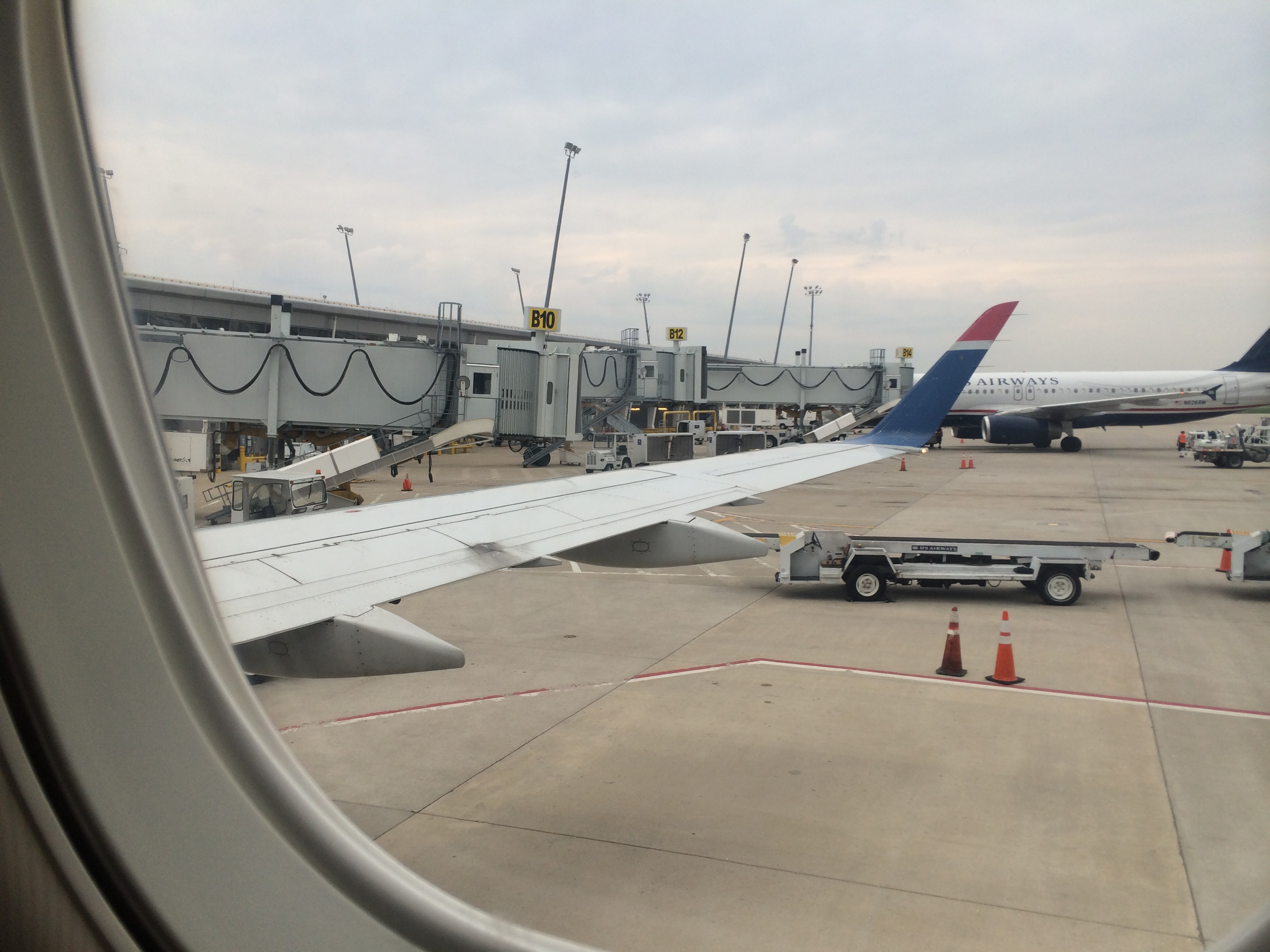
Update 5/30/14 – If you plan to fly, avoid US Airways as if it were the plague. The cost of my ticket for roundtrip Indianapolis to Baltimore with 1 stop in Philadelphia was a reasonable $315. However, inclement weather in Philadelphia made travel impossible the night of 5/27/14. Instead of delaying prior to boarding, they proceeded to board. So, we are all seated and buckled. The captain then tells us all that we have to wait for at least 45 minutes on the tarmac before we get any information from the control tower about weather in Philly. Not bad, right? I can wait another 45 minutes. Yes, well, 45 minutes comes and goes. The captain informs us that we are delayed indefinitely. What does that mean? I guess I won’t be making that connecting flight, but even worse, we are still sitting on the tarmac. The captain informs us that we will be going back to a gate to deboard. However, that didn’t happen for another 1 1/2 hours. Apparently, there were no open gates at the airport? I guess once you taxi away from the gate you advance to a point of no return. I sat on that plane for over 2 hours, and after they let us off, was unable to get a later flight out. I was forced to settle for a fight the next morning. I know it’s not the fault of the staff when weather delays or cancels flights, but they could have at least acted like they cared. I found the staff unfriendly and unapologetic.

The woes do not end there. I arrived in Ft. Meade only to learn our mission was scrubbed, I tried to alter my flight departure date from Saturday 5/31/14 to Thursday 5/29/14, but the cost to change the date was $200 + $25 reservation service fee + $125 for the new ticket. Absolutely ridiculous! Instead of throwing money at that absurdity, I spent $180 on a new one-way ticket from Baltimore to Indianapolis with one stop in Chicago from United. I will never fly US Airways again. If you feel you must travel through that airline, be sure to add extra travel insurance or confirm the fees for changes that may come up in your travels before purchasing a ticket. I’m thinking that driving from Indy to Baltimore may be a favorable alternative.

Al Nashiri Hearings – August 5 2014 – GTMO – Qifan Wang

Today’s hearing starts at approximately the same time as yesterday. Again, the court staff checks with the interpreter during preparation.

Judge’s Comments

The first thing in the morning is Judge Spath commenting on AE305. He agrees that he would be the one ruling on the open motions. While he is going to do it on existing records, without extra hearings, unless the records are not enough to give a ruling. Then he mentions that the defense may file motions for reconsideration if there is any new fact occurrs. Next he comments on the resource issue discussed yesterday. Since there is no motion for that particularly, Judge Spath notices the defense that if they fail to get assistance from the Convening Authority, they may file motions to request in the court and the court would issue orders if necessary.

AE278 – Protocol for the Procedure of Execution

Then we move on to AE278, the defense’s motion to compel the Secretary of Defense to  publish protocol for the procedure of execution. Recognizing the case is still in constructive/evidentiary phase, Mr. Kammen focuses on the impact of protocol upon the jury. He mentions that the jurors are military members, and ‘killing people is part of the bill’ for them. Thus it is highly possible that the way of execution, rather than execution itself would be determinative to the jurors’ decision. If the way is cruel, the jurors may consider that ‘this is not the right way since we are not in battlefield’. Besides, Mr. Kammen argues that it is not rare that the rules are changing all the time. He mentions the security policy regarding cuff links again. Thus to get a settled protocol in writing, a court order would be necessary. On the other side, the government argues that the protocol is a matter of law, and not a mitigation element (not unique to the defendant). Thus it is not appropriate to talk about it to the commission members. Also, if the defendant is found guilty and subject to execution, that would be years later. It is not ripe to discuss this issue at this point. The discussion for this motion does not last long. 

AE279 – Additional Funding for Mitigation Investigator

Next motion is AE279, resource again. The defense is requesting additional funding for a mitigation investigator Mr. Assed to continue his work in Saudi Arabia, communicating with Mr. al Nashiri’s family and neighborhood. As the only person speaks Arabic and is Muslim (only Muslims can travel in Mecca, the home city of Mr. al Nashiri), Mr. Assed’s participation is essential for the mitigation investigation. The defense establishes their argument based on the cultural background, the language barrier, the social atmosphere in Saudi Arabia and argues that the additional 175 hours of work is necessary. Dealing with the fact that Mr. Assed has already been working on this issue for 400 hours, defense mentions that it’s not enough to a large extent due to the lack of proper resource. For example, their request for a female interpreter has been denied, thus they have to go on the trip without one, and later make another travel in order to fulfill the purpose. The government argues that it’s already 400 hours spent on one single person, and the resource provided to the mitigation team is considerable. Besides, the specifities provided by the defense is not enough to articulate the actual needs. It is noticeable that Judge Spath interrupts the government’s counsel several times, mentioning that this is related to the direct communication with defendant’s family. I think that Judge Spath is more with the defense for this motion. At the very end, he comments that since it’s a capital case, there will be more cost incurred. If the government chooses to go for it, those costs have to be accepted. I would not be surprised that Judge Spath rules for the defense. Again, I’m not able to assess the allocation of resource from a comprehensive point of view. But that female interpreter example is impressive. At least in that circumstance, it is indeed a difficult situation the defense is facing.

Classified Information

The next two motions, AE280 and AE281 all deal with classified information. In AE280, the defense is requesting the government to provide more specific markings in the classified document summaries, indicating what is classified and what is not, rather than marking the whole document as classified. The government argues that there is no legal authority to impose this duty, either in the DoD Mannual or in the Executive Order. And as a practical matter, if there is any inconsistency regarding the classification level between the summaries and the subsequent materials, a lot of more litigations will be followed. In AE281, the defense is requesting a guidance of how to handle those classified information to the defendant, Mr. al Nashiri himself. The defense concerns that without a clear and stable secrecy policy dealing with Mr. al Nashiri getting access to the classified information, it is practically difficult to predict what kind of behavior would be considered as leaking information. For example, what if Mr. al Nashiri goes back to his cell and tell other people about the information? In fact, no documents or agreement is for him to sign relating with his security clearance. The government argues that it has been confirmed that Mr. al Nashiri can use the summaries, and other materials. There should be no worries from the defense.

I could see that it’s a matter of trust at issue here again. The defense feels insecure and untrusted, that the government may use any behavior to preclude an defense attorney, to continue detaining Mr. al Nashiri and to impose negative impact upon the defense. Thus they are trying to get as much clear policy or guideline as possible, to ensure that they are complying with everything. In my view this concern is not unreasonable in circumstance. While the production for such document or policy is determined by the OCA, which is not subject to the direction from the government. Thus it is another thing we never know whether the defendant can get or not.

AE283 – Admissibility of Evidence

In the afternoon, the first motion is AE283. The government is requesting a hearing to determine the admissibility of photograph and video taken near the site of bombing as evidence. The defense is not objecting for such hearing, while emphasis that the government must establish solid ground for the admissibility. Being less complex, the discussion of this motion does not last long.

Yemen Friendship Agreement

Next, the court moves on to AE285 and AE306. These two motions are filed by the defense, arguing that applying MCA to Mr. al Nashiri (holding dual citizenship of Saudi Arabia and Yemen) violates the Yemen Friendship Agreement. Under the agreement, Mr. al Nashiri as a citizen of Yemen shall enjoy the full protection of laws and authorities of United States, according to the defense. The Yemen Friendship Agreement is a treaty and shall be the law of the land under the Supremacy Clause of the Constitution. And the Congress cannot pass law (MCA in this circumstance) to alter or limit it. Also, United States is exercising de facto control of Guantanamo Bay, thus the Constitution applies geographically. As for MCA, it limits several fundamental rights and only applies to non citizens. Thus, applying MCA to the defendant constitutes a violation of the Agreement. Judge Spath raises the question that is the Agreement made with a consideration, or applicable to the enemy combatants. In my view this is a question of whether there has been a fundamental change of circumstance which may invalidate the treaty in certain circumstance. Defense counsel argues that the Agreement is reaffirmed in 2004, and if then the President want to change or limit it, he should have done so. The government cites several prior motions and argues that this issue has been discussed. And the law controlling and protecting Mr. al Nashiri is MCA. Besides, the Agreement itself, as an international treaty, does not create private right, or private cause of action.

In fact I have been expecting more robust arguments for this motion. While the defense to some extent focuses on the different treatment Mr. al Nashiri is receiving, rather than bouncing back to the treaty law rebuttal the government made. Noticeably, this motion is one of those the defense trying to make constitutional challenges and get rid of MCA as a whole, followed by AE295 and AE296 – 301.

Constitutional Arguments

AE295 challenges MCA’s constitutionality base on its selective targets towards Muslim. The government rebuts that it is not the case.  MCA deals with those who violate the law of war. And it’s not targeting any religion particularly. Thus it is facially neutral. AE296 – 301 raises the ex post facto argument that the statute of limitation, which is five years, provided by Article 43 of the Uniform Code of Military Justice has passed, thus all the charges against Mr. al Nashiri shall be dropped. The government argues that MCA does not provide a statute of limitation, and the provision of UCMJ does not automatically apply. In addition, having no statute of limitation is consistent to the international criminal law practice.

These two sets of motions, especially the ex post facto arguments, are significantly shorter than I have expected.  These questions touch the basis of legacy/constitutionality of the MCA, as the controlling legal instrument here. Ironically, these motions seem to be less developed comparing with others. Maybe it is just acknowledged that these motions are less likely to work in the Military Commission anyway.

The court recesses. Tomorrow morning would be the end of this weeks’ hearings.

Training to Monitor Trials at Guantanamo Bay

MCOP - Pre-Departure - 11 April 2014 - Classroom shot

IU McKinney Law Affiliates During Briefing to Monitor Guantanamo Bay trials. Some in the photo are members of Professor Edwards’ Spring 2014 International Law class that studied the international law aspects of the 9-11 attacks, other crimes, and jurisdiction to try such crimes.

Guantanamo Bay Briefing

This photo is the of  first group of Indiana University McKinney Law School Affiliates to be part of a Pre-Departure Briefing for monitoring US Military Commission hearings.

The Pentagon awarded IU McKinney’s Program in International Human Rights Law (PIHRL) special “NGO Observer Status” permitting the PIHRL (pronounced “Pearl”) to send IU McKinney Affiliates (students, faculty, staff and graduates) to monitor hearings at Guantanamo Bay, Cuba or at Ft. Meade, Maryland. The training of this first group took place in Indianapolis at the law school on Friday, 11 April 2014.

MCOP Briefing Book; Geneva Conventions

The MCOP Briefing Book — About 2000 pages on Military Commission law and practice. Participants were also provided copies of the 1949 Geneva Conventions and the Protocols Additional.

In the picture are four IU Affiliates who traveled to Ft. Meade in April for hearings in the 9-11 World Trade Center bombing case and the 2000 U.S.S. Cole bombing case. Also pictured are two IU Affiliates who traveled to Guantanamo Bay for hearings in both those cases in April.

Mr. Rick Kammen (center of photo with jeans and light top), who is a lawyer for defendant al Nashiri in the USS Cole Case, lectured on the history of U.S. Military Commissions, substantive and procedural law related to the Guantanamo Bay Military Commissions, litigation strategies, and the logistical difficulties associated with trying cases at a base on an island, away from the Mainland U.S.

Those pictured whose mission was to Ft. Meade are Jeffrey Kerner, Jeff Papa, and Hattie Harman.

Judge Pat Riley (Indiana Court of Appeals) is pictured behing Rick Kammen’s right shoulder.

Professor George Edwards (PIHRL Founding Director & MCOP Founding Director) appears at the far right of the photo.

Absent from the photo above are Jeff Meding (who was in Washington DC for his flight from Andrews Air Force Base to GTMO the next day) and Luke Bielawski, who went to Ft. Meade. Luke is in the photo below.

Briefing Book

Left to right: Luke Bielawski (Ft. Meade – USS Cole), Jeffrey Werner (Ft. Meade – 9-11), George Edwards (Ft. Meade – USS Cole; Guantanamo Bay – US v. David Hicks), Judge Patricia Riley (Guantanamo Bay – USS Cole), Jeff Papa (Ft. Meade – USS Cole) & Hattie Harman (Ft. Meade – 9-11). Absent is Jeff Meding (Guantanamo Bay – 9-11, who was en route to Andrews Air Force Base for his flight to GTMO)

Left to right: Luke Bielawski (Ft. Meade,  USS Cole), Jeffrey Werner (Ft. Meade, 9-11), George Edwards (Ft. Meade, USS Cole; Guantanamo Bay, US v David Hicks), Judge Patricia Riley (Guantanamo Bay, USS Cole), Jeff Papa (Ft. Meade, USS Cole) & Hattie Harman (Ft. Meade, 9-11). Absent is Jeff Meding (Guantanamo Bay, 9-11, who was en route to Andrews for his GTMO flight)

The  Pre-Departure Briefing Book of the MCOP was compiled by Mr. Jeff Meding, Ms. Qifan Wang, Ms. Kristin Brockett, and Professor George Edwards. For each cycle of hearings, a Supplementary Briefing Book will be prepared and distributed to all participants. A copy of our Briefing Book is now permanently housed in the NGO Observer Compound at Guantanamo Bay for subsequent McKinney Affiliates and others to use on their Missions to GTMO for hearings or trials.

Reprisals? (Ft. Meade – 22 April 2014)

Jeff Papa attends U.S.S. Cole al Nashiri Military Commission hearing broadcasted from Guantanamo Bay, Cuba to the Post Theater at Ft. Meade, Maryland.

Jeff Papa attends  U.S. Military Commission (Guantanamo Bay) hearings in the case involving the alleged masterminds of the U.S.S. Cole bombing. The hearings are live at Gitmo & by secure videolink to the Post Theater on the military base at Ft. Meade, Maryland.

Today’s hearings were on the case of  the alleged masterminds of the bombing of the U.S.S. Cole, a naval ship harbored in Yemen in 2000. Judge Pat Riley (Indiana Court of Appeals) from our team is in Guantanamo Bay, sitting in the courtroom. Luke Bielawski and I are at Ft. Meade, Maryland, watching the Guantanamo proceedings on secure videolink.

What’s on for Today? A Question of Reprisals

The Commission hearings covered several interesting issues today. The most interesting issue was the last item discussed.

The defense has requested information about third party civilian deaths and collateral damage caused by US or coalition forces in order to consider a defense of reprisal.

Judge Pohl began by pointing out that the government alleges that reprisal is only a defense if the defendant is a state actor. The defense agreed, but reserved the right to argue that Nashiri is a state actor. The defense claimed that this is relevant to his state of mind and any ability to participate in the governments alleged far-flung conspiracy. This could show extenuation and mitigation.

Judge Pohl followed up on this by asking if you would have to show that the defendant knew about these very specific actions or just that he knew (more…)

Pre-Departure – Jeff Papa – Going to Ft. Meade for USS Cole Hearings

Going to Ft. Meade — USS Cole Case

I will be attending the Guantanamo Bay hearings that are being simultaneously broadcast from GTMO to at Ft. Meade, Maryland next Tuesday and Wednesday. I know very little about the details of these proceedings, other than many I learned from media reports and from good general information I learned from Andrew Northern in my National Security Law course.
Pre-Departure Briefing
Last Friday, we had the opportunity to participate in a Pre-Departure Mission before we set out for our respective sites, Guantanamo Bay for some, and for other like myself, Ft. Meade, Maryland.

We were fortunate to have as our primary Briefing Mr. Rick Kammen, who is an Indianapolis attorney, who is the death penalty counsel in the USS Cole case, which happens to be the case I will be monitorin.

Mr. Kammen described in a very compelling fashion over the course of a few hours the point of view of the defense team and many of the difficulties encountered. He also provided a great basis for critical thinking about the process, pro and con.

This opportunity was extremely valuable, and together with the very extensive briefing book prepared by Professor Edwards’ Program in International Human Rights Law (PIHRL), I believe I will have an outstanding basis from which to begin viewing and thinking about the proceedings next week.

_______