A confusing start to the morning but it looks like everything is working out. Spending the time in the terminal getting to know the other observers, boarding pass in hand! 
Uncategorized
My GITMO Boarding Pass
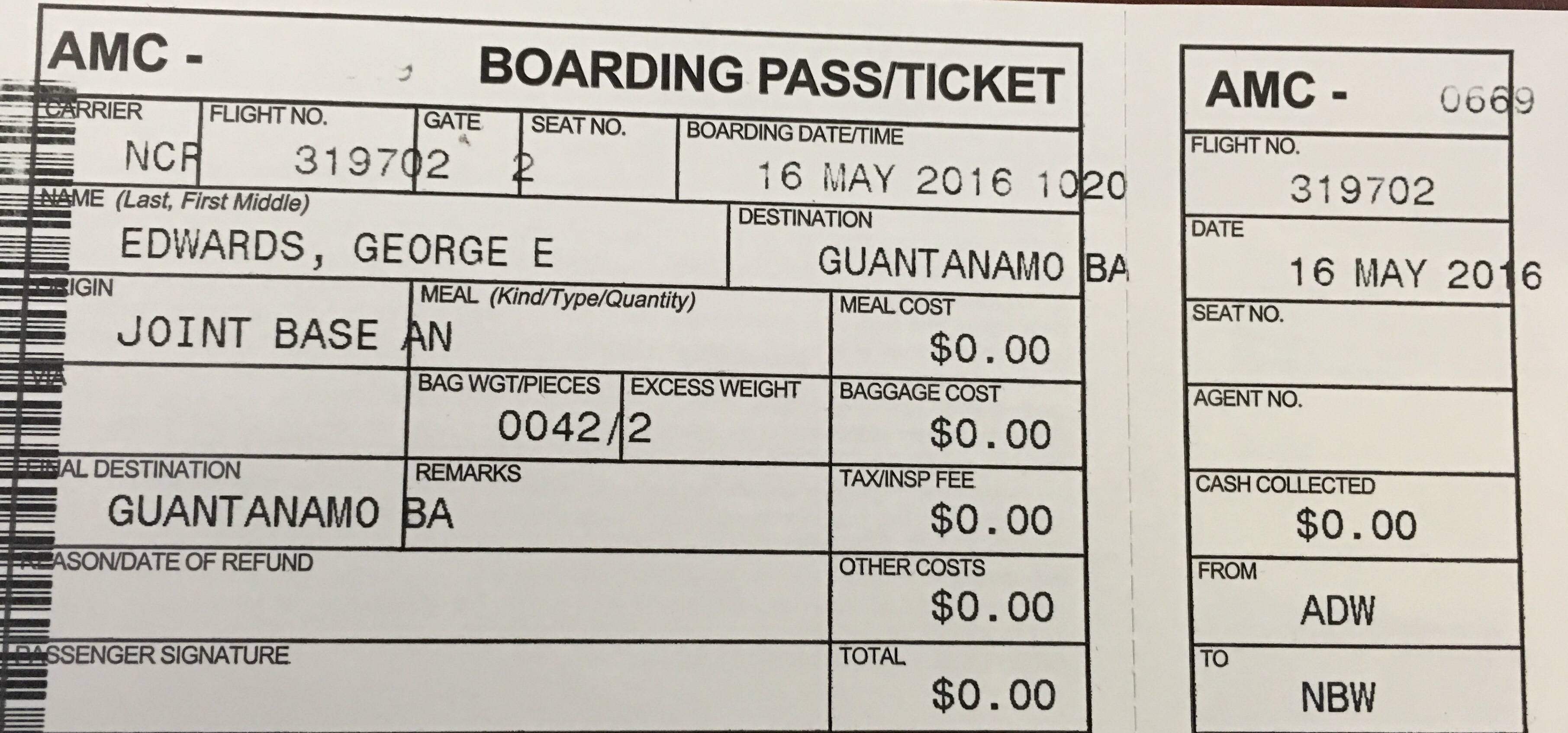 About to board the plane to Guantanamo.
Rick Kammen–GITMO Lawyer
Guess who I bumped into boarding the plane to Guantanamo Bay with me today? Richard Kammen, of Indianapolis. He is Learned Counsel in one of the GITMO Military Commission cases.
Apparently he’s hitching a ride to Guantanamo to visit his client–al Nashiri — who allegedly masterminded the USS Cole attack in Yemen. He has no links with the Hadi case I’m monitoring this week.
We thank Rick for coming to Indiana University McKinney School of Law to talk with us about his GITMO case.
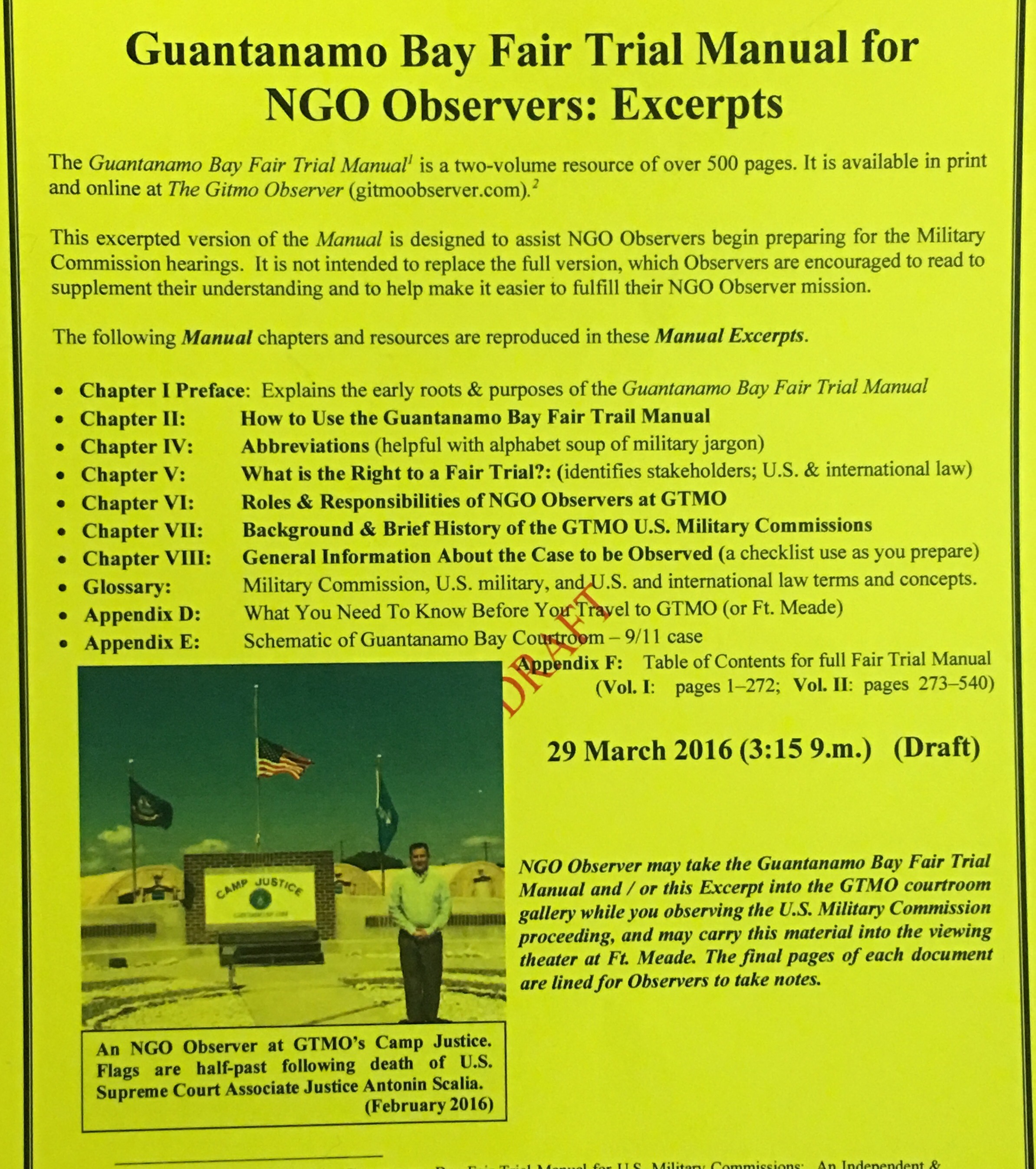
GITMO Fair Trial Manual
NGOs reading the Guantanamo Bay Fair Trial Manual we produced Indiana University McKinney School of Law as we wait for our GITMO flight.
We’re at Andrews Air Force Base. 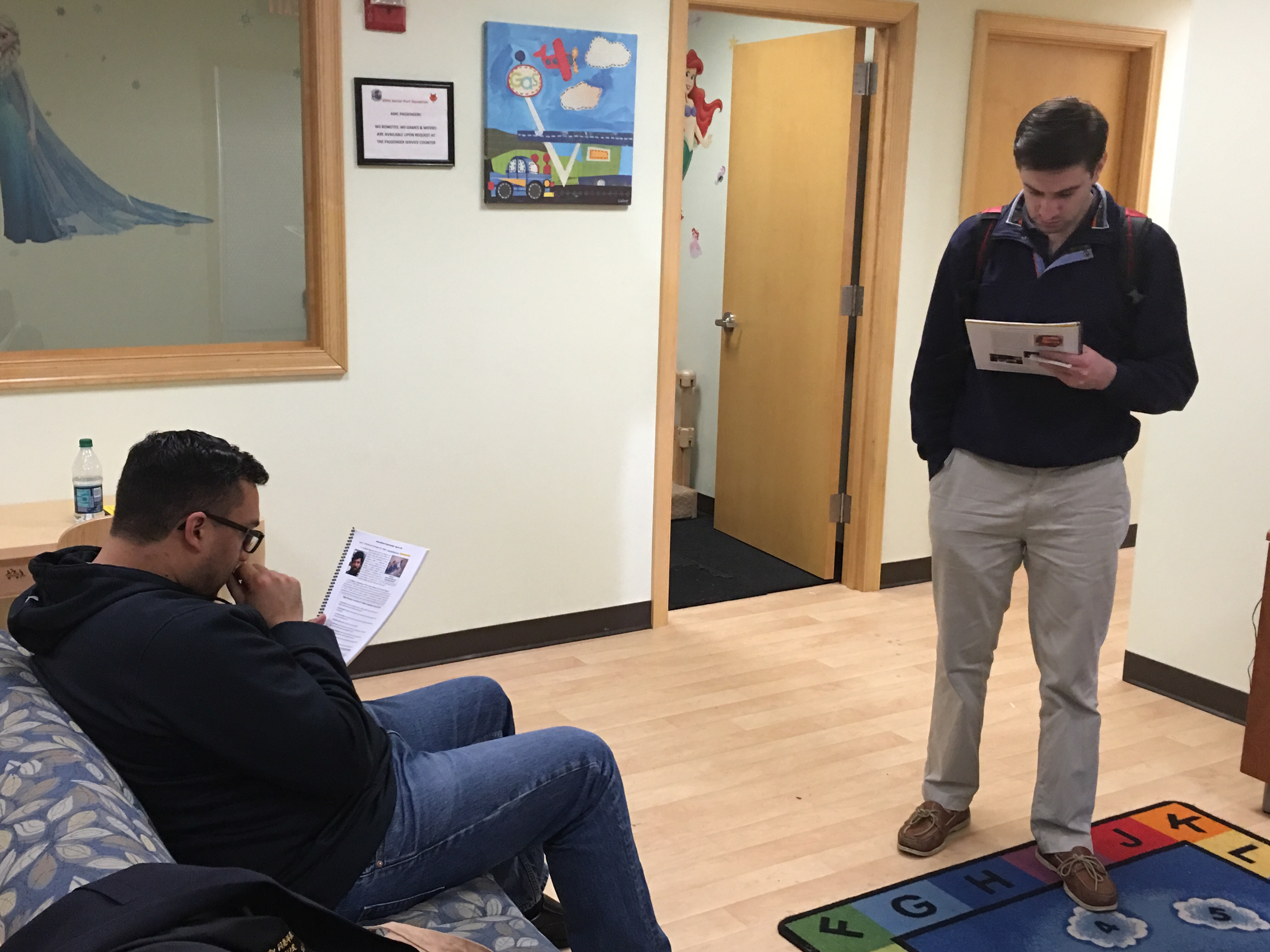
Andrews Air Force Base to Guantanamo Bay
 I just arrived at Andrews Air Force Base, just outside of Washington, DC, for my military flight to Guantanamo Bay, Cuba. This time I’m traveling as a non-governmental organization (NGO) observer on proceedings in the U.S. Military Commission case. I’ve been to Guantanamo Bay (also known as Gitmo) as an expert witness, on a media / research trip for my upcoming book (The Guantanamo Bay Reader), and as an NGO Observer. The rules on the ground have been different each time, in part based on category of travel. But I’ve also learned that rules change even for people in the same category. It’s always interesting to compare notes with other repeat Guantanamo Bay visitors.
I’ve had a chance to meet some of the other 6 NGO representatives who will be with us on this trip. They come from Human Rights First, the American Bar Association, Judicial Watch, the Pacific Council on International Policy, and Georgetown and Seton Hall Law Schools. Several of the Observers have deep knowledge on Guantanamo Bay issues, which will make the trip all the more interesting for us.
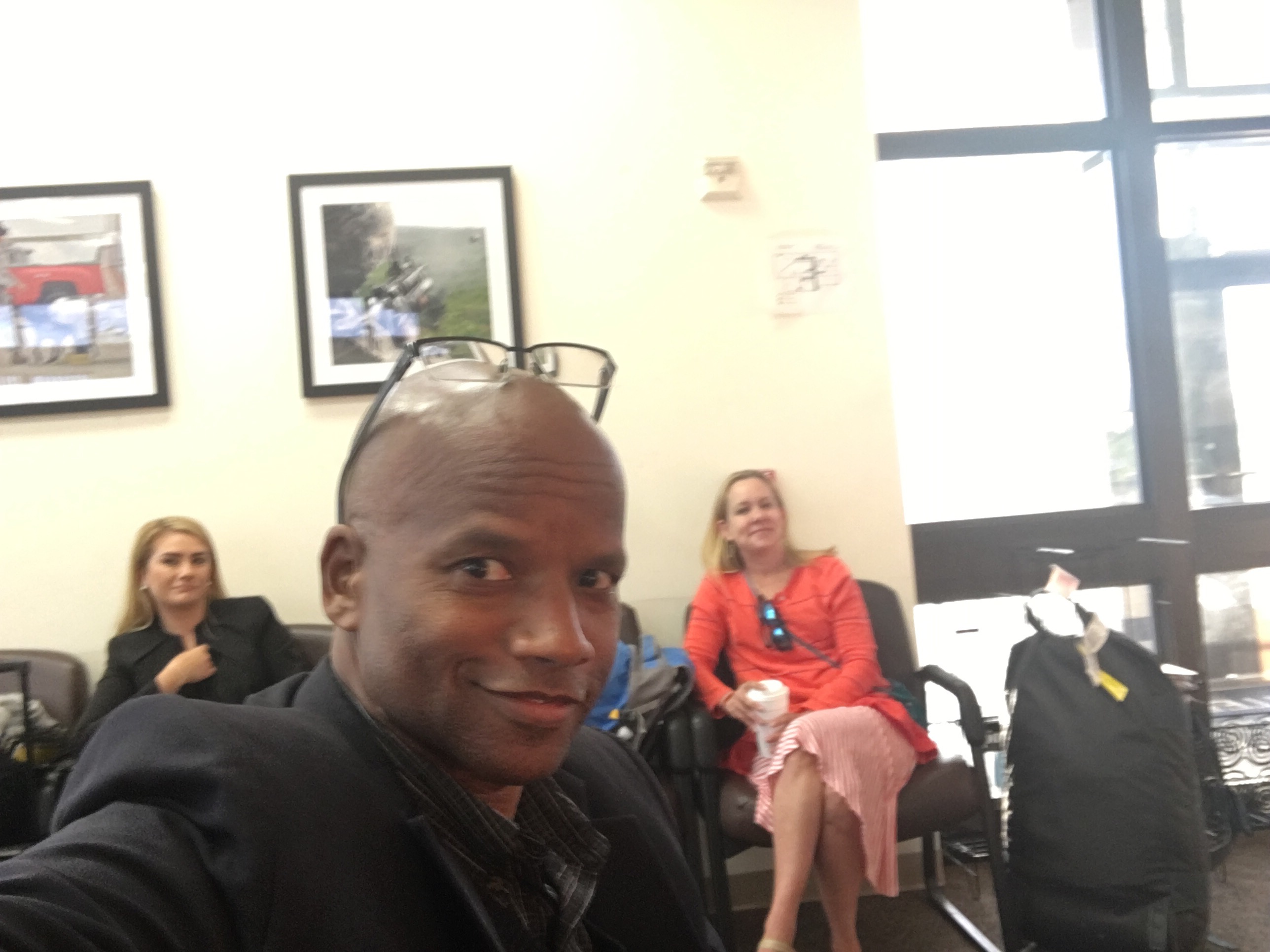 I’ve also looking forward to caching up with our Military Commission NGO escort, who will be with us most waking moments between now and when we return to Andrews late Thursday afternoon. Fortunately, our escort this trip is one of the escorts from my first NGO trip, a couple of years ago. It should be a good trip.
Who is here? What are we doing?
There are dozens of non-NGO representatives set to board our flight to Guantanamo. They are / could be Hadi’s defense counsel, prosecutors, the judge and the court staff, victims or family members of victims, media, and others associated with the Military Commission generally or associated with the case against Hadi. Passengers could also include people who are permanently stationed at Gitmo, returning from temporary duty or returning from vacation.
The Andrews air terminal is much like an air terminal in any small US city, with check in counters where you get your boarding pass, scales to weigh your check-in luggage, bus station like seating where you sit and way – and wait, x-ray machines to scan carry-ones and metal detectors to walk through, and vending machines with soft drinks and junk food. One difference is that the air ticket cost is zero for NGO Observers, who travel as part of the Pentagon’s stated desire to be transparent with the U.S. Military Commissions.
Traveling to Guantanamo Bay for Hadi War Crimes Hearings

Hadi al-Iraqi
I’m scheduled to fly to Guantanamo Bay, Cuba on Monday, 16 May 2016, as a non-governmental organization (NGO) observer of proceedings in the U.S. Military Commission case against detainee Hadi al Iraqi.
Hadi is a high-value detainee who is an alleged high-ranking member of al Qaeda who served as liaison between al Qaeda in Iraq and the Taliban. He is charged under the Military Commissions Act with a series of war crimes, including attacking protected property, perfidy / treachery, denying quarter, and targeting noncombatants such as medical workers and civilians. Among other things, he is alleged to have helped the Taliban blow up the monument-sized Bamiyan Valley Buddha Statues, which were a UNESCO World Heritage site.
Hadi was officially charged in the equivalent of an arraignment in a Guantanamo Bay courtroom in June 2014. I happened to be present in the Guantanamo courtroom for that proceeding.
Unlike most of the other detainees currently facing trial, Hadi is facing a maximum sentence of life imprisonment, rather than a death sentence faced by, for example, the five men charged with masterminding the 9/11 attacks on the World Trade Center and the Pentagon.
Delays
For the last 2 years, since formal charging, Hadi’s pre-trial hearings that have been plagued with disruptions related to, for example, conflict of interest issues, and his “releasing” his counsel.
Recently, Hadi’s defense counsel made a motion to continue (postpone) the 17 – 18 May hearings. The Military Commission website (mc.mil) indicates that the Military Judge has ruled on this motion to continue, but the contents of the ruling have not yet been posted because the ruling must be cleared before posting for public view. Apparently the Judge denied the motion, as all systems appear to be go for the proceedings this week.
Two Days of Hearings Scheduled for This Week
My flight to Guantanamo is set to leave from Andrews Air Force Base, just outside of Washington, DC. I’m due at Andrews at 6:00 a.m. on Monday the 16th, along with defense counsel, the prosecution, the judge and the court staff, the media, other NGOs, and others associated with the case against Hadi. We are all set to fly on the same plane.
We travel down on Monday, get situated, with court scheduled to begin Tuesday morning and run through Wednesday. Then, everyone who flew down to Guantanamo on Monday gets back on a plane to fly back to Andrews.
Unfortunately, details of the nature of the 2 days of hearings are not readily available to observers such as myself, since many of the motion papers are not released yet. At times it takes many days for unclassified motion papers to be made available for public view on the Military Commission website.
Papers that were recently filed that may perhaps be covered on Tuesday and Wednesday include a Trial Counsel Detailing Memorandum (filed 13 May 2016), a Supplemental Defense Notice to Commission IAW Order (filed 27 April 2016), and the Defense Notice of Excusal of Detailed Defense Counsel (filed 20 April 2016). All of these papers are listed on the website, but the contents of these papers have not been made available for public view.
Brigadier General Mark Martins, who is the U.S. Military Commission’s Chief Prosecutor, is typically great about briefing NGOs upon arrival at Guantanamo Bay. papers. That will be very helpful, particularly for Observers who are not familiar with intricacies of each Guantanamo Bay case.
More to come
Please stay tuned for more reports from Guantanamo Bay. Among other things, I plan to talk about the Guantanamo Bay Fair Trial Manual, produced by the Guantanamo Bay Military Commission Observation Project of the Indiana University McKinney School of Law, and share information about the 6 other NGO representatives scheduled to observe this week’s proceedings with me. I will also talk about my new book, The Guantanamo Bay Reader.
George Edwards (Washington, DC)
9/11 Judge Cancels April Hearings
Just received notice that Judge Pohl cancelled the two weeks of hearings that were scheduled to start on Monday, April 4. No announcement has been made as to the reasons why at this point.

Sunset Over Guantanamo Bay
by Catherine A. Lemmer
Articles by Observers from the February 22nd-26th Sessions of the 9/11 Pre-Trial Hearings
 Below are three articles by or contributed to by observers representing other NGOs from the February 22nd-26th, 2016 pre-trial hearings in the case against the alleged masterminds of the 9/11 attacks. These articles were not written or contributed to by representatives of Indiana University McKinney School of Law’s Program in International Human Rights Law or our Military Commission Observation Project. They were written by Observers who were part of various non-Indiana groups at Guantanamo Bay.
2. In a room with a terrorist by Tyler Grant of the University of Virginia School of Law
By Matt Kubal, JD, Indiana University McKinney School of Law
Preparing for the April 9/11 Hearings
This morning I sat down to begin reading the transcripts from the two-week February 2016 session of the 9/11 hearings in preparation for my work as an NGO Observer at the upcoming April session of the 9/11 hearings. I will be attending week one of the hearings (April 4-9), and a recent alum of IU McKinney Law School will be attending week two (April 11-15).

Assuming I did the math right, the two week February 2016 session generated 1453 pages.
The transcripts are made available to the public on the Office of Military Commissions website. Simply select the “Cases” tab and open the case you are interested in following. The left navigation panel lists all the available documents for the case, including transcripts.

Documents Page for 9/11 Hearings
I often refer interested individuals to the Office of Military Commissions page. Reading the transcripts gives the reader a good understanding of why the 9/11 proceedings are an estimated 5 to 8 years from going to trial. For example, on February 17 David Nevin, Learned Counsel (death penalty counsel) for the KSM team, describes the inability to get an interpreter processed through the system so he can join the team. The KSM team has been waiting nearly a year for a replacement after the team’s interpreter was removed without explanation after 2.5 years of service to the team.
If you are going as an NGO Observer, reading the transcripts gets you up to speed, both on the issues that may be on the docket during your observation and for understanding how the courtroom works. For example, in the February 2016 session Jay Connell, Learned Counsel, details the classified information process (pages 10332-10376). Perhaps most importantly, reading the transcripts prepares you with questions to ask the Prosecution and Defense teams. For example, does the manner in which the Prosecution approaches classifying information unreasonably delay the process or harm the defense team’s ability to represent the defendant?
For the general public the transcripts are an easy way to stay informed about the process. Granted there are gaps when the sessions move to classified hearings, but reading the transcripts works for the most part. There are typically two responses when I tell people that I am going to Guantanamo Bay to observe the 9/11 hearings. The first is, “why is it not moving faster?” The second is, “why are we not trying the defendants in federal court in the U.S.?” Reading the transcripts answers both these questions.

As Judge Pohl said in the February hearings (page 10270):
“I want to make something very clear here. I am just a judge. I didn’t pass the MCA; two Congresses did, and two Presidents signed it. I didn’t promulgate the rules, the Secretary of Defense did. Okay? So I want to make this very clear. I take the rules they have and my job as a judge is to do the best that I can. I am not vouching for the system or criticizing the system.The system is, from my perspective, as the system is.”
The Military Commission website hosts 195 transcripts for the 9/11 hearings all labeled as “unofficial/unauthenticated.” Usually I read the transcripts as soon as they are posted at the end of the day; but teaching two classes got in the way of this goal in February. At a minimum I like to download the transcripts as soon as possible. Why? — because sometimes the transcripts change–that is, content is redacted even though it occurred in open court. As Judge Pohl stated, the participants, be they defendants, judiciary, defense, prosecution, victims, or observers, didn’t make the military commission system, it is simply the system we have to work with and we all find our way to work best in it. Downloading and reading the transcripts is one of the ways I work with the system.
Posted by Catherine A. Lemmer, IU McKinney Law School
A Day Exploring Guantanamo Bay

The view of the bay in front of the Jerk House, coffee shop and the Tiki Bar.
Today the court in the 9/11 case was in closed session all day to discuss confidential information. We were not allowed to attend the hearing and instead were left spend the day at our own leisure (with our awesome coast guard escorts to take us around the island). I took advantage of the opportunity to sleep in until a little past 8am and then joined several of my fellow observers to grab a coffee at the shop known as the “Starbucks” (the shop has another name, but everyone seems to call it Starbucks) right by the Jerk House. A few nights ago I had the best jerk chicken I have ever had outside of Jamaica at the Jerk House.

Relaxing on Windmill Beach near the now closed Camp Iguana
It was time for my first visit to the beach for the week and so off we went to Windmill Beach, what I was told was the most popular beach on the base. It’s a rocky shore and there’s a bit of coral to dodge when entering the ocean, but the swimming was refreshing with small waves breaking near the shore and lounge chairs for free use. We also saw a few groups of scuba divers coming in and we were told the base offers scuba certification. I relaxed by the water below the former detention camp and read a bit (my book club is reading Jared Diamond’s “Collapse”; his theories seem a bit speculative to me).
Nearby Windmill Beach was Camp Iguana. The camp’s small size was made up by it’s prominent location overlooking the Caribbean and Windmill Beach. If it wasn’t a detainment facility, it would be a lovely spot for a hotel or spa. The camp formerly held three child soldiers and later some detainees who were classified as no longer enemy combatants. It felt a little odd swimming and relaxing below a detainment facility (even a closed one), but such is the way of Guantanamo Bay: one night you pick up a Big Mac at McDonald’s and listen for a minute to the school’s band playing marches in the McDonald’s playground before you go to see “The Big Short” at the huge outdoor theater. While a few hours earlier you heard testimony from a detainee who alleges he is regularly and professionally tortured by some of the same men and women who are likely eating next to you at that same McDonald’s and sitting next to you at the movie. I’m not making any judgement as to the veracity of Bin al Shibh’s claims, but the contrast between the very friendly, pleasant and safe feeling that one has on the base perhaps belies the great seriousness in that there are numerous claims in the media and from NGOs that torture did take place here not terribly long ago and also that America’s most vilified and allegedly most dangerous enemies are detained here.
On a lighter note, I apparently did a poor job of applying sun screen as my splotchy sun burns are so bad, my roommates asked me if I have a skin disease. We made our way from the beach to three spots for souvenirs on the island: Radio GTMO, the post office and “Personalized Services,” a little gift shop by the Navy Exchange store.

Holding a copy of “The Doors: Setting the Record Straight” from Radio GTMO’s vinyl collection with part of the collection visible in the background
We made our way to Radio GTMO first. A friendly radio engineer service member took us on a tour of the small station. There is a green room, broadcasting room, CD room, server/broadcasting room and a storage room where, tucked away in a corner, is the third largest vinyl collection at any US military base in the world. The vinyls are hidden away for a reason; the radio station employees, who recognize their value and play them regularly (including for throwback Thursdays), try to keep the vinyl’s in a place that is less prominent in the station so they don’t get picked for disposal to free up space. Carol Rosenburg wrote an interesting story about the attempted destruction of the 20,000 or so records. I picked up a few souvenirs including a Fidel Castro Bobblehead with the Radio GTMO logo on the base: “Rockin’ in Fidel’s Backyard.” The visit to the small post office and the Personalized Services store were less exciting, but I was able to pick up a couple souvenirs for friends and family. We had lunch at Subway and

I am very happy with my Fidel bobblehead.
I spent the rest of the afternoon in the NGO lounge catching up with the outside world, preparing posts for this blog and killing time until our meeting with the Hawasawi defense team after the closed hearing in the 9/11 case let out.
By Matt Kubal, JD, Indiana University McKinney School of Law
Guantanamo Detainee Bin al Shibh Testifies; More Transcript Redactions
 Wow, What a morning. I just witnessed Ramzi Bin al Shibh, one of the five defendants on trial for the 9/11 attacks, testify on direct (questioned by his learned counsel, Mr. James Harrington. He was cross examined by Mr.Clayton G. Trivett Jr., a reserve navy lieutenant commander representing the prosecution and re-direct will be after lunch. The testimony is regarding bin al Shibh’s motion regarding complaints of vibrations and loud noises/hammering in his cell preventing him from sleeping, writing, etc. The judge had previously ordered any vibrations and loud noises to be stopped. The motion, AE 152LL, is a motion for the government to show cause (arguing that the previous order to stop the noises/vibration was not followed).
A few interesting notes from Bin al Shibh’s testimony in this morning’s session:
– Prior to testimony, the Government requested the judge advise Bin al Shibh regarding the protective order protected the release of classified information. The judge denied the request saying that Bin al Shibh is not in a position to determine what material is classified. Harrington responded that he believes he has a way to avoid classified material. He starts by using the publicly available (though heavily redacted) torture report as a guide (references page 75 where the report discusses Bin al Shibh).
– Ramzi took an affirmation (like an oath) over a Koran and testified from the witness stand and both testified and received questions entirely in English. He testified without shackles (the judge pointed this out yesterday and today), but with two security officers facing Bin al Shibh (nearby and to his left).
– Trivett cross examined Bin al Shibh. The consensus amongst the observers were that he had a very tough time controlling Bin al Shibh as Bin al Shibh was often allowed to explain away potentially damaging prior statements.
– At one point Trivett asked Ramzi if he remembers his dreams. Ramzi replied affirmatively. Trivett followed with: “Do you ever dream of the people killed on 9/11?” Defense objected and the objection was sustained immediately.

The red light, just to the right and slightly below the judge was activated today indicating classified information was revealed in the courtroom
– The flashing red hockey light in the courtroom indicating classified and/or protected information had been revealed was activated right as Bin al Shibh, who was describing his detention facility, started saying “when you come into camp…” (we watch live behind sound proof two way glass, but hear on a 40 second delay, so we don’t hear anything classified/privileged). After the light turned on the audio cut off, a standby screen was put up on the monitors (monitors are available that are synced with the 40 second delay) and we were removed from the hearings. Everyone in the courtroom remained in the courtroom and I could see the judge speaking (it looked like he was speaking with Bin al Shibh). After 3-4 minutes, we were allowed back in to the gallery to continue viewing the proceedings.
– At one point Bin al Shibh reminded his attorney to object when the Government Prosecutor asked Bin al Shibh if he was a warrior. The judge advised Bin al Shibh that he had to answer the question unless his attorney, Mr. Harrington, objected. Mr. Harrington then objected and the objection was sustained. This was
– Seemingly out of the blue, the judge asked a follow-up question in the middl e of Mr. Trivett’s cross. He asked if Bin al Shibh felt the vibrations in the room where he and his attorneys meet. Bin al Shibh said yes and then clarified that he felt them when the attorneys are gone.
– At one point Bin al Shibh looked at Khalid Sheikh Mohammed, the alleged mastermind of the 9/11 attacks and said, “Before somebody else was captured I was something special,” he also said. “They tried these things until now.” Bin al Shibh was allegedly a potential hijacker, but when he could not gain access to the U.S. he instead served in a support role.
Exhibits From February 23rd Sealed
I wrote this last post late last night. It turns out that the prediction I made that the transcript might be redacted was true. The hearing started today with the government requesting that the court seal exhibits 112L, 112K and 112M. These exhibits were related to a motion to compel discovery by the defense. Off of memory, my guess as to what the Government would like to protect were exhibits presented by Mr. Connell, Ali Abd Al-Aziz Ali’s learned counsel, related to AE 397 motion to consolidate and AE 112 motion to compel discovery.
To summarize Connell’s testimony yesterday, he used several exhibits to argue that the defense needed to be able to see what was behind redacted sections from several documents. In response to a prior claim by the government that his requests were overbroad and not specific, Connell numbered each of 150 redactions (made by a FOIA officer) in a long document and made arguments as to why each section might be important based on what he guessed might be behind it. The judge eventually cut him off and advised that he gets the point: that Connell is able to provide a specific explanation why he wants each redaction removed. Connell also requested that the court order General Baker, the court’s ethics and compliance officer, to be present at the hearing tomorrow (the judge denied the request).
Regarding the government’s request to seal the three exhibits, the judge ordered the exhibits temporarily sealed pending review in a closed hearing. As of 1 pm on February 24th, the unofficial, unauthenticated transcript is not available either.
If the court orders the documents permanently sealed and/or the transcript is redacted, we will likely have motions submitted making a similar 1st amendment argument made in the future regarding yesterday’s transcript as we had this past Monday when Mr. David Schulz, independent attorney hired by members of the press to argue on their behalf, argued that a redaction of a transcript of a public hearing from last October was a violation of the 1st Amendment Freedom of Speech. Indeed, Mr. Connell of the defense for Mr. Ali Abd al-Zziz Ali, already objected prospectively on this issue. On Monday, the defense also argued that the after the fact redaction of a public Military Commission hearing was a violation of the 6th Amendment Right to a Public Trial.
The Way Forward
Finally, the judge ended by describing the way ahead:
1. re-direct of Bin al Shibh by his defense attorney, Mr. Harrington this afternoon
2. AE 018Y and AE 01W (regarding detainee letters) after that until around 3pm
3. At ~3pm the court will go into a closed session to consider the Government’s motion to seal AE 112 (see above)
4. Friday we will continue AE 018 (11 motions in the series that are up for consideration this week) and then move on tho AE 254 if there is time.
Lunch is over and I am heading back to the courtroom for a 1:30pm start.
Update: Re-direct by Mr. Harrington was short and relatively uneventful. After the testimony, the judge advised that if the defense wishes to call the other two witnesses (originally Harrington had requested to call three deainees as witnesses) he may do so at a later date. Allowing Harrington to call only al-Shibh was Pohl’s stated plan prior to the hearing today.
Following al-Shibh’s testimony, the court returned to AE 018Y and AE 018W regarding letters from the defendants. The issue discussed is what the procedures should be for the defendants to send non-legal/legal and classified/non-classified letters (and each combination of those four categories). Testimony ended with the judge seeming to narrow the issue as to how a legal letter is define and requested that the government provide a more specific request as to what relief they want.
At shortly after 3 pm, the gallery was cleared and the defendants removed for a closed hearing to, among other topics, consider whether or not to discuss the governments emergency motion to seal several exhibits that were presented yesterday.
Tomorrow is a closed session. My next and last day of hearings this week will be on Friday.
By Matt Kubal, JD, Indiana University McKinney School of Law
Correction, Clarification, Missing Transcript, and Expectations for Guantanamo’s 9/11 Case

Camp Justice where we live in tents next to the Guantanamo Bay courtroom complex
This evening (23 February) I have for you a correction from my last post, a few notes about the hearing in the 9/11 case today, some thoughts regarding a missing transcript from today (perhaps temporarily), a clarification of a comment I made in my last post and a preview of what we have to look forward to tomorrow and the rest of the week.
A Correction
I mentioned in my last post that I believed that Mr. David Schulz’s oral argument on behalf of members of the press was the first time a third party movant (the Press in this case) had filed a motion and presented oral argument before the court. I was advised this evening that this was not the first time that Mr. Schulz has argued on behalf of he press. You can read about one of the previous times in 2012 when Mr. Schulz argued before the judge in the Nashiri case here.
A Missing Transcript?
Also of note is that, as of 11:30 pm on February 23rd, the daily unofficial/unauthenticated transcript from the hearings today have not been posted. This is interesting as the transcript is usually posted very soon after the hearings are completed for the day. The AE 400 motion filed by the press and argued on Monday was in response to a similar scenario on October 30, 2015, where the government failed to immediately provide the unofficial/unauthenticated transcript and, when they did provide it, redacted a significant portion of the transcript from the hearing that, on the day of the hearing, had been heard by observers, members of the press, victims family members, others in the gallery at the court room and by those watching via the video feed at Ft. Meade. This very well may be a technical error of some kind, but if the transcript for the hearing today (February 23rd) is posted in a redacted form at a later date, I suspect the press would file another motion objecting to the redactions making the similar argument as they made for AE 400. The judge has not yet ruled on AE 400. You can read the arguments made in support of AE 400 made Monday morning by Mr. Schulz on behalf of the press (February 22nd) here
A Clarification and al Shibh’s Expected to Testify

Ramzi Bin al Shibh, a 9/11 case defendant, is scheduled to testify about the his detention conditions at Guantanamo
My clarification from my last post is that, if Ramzi Bin al Shibh (al Shibh) testifies tomorrow (and i suggest that is still an if), it will be the first time a defendant has taken the stand to testify in this case. At the end of the hearing today the judge advised the court that al Shibh would not be shackled or physically restrained while testifying and his testimony would be limited to the issue of external sounds and vibrations while detained pertaining to AE 152LL only. The reason why I say if he testifies is because at the end of the hearing al Shibh’s attorney requested that he be able to testify from the chair where he normally sits, next to his counsel, during the proceedings. Judge Pohl denied the request and said he will be required to take the stand like any witness. If the request to speak at his usual seat in the courtroom is based on any hesitance by al Shibh to testify, then it is possible that he will have cold feet and will not take the stand.
Here is the summary for AE 152LL from the public Motions Hearing Summary:
AE 152LL; Filed by the Defense
Title: Emergency Motion for Show Cause Why The Government, JTF Camp Commander and JTF Guard Force Members Should Not Be Held In Contempt
Brief Summary: Mr. Bin al Shibh continues to be subject to external sounds and vibrations while detained, despite order from the Military Judge prohibiting such actions by Joint Detention Group and Joint Task Force staff. As a result, Mr. Bin al Shibh requests the Military Judge order the relevant staff to show cause why they should not be held in contempt.
After Bin al Shibh’s Testimony Tomorrow (Wednesday, February 24th)
The remainder of the day tomorrow, February 24th, will likely be spent continuing the AE 018 series of motions which we started at the end of today with arguments on AE 018Y. The judge indicated that after Mr. Bin al Shibh’s testimony tomorrow, the court would continue with AE 018Y and then move to AE 018W.
Towards the end of the hearing today Chief Prosecutor General Martins, Mr. Connell (attorney for Mr. Ali Abd Al-Aziz) and Mr. Nevin (attorney for Khalid Sheikh Mohammed) presented oral argument on AE 018Y, Government Emergency Motion for Interim Order and Clarification that the Commission’s Order in AE018U Does Not Create a Means for Non-Privileged Communications to Circumvent the Joint Task Force Mail System. Here is the brief summary from the Motions Hearing Summary document we were provided:
The Government seeks an Emergency Motion for an Interim Order following accusations of unauthorized distribution of materials that did not receive sanctioned review by JTF-GTMO.
On AE 018Y today, the Government claimed the defense facilitated unauthorized distribution of materials that did not receive sanctioned review by prison officials (Joint Task Force – Guantanamo). The defense argued that the Government’s characterization is incorrect, that the mail was reviewed and determined not classified prior to being sent, that they were not restricted from sending it.
Up third tomorrow will be AE 018W. Here’s the summary from the Motions Hearing Summary document we were provided:
AE 018W
Filed by: Defense
Brief Summary: Joint Defense Motion to Amend AE 18U, Privileged Written Communications Order
The Defense seeks an order from the Military Commission amending the Privileged Written Communications Order (AE018U), which governs how defense counsel and the accused can communicate in writing.
There are several other motions outstanding in the AE018 series (11 total in the Motions Hearing Summary document we were provided). Per Judge Pohl at the end of the day on Monday, next up in open session after the AE 018 series of motions is AE 391:
Here’s the summary from the Motions Hearing Summary document were provided
AE 391
Filed by: Government
Brief Sumary: Government Motion For the Admission of Death Certificates Into Evidence
The Government requests the admission in evidence now, in advance of the as yet unscheduled trial, of the death certificates of the victims listed in the charge sheet.
Thursday, February 25th, remains scheduled as a closed hearing, so if the court either doesn’t finish AE 018 and/or get to AE 391 tomorrow, I expect those motions will be addressed on Friday.
Options Other Than The Military Commission?
Finally, I have had a few people e-mail me asking what judicial forum might be preferable to the Military Commissions. I would preface my opinion with a caveat that the it is clear from watching the attorneys, judge and court staff operating in the Military Commission in this case are incredibly talented and dedicated professionals. I and my fellow observers have been nothing but impressed with their ability to excel in a very difficult situation.
I touched on some of the theories for what causes delays and challenges in the Military Commission hearings in a previous post. To answer the question, my personal opinion would be to move the hearings to a federal criminal court or a military court in the USA. Another alternative would be for the USA set up a military or special US District court down here. Capital cases take a long time in the USA as well, but trying this case in a judicial system with more established rules, legal precedents and procedures without the need to transplant all of the members of the court to Cuba for each hearing should be significantly faster and more efficient than trying the case in the Military Commission at Guantanamo Bay. This is also the suggestion that several of the attorneys practicing in the Military Commissions attorneys offered when asked a similar question.
I briefly summarized some of the sources of delays in one of my previous blog posts.
Personal notes
On a personal note, I enjoyed some tasty jerk jerk chicken from a little outdoor restaurant by the water. It was ~75 degrees this evening with a nice breeze. Before I returned to the NGO lounge to write this post, several of my fellow observers and I spent the rest of the evening enjoying the lovely weather at a picnic bench in front of our tents in Camp Justice.
By Matt Kubal, JD, Indiana University McKinney School of Law
Posted by G. Edwards on behalf of Mr. Kubal
Guantanamo Bay Hearings Day 1 — 9/11 Case

- 9/11 lead defendant Khalid Shaik Mohammad, in the Guantanamo Bay courtroom. He was not present for the morning session, but was present for the afternoon session (Sketch by Janet Hamlin)
I rolled out of bed at 5:30 am this morning, and was driven from my Guantanamo Bay tent to breakfast at 6:30 am at the Gold Hill Galley. At 8:15 am, the other observers, our escort and I walked, as a group, the 100 yards or so over at from our camp to the courtroom to arrive at the first day of the hearings plenty of time prior to the scheduled 9am start time. We made our way through security (similar to taking a flight, but with no electronics allowed) and into the viewing gallery in the courtroom.
We viewed the hearings live behind a sound-proof glass, but the audio is on a 40 second delay to allow the government to cut the audio if any confidential information is revealed. There are video screens hanging down from the ceiling that show a video feed that matches the 40 second audio delay. There is a red light in the courtroom next to the judge (similar to the light that illuminates when a goal is made) that lights up if confidential information is revealed. If that occurs, the hearing is stopped and the viewing gallery is cleared. The 40 second delay can lead to somewhat as, for example, we hear the all rise from a guard in the viewing room with us in real time when the judge rises to leave at the end of a session when the judge is leaving the room, but via the video and audio feed, we are still hearing the judge or counsel speak.
At one point Mr. Schulz, who was at the hearing to argue on behalf of the press movants regarding AE400 left the courtroom to return to join us in the gallery after addressing the court (he did not have a security clearance to stay in the court room), but, because of the delay, the judge was still addressing him via our feed (despite that being 40 seconds earlier). He heard this and started rushing back out of the gallery only to realize what had happened before he re-entered the courtroom. He smiled sheepishly and muttered that he thought the judge was addressing him as he made his way back to his seat.
A Brief Summary of Substance
Khalid Sheikh Mohammed (KSM) was not present at the morning hearing, but he did come in the afternoon. We were not told any particular reason why KSM was not present. Walid Muhammad Salih Bin Attash was not present either and stated that he would not come to the hearing because Ms. Bormann and Mr. Schwartz were still his attorneys.
I was able to witness what I believe is a first at the Military Commissions: a motion filed by a third party (the press) from outside the Military Commission system. On Wednesday, I will witness another rare event; one of the 9/11 defendants, Mr. Bin al Shibh, will testify regarding to external sounds and vibrations he claims has been subjected to despite an order from the Military Judge prohibiting such actions.
At this point it’s hard to imagine this case making it to trial anytime soon. The current schedule for the hearings are in two week blocks every two months and there are many issues to litigate. The case is still in discovery and, for example, we spent about half the day today listening to the defense argue that the prosecution gave their clients broken laptops and this is an issue in which both parties are in relative agreement. Both parties agree that the defendants should have laptops to assist them in understanding and to expedite the case. The disagreement lied in whether or not certain restrictions such as disabling the CD/DVD drive placed on the laptop violate the Judge’s prior order to return the laptops to the defendants or whether Government can and/or should provide the laptops with restrictions decided on by the Joint Task Force. In addition, the Government’s AE 397 motion would delay production of discovery by the Government until October 2016. Once that discovery is received, the defense will need ample time to review it. That discovery will undoubtedly lead to more discovery and/or motions related to the new information obtained and the process continues. The closure of Guantanamo Bay’s detainee detention facility is not out of the question as just today the Pentagon committed that they would send Congress their plan to close the Guantanamo Bay Prison Facility.
Chief Judge Pohl originally presided over both the al Nashiri case and the 9/11 case.
The unofficial, unauthenticated transcript for the day is available on the military commmissions website, but, generally, the day was spent discussing:
– AE400 (the motion filed by members of the press moving to unseal a transcript of a
public hearing of the Military Commission which was held on the 30th of October, 2015),
– a request for reconsideration regarding bringing in an expert witness to testify on the issue of female guards touching the defendants in the normal course of their job in motion AE 254YYY,
– AE 254Y, a request for the judge to order that the defendants not be subjected to physical contact by female guards as such physical contact is a violation of their rights under the Religious Freedom Restoration Act.
and
– AE 182, a request for an order that the government comply with a previous order to return laptops to the defendant. Defense alleges that the government failed to return the computers that the defendants previously had as they were returned with certain restrictions on their functionality that make them useless.
Plans for the Remainder of the Week
The judged ended the hearing laying out he plan for the week accordingly (summaries are taken from:
1. AE 112 defense motion for discovery & related AE 397 (also discussed last week) filed by the Government to consolidate several motions related to discovery of information related to the CIA’s Torture program. Approval of the consolidation would delay production of Government discovery to October 2016.
2. AE386 Defense Defense Motion to Invalidate Touhy Requirements as Non Reciprocal Discovery (to include filings in the AE 350 series of motions addressing Touhy) Mr. al Baluchi requests the Military Commission determine that Touhy regulation (which governs whether and how a government agency witness, from an agency that is not a party to the litigation, may be subpoenaed to testify) does not apply here since the regulation amounts to a requirement on the defense that does not apply to the Prosecution, and therefore violates the Due Process Clause and the Detainee Treatment Act.
3. AE018 Series: 11 motions on the docket under the AE018 umbrella:
AE018EE Defense Defense Motion to Compel Discovery Responsive to Mr. Mohammad’s Request for Discovery Dated 14 March 2014; The Defense requests the Military Commission compel the production of all documents contained in Mr. Mohammad’s Request for Discovery on 14 March 2014.
AE018FFF Defense Defense Motion to Compel Production of Witnesses for Evidentiary Hearing on Motions in the AE018PP Series; Mr. al Hawsawi requests the Military Commission require that the Government produce witnesses in the AE 018PP series of motions, which includes the relevant JTF personnel involved with the seizure of privileged legal materials.
AE018W Defense Joint Defense Motion to Amend AE 18U, Privileged Written Communications Order The Defense seeks an order from the Military Commission amending the Privileged Written Communications Order (AE018U), which governs how defense counsel and the accused can communicate in writing.
AE018EE Defense Defense Motion to Compel Discovery Responsive to Mr. Mohammad’s Request for Discovery Dated 14 March 2014 The Defense requests the Military Commission compel the production of all documents contained in Mr. Mohammad’s Request for Discovery on 14 March 2014.
AE018FFF Defense Defense Motion to Compel Production of Witnesses for Evidentiary Hearing on Motions in the AE018PP Series Mr. al Hawsawi requests the Military Commission require that the Government produce witnesses in the AE 018PP series of motions, which includes the relevant JTF personnel involved with the seizure of privileged legal materials.
AE018W Defense Joint Defense Motion to Amend AE 18U, Privileged Written Communications Order The Defense seeks an order from the Military Commission amending the Privileged Written Communications Order (AE018U), which governs how defense counsel and the accused can communicate in writing.
AE018Y Government Government Emergency Motion for Interim Order and Clarification that the Commission’s Order in AE018U Does Not Create a Means for Non-Privileged Communications to Circumvent the Joint Task Force Mail System The Government seeks an Emergency Motion for an Interim Order following accusations of unauthorized distribution of materials that did not receive sanctioned review by JTF-GTMO.
AE018BB Defense Defense Motion to Compel Paper Discovery in Accordance with Privileged Written Communications Order Mr. bin ‘Atash requests the Military Commission to order the Government to provide a copy of all paper discovery materials releasable to Mr. bin ‘Atash, and for the Privilege Team to deliver that to Mr. bin ‘Atash directly.
AE018KK Defense Defense Motion to Invalidate Non-Legal Mail Restrictions Unrelated to Legitimate Penological Interests The Defense requests that the Military Commission order JTF-GTMO to stop refusing to deliver written materials from counsel to Mr. bin ‘Atash on the ground that such non-legal materials are written in Arabic or are too voluminous. Refusing on that basis requires the defense to translate every page of Arabic material.
AE018MM Defense Defense Motion to Compel Reasonable Privilege Review Team Hours of Operation Mr. bin ‘Atash seeks an order from the Military Commission requiring the Privilege Review Team (which reviews legal and non-legal written materials sent to the accused from defense counsel) maintain reasonable weekend hours for the immediate processing of deliverable materials.
AE018PP Defense Defense Motion for Government to Show Cause For Its Violation of AE018U The Defense requests the Military Judge Order the Government to show cause for its violation of AE 018U and thoroughly review a new breach of attorney-client privilege by JTF-GTMO in February 2015.
4. AE 391: AE 391 Government Government Motion For the Admission of Death Certificates
Into Evidence The Government requests the admission in evidence now, in advance of the as yet unscheduled trial, of the death certificates of the victims listed in the charge sheet.
Also, for Wednesday morning: AE 152LL: Ramzi bin al Shibh can testify on noises/vibrations this Wednesday (AE 152LL)

I made a friend outside our tent after returning from the hearings. We’ve seen lots of iguanas around Guantanamo Bay.
A few hours ago we ate dinner as a group at an Irish Pub here on the base. I spent most of the evening writing reports on the happenings of the day.
By: Matt Kubal (JD, Indiana University McKinney School of Law); Monitor, Military Commission Observation Project
Posted by G. Edwards
Guantanamo Bay 9/11 Hearing Observed from Ft. Meade, MD
This week I traveled to Ft. Meade, Maryland to observe the pre-trial hearings in the Guantanamo Bay, Cuba criminal case against 5 alleged masterminds of the 9/11 attack on the World Trade Center and Pentagon. The proceedings in the Cuban courtroom were broadcast via “live stream” into Ft. Meade’s Post Theater. The proceedings took place Monday, 22 February 2016.
9/11 lead defendant Khalid Shaik Mohammad, in the Guantanamo Bay courtroom. (Sketch by Janet Hamlin)
Rights of Guantanamo Bay Stakeholders
As an NGO Observer I am charged with ascertaining whether the right to a free trial is being afforded at Guantanamo Bay.
The right to a fair trial is a foundation of a just legal system. Often, the defendant is presumed to be the most important and perhaps the only stakeholder. However, the Fair Trial Manual stresses that there are other stakeholders whose rights also need to be considered. The right to a fair trial is not only to be afforded to the defendant but also to the Prosecution, Victims and Victims’ Families, Witnesses, the Press, the Court, JTF-GTMO Detention Personnel, NGO Observes and Others.
During these hearings, which took place on Monday, 22 February 2016, lawyers argued points of law about pre-trial matters. These arguments, called “motions”, focused on three different topics:
- the release of an un-redacted transcript of a public hearing held on 30 October 2016 (the AE400 Motion, filed by the media and joined by the defense);
- to allow expert testimony to show that the touching of a defendant by female guards forces the defendant to relive the torture inflicted by female guards in the past (the AE254 Motion, filed by the defense)
- to return to defendants laptops the government seized (the AE182 Motion, filed by the defense)
AE400 Motion to Unseal 30 October 2015 Transcript of Public Proceedings.
IU McKinney Observer Matt Kubal posted a bit about the background of this motion. Carol Rosenberg, a reporter for the Miami Herald, who dedicates much effort to covering Guantanamo Bay developments, has also written about the motion.
In short, on 30 October 2015 a 9/11 case hearing was held at Guantanamo Bay. Present in the courtroom for the hearing were observers (including a representative of Indiana McKinney School of Law), media, and many other persons without security clearances, and all of these people were aware of all that was said during the hearings. Subsequent to the hearing, Military Commission published a redacted transcript of that public hearing, rather than publish the entire transcript. The Press and Defense argue that the redactions are unconstitutional. The Prosecution argues that there are no constitutional violations.
This motion is an example of an allegation that the right to a fair trial, which is a right afforded the Press, is being violated. The motion dealt with the redaction of information from a transcript of a public hearing held 30 October 2015. The motion was filed by various news outlets. I don’t expect to see the New Yorker, The New York Times, The Associated Press, Fox News Network, and the Washington Post to be on the same side of an issue, but here these news outlets and a handful of others are collectively known as the “Press Movants”. The rights implicated in this motion are found in the Manual on pages 81, 127, and 183.
This motion is not only a clear example of the rights of a non-party stakeholder, it also presents examples of some of the reasons for the delay that has plagued the progress of the Commission. To an extent, every issue brought to the Judge in these cases is an issue of first instance, as there are no prior decisions issued by this court regarding many issues.
Arguments by Press Movants and Defense
The Press Movants, who were represented by non-party counsel Mr. David Schulz, argued that their 1st amendment right had been violated because they were denied access to public information when the Military Commission published a redacted transcript of a public hearing held on 30 October 2015. Mr. Schulz argued that “there can really be no serious doubt that the First Amendment, the constitutional right of the public to inspect that record applies to these transcripts.” Unofficial/Unauthenticated Transcript-The R.M.C. 803 session called to order at 0902, 22 February 2016. Lines 1-3, pg 10614.
Furthermore, Mr. Schulz argued that, among other things, the government has gone to great lengths to prevent the release of classified information both before the start of any hearings but also during, with the implementation of the 40 second audio delay and redlight system. However, once the information is released to the public after passing the implemented filters, the removal of such information from the record after the fact is unconstitutional.
Another part of the argument put forward by the Press Movants was that the government actually released two versions of the transcript. The first had entire pages redacted while the second had significantly less redacted information. The defense discussed both versions to show that the redactions could not have been narrowly tailored and were unjustified in the first redaction. Accordingly, the argument continued, it is likely that the redactions in the second version are also not justified.
As stated above, the motion was filed by Press organizations, however it was also joined by the defense. The Press Movants based their argument on a violation of the first amendment, while the Defense based their argument on a violation of the sixth amendment. According to the Defense, the sixth amendment guarantees a defendant’s right to a public and open trial. The government can impinge on this right but only if it has an overwhelming interest in keeping the information from the public. The Defense argues that the government is not able to meet that standard. (Mr. al Baluchi’s Motion to Join Press Movants’ Motion to Unseal 30 October 2015 Transcript of Public Proceedings, pg 2) The arguments by the Defense in this instance were made by Mr. Perry. Mr. Perry mentioned that the Defendants’ rights as enumerated in the sixth amendment were violated not only because of the limitation on the right to a public and open trial but also because the Defense relies on the Commissions’ transcripts “every day.” I do not believe this was explicitly stated, but in my mind, the government’s imposition of limitations to the Defense access to documents they require to provide effective assistance to their client, is a violation of the Defendant’s Sixth Amendment Right to Counsel.
Arguments by Prosecution
The Prosecution provided four arguments against the release of the previously redacted information.
- Prosecution argued that the unofficial/unauthorized transcript is not a Judicial Document, so the redaction after the fact is fully authorized.
- Prosecution argued that the redacted information was redacted because it is classified. If someone determined that this information is classified, they did so in the interests of national security. Furthermore, the person designating certain formation classified has a broader view of the effect of the information on national security. Accordingly, the prosecution gave little weight to the argument that they may have waived their right to protecting any classified information by not raising the issue during the 30 October 2016 hearing.
- Prosecution also argued that because the second release contained less information designated as classified, the redactions were indeed narrowly tailored.
Judge
The Judge asked the prosecution what they think the best way forward is, which leads me to believe that he will not order the government to release the redacted information.
Logistical/Administrative Hurdles related to the redacted transcript motion
Before the start of the substantive evidentiary hearings, the parties presented arguments on whether Mr. Perry, one of the defendants’ attorneys, should be allowed to present arguments before the Judge. Mr. Perry was a government worker for over 12 years and has a secret security clearance, but does not have the proper clearance to argue before the Judge in Guantanamo Bay on behalf of the defendants. For one reason or another paper work was not processed and clearance was not obtained before the hearing. Mr. Perry and his team applied for the proper clearance in June 2015. The judge ultimately allowed Mr. Perry to argue but only on this particular motion. Mr. Perry was only allowed into the court room to present his arguments and had to watch the rest of the proceedings from the viewing room which as a 40 second delay. While Mr. Perry was able to argue before the court in this instance, obtaining required security clearance causes delays in the resolution of these trials.
Another example of a reason for delay in the resolution of these trials can be found in the substantive discussion of the AE400 Motion when the Judge asked if he even had the authority to question the decision by the executive branch to make certain information classified. The Judge pointed out that there is a high standard to mark information classified, and he is not sure if he is in the best position or even has the authority to question that determination. One reason for the ongoing pre trial hearings is to determine exactly what rights should be afforded to stakeholders’, including the rights/authorities of the Court and its Judge. I would like to note that I do not show this example to critique the court or the progress made, but merely to show that a judicial system without precedent does not function as efficiently or timely as one with decades of precedence and established procedures.
Mr. Nevin, counsel for Khalid Sheikh Mohammed, brought up an incident he believes occurred in 2012. Mr. Nevin recounted that in 2012, he was speaking before the Judge when the red light went off. The red light is an indication that classified information is being released and if the light goes off the hearings are stopped. Mr. Nevin stated that when the red light went off, he was not discussing classified information. Neither the Judge nor courtroom staff activated the light, meaning that someone outside of the courtroom must have activated the red light. It was discovered, according to Mr. Nevin, that the CIA, viewing the hearing from another location had the power to, and did, activate the light. The Military Commission then disabled the ability of out of courtroom CIA viewers to active the light and restrict the information that leaves the court. Mr. Nevin reminded the Judge that the Judge was not happy about the possibility of someone outside the courtroom restricting the release of information, implying that the Judge does have the authority to determine what information is to remain public.
Other Motions
AE254YYY Motion
This hearing was based on a motion to reconsider a previous Order denying a request by Mr. Nevin, learned counsel for Khalid Sheikh Mohammed, to bring in an expert witness to testify as to the religious and cultural norms behind the pain Mr. Mohammed experiences when touched by female guards.. While, the focus of the Defense was that the Judge used a wrong standard in making his earlier ruling, I was more intrigued by the discussion of the use of an expert witness. The Defense would like to bring an expert witness to testify that female guards’ touching of the Defendants previously tortured, and specifically sexually abused by female guards in Guantanamo during torture, forces the Defendants to re-live the experience.
AE182 Motion-Government Return of Laptops to Defendants
Defendants had access to laptops between 2008 and 2010. They did not have counsel during that period, and the government provided access to laptops because the use of laptops would provide a better opportunity for Defendants to defend themselves. The government seized the laptops in 2010 after Defendants received legal representation. The defense stated that the Judge has issued three previous Orders requiring the return of the laptops to the Defendants and again asked the Judge to enforce his Orders. The Prosecution argued that they released the laptops to defense counsel, and defense counsel is allowed to give the laptops back to Defendants as long as they follow certain security protocol. Defense counsel summarized the prosecution’s strategy in the following way:
“The judge intends for you to get back the computers you had in 2008-2010, but before we do that we are going to break them, and the reason — the way we’re going to break them is in compliance with security protocols that have just been miraculously developed by our good friends at Joint Task Force Guantanamo Joint Detention Facility.” Unofficial/Unauthenticated Transcript-The R.M.C. 803 session called to order at 1331, 22 February 2016. Lines 11-17, pg 10794.
This hearing was the only one where I sensed any hostility or aggression between counsel for both parties. Counsel for Defense was combative and attacked the motive of the Prosecution. The Judge expressed confusion with respect to some of the underlying facts and it was my impression that both sides were trying to hide the ball. This motion shows that not only are there logistical and administrative obstacles to the progress of the hearings but that, like in any other court, strategy and the adversarial structure also play a role in the delay.
Personal Observation and Experience
I drove through the inspection entrance at Ft. Meade around 7:15 am. When asked why I was coming I told the inspectors I was here to observe the 9/11 hearings. They seemed to have no idea what I was talking about and asked a few additional questions. Full disclosure, I became a bit nervous after they started asking additional questions. I started to think it was some sort of test/screening process. I now think they genuinely did not know what I was talking about. Ft. Meade is a huge base and Post Theater, where the live stream is shown, is a very small part of it. While the 9/11 hearings are of extreme significance to some, it is perfectly reasonable that others would not be aware of the place, time, and substance of related pre-trial evidentiary hearings occurring in Cuba and being “live” streamed to a small theater in Maryland. I notified Professor Edwards of my arrival and took some photos of the theater and a nearby park.
I was inclined to drive around the base but wanted to make sure I was able to get into the theater when it opened. One of the day’s hearings dealt with a motion filed by the press. I was concerned that the theater will be filled with media types. Turns out my fears were not justified as no one arrived until right around 8:30 and at a maximum there were about 16 people at any given time. I talked to an employee of the theater after the hearing who mistook me for a law professor. During the conversation I learned that there are usually no more than 20 people in the theater and that Post Theater is reserved for legal professionals and victims/victims’ families. The media observes the hearings from a different location in part, I imagine, to avoid contact between members of the media and the victims/victims’ families. I asked if I could take pictures of the theater when court was not in session; the answer was a resounding “no”.


The drive home was an experience in and of itself. I finished listening to the Guantanamo Diary, a book written by a current GITMO detainee. I took a break to listen to the Pentagon Press Briefing on the closure of Guantanamo Bay as I drove past the site the Flight 93 crash.
Leontiy Korolev, JD 2012, Observer
Many of the ideas above are based on my memory and understanding of the 22 February 2016 Hearings and related motions and transcripts. The foregoing is my opinion in my own personal capacity, and my blog posts and other comments are my own and do not necessarily reflect those of the Indiana University McKinney School of Law or anyone else, for that matter.
Guantanamo Bay Naval Base Tour and More Counsel Meetings
2/21/2016 Day 2: Breakfast and a Tour

The Gold Hill Galley is a great deal at ~$3 for all-you-can-eat breakfast
Thank you to Professor George Edwards who had the wherewithal to leave an electric blanket at the NGO lounge for observers to use. The tents are kept very cold and I think I was the only person in my tent who slept comfortably last night. This morning most of us left for breakfast at 7:30 AM. Our driver Carl and our escort Mark told us last night that the Gold Hill Galley is by far the best breakfast option on the island and they were not kidding. I had a big plate of bacon, biscuits and gravy, a few hard boiled eggs and fresh fruit (enough that I skipped lunch today). At about $3 for all-you-can-eat, it’s a very good deal as well.
After breakfast our driver Carl took us on a tour of the island. Around the Navy Exchange we saw the less-exciting familiar arches of a McDonald’s and later on a Pizza Hut. A Taco Bell and a KFC were formerly on the base as well, but both are no longer open. We passed a variety of recreation facilities including the Lateral Hazard golf course (which is where I assume that MCOP observer Paul Schilling golfed during his visit last week), a paintball range, a bowling alley, a 24 hour fitness facility, an outdoor movie theater showing first-run movies (schedule available here; we made tentative plans to see “The Big Short” on Wednesday night), an Irish bar, a Jamaican restaurant and a marina where we were told we could rent kayaks and anyone with a captain’s license can rent boats to take out on the bay.

Matt Kubal in front of Camp X-Ray, the detainment facility where detainees were held when they first arrived at GITMO in 2002
We also had the unique opportunity to see two pieces of United States history from afar: Camp X-Ray and a facility where the some of the detainees are currently held. Camp X-Ray is the temporary detainment facility that inspired the independent drama film of the same name and a full-scale replica built in Manchester, England. Camp X-Ray is where the first detainees transferred to Guantanamo Bay in 2002 were first held. It was originally built in 1990 to temporarily house some Cuban asylum seekers who had crossed the minefield surrounding the Guantanamo Bay facility, but were denied asylum for one reason or another. Now the facility looks spartan and overgrown. Compared to the current detainment facility, Camp X-ray offered a very different experience for the prisoners and guards as the facility’s open design meant that detainees and guards could communicate freely whereas the current facility is closer in design to a maximum security facility where detainees are much more isolated from guards and their fellow detainees.
While we were able to take photos of Camp X-Ray and see it from a distance of roughly 200 yards, we were very far away from the current detainment facility on top of a ridge above the base. We were absolutely prohibited from taking photos. Of the 91 detainees still housed at Guantanamo Bay, some of them are accused of horrific crimes while many others have already been approved for release. As of 2010, 48 detainees held in Guantanamo Bay were designated for indefinite detention. As I looked at the facility from afar, I felt a mixture of sympathy for those held who are already cleared for release and for the guards who are tasked with the duty of guarding and maintaining the facility (a job I do not envy) and frustration that this justice system we have created to determine guilt and prosecute those accused of some of the most notorious and horrific crimes in modern history moves so slowly. I only had a moment to briefly ponder the mixed feelings I felt looking at the facility from afar before it was time for us to return to our camp and our nearby NGO lounge.

Matt Kubal in the NGO lounge reading the Guantanamo Bay Fair Trial Manual
I am typing this post from a desk in the NGO lounge. The NGO lounge is a couple of rooms in Camp Justice that are connected to the hangar where the media briefings are held. We can view press conferences via CCTV on the television here and some of the NGOs store supplies for observers to use during their time here (including the electric blanket that allowed me to sleep last night). The lounge also has desks, phones, a small refrigerator and we can access the internet here.
It is great to have a permanent space to store supplies, prepare for hearings and work to ensure that, “what happens at Guantanamo Bay, should not stay at Guantanamo Bay” (p. 29, Guantanamo Bay Fair Trial Manual, DRAFT , 20 Jan 2016, 4:15 am). Offering the NGO lounge is a good example of the U.S. government’s commitment to encourage independent observers to attend and monitor the Military Commission hearings. The Guantanamo Bay Fair Trial Manual provides an excellent description as to why the U.S. Government invites observers:
The U.S. government (the Pentagon / Department of Defense) invites NGO Observers to monitor U.S. Military Commission hearings to demonstrate to the U.S. and international community that the rules under which the Commissions operate are legal under U.S. law and international law, and that these rules are being applied in compliance with U.S. and international law. The Pentagon seeks to have NGOs examine whether the rights of all Military Commission stakeholders are being fully afforded to them, under U.S. and international law, and to confirm that these rights are being so fully afforded. (p. 29, Guantanamo Bay Fair Trial Manual, DRAFT , 20 Jan 2016, 4:15 am)
Since I arrived yesterday, I have been impressed by the resources provided to us and the access we have been provided to prosecution and defense counsel.
Day 2: A Briefing and Q&A with General Martins

Matt Kubal after the briefing with General Mark S. Martins, the Chief Prosecutor of the Military Commissions overseeing the 9/11 case
This afternoon we had the opportunity to meet with General Martins and ask him questions regarding his personal history, the 9/11 case and the Military Commissions more generally. General Mark S. Martins is the Chief Prosecutor of the Military Commissions overseeing the 9/11 case. I was impressed with the ease in which General Martins’ discussed the various motions and answered our questions about the 9/11 case and the Military Commissions. Afterwards, several of the observers commented that they were similarly impressed and understand why he was selected as Chief Prosecutor. As Paul Schilling wrote last week, General Martins, “sounds like a prosecutor.” I very much appreciate General Martins taking the time to speak with us today and staying afterwards to take photos with us.
I hope to create a separate post in the next few days with a summary of some of the main themes in the comments made by the defense yesterday at the barbecue and by General Martins and the prosecution this afternoon. I will also summarize the hearing in the 9/11 case held on February 22, 2016.
Travel to Ft. Meade for Guantanamo Bay 9/11 Hearings
9/11 lead defendant Khalid Shaik Mohammad, in the Guantanamo Bay courtroom. (Sketch by Janet Hamlin)
A schedule conflict prevented me from traveling to Guantanamo Bay last week, but I will be in Ft. Meade on Monday to observe one day of hearings in the 9/11: Khalid Shaikh Mohammad et al. case. These are truly historic proceedings from so many perspectives including legal, cultural, and political, and I am glad to have the opportunity to Observe. Paul Schilling reported directly from Guantanamo last week, and Matt Kubal will be doing the same this week. Their posts have contributed, and I have no doubt will contribute to the mission of the Military Commission Observation Project and I hope mine will do the same.
Travel:
I left Indianapolis around 2pm, it was sunny and in the 60s. I saw people in shorts and t shirts as I drove through Fountain Square and onto 70 East, where I would spend the next 9 or so hours. Professor Lemmer referenced the “Guantanamo Diary” in one of her posts. It is a book written by Mohamedou Ould Slahi, a current detainee at Guantanamo Bay. I was able to listen to a few hours of it on the drive out east. I won’t turn this into a book review, but I highly recommend it. The book certainly helped pass the time, and the perspective it provides, I imagine, is unlike any other. The drive gave me a lot of time to reflect and the substance of the book certainly provided plenty of food for thought. I arrived at my parents’ house around 11:30 pm, it was pitch black and parts of the ground were still covered in snow.

Fountain Square, Indianapolis at 2 pm. Sunny and in the 60s

Leaving the city.

About 9 hours on 70 East took me past Columbus, Pittsburgh as well as through Indiana, Ohio, West Virginia and Pennsylvania

Still plenty of snow on the ground in Hanover, PA

Getting ready for tomorrow’s hearing.
I am staying at my parents’ house who live an hour and a half from Ft. Meade. I plan on getting up in the morning in time to arrive at Ft. Meade by 8:00 am. In the meantime I’ve been reviewing the manual, recent transcripts, and some of the ae400 Motion documents. One of the hearings tomorrow is expected to deal with the ae400 Motion. The ae400 Motion was filed by members of the media stating that certain information was improperly withheld from the public. Mr. Kubal should be posting shortly with some background on the ae400 Motion, and I hope to provide a substantive overview of the hearing on the ae400 mid-week.
Leontiy Korolev, JD ’12, Indiana University McKinney School of Law Monitor, Military Commission Observation Project
Travel to Guantanamo Bay

My passport and boarding pass. The boarding pass destination originally said New Orleans, but the gate agent was able to change it to NBW (Guantanamo Bay)
This morning I traveled from Andrews Air Force Base (Andrews) to Camp Justice at the Guantanamo Bay Naval Base to attend hearings in the 9/11 case. I arrived at the terminal at Andrews at 6 AM this morning. I was bleary eyed, but excited to finally get a chance to travel to Guantanamo. My last three trips were cancelled prior to departure and I told my wife when she dropped me off to make sure her cell phone was on in case we found out that the hearings were cancelled or delayed. I walked in and found five or six people in the waiting room. I was a little nervous that I was in the wrong place (the e-mail we received said to arrive at 6 and no later than 7) and the first thing I did is to confirm with at the check-in desk that this was the the passenger terminal (it was). About 30 minutes later, our escort, Mark, arrived with most of the observers. Everyone else had been dropped off at the visitor center and had been waiting there for Mark to bring them to the terminal.
After introducing myself to the other 10 observers, I distributed copies of the Guantanamo Bay Fair Trial Manual and I has happy to see most of the observers reading through the Manual over the next hour or so until it was time to check-in. I am proud that the Gitmo Observer and Professor George Edwards created the Manual as I believe it is an excellent resource for anyone who wishes to better understand the Military Commissions and to ascertain whether a fair trial is being had, has been had or can possibly be had under the Military Commision judicial system. In the short-time prior to the flight, several observers mentioned that they skimmed the Manual and believe it will be useful throughout this upcoming week.

Prior to departure after being dropped off at Andrews Air Force Base. The brown bag is full of copies of the Guantanamo Bay Fair Trial Manual
My fellow observers are roughly 60% law students and 40% practicing attorneys hailing from everywhere from California to Virginia and, based on our brief conversations thus far, seem an interesting mix of backgrounds including a deputy prosecutor, former members of the military and and a lawyer that works in poverty law. A few folks napped while we waited in the terminal for our 10am departure. My excitement was tempered only slightly by my drowsiness.
We checked our bags at around 8:15 AM and other than a prohibition against open-toed or open heeled shoes on the flight, the check-in process was similar to previous flights I have taken. We took a shuttle bus out to the tarmac and boarded our chartered Sun Country Airlines 737-800 plane at roughly 10am and left shortly thereafter. While boarding one of the observers asked whether the first class seats were available. We were told they are reserved for victim’s family members. I later found out that there were 10 victim’s family members that traveled with us to view the hearings.
The flight was pleasant, with a large meal and plenty of space as there were enough empty seats that everyone got their own row (and there were still empty rows left over). I estimate that there were roughly 60 people on flight. I had never heard of Sun Country Airlines, but according to their flight map in my seatback pocket, almost all of their flights depart from Minnesota. I spent most of the roughly three hour flight reviewing the fair trial manual and a summary of the motions for the upcoming week from an e-mail I received a few days ago.
My next post will cover my arrival at Guantanamo Bay, summarize my second day and provide a brief introduction to the AE400 motion scheduled for tomorrow.
Guantanamo hearings begin in 9/11 case

Paul Schilling at Camp Justice. The U.S. flag is flying at 1/2 mast to honor the memory of U.S. Supreme Court Associate Justice Antonin Scalia. (Photo taken 16 February 2016)
Our Guantanamo Bay tents are about 50 yards from the entrance to the war crimes courtroom complex that we walked to at 8:15 a.m. today, Tuesday, 16 February 2016. We had to pass through airport-like security to get into the courtroom. Today’s hearings are in the case against the 5 alleged masterminds of the 9/11 attacks on the World Trade Center and Pentagon.
The Observers sit in the gallery, with a thick protective glass separating our seating area from the defendants, counsel, judge and others in the main part of the courtroom. We stare through the glass at the backs of most of those of the courtroom, facing the judge.
We can see all that happens in the courtroom, as we peer through the thick glass. But our room is soundproof, and we can only hear what’s happening in court when TV screens with speakers are turned on, hanging in front of the glass gallery wall, piping in the audio.
Different sections of the gallery are reserved for the media, NGO Observers, and victims and their families (whose section can be cordoned off by a curtain should they wish). Military personnel may also take some of the gallery seats.
After we were all seated, the 5 accused entered the courtroom.
Each of these 5 accused has a civilian legal counsel and military counsel (Judge Adjutant General (“JAG”) attorneys). Since this is a death penalty case, the Military Commission Act requires that the accused have an attorney that has previous death penalty case experience. Civilian counsel for these 5 defendants have death penalty experience, and they are referred to as “Learned counsel”.
Courtroom Layout
Facing the judge on the left hand side of the courtroom are 5 tables, one for each of the accused, their civilian and military counsel, an interpreter and others on the defense team. In the front and center of the courtroom is the military judge, Judge Pohl. Judge Pohl sits elevated on the bench with a court security officer to his right (the left front of the courtroom), the witness stand to his left (the right front of the courtroom) with the court reporters located below, in front of the judge. A speakers’ podium sits front and center of the judge and courtroom. The prosecution sits on the right side of the courtroom. General Mark Martins is the Chief Prosecutor for all the U.S. Military Commissions. We was present in court today and was seated with and assisted by attorneys from the Department of Justice and the Department of Defense, interpreters and 3 JAG officers. To the far right of the courtroom is the jury box. Since these hearings are for pre-trial discovery motions, there is no panel present. Military Police (“MP”) personnel are located to the far left of the courtroom, along the left wall, and are seated there after escorting the defendants into the courtroom. The are approximately 2-3 MPs for each defendant. Paralegals, interpreters, MPs and other court personnel are located in the courtroom and may move about freely.
My general observations
As Observers, behind the glass, one of the ways we can best observe the proceedings is by closely observing the interactions of the players. Here are some of my observations.
- All 5 accused wore glasses entering the court and removed them as the proceeding went on
- Kalid Sheikh Mohammad’s beard was partly black, partly white and partly orange. It looked like it was dyed.
- All of the accused interacted with their attorneys. They shook hands, smiled and appeared to listen to their attorneys. In fact, the interaction was similar to what you would expect to see between a defendant and his attorney in a criminal trial in a regular U.S. courtroom.
- Two of the accused, Ali Aziz Ali and Mustafa al Hawsawi, spent much of today’s short court session talking to one another.
- I thought Judge Pohl did an excellent job maintaining courtroom order and decorum. He set out to explain things to the accused, and apparently sought to understand any concerns raised by the accused or counsel. He appeared to ask pertinent, difficult questions. It seemed clear to me that he was in control of the hearing and has respect of counsel on both sides.
- The Observers are viewing the hearing in real-time, through the glass. However, the audio is delayed 40 seconds, for security reasons we were told. This can make for awkward viewing. For instance, we can see the personnel in the court stand up when the Judge enters. However, we do not hear the “all rise” command until almost a minute has passed. It can also make it difficult to determine when someone has finished speaking. We can see them depart the podium, but we are still hearing their final remarks on the audio feed.
Proceedings
Today’s hearing did not begin until 9:15, about 15 minutes behind schedule. Once the Judge was seated, he took the appearance of the parties and advised the accused of certain rights that they have. He explained that the accused had a right to be present and it was their personal choice to attend or leave. Most of the gallery was waiting in anticipation to hear the accused speak. Each of the accused affirmed orally that they understood their rights as explained by the judge. As Observers, we realized this is one of the few occasions that we may have to actually hear the accused speak, since during most hearings traditionally the lawyers and the judge do the talking. The Judge explained what motions were going to be heard and asked defense counsel if there were any issues.
One of the defendants, Walid bin-Attash, expressed his desire to dismiss his learned counsel and military counsel. From the testimony received and the judge’s statements, it appears that bin-Attash sent a letter (in arabic) to the Judge. When questioned about the letter, bin-Attash stated that he did not trust his attorney and wished for new counsel. It is my understanding that his lead attorney, Cheryl Bormann has been on the case since the beginning. bin-Attash also expressed his intent to dismiss his other counsel, Michael Schwartz. Schwartz was his previous military attorney. Based on the testimony of his new military attorney, US Army Major Michael Seeger and bin-Attash, Seeger has only been on the case a very short period of time. The Judge questioned counsel regarding an attorney’s duties to his/her client. The Judge also questioned the accused regarding his intentions and whether he wished to retain Seeger. bin-Attash also provided the court with a second hand-written letter at the hearings, expressing his desire for new counsel.
The court allowed for input from other defense counsel and the prosecution.
After about an hour and a half, the court went into recess until tomorrow. The Judge decided to have the letters translated and he would reconsider the request to dismiss counsel tomorrow.
For now, we are scheduled for a full day of hearings tomorrow, with the total hearing time today being only about 90 minutes.
Paul Schilling, JD graduate, Indiana University McKinney School of Law
(Published by Professor George Edwards on behalf of Mr. Shilling.)