Mission to Guantanamo Bay to Monitor 9/11 Pre-Trial Hearings.

From 1 – 8 October 2016, I am scheduled to be in Guantanamo Bay (GTMO), Cuba as a non-governmental organization (NGO) representative to monitor U.S. military commission proceedings against 5 men alleged to have masterminded the September 11, 2001 attacks on the World Trade Center and the Pentagon. I was selected to as a monitor for the Military Commission Observation Project (MCOP) of the Indiana University McKinney School of Law.

I was first introduced to the complex issues surrounding Guantanamo Bay during the summer of 2015 when I monitored a pre-trial proceeding of Abd al Hadi al Iraqi, who is an alleged high ranking member of al Qaeda and liaison between al Qaeda Iraq and the Taliban. Those proceedings were held at Guantanamo Bay, but I observed them through a secure video feed at Ft. Meade, Maryland, along with Ms. Hee Jong Choi (an IU McKinney School of Law alumni), and Professor Edwards (who founded and directs the IU McKinney Guantanamo Bay project).

ft-meade-summer-2015

I was previously at Ft. Meade monitoring a pre-trial proceeding of Abd al Hadi al Iraqi.To my left is Ms. Heejong Choi and Professor Edwards.

Since 2015, I have learned a great deal about military trials and the rights of all stakeholders during this arduous process. I applied to travel to Guantanamo Bay to gain a further understanding of the military proceedings and to observe firsthand whether the rights of all stakeholders are being afforded to them. I recognize that detainees have the right to a fair trial. But other individuals and entities have rights and interests as well – for example, the victims and family members, media, the prosecution, and the general public all have rights and / or interests in this process. Because of this, I am very excited that I have been selected to travel to Guantanamo Bay.

Initial thoughts on my travel to Guantanamo Bay

Throughout the past 2 years of law school, I have had a few experiences related to the U.S. Military.

During the summer of 2015, I worked with the Navy JAG as a legal clerk for the Military Court of Criminal Appeals located at the Washington Navy Yard in Washington, D.C.

Also, as mentioned, during that summer I had the chance to observe a military hearing of Abd al Hadi al Iraqi, an alleged senior member of al-Qaida, at the Fort Meade military base. During these proceedings I was able to listen to Hadi speak at length with the military judge – in open court — about whether he understood the rights afforded to him. Also, at this proceeding I was able to observe the issue of whether there was a potential conflict of interest in having the defendant’s lawyer represent another detainee, with whom the defendant had close ties.

Upon returning to school for the Fall 2015 semester, as part of my International Criminal Law class, I conducted high level academic research on the use of hearsay in military courts for the Guantanamo Fair Trial Manual.

I believe the ability to remain objective is an essential skill for human rights advocates and lawyers. Collectively, my past experiences involving the military have greatly shaped how I view the issues surrounding military trials and Guantanamo Bay. I believe my ability to remain objective during the upcoming proceedings will require less mental effort as my prior experiences have given me a balanced understanding of the issues.

My Indiana McKinney Law School Career

Since beginning law school in the fall of 2014, I have been engaged in a variety of activities.

During my 1L year, I was a legal intern at the Neighborhood Christian Legal Clinic in Indianapolis. Also, as previously mentioned, during the summer of 2015 I was an intern for the Navy JAG in Washington, DC and participated in the MCOP at the Ft. Meade military base.

During my 2L, I participated in the JESSUP international moot court competition in Chicago as well as my school’s Staton moot court competition. I was also an executive board member of the Asian Law Students Association (ALSA) and the International Human Rights Law Society (IHRLS). Through the IHRLS, we were able to raise over $8,000 for Women and Law Swaziland (WLSA), an NGO in Swaziland involved in promoting women’s rights.

swaziland-pihrl-summer-2016

In Swaziland with three women for a rural village. I had the opportunity to work with Women and Law Swaziland (WLSA) promoting women’s rights. 

During the summer of 2016, I was a participant in my school’s Program in International Human Rights Law Overseas Internship Program. As part of that program, I had the opportunity to work at Women and Law Southern Africa (WLSA), a women’s rights NGO in Manzini, Swaziland for 5 weeks, and HURIGHTS, a human rights NGO in Osaka, Japan for 8 weeks.

charm-npo-osaka-japan

I interned at HURIGHTS Osaka for 8 weeks during the summer of 2016. I collaborated with a few NGOs as part of my research. Here I am with a staff members of CHARM, which I wrote a newsletter article on. 

Now as a 3L, along with being a full-time student, I am an intern at the American Civil Liberties Union (ACLU) in downtown Indianapolis.

I am hoping to work as an intern for the United Nations Office of the High Commissioner for Human Rights in the spring of 2017, and delay my law school graduation.

Conclusion

I am hoping that my travel to Guantanamo Bay and my observation of the week’s proceedings will give me insight into the U.S. military’s approach with high profile cases and will help clarify some of my questions, namely, how the legal mechanisms in place are implemented and are they implemented in a way that conforms with international standards of justice and a fair trial?

I am glad that I had an opportunity to travel to Ft. Meade for the Hadi al Iraqi hearings and to work on the Guantanamo Bay Fair Trial Manual. I would encourage any IU McKinney law student, graduate, or faculty or staff member to participate in the MCOP.


Tex Boonjue, J.D. ’17

NGO Monitor, U.S. Military Commission Observation Project (MCOP)

Program in International Human Rights Law

Indiana University McKinney School of Law


Back to Guantanamo Bay Post 9/11 Anniversary 

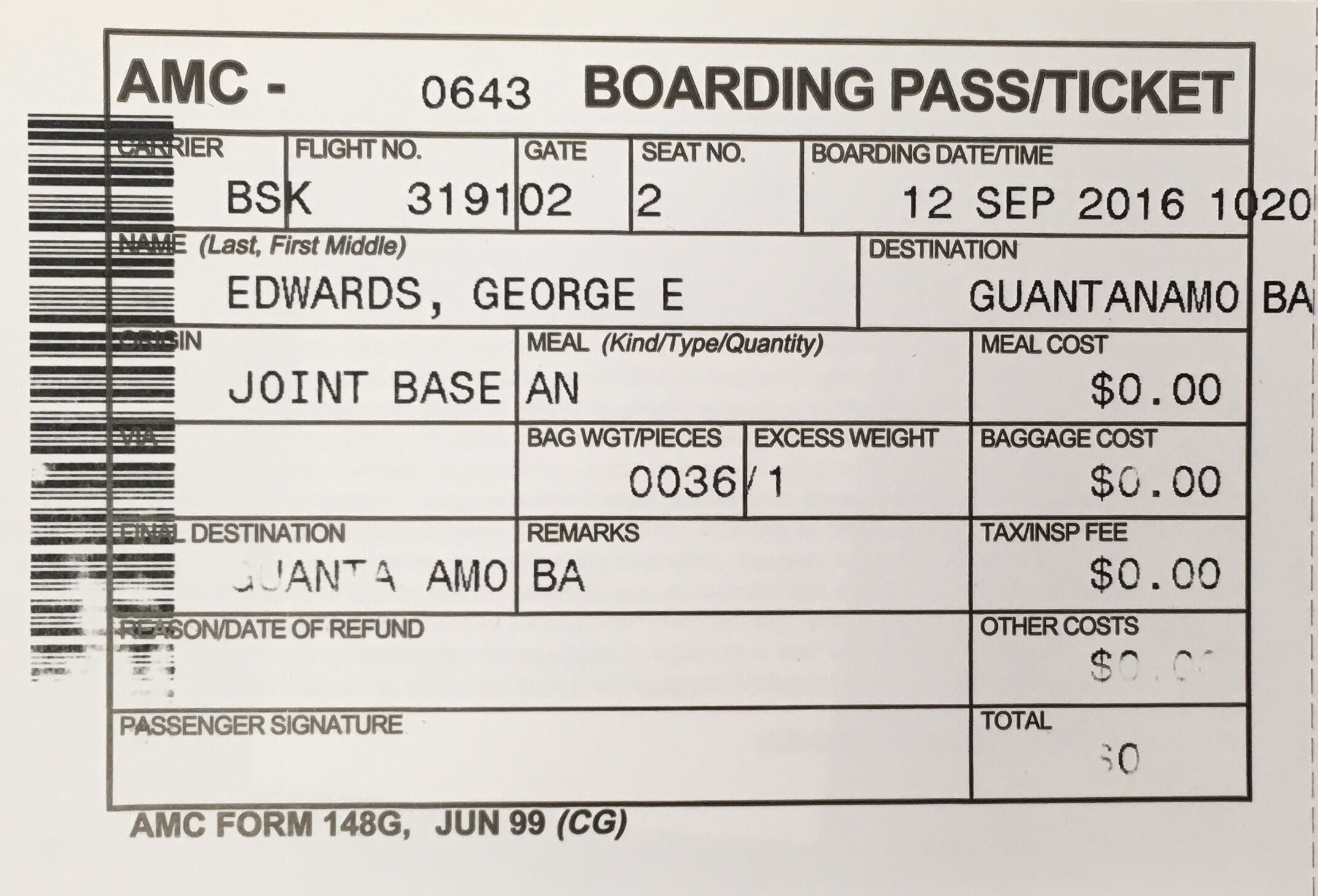
I returned to Washington, DC from Guantanamo Bay on Saturday the 10th of September, and am going back to Guantanamo on Monday the 12th.

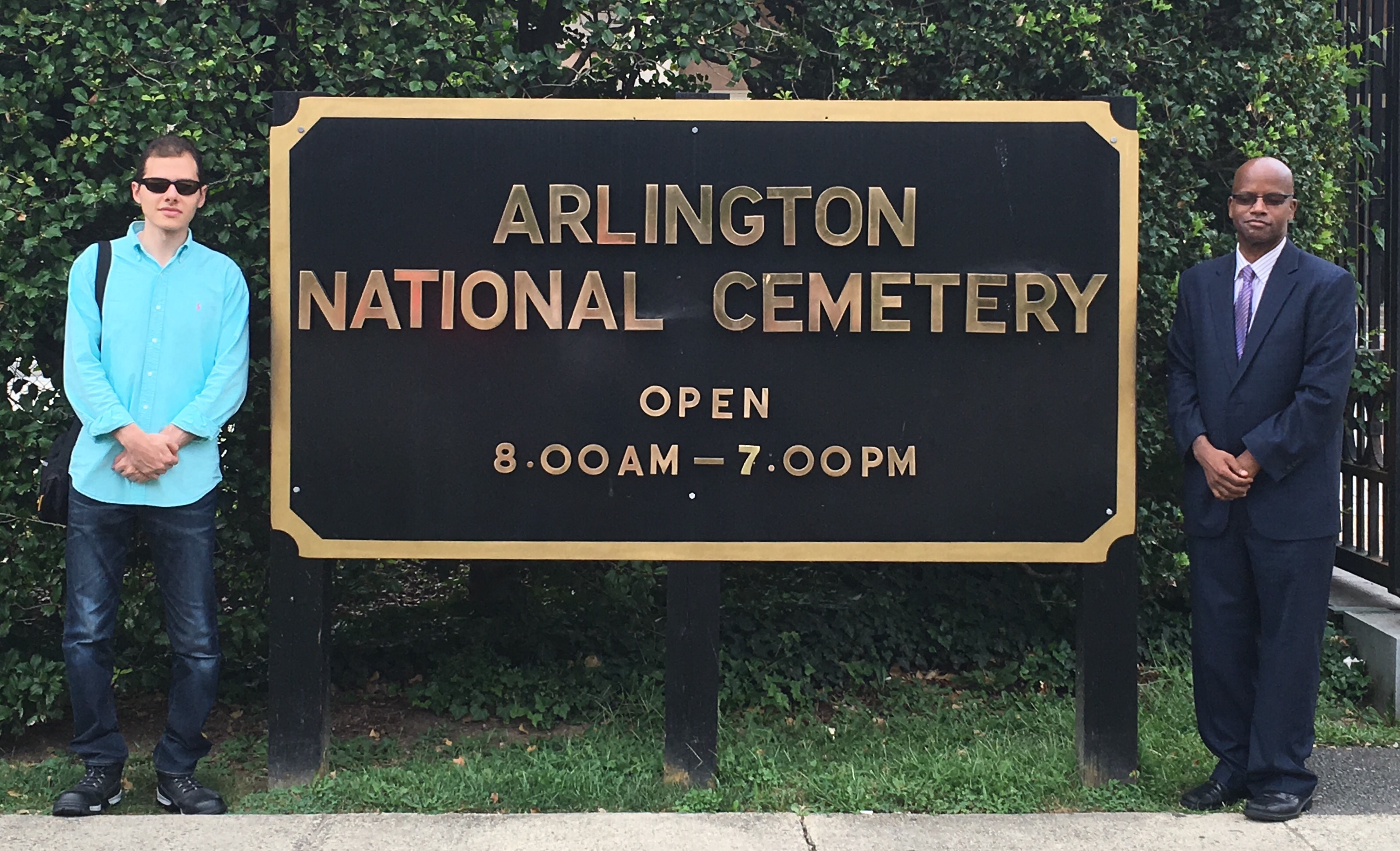
On Sunday, the 15th Anniversary of the World Trade Center and Oentagon attacks, my law student Faisel Sadat and I paid respects at Arlington Cemetery. 

Why Guantanamo Bay again?

Last week I was there for pretrial hearings in the U.S. Military case against all Nashiri, who allegedly masterminded the 2000 bombing of the USS Cole off the coast of Yemen, killing 17 US sailors. 

This week I am monitoring the modification of the guilty plead for Majid Khan, who is the only person convicted of crimes among the 61 men being held at the Guantanamo prison. 

I am joined by 6 non-governmental organization (NGO) representatives (pictured above), including one who was with me last week.

We are expected to have only one hour of court this week, on Wednesday. 

Guantanamo Bay lawyers on all sides brief non-governmental organizations (NGOs)

9 NGO representatives following briefing by Guantanamo Bay Chief Prosecutor Mark Martins

9 NGO representatives following briefing by Guantanamo Bay Chief Prosecutor Mark Martins

Non-governmental organizations (NGOs) fly to Guantanamo Bay, Cuba for ringside seats at U.S. Military Commission war crimes proceedings. NGOs, which tend to focus on human rights issues, attend, observe, analyze, critique and report on what they see and hear at Guantanamo. NGOs are windows to the outside world for people without Guantanamo access.

For the first time in recent memory, this week NGOs at Guantanamo had separate briefings by each of the three sets of lawyers involved with a pending case against a particular defendant.

The 9 NGO representatives present were briefed by: (a) the Chief Prosecutor; (b) the Chief Defense Lawyer; and (c) the military and civilian lawyers for al Nashiri, who is accused of masterminding the 2000 bombing of the U.S.S. Cole off the coast of Yemen, killing 17 U.S. sailors and wounding dozens. The NGOs were at Guantanamo for a week of pre-trial hearings in the case of al Nashiri, who faces the death penalty.

The first lawyers’ briefing of the week was by Chief Prosecutor Brigadier General Mark Martins, who is responsible for the prosecution of any and all Guantanamo Bay detainees. He is formally part of the prosecution team against all defendants, including al Nashiri, and he actively participated at the prosecution table in this week’s hearings.

9 NGO representatives following briefing by Guantanamo Bay Chief Defense Counsel John Baker and Deputy Chief Defense Counsel Brent Filbert

9 NGO representatives following briefing by Guantanamo Bay Chief Defense Counsel John Baker and Deputy Chief Defense Counsel Brent Filbert

The next lawyers’ briefing was by Chief Defense Counsel Brigadier General John Baker, joined by Deputy Chief Defense Counsel Captain Brent Filbert.  General Baker is responsible for all defense counsel on all Guantanamo cases, and is not part of the al Nashiri defense team or of any other defense team. Neither he nor Captain Filbert has an attorney client privilege with any detainee.

The final lawyers’ briefing was by civilian and military attorneys for al Nashiri. These were civilian lead counsel (Learned Counsel Rick Kammen) and military co-counsel (Lt. Commander Jennifer Pollio).

NGOs with al Nashiri's Learned Counsel Rick Kammen and military co-counsel Lt. Commander Jennifer Pollio.

NGOs with al Nashiri’s Learned Counsel Rick Kammen and military co-counsel Lt. Commander Jennifer Pollio.

These briefings offered the 9 NGOs insights into a range of perspectives on Guantanamo law and practice. The NGOs on this mission, who agreed that these briefings were insightful and very helpful, expressed hope that the NGO briefings would continue when future NGO representatives travel to Guantanamo for future hearings.

Substance of the briefings

Predictably, the three briefings focused on similar issues. Military Commission fairness (or not). Compliance with U.S. and international law (or not). Transparency of the process (or not). Rights afforded to all stakeholders (or not). Comparisons among U.S. federal criminal law and criminal procedure, the Uniform Code of Military Justice (UCMJ), and the Military Commission substantive and procedural statute, regulations and rules (favorable / unfavorable comparisons).

The lawyers expressed different perspectives on the pace of the proceedings, to whom delays should be attributable, and logistical and other issues regarding trials at Guantanamo Bay versus on the U.S. mainland. They also shared on more personal issues, such as their careers and families, and possibilities for life for the lawyers after Guantanamo. And yes, the topics of Guantanamo iguanas, banana rats, gnats and mosquitos came up.

None of the briefings was on the record, and of course none included any classified information. All the briefings helped NGOs understand critically important matters related to the case at bar – against al Nashiri – and about larger Guantanamo-related issues.

Briefing Style; Briefing Tools

Each of the briefings differed from the others. Each lawyer had a unique personal style, had particular messages they apparently wanted to convey, and used different means to communicate with the NGOS — including visual aids.

Briefing tools used during the week included (without disclosing which lawyers used which briefing tools!): CDs that contain papers for motions on the week’s docket; basic Military Commission instruments and other information projected onto a screen and a staffer to navigate such; CD readers for NGOs whose new generation laptops lack CD drives; prepared remarks; a scribe to record briefing notes; e-mail addresses and invitations for further NGO communication; a follow-up invitation to a bar-b-que (that served Subway sandwiches!); and a staffer who served as photographer for group and individual shots of the lawyers and the NGO representatives.

[Sidebar – The NGO representatives came into contact with various members of the lawyers’ staffs. In every instance those staff members were helpful, informative, and genuinely interested in assisting the NGOs. And, without exception, each staffer was friendly, pleasant, and just nice — both formally during the briefing, and informally when we would bump into them around the Guantanamo Bay Naval Station, whether at Subway or another restaurant, the gym, the bowling alley, or the Guantanamo airport or Andrews Air Force Base.]

Conclusion

NGOs huddled during the week seeking to think of ways that the lawyers might further enhance the NGO experiences. Among the NGO suggestions were for the lawyers to provide NGOs — before the NGOs depart for Guantanamo Bay —  a short summary of the week’s expected motions, the statutory and other information on the CD that was provided, statements / remarks to be presented by the lawyers to the media (if available), and confirmation that the briefing will take place (to prevent NGOs from having to inquire as to whether a particular briefing will occur).

Some of the NGOs wondered about the venues of the different briefings, and who decided which briefings were held in which venue.

Venue 1:  The Media Operations Center (MOC), in a room with cushioned chairs, a blue velvet stage curtain, high tech audio / visual equipment, and parasol shades for camera lighting.

Venue 2:  The NGO Resource Center, barren, with the lawyers sitting on folding card-table chairs.

The NGOs unanimously agreed that the NGO briefings by all sets of lawyers were very helpful to the NGOs as they seek to fulfill their remit of attending, observing, analyzing, critiquing and reporting on the U.S. Military Commissions.

If NGOs are to be the eyes and ears to the outside world, they should be able to see and hear from the lawyers who are most intimately involved with the Guantanamo Bay cases.  The NGOs all hope that briefings by all sets of lawyers will become routine at Guantanamo Bay during weeks when hearings or trials are held.

Full NGO briefings by Guantanamo Bay lawyers promote transparency, human rights, and the rule of law.

_______

al Nashiri

Going to Guantanamo to Monitor War Crimes Hearings

The sun rises this morning at Andrews Air Force Base as we gather to fly to Guantanamo Bay.

I’m at Andrews Air Force Base again, at sunrise, heading for Guantánamo Bay, Cuba. This time I’m scheduled to attend hearings in the US military commission case against al Nashiri, who it is alleged to have masterminded the 2000 bombing of the USS Cole off the coast of Yemen, killing 17 US sailors. I’m to monitor the proceedings from an international law perspective.

The Hearings

al Nashiri has not had a hearing in 18 months. The court sessions were stayed for this period, during which time conflict and controversy has not ceased. 

The 3 days of hearings this week, if they go forward, may cover dozens of substantive issues the military judge listed on a scheduling order filed in August. It is not clear how much can be accomplished in 3 days. History has shown that during hearing weeks, often there is very little court time. Issues have often arisen, detailing hearings. 

al Nashiri

Some pre-trial issues in the pasta have related to his treatment while in CIA black sites beginning in 2002 for 4 years, where the Senate Torture Report and other sources (including al Nashiri himself) have identified the following practices against al Nashiri – waterboarding (admitted by the government), mock executions, stress positions, and threats of sexual violence against his mother.

Another issue is the length of time between 2002 when he was arrested and now, 14 years later, without his trial beginning. Numerous other issues, some pending before or decided by the military commission or by other courts, appear to stand in the way of a firm trial date in the foreseeable future. 

Human Rights Observers on this Trip

Today 9 non-governmental Organization representatives are set to travel to Guantánamo, to monitor this weeks hearings. I am representing the US Military Commission Observation Project (MCOP) which is part of the Program in International Human Rights Law of the Indiana University McKinney school of Law. We have been sending IU McKinney faculty, staff, students, and graduates to Guantánamo Bay to monitor hearings in these poor crimes trials.

Our Indiana mission includes to attend, observe, analyze, critique and report on these proceedings. We hope to promote transparency, in line with the Pentagon’s stated goal of transparency for these proceedings.

We also seek to shed light on the internationally recognized human rights that should be afforded to all stakeholders in these proceedings. Stakeholders include the defendants, who have rights and interests. Stakeholders also include the prosecution, victims and victims’ families, the media, the monitors, the military charged with operating the detention center, and many other individuals and groups.

We are producing the Guantanamo Bay Fair Trial Manual, which explores the full range of Guantanamo stakeholders’ rights and interests. 

More blog posts will be posted as we continue to monitor the hearings this week

Guantanamo Bay Hearing for USS Cole Bombing Suspect

Courtroom sketch of al Nashiri by artist Janet Hamlin. Today in court he was wearing a similar white jumpsuit.

Guantanamo Bay courtroom sketch of al Nashiri by artist Janet Hamlin. (copyright Janet Hamlin)

A U.S. Military Commission at Guantanamo Bay, Cuba has scheduled pre-trial hearings next week in the case against Abd al-Rahim al-Nashiri, who allegedly masterminded the 2000 USS Cole bombing that killed 17 U.S. sailors off the coast of Yemen.

At pre-trial hearings defense and prosecution lawyers routinely debate evidentiary, jurisdictional, logistical and other issues, and deal with matters such as what evidence will be admissible at trial, which witnesses will be called and when, whether the court possesses jurisdiction to hear the case, and what date to set for the trial to commence.

What is typical (or atypical) about the al Nashiri pre-trial hearings, about his case itself, or about his plight before other tribunals that have or could exercise jurisdiction? Is his case more complex than others?

Multiple courts have either resolved issues related to charges against al Nashiri or have sought to resolve such issue, or to exercise such jurisdiction. These proceedings appear to have extended beyond routine evidentiary, jurisdictional or logistical issues.

Though the military commission judge identified issues to be debated next week (see his 12 August 2016 docketing order below), it is unclear what will be heard. Indeed it is unclear whether the hearings will go forward. al Nashiri hearings were stayed for almost a year, and when they were set to resume in April, they were abruptly postponed until now. Though many dozens of us are gathered in Washington, DC for a post-Labor Day flight from Andrews Air Force Base to Guantanamo, the hearings can be cancelled at any moment, even after we touch down at Guantanamo Tuesday afternoon.

The stakes are high, as proceedings in different courts could result in one, more or all the charges against al Nashiri being permanently dismissed.

The USS Cole after it was attacked by suicide bombers in October 2000 in Yemen. (Photo courtesy of United States Marine Corps)

The USS Cole after it was attacked by suicide bombers in October 2000 in Yemen. (Photo courtesy of United States Marine Corps)

al-Nashiri is charged with multiple war crimes, including perfidy, murder in violation of the law of war, attempted murder in violation of the law of war, attacking civilians, and attacking civilian objects. He faces the death penalty.

Courts’ jurisdiction

Several courts have exercised or sought to exercise jurisdiction over al Nashiri, that is, the courts have or have sought to resolve matters related to his detention or his alleged crimes.

First is the military commission itself at Guantanamo Bay. al Nashiri was picked up in 2002, held in secret CIA camps for about 4 years, taken to Guantanamo Bay in 2006, and arraigned in 2001 in a military commission. In that commission, he is charged with war crimes associated with the U.S.S. Cole and other ships. This commission is the primary court exercising jurisdiction over al Nashiri.

The D.C. Circuit Court of Appeals has also exercised jurisdiction, ruling on 30 August 2016 that it would not halt the Guantanamo commission against him. The defense had asked the appeals court stop the commission because the commission was not lawfully able to exercise jurisdiction. The appeals court chose not to decide the merits of the matter unless al Nashiri is convicted, at which time the appeals court would decide whether the commission had conducted a trial without jurisdiction.

The Court of Military Commissions Review (CMCR) issued a ruling in his Military Commission case in June 2016, and one in July.

The U.S. District Court for the Southern District of New York also has had a stake, as al Nashiri was indicted in that district but the case has not moved forward because Congress prohibited moving detainees to the U.S. for trial.

The European Court of Human Rights ruled that the government of Poland breached international human rights law when it permitted the U.S. to detain al Nashiri on Polish soil, where he was tortured. The court ordered Poland to pay al Nashiri over $250,000.

At the pre-trial hearings this week, the issue of jurisdiction will certainly arise.

al Nashiri

al Nashiri

Pre-trial Issues in his case

al Nashiri’s pre-trial hearings have touched on many issues.

Front and center recently have been jurisdictional issues, such as those discussed above handled by the DC Circuit and the CMCR, and also raised in the commissions.

Pre-trial issues have related to his treatment while in CIA black sites beginning in 2002 for 4 years, where the Senate Torture Report and other sources (including al Nashiri himself) have identified the following practices against al Nashiri – waterboarding (admitted by the government), mock executions, stress positions, and threats of sexual violence against his mother. Should a person be tried on criminal charges after being subjected to this treatment? Can any statements made by al Nashiri after such treatment be allowed as evidence in the trial against him?

Other pre-trial issues in his case or that may be raised include:

  • whether the U.S. can use as evidence the testimony of a man the U.S. killed (alleged co-conspirator Fahd al-Quso);
  • whether and to what extent the U.S. Constitution applies to al Nashiri’s military commission;
  • whether the right to a speedy trial was violated (over 13 years since al Nashiri was taken into custody and over 9 years since arriving at Guantanamo Bay — with the trial itself not commencing as of 2016 and no trial date set);
  • whether his right to humane treatment was violated (even regarding his Guantanamo housing situation – during these proceedings);
  • his right to have access to classified and other information that might be used against him at trial;
  • whether high-ranking military members engaged in undue influence;
  • the timely acquisition of defense lawyers’ security clearances; and
  • al Nashiri’s physical and mental health.

Much remains to be resolved before any actual trial is held.

At Camp X-Ray, Guantanamo Bay

At Camp X-Ray, Guantanamo Bay — George Edwards

My four 2016 summer trips to Cuba

This will be my fourth visit to Cuba in as many months, with three visits to Guantanamo Bay and one to Havana.

My first visit to Guantanamo Bay in this cycle was to monitor U.S. Military Commission pre-trial hearings in the case against Hadi al Iraqi, who is alleged to have been a high-ranking al Qaeda Iraq member, and to have liaised between al Qaeda Iraq and the Taliban. Hs is charged with various war crimes.

My Hadi al Iraqi monitoring mission was through the Military Commission Observation Project of the Program in International Human Rights Law of Indiana University McKinney School of Law. Our project seeks to attend, observe, analyze, critique and report on U.S. Military Commissions. We are producing the Guantanamo Bay Fair Trial Manual, which is used and usable by any person interested in assessing whether the rights and interests of all military commission stakeholders are being afforded to them. We are interested in the rights of the defendants. We are also interested in the rights and interests of the prosecution, the victims and their families, the media, the guards and other prison personnel, witnesses, and others.

Edwards on U Boat Crossing Guantanamo Bay - 14 August 2016 - the morning that 15 detainees were released to the UAE, bring the total GTMO population down 20 from 76 to 61

Edwards on U Boat Crossing Guantanamo Bay – 14 August 2016 – the morning that 15 detainees were released to the UAE, bringing the total GTMO detainee population down 20 percent from 76 to 61

On my second trip to Cuba this summer I was part of a delegation from the National Bar Association (NBA), which is the organization principally for African American lawyers, judges, law professors, and other legal professionals. An NBA conference was held jointly with the Cuban bar association, focusing on a wide range of U.S. interests and Cuban interests, and interests affecting both countries. The topic of Guantanamo Bay came up repeatedly in our discussions with Cuban judges, lawyers and law professors. I also gave a lecture at the U.S. Embassy – Havana.

NBA - Ambassador's Residence - law profs and deputy ambassador

NBA law professors at Residence of U.S. Ambassador to Cuba, with Deputy Ambassador

My third trip to Cuba this summer was in August for a Guantanamo media tour. When I arrived on Guantanamo at noon on Saturday, 13 August 2016, 76 detainees were imprisoned there. When I left Guantanamo at noon the next day, Sunday the 14th, only 61 detainees remained. During the darkness of night, 15 detainees were released to the United Arab Emirates (UAE). That resettlement marked a 20% drop in the Guantanamo Bay detention population over night.

NBA - Group of law professors at end

NBA law professors at Cuban lawyers collective.

Writing projects of mine I was researching at Guantanamo on that third trip include The Guantanamo Bay Reader and a contributions to The Indiana Lawyer.

This fourth trip to Cuba is to monitor the al Nashiri hearings pursuant to our Indiana McKinney School of Law observation program.

More about all of the above (and below) is available on http://www.GitmoObserver.com.

Docketing Order – Motions on the schedule to be heard

The Military Judge in the al Nashiri case on 12 August 2016 issues a Revised Docketing order, outlining the proposed program for the 3 days of scheduled hearings this week (7 – 9 September 2016). Here is that order.

[office src=”https://onedrive.live.com/embed?cid=AA02978A4AC8C787&resid=AA02978A4AC8C787%21167&authkey=AFSd734PKQgcS9U&em=2″ width=”876″]

Afghan money changer pleads for release from Guantanamo Bay

Haji Wali Mohammed, an Afghan money changer, seeks release from Guantanamo Bay

Haji Wali Mohammed, an Afghan money changer, seeks release from Guantanamo Bay

This morning an Afghan who traded currency with the Taliban formally asked the U.S. to release him from Guantanamo Bay after over 14 years of imprisonment.

Haji Wali Mohammad, who is referred to as “Wali Mohammed” or “Mr. Mohammed” by his U.S. Government personal representative and his private counsel, hopes that the PRB will find that he is not a threat to US national security, and that the U.S. Government will thus release him from Guantanamo Bay. A detainee may either be repatriated to his home country, or resettled to a third country.

There seems to be agreement across the board that Wali Mohammed operated a currency exchange business and conducted financial transactions in the 1990s, when the government of Afghanistan was under Taliban control, and that some of the transactions involved Taliban members or Taliban controlled entities, and there seems to be agreement that transactions with certain entities occurred before, during and after the Taliban was in control.

The U.S. government noted:

We assess with moderate confidence that AF-560 conducted financial transactions for Usama Bin Ladin in 1998 and 1999, either directly or through his ties to the Taliban, and was probably motivated by financial gain. We note identifying details for AF-560 have been corroborated, but there has been minimal reporting on AF-560’s transactions completed on behalf of Bin Ladin. Efforts to link AF-560 to Bin Ladin are complicated by several factors, including incomplete reporting, multiple individuals with AF-560’s name-Haji Wali Mohammad, and lack of post-capture reflections. AF-560 was captured on 24 January 2002.

The U.S. government continued:

AF-560 during his detention has never made statements clearly endorsing or supporting al·Qa’ida or other extremist ideology, but probably has a pragmatic view of the role the Taliban held in Afghanistan. He most likely judged that it was prudent to work with, rather than against, the Taliban Government in the 1990s. During his detention, AF-560 appears to have formed a more liberal view of politics in Afghanistan and has said the Taliban will have to change if they want to remain viable in the country, including changing their policy on women’s rights and education.

Countering, the Wali Mohammed’s private counsel contended:

Wali Mohammed’s business was currency exchange. He bought and sold currency in Pakistan and the UAE with the aim of capitalizing on differences in exchange rates. As he has freely admitted, in late 1997 and early 1998, he entered into a partnership to pursue such a currency arbitrage with the Central Bank of Afghanistan -then under the control of the Taliban government. As Wali Mohammed has said, and as an expert on his behalf confirmed ,such partnerships were commonplace before, during, and after the Taliban regime. Wali Mohammed described, and the expert confirms, the sudden and significant volatility in the value of the Pakistani rupee in 1998.

The result was a catastrophic loss -roughly a half-million of the $1.5 million the Central Bank had invested. After the Taliban government learned of the loss, investigators fired the head of the Central Bank, threatened Wali Mohammed with prison, actually imprisoned his cousin, and forced the entire loss on him – in violation of the terms of the deal. This is not the kind of treatment one would expect of someone who was part of or of any importance to the Taliban.

The disastrous failure of the Central Bank transaction also makes it implausible that Wali Mohammed conducted financial transactions for Osama Bin Ladin thereafter -leaving aside that Mr. Mohammed speaks little Arabic and bin Ladin spoke no Pashto. Two intelligence experts on behalf of Mr. Mohammed -one, the former Director of Human Intelligence Collection for the DIA; and the other, a former DIA intelligence analyst, identities expert, and, after the 9/11 attacks, a CIA contractor and charter member of the Terrorist Threat Integration Center, the National Counter Terrorism Center, and the Advanced Analytics Team -have shown, consistent with the Detainee Profile, that the identification of Mr. Mohammed is problematic .Even the late Taliban leader, Mullah Akhtar Mansour, reportedly carried a passport bearing the name “Wali Mohammed.”

This Periodic Review Board (PRB) was ordered pursuant to a 2-11 Executive Order for Guantanamo detainees.

Indiana McKinney involvement in this PRB

This morning’s PRB had no representation by the Periodic Review Board Project (PRBP) of the Indiana University McKinney School of Law. To date, I am the sole individual from the PRBP monitoring PRBs on site, and I have attended several PRBs over the last several months. Postings about these PRBs can be found here.

We nominated Mr. Jeffrey Meding, a McKinney Juris Doctor graduate, to attend today’s hearings, but his request to attend and monitor has not been granted. We are in discussions with the Periodic Review Secretariat (www.prs.mil) further to seek permission for Mr. Meding to attend PRBs, and for others affiliated with our PRB project (PRBP) to attend, particularly when I am not able to attend.

As it happens, in any event, I did not receive my usual clearance from the Pentagon to attend today’s PRB, though I submitted my request to attend last week. Typically, a day or so before the PRB, the Pentagon sends cleared observers an e-mail with details about permissions, logistics, and rules. I did not receive such and e-mail yesterday before this morning’s (25th) scheduled PRB.

We look forward to clarity in the process, and full opportunities to cover PRBs, under one or more of the various categories of persons / entities permitted to observe PRBs – whether media, non-media NGO, non-media individual.

As I did not attend this morning’s hearings, at this point I do not know whether Wali Mohammed actually attended his PRB this morning, or indeed whether the PRB went forward as scheduled. I cannot comment on his apparent demeanor, his looks or clothing, his interaction or non-interaction with the others in the room, whether there were any technical or other difficulties, or anything else of note regarding this PRB. I cannot comment on the efficiency of our usual Pentagon escorts this morning, though it is likely that all went like clockwork, as is typical, from pickup at the Pentagon’s Visitor Center, through badge clearances, winding-hall walking, and escort to the Pentagon’s exit post-hearing.

But as for the PRB hearings themselves, reading the text of submitted documents before the hearings does not provide a full picture of the hearing. Reading transcripts post-hearings does not provide a full picture of the hearing. Reading news reports or postings by NGOs also does not offer a full picture of the hearing. Short of being present in the PRB room at Guantanamo Bay, the best place to observe PRB hearings is in the closed, secure conference room at the Pentagon. In that room, you can see and hear in a way that is more helpful than just reading.

Standing in front of Camp Justice.

Jeff Meding in front of GTMO’s Camp Justice.

Mr. Meding was the first Indiana University McKinney Affiliate to travel to Guantanamo Bay, Cuba on behalf of the Military Commission Observation Project (MCOP) of the Indiana University McKinney School of Law.

Mr. Meding’s PRB participation on behalf of the McKinney Law School’s PBRP was approved by the MCOP Advisory Council. Furthermore, the Office of General Counsel of Indiana University cleared our Pentagon travelers for PRB purposes. We now await the Pentagon’s grant of permission for us to send IU McKinney Affiliates to observe PRBs at the Pentagon.

Again, we hope that we receive permission to have full representation at the PRBs that are being broadcast to the Pentagon, typically on Tuesday and Thursday mornings.

My PRB posts

Many of my PRB postings can be found here:

https://gitmoobserver.com/blog/

Jeffrey Meding’s Guantanamo Bay posts

Following are some posts by Jeff Meding from his 2012 mission to Guantanamo Bay, Cuba to monitor U.S. Military Commission hearings on behalf of the Military Commission Observation Project of the Indiana University McKinney School of Law:

https://gitmoobserver.com/2014/03/21/gtmo-impressions-jeff-meding-2/

https://gitmoobserver.com/2014/04/12/12-april-2014/

https://gitmoobserver.com/2014/04/14/14-april-2014-1st-day-of-hearings/

https://gitmoobserver.com/2014/04/15/15-april-2014-2nd-day-of-hearings/

https://gitmoobserver.com/2014/04/17/16-april-2014-hearing-adjourned-until-thursday/

https://gitmoobserver.com/2014/04/18/17-april-2014-final-day-of-hearings-selected-pics/

Additional PRB & PRBP Information

Additional information about PRBs can be found here:

https://gitmoobserver.com/blog/

Additional Information abour the Guantanamo Bay Periodic Review Board Project can be found at:

https://gitmoobserver.com/prbs/


PS:  The full U.S. government unclassified statement on Wali Mohammed is here:

[office src=”https://onedrive.live.com/embed?cid=AA02978A4AC8C787&resid=AA02978A4AC8C787%21165&authkey=APi5MUmQoAi2XVM&em=2″ width=”876″ height=”688″]


The full Personal Representative Statement & Private Counsel Statement are here:

[office src=”https://onedrive.live.com/embed?cid=AA02978A4AC8C787&resid=AA02978A4AC8C787%21166&authkey=AJG8Q2LmAm6OEs4&em=2″ width=”876″ height=”688″]

By George Edwards

Saudi-born Palestinian Abu Zubaydah asks Pentagon for release from Guantanamo

Abu Zubaydah - Eye patch -- darker - facing front

Abu Zubaydah apparently lost his left eye while in U.S. custody.

For the first time in almost 15 years, the outside world saw the face of war crimes suspect Abu Zubaydah. He was arrested in Pakistan in 2002, awarded $100,000 Euros damages from Poland for torture in U.S. / CIA black sites, lost his left eye while in U.S. custody, and was transferred to Guantanamo Bay in 2006.

At this morning’s Periodic Review Board (PRB) hearing, Abu Zubaydah and his pentagon-appointed personal representatives formally tried to convince the U.S. government that he is not a threat to U.S. national security. They asked the U.S. to release him from Guantanamo.

The hearing was held in the back corner of a Guantanamo Bay courtroom, but was broadcast live to a nondescript Pentagon conference room. Instead of the typical handful of media and human rights workers attending at the Pentagon, today we had 15 – more than I’ve seen at any other PRB.  Maybe this was because of Abu Zubaydah’s reputation, the loss of his eye, or the extreme extent of his alleged criminal activities over many years, coupled with his proved torture and his being cloistered in U.S. custody for 1/3 of his life. The conference room was full. All wanted the first glimpses of Abu Zubaydah in 15 years.

Who is Abu Zubaydah?

Abu Zubaydah, a Palestinian, was born in Saudi Arabia in March 1971. The U.S. government does not clearly indicate when they believe he became involved in terrorism or war crimes activities, but the U.S. alleges that he trained militant recruits in Afghanistan as early as 1989, when Abu Zubaydah was a late teen, early adult.

The U.S. alleges that he perpetrated international crimes over many years in different jurisdictions. These include involvement in the 9/11 attacks, the U.S. Embassy bombings in East Africa in 1998, the USS Cole bombing off the coast of Yemen in 2002, and other atrocities.

Abu Zubaydah - Eye patch -- lighter - facing left

Abu Zubaydah — Apparently with both eyes.

While Abu Zubaydah was being apprehended in Pakistan in 2002, he was shot and severely wounded. While he was being held in a hospital under the custody of the U.S., FBI investigators sought to build a rapport with him, as he was recovering, and that rapport is said to have led Abu Zubaydah revealing useful intelligence to the FBI. The CIA took over the interrogations, and switched from non-coercive rapport building techniques used by the FBI to enhanced interrogation techniques (EITs), that are widely referred to as torture, and were part of a secret overseas detention and interrogation program authorized by President Bush on 17 November 2019, soon after the 9/11 attacks.  Abu Zubaydah was the first prisoner upon whom the CIA used EITs / torture, conducted at CIA “black sites” – overseas detention and interrogation facilities in about a half dozen countries on four continents. The EITs / torture used against Abu Zubaydah included sleep deprivation, walling, water boarding, stress positions, dietary manipulation, forced nudity, rectal feeding, and confinement in coffin-like and smaller boxes. He was water boarded no fewer than 83 times.

As reported by Al Jazeera America, Abu Zubaydah apparently kept diaries for approximately 10 years, ending around the time he was captured in Pakistan, in 2002. Those diaries purport to tell his story in his own words.

On 24 July 2014 the European Court of Human Rights (ECHR) ordered Poland government to pay Abu Zubaydah 100,000 euros in damages and 30,000 euros for costs because Poland permitted the CIA to detain and torture him in Poland in 2002 – 2003.

This morning’s PRB hearing.

 As usual, I arrived at the Pentagon before 8:00 a.m., cleared through the first round of security (badging, metal detectors), and spotted a group of other regular observers, waiting for our Periodic Review Secretariat escorts.

This time, I noticed a several other people, whom I did not know, hovering around the regular observers.  In addition, it was a treat to see two media reps I met on my recent media trip to Guantanamo Bay.

The escorts arrived as scheduled, ready to take us through the next round of the building’s security, and the maze that leads to the conference room where this high-value detainee (HVD) alleged war criminal would appear on TV monitors at 9:00 a.m.

It took a little extra maneuvering to get of us all through the main internal Pentagon portal.

Today we had 5 human rights workers, academics or authors in our Observer group, along with 10 media representatives (al Jazeera, Courthouse News, NPR, AP, the New York Times, the Huffington Post, the Guardian, the Miami Herald, the Intercept, and the Washington Post). No representatives of the Saudi Arabian government or the Palestinian government were present.

We deposited our cell phones and cameras on a table outside the conference room, and filed in. Some of the Observer have attended dozens of PRBs, and have favorite seats.

We filled out a form swearing that we had indeed left our cell phones and cameras outside the room.

In the middle of the room is a large conference table, on top of which sits an octopus-like device that houses the phone line to connect us to Guantanamo. Today a Pentagon official (our escort) designated me as the person to answer the conference room phone when Guantanamo called to start the PRB connection, to adjust the volume if necessary, and to mute the speaker. I followed instructions when the phone rang at 9:01 a.m.

The History Channel that we had been watching on the big screen was switched off, and all eyes stared at an empty chair on the screen, broadcast live from the Guantanamo Bay courtroom.  It was the chair where the judge sits during regular Military Commission hearings. PRBs are not judicial proceedings, there is no judge present, and there is no need for them to be conducted in a courtroom. Indeed, most PRBs have been conducted in trailer-like structures very close to where most of the detainees are housed.

After about a minute, we lost sound. We lost visuals. We lost our Guantanamo connection. Our escort exchanged chat messages with Guantanamo, and we were told to hold tight.

For the next 16 minutes, we sat in the conference room, engaging in nervous chatter. Would the hearing go forward even if the Pentagon observers couldn’t see and hear the proceedings? What if we could hear but not see the hearings, or see but not hear them? Would they postpone them until we could both see and hear? Would they start without us if the reconnection took too long?

The name Abu Zubaydah is a household name, at least for those of us involved in the national security arena. Many had been waiting for years to see him face to face, after his being under cloak of confinement for so long.

At 9:17, a picture of the four Guantanamo participants appeared on our Pentagon big screen.

Abu Zubaydah - Eye patch -- with both eyes

Purportedly a photo of Abu Zubaydah

Abu Zubaydah sat at the head of a narrow rectangular table, directly facing the camera – that is, directly facing us who were viewing the hearing at the Pentagon. To his right, sitting along the long side of the table, were his two camouflage-clad Pentagon-appointed personal representatives (one of whom appeared to be the same personal representative who represented both detainees whose PRBs I attended last week, in this same Pentagon room). Directly across from the 2 representatives was the interpreter, a balding middle-aged dark-olive-skinned man, with a short brown tropical shirt.

Some of the words spoken during the hearing were in Arabic, and were spoken by the on-camera interpreter.

An off camera voice, presumably from but not necessarily from Guantanamo, advised in English on the nature of the hearing, the format, and the short agenda.

Another off camera voice read aloud an “unclassified summary statement”, in English, of behavior that Abu Zubaydah allegedly engaged in, both before he arrived at Guantanamo and after he arrived. (See comment below.)

After the government’s unclassified summary statement, one of the two personal representatives read an opening statement in English.

After both statements, an off camera voice asked if anyone had any questions. There were none.

The unclassified portion of the hearing ended roughly 14 minutes and 32 seconds after it started. Observers were invited to leave the conference room, since Observers are not permitted to observe classified portions of the PRB hearings.

Government’s Unclassified Summary Statement

As mentioned, during the hearing, the government submitted an “unclassified summary” statement that an off-camera voice read aloud.

That statement listed a number of unlawful activities allegedly engaged in by Abu Zubaydah, and alleged that Abu Zubaydah:

  • “possibly had some advanced knowledge of the bombings of the US Embassies in Kenya and Tanzania in 1998 and the USS Cole bombing in ”
  • Was “generally aware of the impending 9/11 attacks and possibly coordinated the training at Khaldan camp of two of the hijackers”
  • “most actively plotted attacks against Israel” at home and abroad
  • “was convicted in absentia by the Jordanian Government for his role in planning attacks against Israeli, Jordanian, and Western targets during the Millennium time frame in Jordan” and
  • post-9/11, allegedly “took a more active role in attack preparations, sending operatives to al-Qa’ida senior member Khalid Shaykh Muhammad (KU-I 0024) to discuss the feasibility of exploding a radiological device in the United States, and supporting remote-controlled bomb attacks against US and Coalition Forces in Afghanistan “.

The government’s statement asserted that:

[abu Zubaydah] has shown a high level of cooperation with the staff at Guantanamo Bay and has served as a cell block leader, assuming responsibility for communicating detainees’ messages and grievances to the staff and maintaining order among the detainees. He readily and consistently responded to most if not all lines of                 questioning by the debriefers, including providing detailed information on his terrorist activities and those of his associates. His debriefers assessed that he withheld information, which might have been to protect historical or current activities. GZ-10016 has used his time in Guantanamo to hone his organizational skills, assess US custodial and debriefing practices, and solidify his reputation as a leader of his peers, all of which would help him should he choose to reengage in terrorist activity.

Furthermore, the government’s statement noted that:

OZ-I 0016 probably retains an extremist mindset, judging from his earlier statements. GZ-10016 has not made such statements recently, probably to improve his chances for repatriation . GZ-10016 has condemned ISIL atrocities and the killing of innocent people. He has had little communication with his family, suggesting he  would lack a support network, even if he tried to leverage his university coursework in computer programming to get a job and reintegrate into society. Some of GZ-100 I 6’s former colleagues continue to engage in terrorist activities and could help GZ-10016 return to planning attacks against Israel and the United States in Pakistan, should he choose to do so.”

Personal Representatives’ Opening Statement

The Personal Representative Opening Statement of the two personal representatives is reproduced here in its entirety:

 UNCLASSIFIED

Approved for Public Release


Periodic Review Board Initial Hearing, 23 Aug 2016 Zayn Al-Ibidin Muhammed Busayn, ISN 10016 Personal Representative Opening Statement

Good morning ladies and gentlemen of the Board. We are the Personal Representatives for ISN 10016, Mr. Zayn al-Ibidin Muhammed Husayn. We will be working with Zeinelabeden to present his case to you on why he no longer needs to be detained in order to ensure that the security of the United States is not in jeopardy.

Although he initially believed that he did not have any chance or hope to be released, because of the reputation that has been created through the use of his name, he has been willing to participate in the Periodic Review Process. He has been respectful to us in all of our meetings and dealings with him, and he has come to believe that he might have a chance to leave Guantanamo through this process.

Zeinelabeden has expressed a desire to be reunited with his family and begin the process of recovering from injuries he sustained during his capture. He has some seed money that could be used to start a business after he is reintegrated into society and is living a peaceful life.

Zeinelabeden has stated that he has no desire or intent to harm the United States or any other country, and he has repeatedly said that the Islamic State is out of control and has gone too far.

Zeinelabeden would like to thank the board for this opportunity to plead his case and looks forward to answering any questions the board may ask him.

Observations of Abu Zubaydah at today’s PRB hearing

Until today, no member of the public has seen Abu Zubaydah since he was arrested in Pakistan in 2002. After arrest, he was immediately taken to a CIA black site and remained in CIA custody until September 2006, when he was delivered to Guantanamo, exactly 10 years ago next month (September 2016).

Photographs of him in custody are generally not permitted (with the exception of Red Cross and file photos), and we were not able to take photos of him at the Pentagon today. Even if we were permitted to sketch him, there would not have been enough time, given that today’s hearing last only 14 ½ minutes.

But I can say that Abu Zubaydah appeared to be of sturdy build, with a full face covered with a healthy closely cropped, dark, kempt beard.

The hair on his head was dark, full, stylish, as though neatly and well-trimmed for today’s hearing.

He wore a high-collared white seemingly starched tunic-like top, ¾ sleeved, pleated in front. It looked like a fine, dress garment, unlike ordinary household or prison clothing worn by some of the other detainees during their hearings or during their day-to-day life at Guantanamo Bay.

Strikingly, hanging from a cord around Abu Zubaydah’s neck throughout the hearing appeared to be his round, black eye patch, several inches in diameter – apparently bigger than his left eye, which he purportedly lost while in U.S. custody.

At first glance, it looked like an old-fashioned round microphone, perched in front of him, chest level as he sat at the head of the table. But it did not take long to recognize that it appeared to be more like a round hip hop medallion, but jet black and cloth, not a glistening metallic gold. The ornament’s blackness contrasted brilliantly with Abu Zubaydah’s bright white top.

With the stories that circulated about the loss of his eye and the circumstances of that loss, it was of curiosity as to why his eye patch would be nestled in the white fabric in the center of his chest, and not covering his left eye socket.

When the hearing began, Abu Zubaydah wore metal-framed eyeglasses, silver-looking, fashionably shaped – not regularly round or regularly rectangular, but with molded angles. From time to time he dabbed beneath his eyes, and his forehead, with a neatly rectangularly-folded handkerchief he would shift from his right hand to left, and back.

At one point he lifted his eyeglasses, and deliberately rubbed his right eye (his only eye) with his hand, as if to scratch or console. Or was it to draw attention to his eye, on which perhaps many in the room were focusing anyway?

The blink of his right eye was visible through his glasses. There appeared to be no movement from his left eye socket, which was visible, albeit not too clearly, when he removed his glasses.

Abu Zubaydah appeared intently to follow the proceedings, paying rapt attention, though at times his actions could be perhaps interpreted as reflecting a lack of interest, for example, when he would rest his right arm on the armrest or table, put his index finger to his temple, his thumb to his chin, and his middle finger to his lips — as though bored.

When the off-camera U.S. government male voice began reading in English the government’s unclassified statement about Abu Zubaydah, he began searching through documents apparently looking for a copy of the document, which one of his personal representatives pointed out for him.

He accepted the document, then placed it on the table in front of him. He took off his glasses, reached forward and picked up a second pair of wire-rimmed glasses, and swapped them out. Perhaps one pair of glasses was for distance, and the other was for reading. I had seen detainees at hearings with glasses, but never with two pair, swapping out as called for by the situation.

As the 15 observers left the conference room after the hearing, words like “handsome”, “striking”, “good looking”, “not so disheveled like you might expect”, “well-groomed”, “nicely dressed” could be heard, describing someone who is alleged to have perpetrated unspeakable crimes against humankind, but who looked as though this morning he could have been participating in any sort of a business meeting – lease signing, mortgage loan closing or other corporate transaction – given the manner in which he was dressed, how he comported himself, and how he sat at the head of the table and commanded the audience of the personal representatives and the interpreter who straddled the sides of the conference table.

But, Abu Zubaydah is not being judged by his looks, his clothes, his hair, or his mannerisms. Regarding the PRB, he will be judged by what was revealed in the public portion of the PRB, and presumably what is covered in the classified portion of the PRB, which was scheduled to commence 15 minutes after the public portion.

Next steps

The PRB – which comprises one representative each from the Departments of Homeland Security, State, Justice and Defense; the Joint Chiefs of Staff; and the Office of the Director of National Security – will deliberate and determine whether they believe that Abu Zubaydah poses a threat to the national security of the U.S.

The PRB will likely render its assessment soon. You can check www.prs.mil (under “initial reviews”) for updates.

By George Edwards,

Professor of Law, Indiana University McKinney School of Law

Faculty Director (Founding), Guantanamo Bay Periodic Review Board (PRB) Project

Faculty Director (Founding), U.S. Military Commission Observation Project

PS:  Like last week, during the PRB a narrow, stream of light shined vertically down the large viewing screen today, whispering through cracked blinds of the Pentagon room. I’d forgotten to ask that the blinds be fully closed to maximize the observers ability to observe.

PPS:  Photos are from various websites. Citations available.

Alleged Bali Bomber’s Guantanamo Hearing Viewed at the Pentagon Today

PRB -- Hambali - hambali Riduan Isamuddin

Indonesian born “Hambali”, also known as “Asia’s Osama bin Laden”. He allegedly plotted the 2002 Bali bombing.

One of the 61 detainees now held at Guantanamo Bay is Indonesian-born Riduan Issamuddin, also known as “Hambali” or as “Asia’s Osama bin Laden”. He allegedly plotted the 2002 nightclub bombing in Bali, Indonesia that killed 202 people, including 88 Australians and 7 Americans.

This morning Hambali appeared at a formal hearing in which he and his pentagon-appointed personal representatives asked the U.S. government to release him from Guantanamo. The hearing, called a Periodic Review Board (PRB), was held in a back corner of a Guantanamo courtroom, and broadcast by live video-feed to a Pentagon conference room. I and a dozen or so others traveled to the Pentagon and watched and listened.

Who is Hambali

Bali-bombings-in-2002-with-great-destruction

The 2002 Bali nightclub bombing killed 202 people, including 88 Australians.

Hambali, who is 52 years of age, was born in the small Indonesian village of Sukamanah in Cianjur, West Java, Indonesia. As a young adult, he moved to Malaysia, and then, after apparently receiving a calling, fought Soviet troops in Afghanistan and the Philippine army in Mindanao. He eventually became one of the most wanted terrorist suspect in all of Southeast Asia.

Hambali purportedly became operations chief for a militant group known as Jemaah Islamiah (JI). As a senior member of JI, Hambali allegedly served as a liaison between JI and al Qaeda.

Another scene from the Bali bombing.

Another scene from the Bali bombing.

In addition to being an alleged plotter of the Bali nightclub bombing, he is alleged to have plotted the 2003 JW Marriott bombing in Jakarta, Indonesia.

Hambali has also been accused of participating in a plot to put explosives on planes bound for the U.S., and of playing a supporting role (handling some finances) in the 9/11 attacks.

Hambali was arrested in August 2003 in Thailand, and spent over 3 years in CIA custody – in black sites – where he was subjected to nakedness for extended periods, stress positions with hands cuffed to a hook in the ceiling, being blindfolded with a sack over his head, and other tactics.

The 2003 JW Marriott Hotel bombing in Jakarta, Indonesia, also caused great destruction.

The 2003 JW Marriott Hotel bombing in Jakarta, Indonesia, also caused great destruction.

One might expect Hambali’s “nickname” of Hambali to be linked to Bali, Indonesia, the sight of the horrific 2012 Bali bombing, but that may not be the case.

It has been reported that:

“Security officials in Indonesia, Malaysia and the Philippines add that “Hambali”, a nom de guerre taken from Imam Hambali, a famous 8th-century Islamic saint, is also linked to attacks in the region that started with the Christmas bombings of churches in Indonesia in December 2000 and the subsequent bombings in the Philippines. “ (http://www.atimes.com/atimes/Southeast_Asia/EH19Ae06.html)

A JW Marriott restaurant after the bombing.

A JW Marriott restaurant after the bombing.

The PRB hearing this morning.

 As usual, I arrive at the Pentagon before 8:00 a.m., cleared through the first round of security (badging, metal detectors), and joined a group of other regular observers, waiting for our Periodic Review Secretariat escorts.

The escorts arrived on schedule, ready to take us through the next round of the building’s security, and the maze that leads to the non-descript conference room where Asia’s once most notorious alleged terrorist would appear on TV monitors at 9:00 a.m.

Today there were 5 human rights workers or academics present in our Observer group, along with 4 journalists (al Jazeera, Courthouse News, AP, and Straights Times Singapore). There were no representatives of the Indonesian government there to witness the hearing on behalf of their citizen.

We deposited our cell phones and cameras on a table outside the room, and filed into the room. Some of the Observer have attended dozens of PRBs, and almost have assigned seats in the viewing room.

After we sat, we filled out a form swearing that we had indeed left our cell phones and cameras outside the room.

On a big screen in the front of the room, we watched a few minutes of the History Channel before the conference table phone rang to alert us that the hearing was beginning.

At 9:02, the History Channel was switched off, and all eyes in the room descended upon Hambali, live from the Guantanamo Bay detention center.

Hambali sat at the head of a narrow rectangular table, directly facing the camera – that is, directly facing us who were viewing the hearing at the Pentagon. To his right, sitting along the long side of the table, were his two camouflage-clad Pentagon-appointed personal representatives (who also appeared to be the same personal representatives who represented on behalf of the detainee whose PRB I attended 2 days previous, in this same Pentagon room). Directly across from the 2 representatives was the interpreter, with head wrapped so full with a blue flowery scarf that not one inch of her face showed throughout the entire hearing.

One off camera voice, presumably from but not necessarily from Guantanamo, advised on the nature of the hearing, the format, and the short agenda.

Another off camera voice read aloud an “unclassified summary statement” of behavior that Hambali allegedly engaged in, both before he arrived at Guantanamo and after he arrived. (See comment below.)

After the government’s unclassified summary statement, one of the two personal representatives read an opening statement.

After both statements, an off camera voice asked if anyone had any questions. There were none.

The unclassified portion of hearing ended at 9:12, roughly 10 minutes after it started. Observers were invited to leave the conference room, since Observers are not permitted to observe classified portions of the PRB hearings.

Hambali -- Changing facesGovernment’s Unclassified Summary Statement

The government submitted an “unclassified summary” statement, that an off-camera voice read aloud during the hearing.

It listed out a number of unlawful activities allegedly engaged in by Hambali, including associated with the Bali Bombing of 2002, the JW Marriott bombing of 2003, and the 9/11 attacks.

Regarding his behavior while at Guantanamo, the government’s statement noted

[Hambali] has mostly been compliant at Guantanamo Bay, having committed a low number of infractions relative to other detainees. [Hambali] has emerged as a mentor and teacher to his fellow detainees, seemingly exerting influence over them and has been heard promoting violent jihad while leading daily prayers and lectures.

The government’s statement concluded:

We judge that [Hambali] remains steadfast in his support for extremist causes and his hatred for the US. He most likely would look for ways to reconnect with his Indonesian and Malaysian cohorts or attract a new set of followers if he were transferred from Guantanamo Bay. He is close to his family and probably would quickly contact them as well, but we do not know if they would be able to support him financially. Hambali’s younger brother Rusman Gunawan has emerged as part of the Islamic State of Iraq and the Levant’s(ISIL) Indonesia-based network.

Personal Representatives’ Opening Statement

 The Personal Representative Opening Statement of the two personal representatives is reproduced here in its entirety:

PERIODIC REVIEW BOARD INITIAL HEARING, 18 AUG 2016 ENCEP NURJAMAN HAMBALI, ISN 10019

PERSONAL REPRESENTATIVE OPENING STATEMENT

Good morning ladies and gentlemen of the Board. We are the Personal Representatives for ISN 10019, Encep Nurjaman Hambali.

Hambali has attended all scheduled meetings. During these meetings he has been respectful and energetic. He has been most enthused about his PRB. He always smiles and never hesitates to answer any questions we have.

During his time in detention he has learned English, some from his interaction with JTF Staff and some from Rosetta Stone. He also taught himself Arabic, which he then held classes to help teach his fellow detainees.  He went so far as to have homework and tests for them.  His father and uncles were all teachers, so it came naturally for him.

When programs were offered, he was eager to attend. He enjoys watching the programs Planet Life, Blue Planet and also enjoys the great courses on DVD’s.

Hambali has stated he has no ill will towards the U.S. He believes America has diversity and sharing of power which is much better than a dictatorship. He states that he wants nothing more than to move on with his life and be peaceful.  He hopes to remarry and have children to raise.

We stand ready to answer any questions you may have.

 Observations of Hambali at today’s PRB hearing

Since Hambali was arrested in Thailand in 2003 – when he was held for over 3 years in CIA black sites and over 9 years at Guantanamo – virtually no members of the public have seen Hambali. Photographs of him are not permitted. Even if those of us who have seen him at hearings were permitted to sketch him, there would not enough time, given that, for example, today’s hearing last only 10 minutes.

But I can say that Hambali appeared to be of sturdy build, with a full face covered with a healthy but medium-length beard, ¼ of which was dark and close to his skin, with the remaining white or gray barely touching his upper chest when he leaned forward. His sideburns appeared to be tufted, and not as full as his beard, mixed mostly dark with some white.

His hair was dark, stylish, parted on the left, with windows of slight recession on the left and right forehead.

He wore dark Clark Kent eyeglass, that gave the impression of being thick, and his eyebrows rose above the rims, whether he was looking down at his papers or whether he was looking up towards the camera, as he occasionally did.

Hambali wore a short sleeved white top, and sat erect, though he leaned slightly forward throughout the hearing, except for when he occasionally reached down to touch his left thigh or leg. Was he in pain or just uncomfortable? He did not shift around in his chair, as some detainees have done at their PRBs.

His eyes focused intently on a small stack of white and yellow papers he shifted from one stack to the other, and back again, even while the interpreter was speaking to him in a language he understood. On the one hand, it looked like he was following the proceedings intently, with a serious, firm face. But, that face continued whether an off camera voice was speaking in English, his representative was speaking English, or the interpreter was speaking his own language.

A narrow, stream of light shined vertically down the large viewing screen today, whispering through cracked blinds of the Pentagon room. Note to self – ask if the blinds can be totally shut for the PRB hearing next Tuesday – for Abu Zubaydah, who as a high value detainee has also not been seen by any member of the public in over a decade.

Next steps

The PRB – which comprises one representative each from the Departments of Homeland Security, State, Justice and Defense; the Joint Chiefs of Staff; and the Office of the Director of National Security – will deliberate and determine whether they believe that Hambali poses a threat to the national security of the U.S.

The PRB will likely render its assessment soon. You can check www.prs.mil (under “initial reviews”) for updates.

When the PRB assess whether Hambali poses a significant threat to the national security of the U.S., how much deference will the PRB give to the following portion of the government’s unclassified statement?

We judge that [Hambali] remains steadfast in his support for extremist causes and his hatred for the US. He most likely would look for ways to reconnect with his Indonesian and Malaysian cohorts or attract a new set of followers if he were transferred from Guantanamo Bay. He is close to his family and probably would quickly contact them as well, but we do not know if they would be able to support him financially. Hambali’s younger brother Rusman Gunawan has emerged as part of the Islamic State of Iraq and the Levant’s(ISIL) Indonesia-based network.

We will need to wait until the PRB posts its decision on http://www.prs.mil.

My weekend at Guantanamo Bay – Business as usual then 20 percent of detainees released

gtmo-visit4---camp 6 prayer - front standing

Guantanamo camp 6. Prayer time on Saturday, 13 August 2016. Photo by George Edwards.

This past weekend while 15 detainees were packing their bags for their one-way flight from Guantanamo Bay to the United Arab Emirates (UAE) for resettlement, much of the rest of the remote island prison was business as usual. I was at the base from about noon on Saturday to noon on Sunday, 13 and 14 August, and nothing seemed out of the ordinary. Then, the prison population dropped 20% in size with a plane load of detainees released.

This weekend, most detainees in Guantanamo Bay camps 5 and 6 ate their meals on schedule, enjoyed indoor and outdoor recreation, interacted with each other in communal areas or isolated in their cells, and prayed facing Mecca 5 times each day. I was able to see a few detainees through the one-way mirrors between detainees in Camp 6 and the cell’s hub, where guards may keep a watchful eye unseen by the detainees. Detainees were presumably unaware that someone other than guards were in the hub, observing and taking photos. I understand that they can see camera flashes from the inside looking out, which is why flashes are prohibited on cameras.

Prayer in communal area, wedged in between plastic white chairs and a green overstuffed couch. Photo by George Edwards - 13 August 2016 -- Camp 6, Gitmo.

Prayer in communal area, wedged in between plastic white chairs and a green overstuffed couch. Photo by George Edwards – 13 August 2016 — Camp 6, Gitmo.

Prayer time

The Muslim detainees being held at Guantanamo Bay are permitted openly to prayer  as they wish, but no fewer than 5 times per day. Arrows on the floor of cells, communal rooms, and other facilities point towards Mecca. Prayer rugs are provided to each detainee, as as copies of the Koran in Arabic and other languages. Court sessions, hearings, and other activities are halted at pre-determined prayer times each day.

DSC_0887

Camp Delta shines under the early morning sun at Guantanamo Bay. Silhouettes of media in the foreground.Photo by George Edwards, 14 August 2016.

Sunrise at Guantanamo Bay

My driver picked me up at 5:30 on Sunday morning. I wanted to try to catch the sun rise over the Camp Delta, where the majority of the 61 remaining detainees are being held.

I angled for a shot that would show the depth of the camp, which extends many yards into the distance, and capture the barbed wire in the foreground and guard posts, vanishing in the pinpoint perspective, with the early morning sun rays piercing through the clouds.

Sunday morning at Guantanamo Bay with Rear Admiral Peter J. Clark, Commander, Joint Task Force-Guantanamo (JTF-GTMO). He is responsible for all 2,100 men and women serving at JTF-GTMO, which is charged with "Safe, Humane, Legal, and Transparent care and custody of law of war detainees".

Sunday morning at Guantanamo Bay with Rear Admiral Peter J. Clark, Commander, Joint Task Force-Guantanamo (JTF-GTMO). Photo taken Sunday, 14 August 2016, about 8:15 a.m., at Guantanamo Bay.

Prison population down from 76 to 61

On Sunday, 14 August 2016, I was able to speak with Rear Admiral Peter Clarke, who briefed on the state of affairs at Guantanamo, answering a series of questions from 5 media representatives. Admiral Clarke is responsible for all 2,100 men and women serving at JTF-GTMO, which is charged with “Safe, Humane, Legal, and Transparent care and custody of law of war detainees”

Admiral Clarke did not mention that plans were in place for the imminent release of 12 Yemeni and 3 Afghan detainees, all bound for resettlement in the United Arab Emirates (UAE).

While I was at Guantanamo Bay this weekend, the prison population dropped by 20%, with the 15 detainees released to the UAE. When I arrived at Guantanamo on Saturday noon on the 13th, the prison held 76 detainees. The current population stands at 61, of whom 7 face charges, 20 are cleared for release, 1 is convicted, and others who have not been cleared for release after a new hearing or have not yet faced a new hearing.

DSC_0943

Another sunrise shot of Camp Delta at Guantanamo Bay, Cuba, Sunday, 14 August 2016, 6:00 a.m. — Photo by George Edwards

_______

Libyan Detainee Skips Guantanamo Bay Parole Hearing

al libbi - image

The PRB for al Libbi is scheduled for Tuesday, 16 August 2016.

Today a Libyan detainee had an opportunity to formally ask a Guantanamo Bay panel to release him from the remote island prison. But the detainee, nicknamed “al Libbi”, did not show up for the hearing, which proceeded without him.

The hearing — called a Periodic Review Board (PRB) — opened at 9:02 a.m. in a back corner of the main Guantanamo Bay courtroom. From my perch in a Pentagon conference room where the hearing was broadcast live via secure link, I could see al Libbi’s empty short-backed chair, tucked under a table on which sat a tall personal unused microphone.

Seated at the table were al Libbi’s personal representatives”, in U.S. military uniforms, who had been appointed by the U.S. government. There was no interpreter, as there was nothing to interpret and no one for whom to interpret. And, there was no personal private counsel, as al Libbi apparently has no lawyer.

Other images visible on the large Pentagon video screen were a few items on the narrow table top at which the representatives sat, and the blank white walls of a narrow slice of the courtroom.

Record short PRB

The Pentagon has conducted around 50 or so PRBs. They have tended to last about 20 or more minutes each, with the government reading an unclassified summary about the detainee, followed by the personal representatives speaking on behalf of the detainee, and concluding with questions that members of the PRB might have for the personal representatives.

Today’s PRB lasted about 7 minutes, from approximately 9:02 to 9:07. Others in the room with me said that this was likely the shortest of the dozens of PRBs they have attended.

If al Libbi is cleared for release after his initial review today, he would have no additional hearings. If he is not cleared for release he would have a “file review” every six months. If he remains uncleared, he would have a “full review” every three years.

PRBs are authorized by President Obama’s March 2011 executive order. If a PRB determines that a detainee is not a threat to the national security of the U.S., the detainee becomes cleared for release. If deemed a continuing threat, the detainee stays at Guantanamo, but is entitled to subsequent PRBs.

PRBs do not assess the defendant’s guilt or innocence, and are not criminal proceedings.

Who is al Libbi?

al Libbi’s full name is Mustafa Faraj Muhammad Masud al-Jadid al-Uzaybi, and he is registered at Guantanamo Bay as ISN 10017.

He hails from Libya, and is an alleged high-level member of al Qaeda. He was arrested near Peshawar, Pakistan, following his detention at a secret camp previously. He is alleged to have at one point been the 4th highest-ranking member of al Qaeda.

Al Libbi is considered to be an HVD (“High Value Detainee”), as compared to the LVD’s (“Low Value Detainee”).

Detainees released after PRBs

About 45 the 61 men remaining captive at Guantanamo are entitled to PRBs per the rules, and about 40 have had an initial review. Many who have had initial reviews were subsequently cleared for release, and many of those have actually been released post-initial review, including a number who were repatriated to the United Arab Emirates, reportedly on Saturday, 13 August 2016, while I was on a 2-day tour of Guantanamo Bay detention facilities.

As of today, 61 prisoners remain at Guantanamo Bay, with 15 being released over the weekend.

Libyan “High Value Detainee” to have parole hearing at Guantanamo Bay

al libbi - image

The PRB for al Libbi is scheduled for Tuesday, 16 August 2016.

On Tuesday, 16 August 2016, a board related to Guantanamo Bay will conduct a hearing to determine whether Guantanamo detainee Mustafa Faraj Muhammad Masud al-Jadid al-Uzaybi (ISN 10017)  (also known as “al Libbi”) poses an ongoing threat to the national security of the U.S. If he is deemed not to be such a threat, he may be released from Guantanamo Bay.

Al Libbi, who hails from Libya, is an alleged high-level member of al Qaeda. He was arrested near Peshawar, Pakiston, following his detention at a secret camp previously. He is alleged to have at one point been the 4th highest-ranking member of al Qaeda.

Al Libbi is considered to be an HVD (“High Value Detainee”), as compared to the LVD’s (“Low Value Detainee”).

The ‘hearing” is officially known as a “Periodic Review Board”, and has authority flowing from a Presidential Executive Order Number 13567, dated 7 March  2011, which has required most detainees to have a “periodic review” of their detention status. This will be was al Libbi’s “initial review” (or “initial PR”).

This PRB will be held in the primary courtroom in Guantanamo Bay, inside the Expeditionary Legal Complex, but will be broadcast by secure video-link to secret locations at the Pentagon and elsewhere within the U.S. Government. I plan to view it at the Pentagon.

If a detainee is cleared for release after his initial review, he would have no additional hearings. If he is not cleared for release he would have a “file review” every six months. If he remains uncleared, he would have a “full review” every three years.

About 45 the 61 men remaining captive at Guantanamo are entitled to PRBs per the rules, and about 40 have had an initial review. Many who have had initial reviews were subsequently cleared for release, and many of those have actually been released post-initial review, including a number who were repatriated to the United Arab Emirates on Monday, 15 August 2016.

PRBs do not assess the defendant’s guilt or innocence, and are not criminal proceedings.

As of today, 61 prisoners remain at Guantanamo Bay, with 15 being released over the weekend.

Guantanamo has 61 prisoners left after 15 released

DSC_0943

Sunrise over Guantanamo Bay detention camps on Sunday, 14 August 2016.  Fifteen detainees gained their freedom this weekend. Photo by George Edwards.

Today the Pentagon announced that 15 detainees were transferred for resettlement from Guantanamo Bay, Cuba to the United Arab Emirates.

Six of the detainees were released after a “comprehensive review” pursuant to President Obama’s 22 January 2009 executive order, by the Guantanamo Review Task Force. This task force, comprising six departments and agencies, unanimously approved release of the following 6 detainees:  al-Busi, Sulayman, Kazaz, al-Muhajari, al-Adahi, and al-Mudafari.

The other nine detainees were released following Periodic Review Boards (PRBs), authorized by President Obama’s 2011 executive order, that calls representatives of 6 departments or agencies to assess if continued detention “remain[s] necessary to protect against a continuing significant threat to the security of the United States”. These 9 detainees are:  al-Mujahid, Jarabh, Kamin, bin Hamdoun, al-Razak (aka Haji Hamidullah), Ahmed, Salih, Obaidullah, and al-Marwalah does not remain necessary to protect against a continuing significant threat to the security of the United States. As a result of those reviews, which examined a number of factors, including security issues, al-Mujahid, Jarabh, Kamin, bin Hamdoun, al-Razak (aka Haji Hamidullah), Ahmed, Salih, Obaidullah, and al-Marwalah were recommended for transfer by consensus of the six departments and agencies comprising the Periodic Review Board.

PRBs consist of representatives from the Departments of Defense, Homeland Security, Justice, and State; the Joint Chiefs of Staff, and the Office of the Director of National Intelligence.

My visit to Guantanamo Bay this weekend

I was at Guantanamo Bay yesterday, Sunday the 14th, and was briefed by the Chief of the Joint Detention Group, Rear Admiral Clarke. The topic of reduction in number of detainees was discussed. However, he did not mention that the number of detainees at Guantanamo Bay was that weekend decreasing by 20%, from 76 detainees on Friday to only 61 detainees by Monday.

He and others we met with on Saturday and Sunday did discuss the justification for having almost 2000 Joint Detention Force personal for fewer than 100 detains, and that is because staffing is linked in part to structures and facilities, and not linked specifically to individual detainees or the number of individual detainees.

Pentagon holds hearing on whether to release Yemeni detainee Zakariya

Omar Mohammed Ali al-Rammah - Internment Serial Number 1017

Omar Mohammed Ali al-Rammah – Internment Serial Number 1017 (“Zakariya”)

I was back at the Pentagon today at 7:30 a.m. (Thursday, 21 July 2016) to monitor the Periodic Review Board (PRB) hearing during which Yemeni detainee # 1017 asked the U.S. government to release him from the Guantanamo Bay, Cuba prison after being held there for over 13 years, about one-third of his life.

Omar Mohammed Ali al-Rammah, who is referred to as “Zakariya” by his U.S. Government personal representative and “Zakaria” by his private counsel, hopes that the PRB will find that he is not a threat to US national security, and that the U.S. Government will thus release him Guantanamo detainees can either be repatriated to their home country, or resettled in a third country.

Currently, 76 detainees remain at Guantanamo Bay, down from the approximately 780 detainees who have been held at the remote prison since January 2002.

pentagonMonitoring today’s PRB

After winding down Pentagon corridors, my escort and I arrived at the non-descript conference room where we would watch live feed direct from Guantanamo. We were later joined by 3 NGO representatives and several military officials.

The PRB was scheduled to begin at 9:00, but Guantanamo informed us that we would be on a 5-10 minute delay. While waiting, we caught the tail end of a Military History Channel show on Gettysburg, and heard details of battle strategy successes and failures, the carnage, and how Gettysburg got its name.

military history channelWe then watched the beginning of The Wehrmacht: The Turning Point, that shifted us from the American Civil War to World War II.

At 9:06 or so, the Military History Channel was switched to the video-conference platform, and we could see Zakariya, his U.S. Government-appointed personal representative, his private counsel, and a linguist, sitting around a small, rectangular table in what looks like a Guantanamo Bay trailer.

The PRB commenced at 9:08.

The large screen image of the Guantanamo participants was a bit grainy, though I could see the faces of the linguist, he personal representative, and private counsel pretty well. Zakariya sat furthest from the camera, and his image was not as neatly visible, such that it wasn’t clear to me whether he had a closely cropped beard or was clean shaven. (It was clear that he did not have a big, bushy beard as last week’s detainee had.)

Zakariya wore an elbow length white garment, like a classy rounded-neck tunic, with what appeared from a distance to be an emblem or logo on the left breast. His rounded glasses complemented a face that looked young, compared to the faces of some of the detainees I have seen via video at the Pentagon and Ft. Meade, and whom I’ve seen in person at Guantanamo Bay.

Zakariya had three stacks of paper in front of him, and during the hearing he would periodically shuffle the pages. He’d pick up a sheet from one stack and place it in another stack, then later do the same with another sheet, then later shift the paper back to the original or the third stack. At times he sat seemingly patiently, with his hands folded gently on the table-top.

The linguist uttered not a word the entire hearing. The voice of unseen interpreter would at times chime in, with the interpretation being one way – with the non-Arabic speakers speaking to Zakariya.

Zakariya did not speak in the public portion of his PRB, as he is not permitted to do so.

Why? Because everything that Zakariya says is presumed to be classified, and the public is not entitled to be privy to classified information. So, NGOs, media, and others without security clearances cannot hear a detainee speak directly at his PRB. Some detainees appear to authorize their PRB transcripts to be posted on Periodic Review Secretariat’s (PRS’s) website.

After formalities, presented off-camera by male and female voices, the personal representative read his one page Opening Statement. Then the private counsel read her two page Opening Statement.

No PRB member had any questions. The public session ended about 18 – 19 minutes after it began.

Zakariya’s background – early life & leading up to capture

Zakariya was born and raised in Jeddah, Saudi Arabia, but his family is by blood Yemeni.

His personal representative indicated that in the 1990s Zakariya traveled to Bosnia to help protect Muslims there. After being injured, he returned home for a couple of years before traveling to Chechnya to help Muslims there, and then after further training in Afghanistan traveled to the Republic of Georgia. He was captured in Georgia, transferred to Afghanistan for a year, and then sent to Guantanamo Bay. He is approximately 40 or 41 years of age.

U.S. Government’s view of Zakariya’s activities

Zakariya’s personal representative’s comments about Zakariya’s time in Chechnya, Afghanistan, and Georgia are consistent with what the Government outlined in an unclassified summary it read into the record at this morning’s PRB. But, the Government version includes specific allegations not mentioned in the personal representative’s statement (or the private counsel’s statements).

The Government’s unclassified statement states that Zakariya was “a trusted but low-level mujahidin facilitator” and he “arranged to acquire fraudulent passports, and sought to acquire weapons, ammunition and other supplies for mujahidin operations in Chechnya”.

No contact with Zakariya’s family; Life after Guantanamo?

In today’s remarks, all sides agreed that Zakariya had had no contact with family since his arrival at Guantanamo Bay, and that he has little formal education. While the Government states that “he has not articulated any plans or hopes for his life after release”, his private counsel stated that “he would like to work in a store, perhaps one selling sweets, or drive a taxi”. Furthermore, the private counsel stated that Reprieve’s “Life After Guantanamo” program “has agreed that Zakaria can participate in that program”, and that two international law firms (including the private counsel’s firm — Kelly, Drye & Warren), “are committed to continuing our work as his lawyers to give him or find for him whatever assistance is needed.”

The U.S. Government Unclassified Summary for Zakariya, that was read into the record today by a faceless female off-camera voice, is here:

[office src=”https://onedrive.live.com/embed?cid=AA02978A4AC8C787&resid=AA02978A4AC8C787%21162&authkey=AKGaNwCKCXQPDcg&em=2″ width=”876″ height=”688″]


The Opening Statement of Zakariya’s U.S. Government’s Personal Representative and the Opening Statement of Zakariya’s Private Counsel are here:

[office src=”https://onedrive.live.com/embed?cid=AA02978A4AC8C787&resid=AA02978A4AC8C787%21163&authkey=ALc1bx8zZrDR43A&em=2″ width=”876″ height=”688″]


What is a PRB?

Today’s hearing is a Periodic Review Board (PRB), and was conducted pursuant to a 2011 Executive Order which has required most detainees to have a “periodic review” of their detention status. Though Zakariya has had similar reviews under now defunct processes, this was his “initial review” (or “initial PRB”) under the 2011 procedure.

If a detainee is cleared for release after his initial review, he would have no additional hearings. If he is not cleared for release he would have a “file review” every six months. If he remains uncleared, he would have a “full review” every three years.

About 60 the 76 men remaining captive at Guantanamo are entitled to PRBs per the rules, and about 55 have had an initial review. Many who have had initial reviews were subsequently cleared for release, and many of those have actually been released post-initial review.

Yesterday, 20 July 2016, the Pentagon released PRB hearing dates for 7 additional detainees, with roughly 2 scheduled each week in August 2016. I was informed that an additional 3 PRBs will be scheduled, and these will be the final “initial reviews” for all of the detainees eligible for PRBs.

PRBs do not assess the defendant’s guilt or innocence, and are not criminal proceedings.

Who else was present at the PRB?

As mentioned, present in the room in which Zakariya sat were his personal representative, his private counsel and a linguist. Four NGO representatives and several military officials could see those four people on two screens in our Pentagon conference room.

Hidden voices announced other people who were present for the hearings, though none of these others who were “present” could be seen by us at the Pentagon. Presumably these others were in virtually attendance, with some of them persona even viewing from a different room at the Pentagon. Some who were present were certainly on sight at Guantanamo Bay.

Others present for the PRB but out of sight included members of the “Board” itself that conducts the PRBs, and that consisted of one representative each from the Departments of Defense, State and Homeland Security; the Joint Chiefs of Staff; and the Office of the Director of National Intelligence. Presumably each of those representatives will watch remotely in his or her office in the DC area. Also present but out of sight were re the Legal Advisor to the Board; the Case Administrator; a Hearing Clerk; and a Security Officer.  And, as suggested, staff at Guantanamo Bay were necessarily present, and also out of sight.

Other information – PRB, Other proceedings

The Government is expected to release additional PRB-related documents over the next couple of days.

FYI, the New York Times has posted 5 documents related to this detainee, and prior reviews for possible release (http://projects.nytimes.com/guantanamo/detainees/1017-omar-mohammed-ali-al-rammah):

  1. Combat Status Review Tribunal (CSRT) Summary
  2. Administrative Review Board (ARBs) (3 documents)
  3. Joint Task Force – Guantanamo (JTF-GTMO) Assessment

 The Pentagon’s PRB Conference Room

I mentioned in a previous post that I would share a little about the conference room where the PRBs are viewed.

The office suite that contains the conference room has always looked as though no one works there. Maybe its occupants take leave when the PRBs are aired in their conference room.

The suite has large windows commanding a spectacular view of Washington, DC monuments across the Potomac. Inside, 10 leather high-back chairs surround a slender diamond-shaped table, that has a hidden compartment where our “missing” conference call spider telephone was finally found after phone and video-chat messages saying “we can’t find the phone to connect to the PRB”. The rich blue carpet complemented the wood and leather, and even matched the dozen grayish and red low-back chairs lining the walls.

On the walls hand five or six blown up photographs depicting soldiers being greeted by family when coming home, parachuters peering out of a helicopter hovering over a packed Navy football stadium, and other military scenes.  In the corner behind the door was a bold, snazzy poster for Armed Forces Day, 21 May 2016, with the slogan “Americas Military – Guardians of Freedom”.

Basically, it was just a regular conference room. But it happened to have a live video connection to one of the most inaccessible, secretive prisons that exists anywhere in the world.

 George Edwards

_______

Three Guantanamo detainees cleared for release; A fourth held as continuing threat

Department of Defense LogoIn July 2016, Guantanamo Bay Periodic Review Boards (PRBs) cleared three detainees for release, and found that a fourth detainee posed a continuing threat to the national security of the United States and would not be cleared for release.

These detainees, each of whom has each been held at Guantanamo Bay since 2002, each had argued in separate PRB hearings that he should was not a threat, and that he should be repatriated to his home country or resettled in a third country.

Those cleared between 6 and 11 July 2016 were: Muhammed Rajab Sadiq Abu Ghanim (ISN 044), of Yemen, who requested that he not be sent home to Yemen; Shawqi Awad Balzuhair (ISN 838), also of Yemen; and Abdul Latif Nasir (ISN 244), of Morocco, and whom the PRB recommended be released only to Morocco.  The PRB did not clear for release Said bin Brahim bin Umran Bakush (ISN 685) of Algeria.

As an example of a PRB decision in which a detainee is cleared, I quote below the full text of the PRB decision in the case of Shawqi Awad Balzuhair (ISN 838)

The Periodic Review Board, by consensus, determined that continued law of war detention of the detainee is no longer necessary to protect against a continuing significant threat to the security of the United States.

In making this determination, the Board considered that the detainee’s degree of involvement and significance in extremist activities has been reassessed to be that of a low-level fighter. The Board also noted the detainee’s lack of expression of support for extremist ideologies, the detainee’s compliance record at Guantanamo, and the detainee’s lack of ongoing extremist ties.

The Board recommends transfer, with the appropriate security assurances as negotiated by the Special Envoys and agreed to by relevant USG departments and agencies.

The PRB decision in the case of Said bin Brahim bin Umran Bakush of Algeria (denial of release) is found here:

[office src=”https://onedrive.live.com/embed?cid=AA02978A4AC8C787&resid=AA02978A4AC8C787%21160&authkey=AHO9ARJedyYo7CE&em=2″ width=”876″ height=”688″]


The Periodic Review Board Secretariat today announced that 7 additional PRBs have been scheduled for detainees in August 2016.

The Periodic Review Boards are being studied by the Period Review Board (PRB) Project of the Indiana University McKinney School of Law.

___

Yemeni Detainee Expected to Request Release from Guantanamo

Omar Mohammed Ali al-Rammah - Internment Serial Number 1017

Omar Mohammed Ali al-Rammah – Internment Serial Number 1017 – Will ask a special Guantanamo Board for his freedom

On Thursday, 21 July 2016, Omar Mohammed Ali al-Rammah (ISN 1017), who is a Guantanamo Bay detainee from Yemen, will likely tell a group of U.S. officials that he is not a threat to U.S. national security, and he should be repatriated to Yemen or resettled in a 3rd country.

al Rammah is about 40 or 41 years of age, was born in Yemen, and has been held at Guantanamo Bay for just over 13 years. He will argue for his freedom from the prison where he has lived for almost a third of his life.

This hearing at which al Rammah will argue is called a Periodic Review Board (PRB), and will be conducted pursuant to a 2011 Executive Order which has required most detainees to have a “periodic review” of their detention status. Though Al Rammah has had similar reviews under now defunct processes, this is his “initial review” (or “initial PRB”) under the 2011 procedure.

If a detainee is cleared for release after his initial review, he would have no additional hearings. If he is not cleared for release he would have a “file review” every six months. If he remains uncleared, he would have a “full review” every three years.

About 60 the 76 men remaining captive at Guantanamo are entitled to PRBs per the rules, and about 55 have had an initial review. Many who have had initial reviews were subsequently cleared for release, and many of those have actually been released post-initial review.

PRBs do not assess the defendant’s guilt or innocence, and are not criminal proceedings.

What will al Rammah’s PRB be like?

al Rammah’s initial review on Thursday will likely be similar to the 55 or so initial reviews held since the 2011 Executive Order was implemented in 2013. His will be the second PRB I attend, with my first being that of Ismael Ali Farag al Bakush held on Thursday, 14 July 2016, after my being denied permission to attend earlier PRBs multiple times. I now have a clearer idea of what to expect.

I suspect that representatives of Non-Governmental Organizations (NGOs) will be present with me at the Pentagon on Thursday, and possibly some media.

Others present for the hearing will include members of the “Board” itself that conducts the PRBs, and that consisted of one representative each from the Departments of Defense, State and Homeland Security; the Joint Chiefs of Staff; and the Office of the Director of National Intelligence. Presumably each of those representatives will watch remotely in his or her office in the DC area. Also likely to be present for the hearing are the Legal Advisor to the Board; the Case Administrator; a Hearing Clerk; and a Security Officer, though it is not clear where these individuals would be located at Guantanamo Bay or elsewhere.

Intelligence gathered on al Rammah

It was been contended that al Rammah traveled to Afghanistan to help support the Mujahedin, and later joined and fought for the Taliban and the Libyan Islamic Fighting Group (LIFG).  He allegedly trained at various camps, developed expertise in explosives, and pledged to overthrow the government of Muammar Gaddafi in Libya. It has been said that if he is not repatriated to his home country of Yemen and is instead resettled to a 3rd country, he would prefer that it be any Arabic-speaking country other than Libya.

He is said to have been captured in the Republic of Georgia, while living in the Pankisi Gorge area of that country.

The Government is expected to release additional PRB-related documents over the next couple of days.

FYI, the New York Times has posted 5 documents related to this detainee, and prior reviews for possible release (http://projects.nytimes.com/guantanamo/detainees/1017-omar-mohammed-ali-al-rammah):

  1. Combat Status Review Tribunal (CSRT) Summary (1 document)
  2. Administrative Review Board (ARBs) (3 documents)
  3. Joint Task Force – Guantanamo (JTF-GTMO) Assessment (1 document)

George Edwards

Founder, Periodic Review Board (PRB) Project

_______

My travel to observe Guantanamo Bay hearings in the case against alleged 9/11 plotters

Klein & Edwards at Ft. Meade Commisary -- 18 July 2016

At the Ft. Meade Commissary.

 Today I traveled to Ft. Meade, Maryland to observe pre-trial hearings in the criminal case against 5 alleged masterminds of the 9/11 attacks on the World Trade Center and Pentagon. The hearings are being broadcast live from Guantanamo Bay, Cuba, into the Post Theater at the Fort Meade Army Base, and can be viewed there by media, human rights non-governmental organizations (NGOs), victims and victims’ families, and other stakeholders.

I traveled there as an official NGO Observer sponsored by the Military Commission Observation Project (MCOP), which Professor George Edwards founded at Indiana University McKinney School of Law. Our Project, which is also referred to as the Gitmo Observer, has sent dozens of IU McKinney Affiliates — faculty, staff, students and graduates  — to Guantanamo Bay, Cuba and Ft. Meade to attend, observe, analyze, critique and report on these hearings.

My trip to Maryland – Sunday

I flew to Maryland last night, and had time to re-review the wealth of background material the Project provided.  One important resource is the Guantanamo Bay Fair Trial Manual – with lead author Professor Edwards, and whose researchers have included many IU McKinney affiliates. The Manual provides significant information — general and basic, as well as highly specialized information — about the military commissions. It summarizes the applicable law, explains the charges, identifies the individuals and entities who have rights and interests associated with the tribunal, describes a plan that Observes might follow as they carry out their observation mission, and even provides a chart of a who’s who in the courtroom. The Manual is a must read for anyone interested in Guantanamo Bay hearings.

Dean Klein & Professor Edwards in front of the McGill Training Center, the new site for Guantanamo video viewing.

We are in front of the McGill Training Center, the new site for Guantanamo video viewing.

Closed hearing – Monday morning

Early this morning I met Professor Edwards at the hotel, and discussed final details before we went to the army base, which happens to be the home of the National Security Agency (NSA) and other intelligence entities.

We were forced to modify our plans to observe hearings of Khalid Shaikh Mohammad (who was waterboarded 183 times) and the other 4 defendants accused of planning the September 11th attacks. We learned that the military judge decided that today’s hearings would be “closed”, meaning that Observers were not permitted to observe. I was disappointed that I would not have a chance to witness today’s hearings. But, it was still a very worthwhile trip.

 What we did at Ft. Meade – hurdles & highlights

The day had highlights and hurdles.  I’ll mention some below.

First, Fort Meade recently instituted security procedures that require new visitors to stop at the Visitor Center at the base’s Main Gate (Reece Road Gate) and collect a hard plastic badge. Ordinarily Observers would submit their personal information 10 days before they arrive for a hearing, and can pick up their sturdy badges quickly at the Visitor Center.  These procedures apply not only to military commission observers, but also to anyone with business on the base, and includes civilians visiting family.

We arrived at the Visitor Center to pick up my badge. We had quite a wait. There were dozens of other people also seeking to get badges. I was grateful that Professor Edwards had a permanent Ft. Meade badge, which made it easier for me to get processed in.  The good news is that once you get cleared, you can swipe your badge at any of the gates and drive onto the base, directly to the viewing site.

A word to the wise for IU  McKinney Affiliates who plan to observe Guantanamo Bay hearings at Fort Meade:  Bring your drivers’ license and passport, and arrive early.

Dean Klein reading a copy of the Guantanamo Bay Fair Trial Manual -- Volume I.

The Guantanamo Bay Fair Trial Manual is an invaluable tool to help prepare for an Observation mission.

Second, after I gained clearance to enter the base, Professor Edwards and I went to the McGill Training Center, which will soon be the new permanent site for video observations of Guantanamo proceedings.  (Until now, all the video hearings were broadcast into a large auditorium at the Post Theater, where they show feature films in the evenings and on weekends.)  A staff member escorted Professor Edwards and me through the training center, and explained that the site change had been made for several reasons, including the ability to move hearings to a variety of different rooms to enhance security by keeping exact screening locations unknown until the hearings take place.  Most of the rooms at the training center are also much smaller than the Post Theater auditorium, which may make sense since at times only a small number of Observers attend hearings on the base.

Outside the Post Theater, where "Central Intelligence" was being screened -- $6.00 for adults, and $3.50 for children.

Outside the Post Theater, where “Central Intelligence” was being screened — $6.00 for adults, and $3.50 for children.

Third, Professor Edwards and I went by the Post Theater, where many IU McKinney Affiliates have viewed Guantanamo proceedings. Unfortunately, the doors were locked and we couldn’t go inside. But, based on what I have heard about the actual theater – that happens to be showing the PG film “Central Intelligence” now (see photo) – it’s very much like a Broadway theater with a big screen set up on the stage to show the Guantanamo Bay feed.

Fourth, Professor Edwards was able to brief me on the status of the Khalid Shaikh Mohammad 9/11 hearings, the substance of some of the upcoming motion hearings that I had hoped to observe today, other cases pending for trial, and the one convicted detainee who is awaiting sentencing.  He also briefed me on the Periodic Review Board (PRB) that he observed at the Pentagon on Thursday the 14th, in which a Libyan detainee asked the Board to send him back to Libya or to a third country for resettlement. That PRB observation is through the IU McKinney Periodic Review Board Project.

Fifth, it was good to tour the facilities mentioned above. It was also interesting to drive around the base, appreciate its size and the breadth of work performed there.

Klein at Ft. Meade - in front of Post Theater sign - 18 July 2016

Another shot in front of the Post Theater

Conclusion

Although I was disappointed that I could not observe a hearing today, I am glad that I made the trip, and I am proud that the McKinney School of Law and our Military Commission Observation Project provides this very special opportunity to members of our community.

Every IU McKinney Affiliate – faculty, staff, student, graduate — is invited to register for the possibility of undertaking an Observer mission to Ft. Meade, or to Guantanamo Bay, Cuba, itself.  Details about this process can be found here.

By Andrew (Andy) Klein

Dean & Beam Professor of Law

Indiana University McKinney School of Law

Posted by George Edwards on behalf of Dean Klein

_______

Indiana Law Dean Travels to Ft. Meade for Guantanamo Bay, Cuba Hearings

Klein & Edwards at Ft. Meade Commisary -- 18 July 2016

Dean Klein (right) and Professor Edwards at the Ft. Meade Commissary.

Andy Klein, dean of the Indiana University McKinney School of Law, traveled to Ft. Meade, Maryland to observe war crimes hearings broadcast live from Guantanamo Bay, Cuba. Dean Klein was an official Non-Governmental Organization (NGO) Observer, sponsored by IU McKinney’s Military Commission Observation Project (MCOP), that was founded by Professor George Edwards, who joined Dean Klein on this observation mission.

The Pentagon granted the IU McKinney project permission to send IU McKinney Affiliates — students, faculty, staff, and graduates — to Guantanamo Bay to view proceedings live and to Ft. Meade to view via secure video feed. Dean Klein is the most recent of the dozens of IU McKinney Affiliates selected for observation missions, during which they attend, observe, analyze, critique and report on these hearings.

Klein & Edwards at Ft. Meade Post Theater -- 18 July 2016

Dean Klein & Professor Edwards at Ft. Meade’s Post Theater, where war crimes hearings from Guantanamo Bay are viewed during the day, and “Central Intelligence” and other movies are viewed at night.

This week’s pre-trial hearings, scheduled for 18 – 22 July, are in the criminal case against five alleged masterminds of and participants in the 9/11 attacks on the World Trade Center and Pentagon. They include Khalid Shaik Mohammed, who is the alleged chief architect of the 9/11 attacks, along with four others including alleged would-be hijackers who were prevented from participating due to visa denials and other reasons, men who allegedly transferred money for the flight training for hijackers, and men who otherwise assisted in the plot that resulted in almost 3,000 dead. Their charges include murder in violation of the laws of war and hijacking.

Typically, first time NGO Observers, such as Dean Klein, stop at the Ft. Meade Visitor Center to gain clearance and then pick up a badge to enter the base.

Dean Klein noted that though they arrived early to pick up his badge they had “quite a wait, made longer because they didn’t have my original paperwork submitted weeks ago and I had to re-register on the spot. Also, there were dozens of other people also seeking to get badges. Fortunately Professor Edwards already had his permanent Ft. Meade badge, which made it easier for me to get processed in.”

Dean Klein & Professor Edwards in front of the McGill Training Center, the new site for Guantanamo video viewing.

Dean Klein & Professor Edwards in front of the McGill Training Center, the new site for Guantanamo video viewing.

After the badging process, NGO Observers then travel to the base’s secure viewing site, which has been the Post Theater (that also shows feature films on weekends), but is shifting to the McGill Training Center, also on the base.

When Dean Klein and Professor Edwards arrived at the viewing center, it was confirmed that the military judge presiding over the 9/11 case had decided that today’s hearings would be “closed”, meaning that NGOs Observers were not permitted to observe.  Both Dean Klein and Professor Edwards noted that despite the absence of an open hearing, the pair had a productive morning at Ft. Meade.

Dean Klein said “I was disappointed that today’s hearings were closed. But, coming to Ft. Meade has offered great insights into our Military Commission Observation Project, and the contributions of IU McKinney on the topic of rights and interests of all Guantanamo Bay stakeholders. Our trip to Ft. Meade was very worthwhile.”

Professor Edwards said “If the hearings had been open, Dean Klein and I would not have been able to tour facilities that would have been unavailable during an open session, and we would not have been able to talk with people who would have been otherwise engaged during an open hearing. Our behind-the-scenes experience at Ft. Meade was enlightening, and would not have been possible had we been watching video feed from Guantanamo that day”.

All IU McKinney Observers contribute to the Guantanamo Bay Fair Trial Manual, of which Professor Edwards is the main author, that provides significant information — general and basic, as well as highly specialized information — about the military commissions. The Manual also contains information about Guantanamo Bay Periodic Review Boards, special proceedings held at Guantanamo Bay and viewable on video at the Pentagon, during which Guantanamo detainees may request repatriation to their home country or resettlement in a third country.

Dean Klein reading a copy of the Guantanamo Bay Fair Trial Manual -- Volume I.

Dean Klein reading a copy of the Guantanamo Bay Fair Trial Manual — Volume I.

The Manual summarizes the applicable law, explains the charges, identifies the individuals and entities who have rights and interests associated with the tribunal, describes a plan that Observes might follow as they carry out their observation mission, and even provides a chart of a who’s who in the courtroom.

Dean Klein said: The Manual is a must read for anyone interested in Guantanamo Bay hearings, and a special must read for anyone doing an Observation mission to Ft. Meade or Guantanamo Bay.”

Dean Klein summarized his Ft. Meade experience, and his recognition of Professor Edwards and his Guantanamo Bay work:

Although I was disappointed that I could not observe a hearing today, I am glad that I made the trip, and I am proud that the McKinney School of Law and our Military Commission Observation Project provides this very special opportunity to members of our community.

Professor Edwards noted that “every IU McKinney Affiliate – faculty, staff, student, graduate — is invited to register for the possibility of undertaking an Observer mission to Ft. Meade, or to Guantanamo Bay, Cuba, itself.  Details about this process can be found on the IU McKinney website. We hope that our Affiliates may also be able to observe Periodic Review Boards at the Pentagon, and we will post notices if Pentagon observation opportunities become available to assist out Periodic Review Board Project”.

_______

Libyan Detainee Requests Release from Guantanamo

GTMO - ismael-ali-farag-al-bakush - ISN 708 -- 1

Ismael Ali Faraj Ali Bakush, Guantanamo Prision # ISN 708, asked Board to release him

This morning, Ismael Ali Faraj Ali Bakush (ISN 708), who is a Guantanamo Bay detainee from Libya, pleaded to a group of U.S. officials that he is not a threat to U.S. national security, and he should be repatriated to Libya or resettled in a 3rd country. Bakush is around 47 or 48 years of age, and has been held at Guantanamo Bay for a month shy of 14 years. Today he argued for his freedom from the prison, where he has lived for almost a third of his life.

This hearing, which is called a Periodic Review Board (PRB), was conducted pursuant to a 2011 Executive Order which has required most detainees to have a “periodic review” of their detention status. Though Bakush has had similar reviews under now defunct processes, this is his “initial review” (or “initial PRB”) under the 2011 procedure.

If a detainee is cleared for release after his initial review, he would have no additional hearings. If he is not cleared for release he would have a “file review” every six months. If he remains uncleared, he would have a “full review” every three years.

About 60 the 76 men remaining captive at Guantanamo are entitled to PRBs per the rules, and about 55 have had an initial review. Many who have had initial reviews were subsequently cleared for release, and many of those have actually been released post-initial review.

PRBs do not assess the defendant’s guilt or innocence, and are not criminal proceedings.

Getting to the PRB hearing; the other observers

Bakush’s initial review today was likely similar to the 55 or so initial reviews held since the 2011 Executive Order was implemented in 2013. Today’s PRB was my first, having multiple times been denied permission to observe. I had some sense of what to expect, having read reports from media and non-media representatives who had viewed earlier PRBs, but I also believe that the more qualified people who observe the proceedings first hand, the greater the transparency.

I was up early to take the Metro from DC to the Pentagon, which is where PRB observation takes place now, rather than its earlier viewing location at a Virginia building near the Pentagon. It was suggested that we arrive at the Pentagon not long after 7:00 a.m., to be certain that all security and other formalities would be completed so we could adjourn to a special conference room before the 9:00 scheduled PRB start.

When I was at the Pentagon a few months ago, the new Visitor Entrance was under construction, and it was cramped and unwieldy to gain access to the mammoth facility. The new Visitor Entrance is markedly updated and spacious, with significantly more x-ray machines and other security measures in place. Though no clear signage instructed visitors to the appropriate queues (e.g., no sign for the uniformed military personnel line or the “other” line), it was still quite easy and quick to be processed – at least at that hour on a Thursday morning.

After clearing security, I entered into the Visitor Waiting Area (after another guard made certain that I still had the Visitors Badge that had been handed to me just a few yards before I passed through the airport-like metal detectors), where I was soon joined by what appeared to be contractors, uniformed military personnel, a high school group, an ROTC group, a group of dozens of Japanese military personnel clad in crisp white uniforms, and others – waiting to be escorted into the Pentagon proper.

Two representatives from the Periodic Review Secretariat (PRS) came to collect the 5 non-media observers, and we all processed into the main complex and walked down multiple hallways in the Pentagon maze. Though I know the names of our escorts, and the name of the offices that housed the conference room where we observed, out of an abundance of caution, I will not provide details of them.

The 4 other observers consisted of a an undergraduate intern from a different DC-based organization, a person who had graduated from law school a year or so ago and was working for a DC-based organization, an investigator from a DC-based organization along with that person’s undergraduate intern. I did ask myself about the observer selection process, taking into account the rounds of application submission / denial / application supplements I went through to get cleared for 2 specific hearings only.

Coincidentally, I knew one of the other observers from another organization with which she had been previously affiliated.

pentagonReaching the Pentagon hearing room

We observers and our military escorts snaked our way down multiple, high-ceilinged corridors in the complex, passing pale nondescript doorways and archways that led to seemingly reinforced entry points into high-security areas. We arrived at the door of an office that looked like a typical government office like those I had seen in any number of other Departments or Agencies – standard desks and chairs, file cabinets and computers, and clutter.

no-electronic-devices-clipart-1Off to the side of that office was a door leading into what I would learn was the conference room where we would observe the hearings. Before reaching that conference room door, we had to relieve ourselves of our electronic devices – phones, laptops, iPad, Fitbit – anything with an on / off switch. We placed all of our items on a table.

Several of us went on a Starbucks run, down to the Pentagon’s expansive restaurant area. It was like any other Starbucks, except that while standing in line our group could not fiddle with our mobile phones, as we had already been liberated of them. It gave me a chance to become reacquainted with the young lawyer observer whom I had met before.

Getting situated in the hearing room

After refreshments, we winded our way back to the nondescript office. It was almost 9:00, the time for the PRB to begin.

We filed past the table that held our electronics, and entered the conference room. We sat around a conference room table that seemed to have just enough seats for the 5 observers, our escorts and a couple of other Department of Defense people who joined us, both uniformed and non-uniformed.

The observers all were required to sign another document (in addition to the Ground Rules we previously signed), this one swearing that we knew the rules related to SCIFs — sensitive compartmented information facilities – and that we were complying with those rules, including not having recording devices in our possession. Another reminder to us to double-check our pockets for extra mobile phones, etc.

This conference room was very small, packed with the conference table and chairs, and lots of other equipment occupying almost every square inch of the room’s real estate, including, as I recall, the walls.

There was a big screen on one wall, positioned such that almost no one in the room had a natural, straightforward view of it. I chose a seat from which at least I didn’t have to turn my body to see the screen.

As 9:00 got closer, the Observers shared small talk. Others in the room sat quietly doing their jobs related to the technical aspects of the hearing, or maybe perhaps observing the observers–I’m not sure.

The Guantanamo side of the camera – the PRB begins

Initially I sought to absorb the environment of the room, but I also focused on signing the SCIF form and exchanging pleasantries with fellow observers (Have you attended a PRB before? You’re a college junior – do you plan to go to law school? What issues are you working on as a summer intern at your organization?)

All of a sudden, we began to hear distant voices over the web-shaped speaker nestled in the center of the conference room table. Audio checks.

Almost precisely on time, the screen came to life. We could see a small, barren-walled claustrophobic room in which sat a very small rectangular table with 3 chairs, which was surrounded by 3 men.

For all PRBs the detainee is physically in Guantanamo Bay. During the hearing, he sits at the head of the rectangular table on the Guantanamo Base, flanked by a linguist who sat at a place setting on one side of the table. The linguist sits directly across from the detainee’s Government-appointed personal representative. Seated on 3 sides at the end of a rectangular table, the arrangements would have been suitable for a shared meal among the 3, or board games. Had Bakush had private counsel, perhaps that person would also have sat at the table.

A video camera is pointed towards the three sitting at the Guantanamo table. The camera faced Bakush head on, and captured the right side of the face of the linguist’s and the left side of the face of the personal representative. The linguist and the personal representative had to turn their heads slightly to see and speak directly into the camera.

At 9:08, a few minutes past the appointed hour, the hearing began.

Eyes naturally gravitated to the focus of the hearings – on Bakush. He appeared hunched forward over the stack of white papers on the table, dressed in white gown flannel-like top that may have been local to Libya. His full, long, seemingly dark beard appeared to touch the table as he leaned forward. The screen appeared to be a little fuzzy, so I cleaned my glasses. The screen was still fuzzy, with the faces a bit blurred.

Bakush’s facial expressions appeared not to change dramatically throughout the 13-minute hearing. It was impossible to know whether he understood what was being said or read, as virtually the entire hearing was conducted in English, and I do not know if he understands English. He waived reading of the unclassified government document in Arabic.

Was Bakush emotionless during the PRB? Was he detached or interested? It is impossible to know what was going on in his mind, and it does not do justice to try to read what could be made out of his expressions, his mannerisms, or his posture.

As documents were being read into the record in English, Bakush from time to time would flip through white papers sitting in front of him on the table. I do now know what, if anything, was written on those sheets, or what language any text might have been. Perhaps those pages contained his own personal statement that he would read into the record later? The observers were not permitted to stay in the room while he, through his own mouth, made his personal plea for release from Guantanamo.

A distant voice was heard listing out the titles / roles of various people who were present at the hearing, either at Guantanamo in the hearing room, or elsewhere.

Others present for the hearings included members of the “Board” itself that conducts the PRBs, and that consisted of one representative each from the Departments of Defense, State and Homeland Security; the Joint Chiefs of Staff; and the Office of the Director of National Intelligence. Presumably each of those representatives watched remotely in his or her office in the DC area. Also present for the hearing were the Legal Advisor to the Board; the Case Administrator; a Hearing Clerk; and a Security Officer, though it is not clear where these individuals were located at Guantanamo Bay or elsewhere.

The PRB hearing itself

The PRB hearing itself lasted a total of about 13 minutes. The clock on the wall had a time different from the time announced by the distant voice piped in through the speakers, and those times were different from the time on my watch. I didn’t catch the precise number of minutes. I thought I would be able to see the time on the transcript, but the Pentagon posted a notice indicating that Bakush requested that the public transcript of his hearing not be posted online.

Suffice it to say that the hearing was very short.

After the roll call of attendees that began the hearing, a voice said something like this — “This board is called to order. This board is convened to determine whether continued law of war detention is warranted for detainee [Ismael] in order to protect against a continuing significant threat to the security of the United States.” [Quote based on notes and was not verified as the transcript was not available on the PRS website online after the hearing.]

The first document read into the record, in English, was the Government’s Unclassified Statement. It was read by a woman who did not appear on camera. It answer the question of who does the U.S. Government believe Bakush is and what does the U.S. Government believe Bakush did. Essentially, the Statement summarized reasons that the U.S. believed that Bakush poses a continuing threat to U.S. National Security.

Government views on “Who is Bakush”?

First, it should be noted that the allegations that the government made against Bakush in its unclassified summary are not criminal charges. That is, the government has not levied any criminal charges against him in the Guantanamo Bay U.S. Military Commissions. These allegations related to the Government’s assessment as to whether Bakush is a threat to US national security and whether he should be released from detention.

The unclassified summary document alleges that Bakush alleges in definite terms that Bakush “was a Libyan Islamic Fighting Group (LIFG) explosives expert who trained al-Qaida members”, and he “developed close relationships with several al Qaida leaders and provided explosives training to LIFG and al Qaida operatives, including some who later conducted attacks in Kuwait and Morocco”.

A number of other allegations against Bakush were couched in more tentative terms, such as “probably” – he “probably” “associated with and provided operational support to” key al Qaida figures. He “probably” was in Afghanistan from 1991 – 1994, and again starting in 1998.. He “probably helped” al Qaida, and “communicated regularly with prominent” al Qaida figures, including “possibly” Abu Zubaydah and “probably” senior al Qaida leader Abu Faraj al-Libi. However, using stronger language, one allegation was that he “almost certainly” “plotted to kill Libyan leader Moammar Qadhafi”

The full text of the Government’s Unclassified Statement follows:

[office src=”https://onedrive.live.com/embed?cid=AA02978A4AC8C787&resid=AA02978A4AC8C787%21151&authkey=AGBmMjobHPhhryo&em=2″ width=”876″ height=”688″]


Bakush’s Government Appointed Opening Personal Statement

Bakush’s U.S. Government-Appointed Personal Representative, dressed in fatigues, said in his Opening Statement that he was “presenting “Bakush’s case this morning”. He said that Bakush had “been cooperative and receptive while meeting with me”, and that Bakush “is eager and excited to begin a new chapter in his life.” He said that Bakush “has learned to be more opened minded [sic], tolerant and accepting to others while living in a communal living setting”, and that Bakush “believes that his communal living arrangement allows him more opportunities to gain exposure for himself to other detainees’ cultural and religious backgrounds”, and as a result, Bakush “now respects and values the opinions of others from various cultural backgrounds”.

The Personal Representative said that he “was not able to contact [Bakush’s] family, but understand from our discussions that his mother has properties that would enable her to offer [Bakush] financial support. His cousin is employed and is also willing to help [Bakush] financially”. It was not mentioned why the Personal Representative was unable to contact Bakush’s mother, to find out firsthand about the “properties that would enable her to offer [Bakush] financial support”, or could not contact the employed cousin who “is also willing to help [Bakush] financially. Would it be practicable to release Bakush based on his being able to receive family assistance, if the Personal Representative is unable to contact these family members?

The Personal Representative spoke about how Bakush “enjoys watching and playing many sports such as soccer and swimming”, has taken classis in health and life skills, and enjoys cooking for others. Bakush “would like to work in the restaurant industry”. He looks forward to having his own family, and to raising children of his own. He would prefer to live in an Arabic speaking country, but “is willing to relocate to a country that provides him opportunities for a successful future”. He is “willing to participate in a rehabilitation or reintegration program as well”.

Then, the Bakush’s US Government-Appointed Personal Representative of Bakush read the Personal Representative’s Opening Statement, the full text of which follows:

[office src=”https://onedrive.live.com/embed?cid=AA02978A4AC8C787&resid=AA02978A4AC8C787%21148&authkey=AIRpgxkmHfAsWkY&em=2″ width=”876″ height=”688″]


The following document appeared on the PRS website following the hearing, and indicates that Bakush requested to not have his own written PRB statement published to the website:

[office src=”https://onedrive.live.com/embed?cid=AA02978A4AC8C787&resid=AA02978A4AC8C787%21150&authkey=AOOGj3FqDg3mxgw&em=2″ width=”876″ height=”688″]


The following document appeared on the PRS website following the hearing, and indicates that Bakush requested to not have the transcript of his PRB published to the website.

[office src=”https://onedrive.live.com/embed?cid=AA02978A4AC8C787&resid=AA02978A4AC8C787%21149&authkey=AOVSb2TjxjzeO_c&em=2″ width=”876″ height=”688″]


FYI, the New York Times has posted http://projects.nytimes.com/guantanamo/detainees/708-ismael-ali-farag-al-bakush/documents/115 documents related to this detainee, and prior reviews for possible release:

  1. Combat Status Review Tribunal (CSRT) Summary
  2. Administrative Review Board (ARBs) (3 documents)
  3. Joint Task Force – Guantanamo (JTF-GTMO) Assessment

George Edwards

_______