GTMO

A Forever Prisoner

G-Bay Diary Book Cover

NPR’s David Welna  updates NPR listeners on Mohamedou Ould Slahi, a forever prisoner at Guantanamo Bay, and author of Guantanamo Diary.  Written in long-hand,  the book describes his nearly 14-year ordeal as a detainee at Guantanamo Bay. The US Government redacted much of the work and has prohibited the author from seeing a published print copy of his book.

The story details the torture Mr. Slahi was subjected to at Guantanamo Bay and discusses the legal limbo he now resides in as a forever prisoner.

Welna interviews Mr. Slahi’s attorney, Nancy Hollander, and others during the story. You can find the NPR story (and interviews) here.

9/11 Hearings Set To Proceed

Professor Catherine Lemmer at Guantanamo Bay, Cuba

Professor Catherine Lemmer at Guantanamo Bay, Cuba, December 2015

There were no open hearings today, December 7, 2015, in the 9/11 case. The hearings were closed for a 505H hearing during which the prosecution, defense teams, and judge addressed a number of evidentiary issues.

One of the on-going matters the parties discussed today was the use of female guards in the detention camps. The inmates object to the use of female guards for religious reasons. The court heard, during the open session in October 2015, extensive testimony and evidence on this issue.  Despite that the court was in open session the transcript has been significantly redacted and is now labeled: “Unclassified For Public Use.” This means that the previously available information is now classified. For example, there is less than one page of transcript for the 11:16 AM to 12:28 PM session on October 30, 2015.

GITMO transcript

gitmo transcript 2

All the transcripts are available on the Military Commission site. The unofficial word is that the female guard issue will be continued in the February 2016 hearings. Judge Pohl will hear additional classified evidence at that time. Until such time, the interim order will remain in place that prohibits female guards from interacting with the defendants for purposes of “legal activities.”  For example, transporting the defendants to attorney meetings or to court.  It is an order limited to legal matters, therefore the female guards are not prohibited from interacting with the defendants in such instances as escorting them to the recreation area or for matters other than legal.

The unofficial word is that the Military Commission will conduct four days of hearings starting tomorrow morning. At that point Judge Pohl will engage in a colloquy with each defendant regarding his right to be present in the courtroom. This colloquy occurs each time the hearings are convened.

As the NGO Observers were not able to be in the courtroom, we visited the Navel Exchange (NEX) for supplies. There was a huge Christmas display in the entrance to the NEX; many of the units decorate a Christmas tree. The Christmas tree pictured above features two local wildlife — the iguana and the banana rat.

The NGO Observers were taken on a drive up on the windmill ridge. From there you could see the entire naval station. The JTF detention centers are on the other side of the island and off-limits to the NGO Observers.

By: Catherine A. Lemmer, 7 December 2015, 9/11 Hearings, Guantanamo Bay

Travel to Ft. Meade for Hearings on Alleged 9/11 Architect

Main Gate of Ft. Meade, where I am scheduled to attend hearings this coming week.

Main Gate of Ft. Meade, where I am scheduled to attend hearings this coming week.

In a few days, I will travel to Ft. Meade in Maryland to observe, analyze, and report on the upcoming hearings for Khalid Shaik Mohammad and 4 other alleged masterminds of the 9/11 attacks on the World Trade Center and the Pentagon. The U.S. Government has alleged that Mohammed was the “principal architect of the 9/11 attacks”, as reported by the 9/11 commission report. While at Ft. Meade, I will be viewing a secure live feed that links directly to  Guantanamo Bay, Cuba, where the defendants have been detained since at least 2006.

My role with the MCOP

I have been participating in the IU McKinney School of Law’s Military Commission Observation Project (MCOP) program for over a year now. I have had the opportunity to research on our Guantanamo Bay Fair Trial Manual which observers and others can use to help them ascertain whether the rights and interests of all stakeholders have been afforded to them. The Manual examines rights and interests not only of the defendants, but also of the prosecution,  victims and their families, the media, observers / monitors, and others.

I have also registered for multiple trips to Guantanamo Bay to view hearings live in the courtroom. However, all of those sets of hearings were cancelled in the days prior my departure. The repeated delays have given me a sense of the monumentally sluggish pace at which these trials move.

Who am I?

I am a 3L law student at IU McKinney, and am set to graduate in December 2015. Until recently I was a human rights intern with the Universal Rights Group, which is a Human Rights think tank in Geneva, Switzerland. My ongoing interest in the Guantanamo Bay is driven in large part by my passion for human rights work, combined with my ongoing interest in criminal law.

12191533_10156215877250436_7590503562374296296_n

Luke Purdy in front of the UN Building (Palais des Nations) in Geneva, Switzerland (Fall 2015).

Next week’s hearings

I am particularly excited about the fact that judge is scheduled to engage in a colloquy with the defendants on Monday morning the 7th, which will give me a chance to view and report on the spoken words of the accused.

I am also interested to hear evidence/testimony on the defendant’s request to prevent female guards from having direct contact with the defendant for religious reasons.

The hearings are scheduled to begin on Monday, December 7 and run until Friday the 11th. I will continue to blog about my observations at the base. I am expected to be joined at Ft. Meade by IU Affiliates Bob Masbaum (a J.D. graduate) and Professor George Edwards (founder of the Military Commission Observation Project). IU McKinney Professor Catherine Lemmer, who is an international librarian, is scheduled to travel to Guantanamo Bay this weekend to attend these 9/11 hearings live.

By: Luke Purdy, 3L, Indiana University Robert H. McKinney School of Law

9/11 Case August Pretrial Hearings Cancelled

Military tribunals for some accused of terrorist attacks on the United States are held at Camp Justice at Guantanamo Bay. (Photo by Catherine Lemmer, IU McKinney School of Law)

Military tribunals for some accused of terrorist attacks on the United States are held at Camp Justice at Guantanamo Bay. (Photo by Catherine Lemmer, IU McKinney School of Law)

The pretrial hearing scheduled to take place from the 24th of August through the 4th of September has been cancelled. According to the docketing order for the now cancelled hearing, the court was to hear argument pertaining to 36 different motions. The consideration of the motions was contingent on the outcome of motion AE 292, Emergency Joint Defense Motion to Abate Proceedings and Inquire into Existence of Conflict of Interest Burdening Counsel’s Representation of Accused, and that issue remains unresolved per Miami Herald reporter Carol Rosenburg.

Two representatives (Luke Purdy and myself, Matthew Kubal) of the Military Commission Observation Project and the Program in International Human Rights Law at Indiana University Robert H. McKinney School of Law were scheduled to attend the hearings at Guantanamo Bay as observers.

Hadi’s Guantanamo hearings delayed two days

We are 6 NGO Observers on this trip to Guantanamo Bay, along with our Military Commission escort. Next time we wont stand in the shade for our photos!)

We are 6 NGO Observers on this trip to Guantanamo Bay, along with our Military Commission escort. Next time we wont stand in the shade for our photos!)

The Hadi al Iraqi Guantanamo Bay hearings begin tomorrow (Wednesday, 22 July), two days late due to an issue that apparently arose on Sunday the 19th, our first day in Cuba.

I came to Cuba to observe these war crimes hearings, and though the hearings were postponed, I and the other Observers had a very full two days.

On Monday I went for a 4:00 a.m. run with a fellow Observer. We ran early to avoid the daylight heat and humidity. As required, we carried our base identification card and wore reflective gear.

We then met with the other Observers and our escorts for breakfast at the base dining hall. This gave us a chance to get to know each other and learn about the different non-governmental organizations we represent. At the dining hall we saw members from every branch of the U.S. armed forces. As for the food, well, it was pretty decent.

I'm sharing this tent with the two other male Observers. the 4 female Observers are sharing their own tent.

I’m sharing this tent with the two other male Observers. the 4 female Observers are sharing their own tent.

Who are the Guantanamo Observers this week?

I am representing the Military Commission Observation Project of the Indiana University IU McKinney School of Law (MCOP), founded by Professor George Edwards. Five other NGO’s sent representatives to attend this round of Hadi hearings. NGOs generally are tasked with attending, observing, analyzing, critiqueing and reporting on the military commission proceedings. Our Indiana project, which is also known a the “Gitmo Observer”, is specifically looking at the rights and interests of the full range of Guantanamo Bay military commission stakeholders, including, for example, the defendants, the prosecution, the victims and their families, the witnesses, the media, and the military personnel who guard the prisoners and run the detention facilities.

My 3rd of the men's tent.

My third of the men’s tent.

Our group of Observers consists of two attorneys, four law school students from four different law schools, and one representative from an NGO that focuses on human rights. The diverse backgrounds of this group will help provide different points of view from which to observe the proceedings and, thus, hopefully lead to a fuller review of the hearings.

Internet Access

After breakfast, I met with the other Observers for an informal discussion. We met outside near a particular restaurant so that several of the Observers could use the free wifi available at that particular location.

Internet access is quite an issue at the base. Internet access through a wired ethernet connection costs $150/week. This cost is prohibitive to some NGO’s and to some Observers. The Observers who cannot afford to pay for the wired connection must rely upon free wifi. This service, which is only available at select locations is both slow and unreliable due. This, in turn, runs the risk of limiting timely reporting from Observers.

The NGO Library

I then went to the NGO library to learn what resources were present to aid us in our observations. A number of NGO’s, including the Military Commission Observation Project through Indiana’s IU McKinney School of Law, stocked the library with helpful written material.

The MCOP most notably included two resources (1) a briefing book that includes the Manual for Military Commissions and (2) a copy of the 500 page Executive Summary from the Senate Select Committee on Intelligence’s Committee Study of the Central Intelligence Agency’s Detention and Interrogation Program.

To understand the rights of stakeholders, it is important to understand the legal framework in which stakeholders exercise their rights. As such, the Manual for Military Commissions is a great resource as it sets forth how military commissions, such as the one handling the al-Hadi al-Iraqi case operate, both in and outside of court hearings. This includes, for example, discovery issues, trial rules, and sentencing procedures.

The second document will be helpful as the Hadi defense team has made numerous references to this study through many of its pleadings. This document is important as it is referenced by the defense in many of its pleadings.

Big Day Tomorrow

It is hard to believe that the hearings begin tomorrow. I’m excited about this opportunity to watch the hearings, analyze the proceedings, and then report to you.

I and other Observers have been using the Guantanamo Bay Fair Trial Manual, that provides insights as to what we might wish to look for as we assess whether stakeholders are receiving a fair hearing.

Greg Loyd – Guantanamo Bay, Cuba

My arrival at Guantanamo Bay, Cuba

Greg Loyd - At Camp Justice - 21 July 2015

I’m standing at the front of Camp Justice, my home for the next two weeks at Guantanamo Bay. I am facing the makeshift complex that houses the courtroom where hearing are scheduled to begin tomorrow, Monday, 20 July 2015.

I arrived at Guantanamo Bay Naval Station yesterday, on a sunny Sunday July afternoon. I am scheduled to be here from tomorrow (the 20th) through 31 July to monitor hearings in the case against alleged al Qaeda official Hadi al-Iraqi.

I flew from Andrews Air Force Base – along with the judge, prosecution and defense attorneys, media, and other NGO Observers – on an air force flight. Check-in was similar to check-in for a regular commercial flight. I presented my ID card at the Andrews ticketing counter, confirmed my destination, and the attendant gave me a boarding pass.

Greg Loyd - Sunrise at Andrews Air Force Base - 19 July 2015

Sunrise at Andrews Air Force Base, Sunday, 19 July 2015

 Waiting to Board

In the Andrews terminal, I had the opportunity to meet fellow NGO Observers and other people involved in the military commission. Many people traveling with us appeared to have formed strong bonds, as they quite happily greeted one another with wide smiles, a change in the tone of their voice, and a strong handshake or hug.

When did friends and Colleagues last see each other?

Watching the men and women at Andrews greet each other so warmly made a lot of sense to me, since the different groups of people may not have seen each other in a while. I’m not sure when the last hearings were in the Hadi case, but there have been no military commission hearings at all for many months.

Unlike many courts, the Military Commission doesn’t conduct court hearings each and every day. Instead, the court only conducts hearings on the days or weeks designated by the judge in light of pending motions, the status of the parties’ trial preparations, and other considerations. Weeks and months can go by with no hearings in the Hadi case, or in any of the other few pending Guantanamo Bay cases.

The judge and others involved with the hearings (excluding the defendants) do not stay at Guantanamo Bay when there are no hearings. Instead, everybody (again, except the defendants) travel to the base only for the scheduled hearings.

Hearings have indeed been scheduled in multiple cases over the last several months, but most of those hearings were cancelled.

We are 6 NGO Observers on this trip to Guantanamo Bay, along with our Military Commission escort. Next time we wont stand in the shade for our photos!)

We are 6 NGO Observers on this trip to Guantanamo Bay, along with our Military Commission escort. Next time we wont stand in the shade for our photos!)

NGO Impact: A Cost – Benefit Analysis

The repeat cancellations present a potential problem for NGO’s, among other stakeholders. Such cancellations (particularly those that occur shortly before a hearing date) create a degree of uncertainty for NGO’s representatives regarding the cost of planning on attending hearings. This cost notably includes time reviewing relevant motions, statutes, and human rights treaties, and that time could instead be invested in other valuable projects. If hearings are rescheduled too often, there is a risk that NGO’s will elect to invest their time in other worthy goals that may have a more certain application, rather than preparing for a hearing that may be cancelled. Should this occur, then fewer NGO’s may send Observers, which could negatively impact the quantity and quality of Observer reporting.

A personal example

On three prior occasions, I was selected to travel to observe the proceedings as a representative of the Military Commission Observation Project of Indiana University School of Law.

Each previous time the hearings were cancelled. Each time I prepared for the hearing, purchased flight tickets, paid for my ground transportation, and coordinated work schedules and assignments with co-workers. While I am fortunate to work in a very team oriented office, such cancellations (and subsequent rescheduling) put pressure on my co-workers.

As a trial attorney, I understand the need to continue court hearings, sometimes at the last minute. I also understand that the complexity of these issues often necessitates a fair amount of work by all parties to properly prepare for the hearings. Nonetheless, the potential danger to NGO’s remains as they work to balance their limited time, manpower, and other resources.

While these cancellations can be frustrating, I hope that Observers can use this time beneficially to review and re-review the law, commentary, and analysis. Perhaps this additional analysis under multiple deadlines will lead to creative ideas to contribute to the discussion.

Breaking News

Just moments ago, my fellow NGO Obsevers met for Sunday dinner to discuss the hearings set to begin tomorrow morning. While at the restaurant, we were notified that the hearings scheduled for Monday, July 20 and Tuesday, July 21 were postponed until Wednesday.

That’s not a big problem for us, as our Guantanamo Bay tents are only a few feet away from the courtroom, and it is not a logistical nightmare to have Monday and Tuesday without hearings. But, Indiana’s Military Commission Observation Project is sending 4 people to Ft. Meade, Maryland, to monitor these same Guantanamo hearings via a secure simultaneous video-feed. It must be more challenging for the Ft. Meade Observers to change their hearings schedule to get to Ft. Meade.

Its time now to re-read some material I brought along.

Greg Loyd – Guantanamo Bay, Cuba


My flight to Guantanamo Bay – by Greg Loyd

On my way to Guantanamo Bay: a quick meeting with George Edwards

I’m on the left, with Professor George Edwards who founded the Military Commission Observation Project at Indiana. This photo was taken in Washington, DC the day before my departure for Guantanamo.

I’m set this morning to go to Guantanamo Bay to monitor Military Commission hearings. On my plane, which leaves from Andrews Air Force Base, will be the judge, prosecution and defense lawyers, victims’ families, press, court reporters and interpreters, and other hearing observers. For 10 days we will be involved in pre-trial hearing in a case against alleged war criminal al-Hadi al-Iraqi, an alleged high-ranking al Qaeda member.

I appreciate the opportunity to represent the Military Commission Observation Project (MCOP) of the Indiana University McKinney School of Law.

 My Background

I graduated from Indiana’s law school over a decade ago, and I have worked as both a defense attorney and a Deputy Prosecuting Attorney. I have worked with many categories of individuals emotionally vested in cases – criminal defendants scared for their future due to charges against them, detectives who sink their nights and days investigating a case, family members who grieve for a loved one, and fellow attorneys who spend sleepless nights worrying upcoming hearings. I hope this balanced lense will aid me in better understanding each Guantanamo Bay stakeholder’s point of view and lead to reporting that readers find helpful.

 My Role

As an Observer, I will watch, listen, and ask questions about the rights of stakeholders in the al-Hadi al-Iraqi case. Obviously, one such stakeholder is the defendant who has significant rights and interests in the matter. Yet, so too do the families of victims. The press. NGO’s. Yes, even the prosecution. When evaluating the military commissions, it is important to consider not just the rights of any one stakeholder, regardless of who or what this stakeholder is, but rather, the analysis must be global in nature. Given that much has been written about the defendant’s rights, I will try to pay close attention to another stakeholder — the rights of the Guantanamo Bay prosecution — in an effort to contribute to a full discussion.

A helpful starting point is to ensure an understanding of the charges filed against a defendant.

Abd al-Hadi al-Iraqi

Abd al-Hadi al-Iraqi

What are “Charges”?

Charges are the formal method that the government uses to accuse an individual (the defendant) with having committed a crime. The charges are not evidence and the filing of a charge does not mean that the defendant is guilty. Rather, it is the Government’s responsibility to prove at trial that the defendant is guilty. The Government filed fives charges against Hadi al-Iraqi.

Charges Against Hadi al Iraqi

Here is a brief explanation of the charges filed against the defendant.

  1. Denying Quarter

In short, the Government alleges that Hadi al Iraqi ordered his combat forces in Afghanistan and Pakistan that when they engaged in combat, they were to take no prisoners, even if the opposing forces attempted to surrender.

  1. Attacking Protected Property

Here, the Government alleges that the defendant attacked a military medical helicopter as it attempted to evacuate a U.S. military member from a battlefield and that the defendant knew the helicopter was a medical helicopter.

  1. Using Treachery or Perfidy

The Government asserts that the defendant detonated explosives in a vehicles that killed and injured German, Canadian, British, and Estonian military personnel.

  1. Attempted Use of Treachery or Perfidy

Hadi al-Iraqi is charged in this count with attempting to detonate explosives in a vehicle to kill or injure U.S. military members.

  1. Conspiracy

The Government contends that the defendant entered into an agreement with Usama bin Laden and others to commit terrorism, denying quarter, and murder (among other acts), and that he took at least one step to accomplish the purpose of the agreement.

Conclusion

I’m looking forward to monitoring the upcoming hearings. In applying my experiences, I hope to share a thoughtful analysis regarding my observations at Guantanamo Bay that contributes to the exploration of the rights of all stakeholders.

By Greg Loyd

Guantanamo NGO Observers from IU McKinney Law School Featured in Indiana Lawyer

Military tribunals for some accused of terrorist attacks on the United States are held at Camp Justice at Guantanamo Bay. (Photo by Catherine Lemmer, IU McKinney School of Law)

Military tribunals for some accused of terrorist attacks on the United States are held at Camp Justice at Guantanamo Bay. (Photo by Catherine Lemmer, IU McKinney School of Law)

The Indiana Lawyer published the following article by Marilyn Odendahl on 25 February 2015. Text and photos are in the original article.

IU McKinney Gitmo Observers Illuminate Murky Proceedings in Gitmo Trials

by. Marilyn Odendahl (25 February 2015)

      The U.S. Military Commission Observation Project overseen by Indiana University Robert H. McKinney School of Law is continuing to send individuals to watch and report on the accused terrorists’ trials being held at Guantanamo Bay. Blog posts and articles from the observers chronicle the glacial pace of the proceedings, the unexpected courtroom twists and the nagging constitutional questions.

Professor George Edwards

Professor George Edwards

The project regularly sends faculty, students and alumni to either Guantanamo Bay or Fort Meade in Maryland to observe the tribunals. Professor George Edwards, founder and director of the project, explained the work of the observers is not to address the political issues or comment on the substance of the military commissions.

“We’re interested in seeking to assess whether the stakeholders are receiving the rights and interests that are afforded to them,” Edwards said. “(Those rights) include the right to a fair hearing, the right to an independent tribunal, the right to trial without undue delay.”

He pointed out the observers also are looking at the stakes that the victims of the terrorists attacks and their families have in the proceedings. What about their rights to have access to the trials, to make statements, to confront and to have closure?

Professor Catherine Lemmer

Professor Catherine Lemmer

IU McKinney librarian Catherine Lemmer, who Edwards described as instrumental in helping to build the observation program, heard some victims’ voices when she traveled to Guantanamo Bay for the hearings of the alleged co-conspirators of the Sept. 11, 2001, attacks.

One man said he was attending the proceedings to remind the judge and attorneys that planes had flown into the twin towers of the World Trade Center and the Pentagon. A mother of a fallen firefighter said she was struggling to hang on to her opposition to the death penalty, but she believed the trials had to be fair because the United States would be judged by how it handles the detainees.

The project drew praise from panelists who participated in a recent forum at the law school examining the tribunals. Hosted by the Indiana International & Comparative Law Review, the symposium brought together legal scholars from IU McKinney and around the country to discuss whether the end is coming for Guantanamo Bay or if the practice of international criminal law has reached a turning point.

An IU McKinney symposium examined trials at Guantanamo Bay. Panelists included (from left): Richard Kammen, Kammen & Moudy; Shahram Dana, The John Marshall Law School; George Edwards, IU McKinney; and Paul Babcock, editor-in-chief of the Indiana International & Comparative Law Review. Chris Jenks of Southern Methodist University Dedman School of Law participated via video link. (Photo by Dave Jaynes, courtesy of IU McKinney Law)

An IU McKinney symposium examined trials at Guantanamo Bay. Panelists included (from left): Richard Kammen, Kammen & Moudy; Shahram Dana, The John Marshall Law School; George Edwards, IU McKinney; and Paul Babcock, editor-in-chief of the Indiana International & Comparative Law Review. Chris Jenks of Southern Methodist University Dedman School of Law participated via video link. (Photo by Dave Jaynes, courtesy of IU McKinney Law)

Two participants – Shahram Dana, associate professor at The John Marshall Law School and Chris Jenks, assistant professor at Southern Methodist University Dedman School of Law – on the second panel discussion both noted IU McKinney’s effort in documenting the proceedings at Guantanamo Bay is shining a light on America’s response to terrorism and will be an invaluable resource for history.

Lemmer advocates for the proceedings to be shown on C-SPAN. The American public should see for themselves, she said, so they form their own opinions. By seeing what is happening in that courtroom, she said it is easy to realize how things could go wrong.

“The role of the attorneys, our role (as citizens) is to hold fast to the Constitution when really bad things happen and everybody wants to step over it,” Lemmer said. “Ultimately, the price we pay for not doing it right is incredible. This is our Constitution and it is getting overwhelmed, which should not happen.”

Lemmer took her first trip to Guantanamo Bay in December 2014. However, the proceedings were derailed by the ongoing revelations that the Federal Bureau of Investigation may have infiltrated the defense teams. The FBI is accused of listening to defense attorneys’ meetings with their clients and reviewing their correspondence as well as attempting to turn legal team members into informants.

When she returned in early February 2015, the FBI conflict-of-interest issue was still being argued. Then unexpectedly, Ramzi Bin al-Shibh, one of the defendants in the courtroom, said he recognized his interpreter as someone he encountered during the period he was held at one of the Central Intelligence Agency’s secret prisons. Another defendant told his attorney he also remembered the interpreter from the black site.

“It became very surreal,” she said.

To Indianapolis defense attorney Richard Kammen, the confusion and conundrums that swirl around Guantanamo Bay could be resolved by moving the proceedings to federal court. Kammen, lead counsel for USS Cole bombing suspect Abd al-Rahmin al-Nashiri, pointed to the hearings of accused Boston Marathon bomber Dzhokhar Tsarnaev as an example that U.S. courts can handle high-profile terrorism cases.

“There’re so many more moving parts down there than there would be in federal court, so things just get more messed up,” he said.

Currently, Kammen and his defense team are tangling with the federal government to release the details of the treatment of al-Nashiri while he was kept in a black site. The release of the CIA Torture Report publicly confirmed that the defendant had been physically, psychologically and sexually tortured, but Kammen said the defense still needs details of what was done and when.

Professor Tom Wilson

Professor Tom Wilson

IU McKinney professor Lloyd “Tom” Wilson is scheduled to observe the al-Nashiri proceedings during his first trip to Guantanamo Bay. The task of watching and relaying what is happening will be difficult, he said, because he will be seeing just a snapshot of a long, complex and secretive process.

Wilson was careful in his preparation for the trip, not wanting to form any preconceived ideas or prejudices before he arrived in the courtroom. He is going out of a sense of civic duty and to understand the situation better than he does now.

Still, the proceedings are not easy to comprehend and continue to spark debate many miles away from the detention camp.

As part of his remarks during the IU McKinney symposium, Kammen described Guantanamo Bay as a “law-free zone.”

Co-panelist Jenks countered that characterization, arguing traditional rules governing the treatment of prisoners of war have been upended by terrorism. In previous conflicts, nation states battled each other but now the United States is fighting against groups that are unconnected with any organized government or country. Even so, he continued, the detainees at Guantanamo Bay have a right to counsel and are being given a trial.

Kammen responded that even if his client is acquitted, he will not be released.

“That,” Kammen said, “is a law-free zone.”

_______

The original Indiana Lawyer article can be found here:  http://www.theindianalawyer.com/iu-mckinney-gitmo-observers-illuminate-murky-proceedings-in-gitmo-trials/PARAMS/article/36436

Thoughts on My 23-27 March Mission to Guantanamo Bay

Abd al Hadi al-Iraqi

Abd al Hadi al-Iraqi

During the last full week of March 2015, I will travel to Guantanamo Bay (GTMO), Cuba as a member of the Military Commission Observation Project (MCOP) at the Indiana University Robert H. McKinney School of Law. It’s an honor to have been selected. I will observe military commission proceedings for Abd al Hadi-al Iraqi, who arrived from CIA custody to GTMO in 2007.


In 2013, the United States government charged him with denying quarter, attacking protected property, using treachery or perfidy, and attempted use of treachery or perfidy in a series of attacks in Afghanistan and Pakistan between about 2003 and 2004, and conspiracy to commit law of war offenses.

General Preparation for the Project and my Guantanamo Bay travel

Whirlwind is a term I have seen associated with the process of becoming a fair trial observer as a part of the Military Commission Observation Project (MCOP). I didn’t really have any previously determined thoughts on GTMO that were fully fleshed out by thorough law school level research. Prior to conducting research, I think my level of knowledge was comparable to that of the average American. Though, maybe slightly than more than average, given that I have known several members of the military who served there.

Nevertheless, I have begun the process of researching and learning as much as possible about the project itself, the circumstances surrounding the operation of GTMO and military commissions, and the specific case I will observe. Absent a background in international law, the Guantanamo Fair Trial Manual has been a great resource in becoming familiar with the various sources of law that are implicated in the military commission system.

In addition, I’ve had to explore my thoughts and feelings about what the overarching principles of justice really mean as applied to GTMO. As is with any person, my life experiences have shaped my perspectives on the ethical components of domestic and global issues.

My Indiana McKinney Law School Career

Despite my penchant for world travel, becoming a member of MCOP is admittedly my first law school experience dealing with any area of international law. During my second year of law school I worked as a part-time law clerk for the Marion County Public Defender Agency. Following that, I volunteered with the Neighborhood Christian Legal Clinic’s Expungement Help Desk, where I informed members of the community about Indiana’s expungement law. In July 2014, I began working full-time for the Indiana Bureau of Motor Vehicles, and next month I will begin as a part-time law clerk for the Indiana State Personnel Department. This semester I have been fortunate enough to extern for Justice Steven H. David of the Indiana Supreme Court. From July 2007 to August 2008, Justice David (at the time Colonel David) was the Chief Defense Counsel for the Military Commissions at Guantanamo Bay.

My Military Service

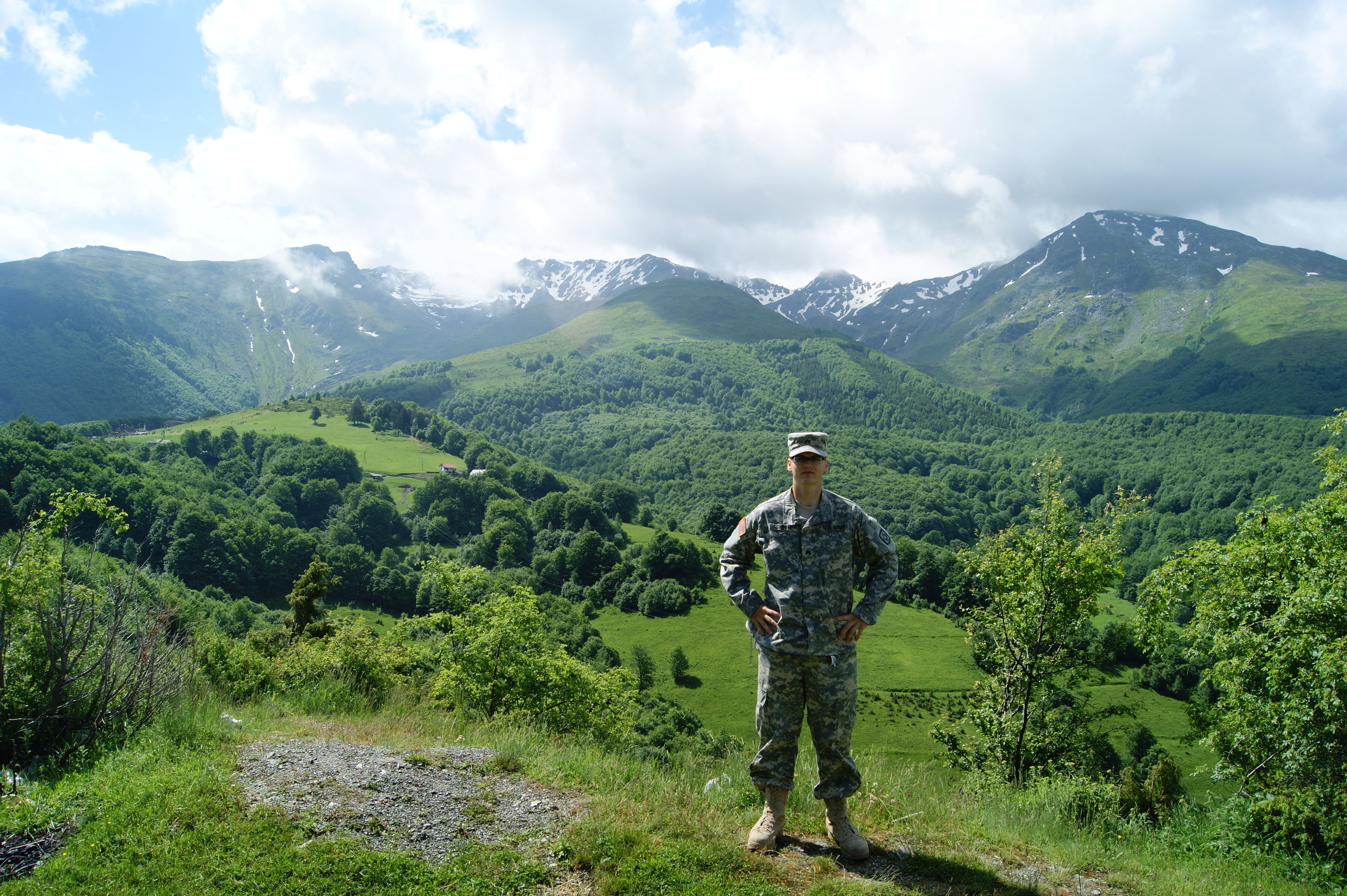
As a member of the Army National Guard for over 10 years, I deployed once in 2011 to Kosovo as a part of Kosovo Force (KFOR) 14. KFOR has been a part of the larger multinational presence in Kosovo since 1999.

Myself in the Shar Mountains National Park in southern Kosovo in 2011.

In addition, I have personally participated in the military funeral honors ceremonies for 323 veterans, a handful of which have been Iraq and Afghanistan war casualties. In no way does this fuel personal anger or hatred towards the detainees held in GTMO. Those servicemen were honored for their sacrifices for democracy that implores fairness in the service of justice. On the contrary, it is all the more reason for me to ensure I am doing everything within my power to help the MCOP fulfill its missions (attend, observe, analyze, critique, and report).

As stated in the Guantanamo Bay Fair Trial Manual, “NGO Observers are the eyes and ears of the outside world as to what happens at Guantanamo Bay. NGO Observers have a unique responsibility to share their experiences, insights and conclusions with the outside world. NGOs should not bow to pressure. What happens at Guantanamo Bay should not stay at Guantanamo Bay.”

As a part of that mission, I have been tasked with expanding the portion of the Guantanamo Fair Trial Manual covering the rights and interests of the men and women in Joint Task Force Guantanamo (JFT-GTMO).

9/11 Hearings Misc Motions Heard

On Wednesday, February 11,  Judge Pohl called for the parties to suggest motions that could be heard outside of the 292 conflict-of-interest matter and the prior CIA black site interpreter matter (350). There was an aura that the 9/11 hearings were on life support as the prosecution and defense struggled to put motions on the table that could be argued during the remainder of this week. Mr. Walter Ruiz, Learned Counsel, proposed a number of motions that deal only with his client, Mustafa al-Hawsawi.

This morning he called to order the Military Commission to hear arguments on a variety of outstanding motions. Defendant Mr. al Baluchi chose not to attend the hearings today. As a result, the first few minutes of the proceedings dealt with an Officer of the Judge Advocate General Corp’s office testifying that he had informed Mr. al Baluchi of his rights to attend and to obtain his waiver. Typically when this happens the prosecution files a “submission of alias” because the testifying officer does not provide his name on the witness stand. Learned Counsel for Mr. al Baluchi, James Connell, noted on the record that the prosecution had not made such admission this morning.

David Nevin, Learned Counsel for Khalid Shaikh Mohammed, again went on the record to make an on the record motion (and to indicate that he will be filing a written motion) to halt all proceedings until such time as the matter of the former CIA black site interpreter issue is resolved.  Again, he was overruled.

Today’s activity focused on motions focused by Mustafa al-Hawsawi.  Mr. Walter Ruiz, Learned Counsel, argued the following motions:

  • AE192 & AE196 Motion to Seek to Disqualify Legal Adviser, Office of the Military Commission Due to the Unlawful Interference with the Professional Judgment of the Chief Defense Counsel and Detailed Learned Military Counsel. Mr. Ruiz requested that Judge Pohl go forward with an analysis of the underlying facts and law because these circumstances are representative of an instance of unlawful influence in the proceedings. The issue of unlawful influence does not resolve itself simply because those involved have left the Office of the Military Commission. Ms. Bohrmann, Learned Counsel, for Mr. Walid bin Attash, similarly urged Judge Pohl to undertake the analysis and make a ruling.
  • AE332 & AE340 Motions to compel discovery of Mr. Hawsawi’s medical records and access to medical personnel who treat Mr. Hawsawi. Mr. Ruiz requested access to medical records and medical personnel in order to judge the standard of care his client is receiving and also to help Mr. Hawsawi make medical decisions. His health has showed signs of deterioration. The prosecution challenged these motions by arguing that the medical issues are arising out of a December 2014 incident in which Mr. Hawsawi was injured while in detainment. The prosecution also stated that his medical records, which were classified, are being declassified and delivered to the defense on a rolling basis.
  •  AE303 Motions addressing conditions of confinement. Mr. Ruiz argued that the circumstances of confinement at Guantanamo Bay violate humanitarian law. He did note that there has been one change. For example, Mr. Hawsawi did not have any access to his family from 2003 through most of 2014.  In October 2014 a process was put in place to allow the defendants to record messages that will be delivered to their families. In January 2015 a process was put in place to enable the defendants to Skype with their families. His overall focus was that quality of life will equal quality of defense and that the United States has a legal duty to abide by the law. The prosecution urged Judge Pohl to stay out of the detention role and noted that the Geneva Convention does not apply to these defendants because they are “alien unprivileged enemy belligerents.”
  • AE214 & AE214A Motion to Compel Mr. Hawsawi Access to the Government of Saudi Arabia in Compliance with United States Law and Motion to Compel Prosecution to Produce Un-redacted Copies of Correspondence etc. Pertaining to Requests by Saudi Arabia to Meet With Its Citizens Held in Guantanamo Bay Mr. Ruiz urged Judge Pohl to order this discovery so that Mr. Hawsawi would have access to officials of his home state, Saudi Arabia.

At the conclusion of lengthy oral arguments, Judge Pohl asked if there was any further outstanding matters.  Again David Nevin renewed his concern that the legal proceedings were continuing in light of the 292 and 350 matters.

James Harrington, Learned Counsel for Ramzi bin al Shibh, brought up what he called a “simmering problem.” He stated that the manner in which the defendants are handcuffed/shackled has changed and that as a result the defendants are experiencing injuries.  Mr. Harrington noted that the defendants are not attending attorney-client meetings rather than suffer the injury. He asked Judge Pohl to ask the prosecution to look into the matter and see if the issue can be corrected.

The proceedings concluded with James Connell, Learned Counsel, asking Judge Pohl to issue an subpoena or other relief to provide the defense access to the former CIA black site interpreter.  Judge Pohl declined to do so and asked for a written motion.

Camp Justice Guantanamo Bay, Cuba December 2014

(Catherine Lemmer, 9/11 Hearings, Guantanamo Bay, February 9-13, 2015)


By the Numbers: An Observation on 9/11 Transparency

Saturday, February 7, will find me again in the departure lounge at Andrews Air Force Base awaiting my departure to Guantanamo Bay to observe the 9/11 hearings scheduled to take place the week of February 9.  The military commission made the 6-page amended docket available on January 26, 2015.  The docket lists over 30 motions; and notes that counsel should be prepared to argue any other motion for which the briefing schedule has concluded.

KSM II Docket February 2015


In an effort to prepare for the upcoming hearings, I went to the military commission website to review the relevant documents. Whenever I go to the case site I am reminded of the overwhelming complexity of these hearings. Here are just a few numbers I noted:

  • 2959 documents listed on the docket (269 webpages)
  • 55 documents filed in January 2015
    • 32 documents filed by the defense teams
    • 4 documents files by the prosecution
    • 19 documents filed by the commission

Of the 55 documents filed in January 2015, three are available for public review. One of these three is the amended docket.

Transparency is one key to making sure there are fair and open trials afforded to the defendants held at Guantanamo Bay. The inability to review court filings casts an interesting shadow on the goal of transparency.  Other key elements of fair and open trials are detailed in the Guantanamo Bay Fair Trial Manual that I will be taking and distributing to NGO Observers and other interested persons next week.

(Catherine Lemmer, 9/11 Hearings GTMO, February 2015)

People Behind the Scenes

DSC00180

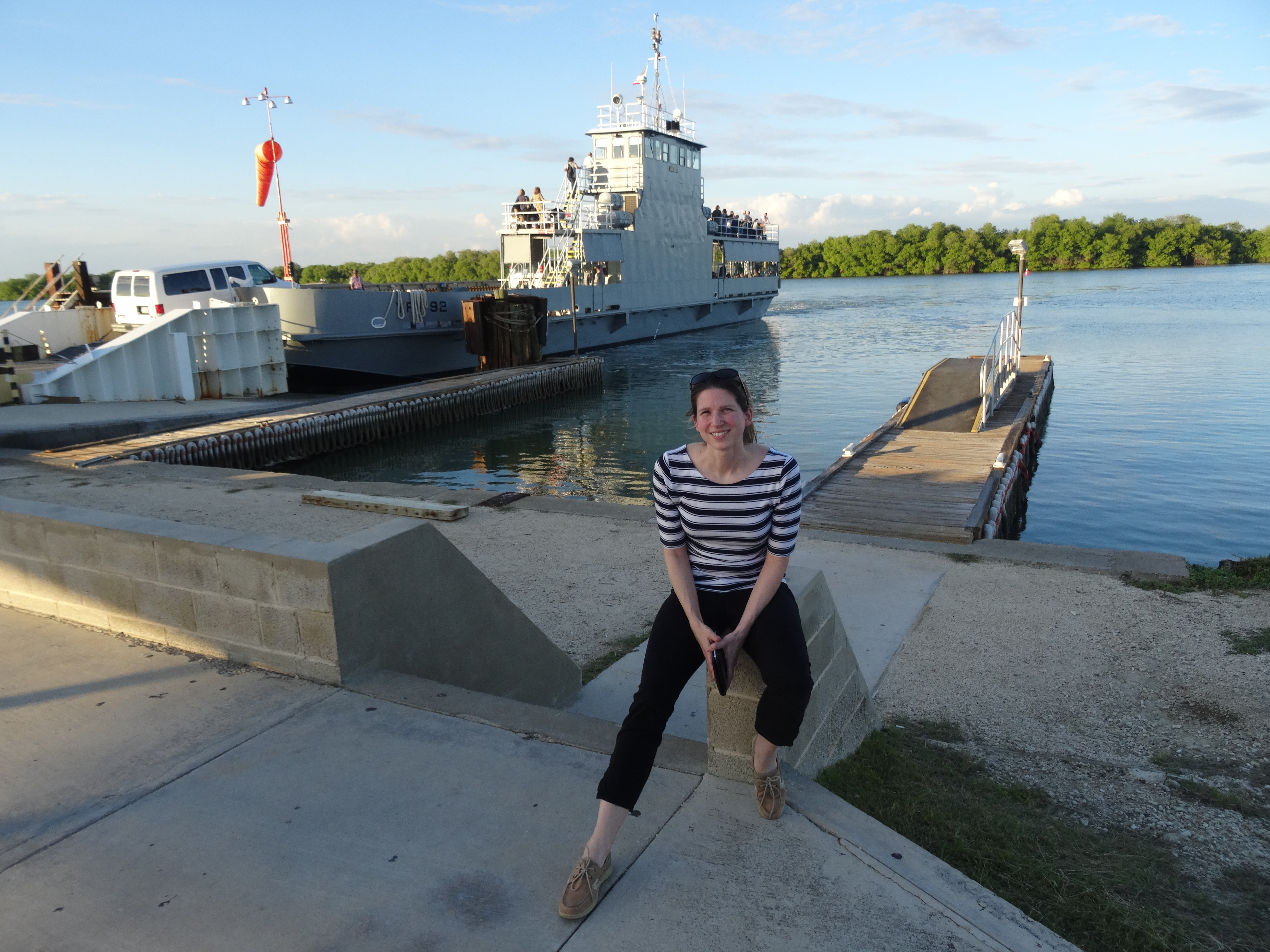
Myself (Margaret Baumgartner) waiting to board the ferry across the base.

Now that I’ve made it home from GTMO, I am trying to process everything that I’ve learned.  I did not have the time I wanted to sit down and really delve into posts.  We were busy with hearings, sit downs, and other interactions, however, I was able to keep a journal.  I jotted items down as I went and from these, I will pull my next several posts.

People Behind the Scenes

One thing I enjoy about travel is meeting new people.  If you take the time to really listen, you can garner some fascinating information.  We had a picnic table that we NGOs would congregate around at night.  Various people involved in the process would join.  Others would meet up with us at dinner.  The base is very small and thus you start recognizing everyone.  There are a lot of people that are very involved in the hearings.

On the ferry ride to our quarters at Camp Justice, I spent some time speaking with the three folks who handle the transcripts.  They are responsible for making sure that the transcripts of the proceedings are done each day and available to the public on the website.  I ran into them again at dinner that night.  They have been involved since the beginning and make sure that the public is kept “in the know”.  They often work late nights to make sure that the transcripts are available at the end of each day.

I also spent some time skipping rocks at a beach with a contractor responsible for the CCTV feed that is sent stateside.  He really likes his job, takes pride in it, and is an integral part of making sure those stateside have access to the hearings.

Our drivers were really nice and willing to take any of us anywhere we needed to go.  One was a fountain of knowledge about the base and he would find out answers if he did not have one.  Most of our questions revolved around military life and what it was like to be deployed to GTMO.  He also knew a lot about the history of the base.  GTMO is more than just a place where detainees are kept.  Families of deployed soldiers live there.  There are recreational sports.  It is like a little town.  There’s even McDonalds, Subway, and Taco Bell along with several other places to get out and eat at.

GTMO housed Haitian refugees in the 90s.  It was a place where Columbus landed in 1494.  Teddy Roosevelt was by the base at one point in the Spanish American War.  GTMO is a port for the Navy and the U.S. Coast Guard.  Detainees are kept there because no one else wants them, those who do may raise concerns for National Security, and mostly because Congress does not want them stateside.  Thus, GTMO has this horrible reputation when it was really one of the few places left to house those accused of terrorist acts while awaiting due process.

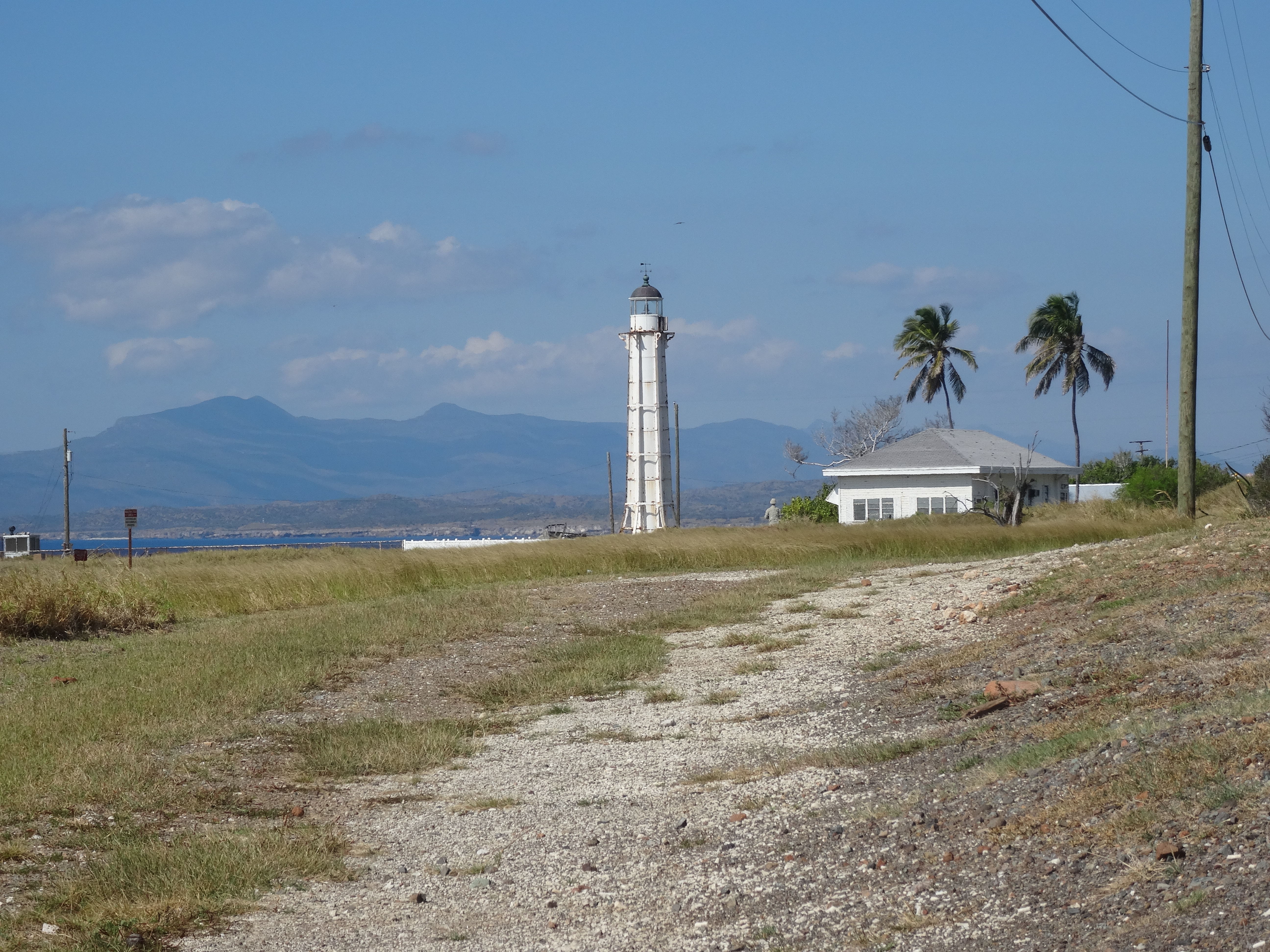
The old GTMO lighthouse.

The old GTMO lighthouse.

One person commented to me that the detainees have it better than they (those stationed there) do in regards to living conditions.  Would this be made known by the media or others reporting on it?  Probably not.  It doesn’t make for a good story.  The soldiers down at GTMO are someone’s brother, sister, father, mother, and loved one.  They are doing what their duty is and it really does sadden me when the collective whole receive a bad reputation for the acts of a few bad apples that are beyond their control.

I have noticed that everyone really does the best they can with what they are given and also the situation.  Defense, Prosecution, Security, Judge, Staff, Contractors, Deployed Soldiers…..it doesn’t matter who they are, they are all working hard.  I definitely gained a lot more respect for those involved in every aspect of the process on this trip.

(Margaret Baumgartner, Hadi al Iraqi Hearings, January 25-31, 2015) 

Jurist Publishes Indiana McKinney Law Student’s Torture Article

JURIST Guest Columnist Clarence Leatherbury from Indiana University Robert H. McKinney School of Law discusses the debate over torture techniques and our nations security. Clarence published a piece for the JURIST since he is a participant in Professor Edward’s Military Commission Observation Project.

The JURIST (jurist.org) is a legal news and commentary publication run by Professor Bernard Hibbitts and professional and student staffers at the University of Pittsburgh School of Law. The original column can be seen at: http://jurist.org/dateline/2014/12/clarence-leatherbury-guantanamo-bay.php

(Catherine Lemmer)

DoD Orders Received

I just received my DoD orders via e-mail today.  Preparation for this trip has been a whirl-wind.  I’m almost done meeting next week’s deadlines for work, since I will be out of the office (I should be careful, they might expect this type of productivity from me on a regular basis!).  My state-side brother and I were talking logistics and he laughed at me for getting excited about the mess hall.  I always have enjoyed the food in the messes and I think it annoyed my brother that I would insist on eating there when I would visit.  In his words, the mess hall only has good food when a General visits.  It’s a lucky week for me then, since there will be a General in camp!

Late night at the office, trying to get through some items in preparation for Sunday's trip!

Late night at the office, trying to get through some items in preparation for Sunday’s trip!

On Tuesday, I had breakfast with former rep (and fellow 2010 graduate) Hattie Harman.  She highly recommended the book “The Terror Courts” by Jess Bravin.  I plan to dig into that book before getting down to GTMO as it mentions several people who are involved in the proceedings.  I hope this will give me a better sense of who I am talking to when I meet people.  The book should also give me some talking points to pass time while we wait in the lines.

I have also started my refresher with “the Manual” in preparation and I also went to the GTMO website for information.  I am not myself until I’ve had coffee in the morning (see my prior Fort Meade postings describing said addiction), so I was scouring the site for information of a rumored cafe.  I will also have my own trusty stash, just in case.

On Friday, I will be attending Professor Edwards’ class as a guest to field questions, talk about the project, and meet other participants.  That is the extent of my preparation outside of the mandatory paperwork to date, however, that will increase as Sunday approaches.

Guantanamo Memoir Published

G-Bay Diary Book CoverGuantanamo Diary, by Mohamedou Ould Slahi, was published today (20 January 2015) by Little Brown & Company. It is the first memoir to be written by a detainee who is still incarcerated at Guantánamo Bay. The author, who has not been charged, has been held at Guantánamo Bay since 2002.  The memoir details his journey from when he was seized in his home country of Mauritania, sent to a prison in Jordan, and eventually imprisoned in Guantánamo Bay. In 2010, a federal judge ordered his release, but the government appealed that decision.

See the transcript and hear the National Public Radio interview with  Mr. Slahi’s lawyer, Nancy Hollander, and book editor Larry Siems. Mr Siems is a writer and human rights activist. He is the author of The Torture Report: What the Documents Say About America’s Post-9/11 Torture Program.

(Posted by Catherine Lemmer)

Travel to GTMO Notification & Initial Thoughts on Hadi al Iraqi, 26 – 30 January 2015 – Margaret Baumgartner

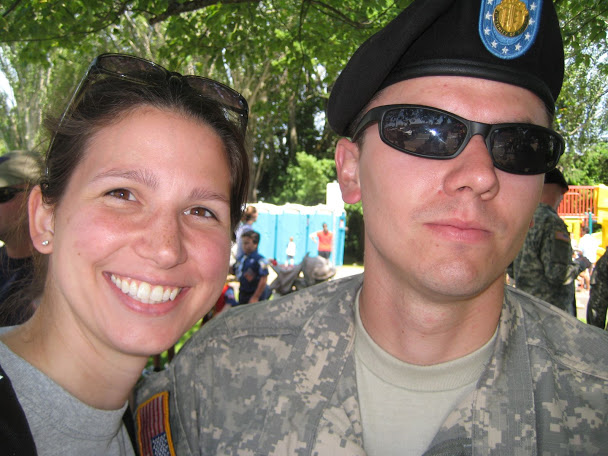
Me (Margaret Baumgartner) and one of my favorite members of our armed services.

Me (Margaret Baumgartner) and one of my favorite members of our armed services.

Notification of Travel

Wow.  I am thrilled to be a part of this opportunity. I think all of my co-workers are also just as excited to hear about the experience, as well as read about it, on this blog.  In fact, one of my Dutch co-workers happened to stop by my office and he was very interested in hearing about this project in general.  A word of caution to the over-achievers (like me), the process for travel is NOT as clear-cut at it seems (is it ever?).  There is a fair amount of paperwork that needs to be filled out precisely and reviewed by other parties.  Luckily, Professor Edwards has a lot of patience and experience!

About Me

By trade, I am a Patent Attorney with a tech company in Indianapolis.  I graduated from the McKinney School of Law in 2010 and have been practicing in a corporate setting since.  My family is heavily involved with the military which has affected me and my interest in the events that have shaped their lives.  I also travel extensively and am incredibly fascinated with foreign policy and history.  I also am fascinated with how people in other countries in the world view the U.S.  This opportunity allows me to help inform people about our country, GTMO, and the ongoing proceedings (or lack thereof) of the detainees. (more…)

Year End Update: More Guantanamo Detainees Released (Catherine Lemmer)

Keeping informed. 

Carol_Rosenberg,_by_Colonel_Bryan_Browles

Carol Rosenberg by Colonel Bryan Browles (from Wikipedia)

The most important thing I observed during my time at Guantanamo Bay is that the activities that occur there are far from the minds of most Americans. In my small opinion, this physical and virtual distance creates a situation ripe for abuse. On the flight home I sat across the aisle from Carol Rosenberg (Miami Herald) and plied her with questions. She is perhaps the best source of knowledge as she has been on the story since the arrival of the first detainees in 2002. During the NGO Observer Tour of the courtroom facilities, the Officer in Charge of the Office of Military Commissions, John Imhof, often looked to her for information.

I made a commitment to myself to stay informed. It shouldn’t take a lot of effort — I’ve started following Ms. Rosenberg’s twitter feed and set up an alert on my news feeds.

National Public Radio interviewed Ms. Rosenberg at 6:45 pm EST on December 31 regarding the release of an additional four detainees and the efforts to close Guantanamo Bay. As of this date, there are still 127 detainees, 59 of whom have been cleared for release. While the rest of the world prepared for year end celebrations, she maintained her vigilance on our behalf.

(Posted by Catherine Lemmer)