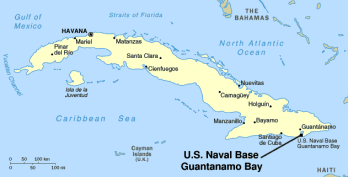
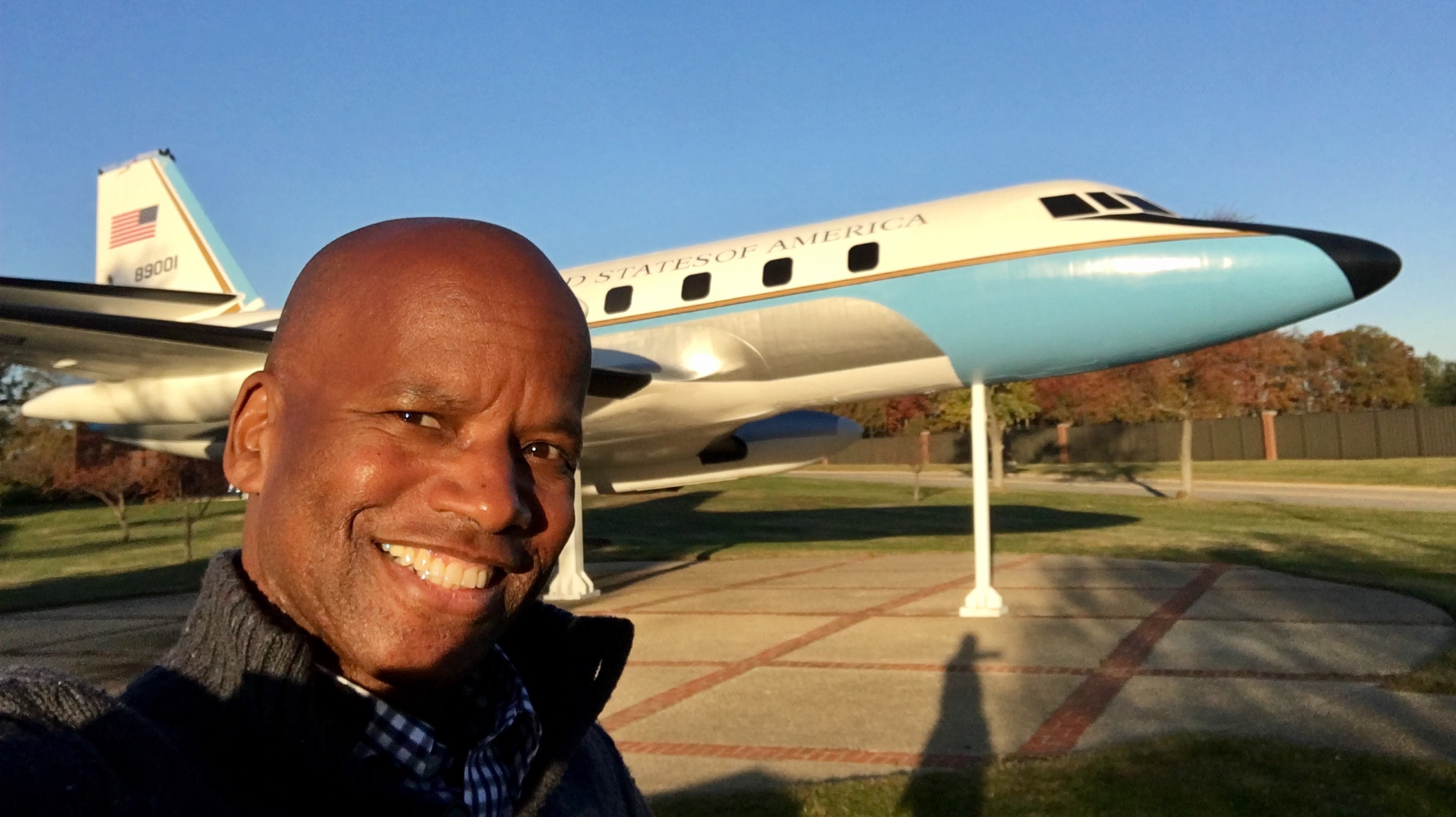
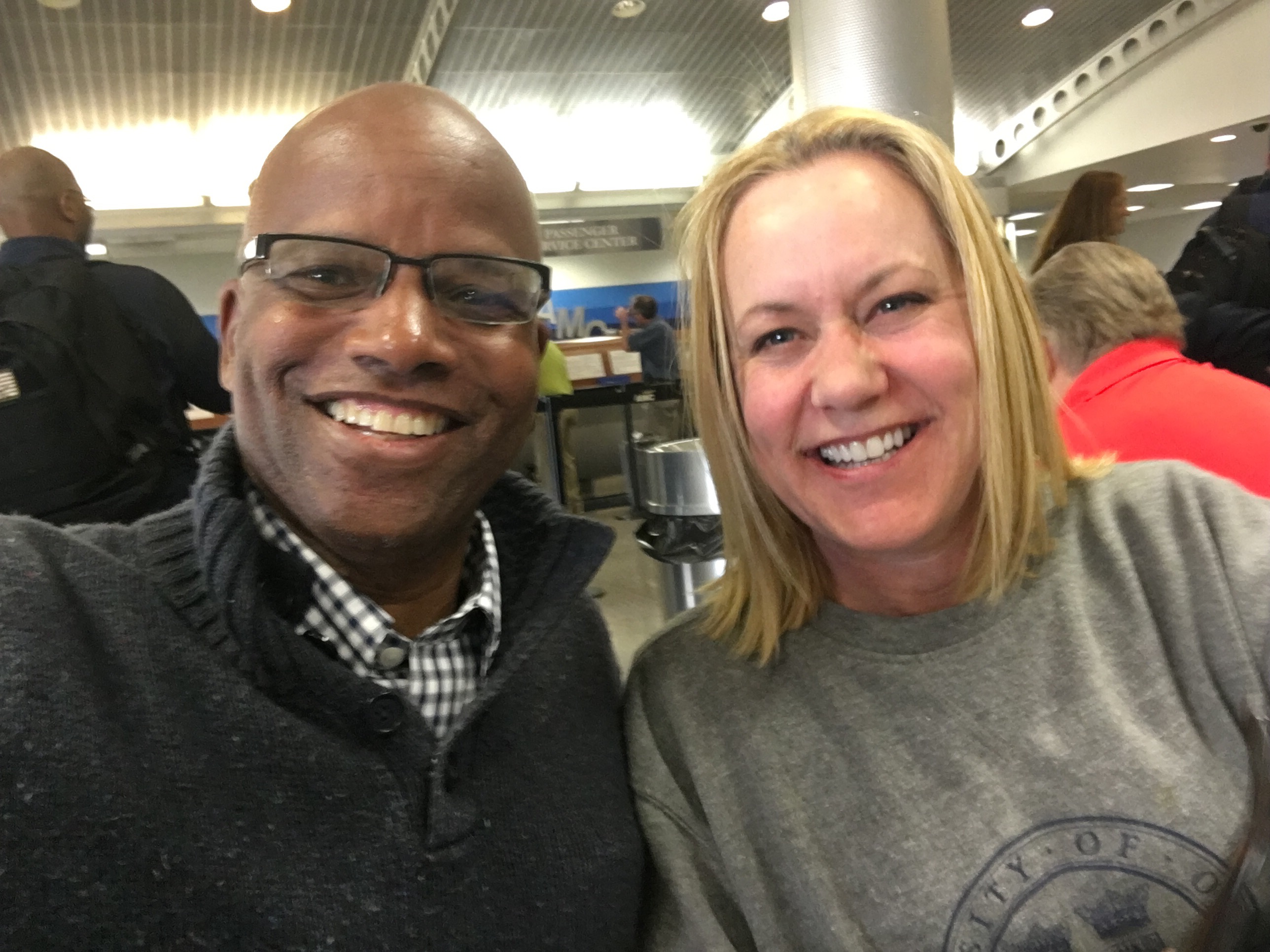
Flying from Joint Base Andrews to Guantanamo Bay, Cuba

The sun has not risen yet as I wait at the Joint Base Andrews air terminal to board a flight to Guantanamo Bay, Cuba.

My mission today is to attend, observe, analyze, critique, and report on U.S. military commission hearings for alleged war criminals. The hearings this week are against five Guantanamo detainees who are alleged to have masterminded the 11 September 2001 attacks on the Pentagon.

I am part of the Military Commission Observation Project of Indiana University McKinney School of Law, where I am a student.

Getting to Andrews
I arrived at Washington National Airport in Washington D.C. after midnight – around 12:30 a.m. – about 7 hours later than I was originally scheduled to arrive at Dulles Airport. I began my trip at Indianapolis airport and two of my flights were cancelled.

img_1628-1

Arriving at the gate in Washington D.C. at 12:30am on 23 January 2017

I had planned to arrive yesterday afternoon but was forced to reschedule flights, which delayed arrival. My flight from Indianapolis to Detroit was cancelled but the folks at Delta were able to put me on another flight to Detroit later in the day. I made it to Detroit in time to catch my connecting flight to Washington D.C. but that connecting flight was also cancelled. All flights from Detroit to D.C. were overbooked so it was not possible to make it on time flying standby. I showed my invitational travel order to the folks at Delta and they put me on the next flight out. Do not book a flight to Washington that arrives the afternoon before a morning flight out of Joint Base Andrews. I barely made it and Washington National Airport is less than a thirty-minute drive from Joint Base Andrews. I went straight from the airport to Joint Base Andrews.

img_1631-1

Floor mosaic and American flag at Washington National Airport

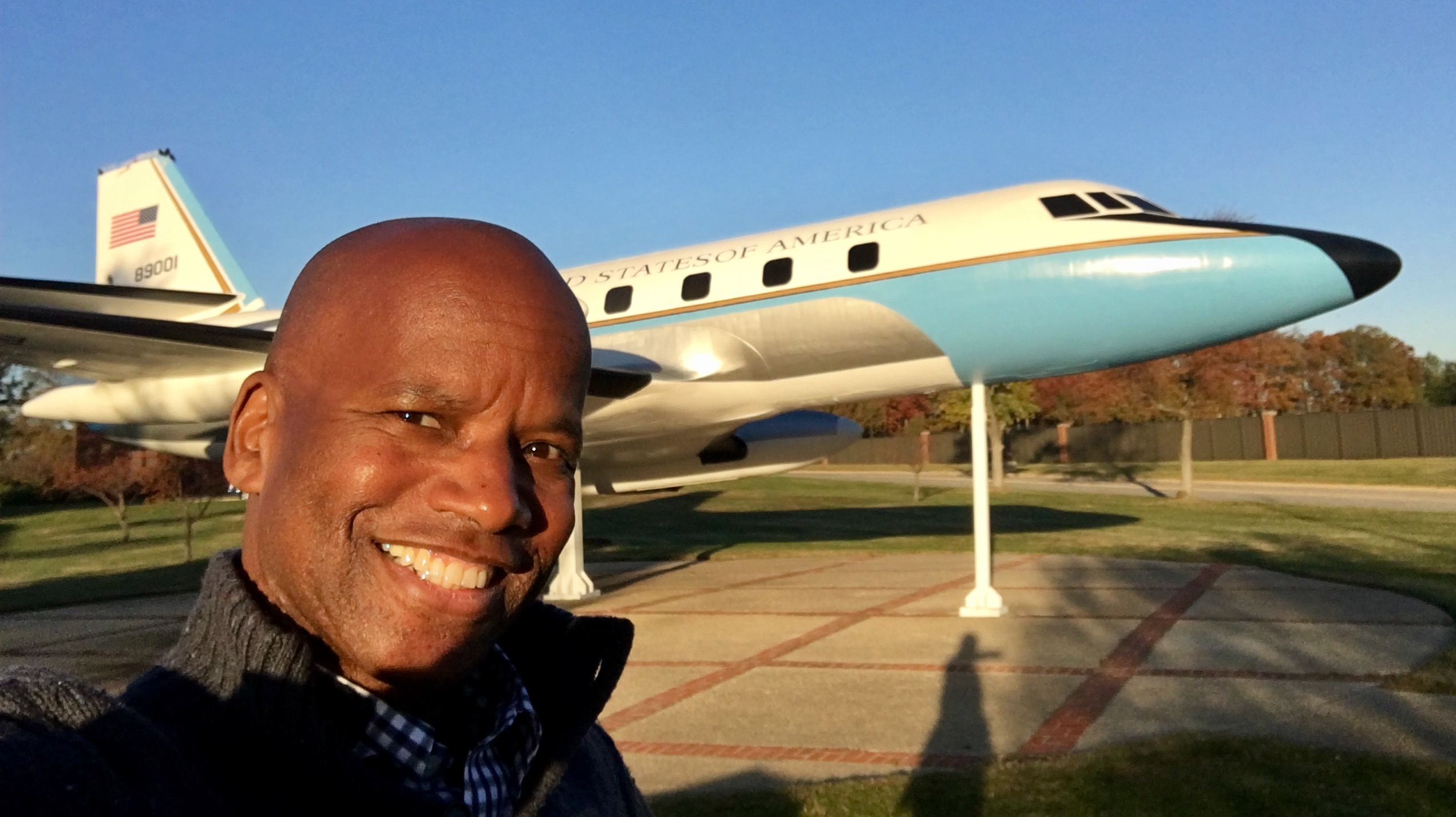
When I arrived at Andrews Visitor Control Center, a civilian escort picked me up and took me to Andrews air terminal, from where President Obama took his last flight on Air Force I 3 days ago — on Friday, 20 January 2017, after he left the Office of the Presidency.

At the terminal I met about a dozen other non-governmental organization (NGO) representatives who are also serving as Observers. I distributed copies of the Guantanamo Bay Fair Trial Manal: Excerpts, which was authored by Professor George Edwards and others at Indiana University McKinney School of Law. I have found the Excerpts to be a valuable tool to help me prepare for my mission, and I believe that other observers agree.
After distributing the manuals, the remaining manuals are left in the NGO Resource Center at GTMO.

Checking in at Andrews
Checking in at Joint Base Andrews is straight forward, similar to any commercial flights. Bags are labeled with green colored tags to identify the bags as belonging to NGO representatives. Next, I had to present my invitational travel order, APACS, and identification. Our identification functions as our boarding passes, although this is only because the printer is not working. Our military escort was kind enough to drive us all to the Starbucks on base, which opens at 5:30am.

img_1635

NGO representatives enjoy Starbucks and wait to board the flight at Joint Base Andrews

Waiting to Board
Our flight to Guantanamo Bay was originally scheduled to depart at 8:00am, and we were required to be at Andrews at 4:30am for the flight

We just learned that our flight time has been delayed to 10:30am.

Now we sit and wait patiently to be allowed to board the plane and depart for Guantanamo Bay!

Written on 23 January 2017

Posted 24 January 2017

By Ben Hicks
J.D. Student
Military Commission Observation Project
Program in International Human Rights Law
Indiana University McKinney School of Law


First Guantanamo hearings in Trump Era possibly derailed

cheryl-bormann-waleed-bin-attash-counsel

Cheryl Bormann, counsel to 9/11 case defendant Waleed bin Attash, did not travel to Guantanamo Bay reportedly due to a medical emergency. (Photo from Flickr)

The first Trump-Era Guantanamo Bay war crimes hearings are set to commence tomorrow, 25 January 2017, but they may be derailed. A death penalty lawyer for one of the accused is absent from Guantanamo this week due to a medical emergency, and it is unclear whether hearings can or will go forward in her absence. Her client, one of the 5 alleged masterminds of the 9/11 attacks on the World Trade Center and Pentagon, is entitled to death penalty counsel. Ms. Bormann is the only death penalty lawyer who is representing him.


walid-bin-attash

Walid bin Attash, a 9/11 case defendant who faces the death penalty, is without his death penalty lawyer for this week’s hearings at Guantanamo

The military judge for the case ordered that the hearings go forward on Wednesday morning, 25 January 2017, despite objection by the defense. If hearings commence on Wednesday morning as scheduled, it is unclear whether they will continue for the full 2 scheduled weeks, or whether they will come to a hasty end Wednesday, Thursday or Friday if objections continue.

Hearing participants — travel to / from Guantanamo

The hearings are held at the remote Caribbean island U.S. Naval Base at Guantanamo Bay, yet the only participants in the hearings who reside at Guantanamo Bay are the detainee defendants. Virtually everyone else involved lives in the mainland U.S., and must be shuttled down.  Typically a day or two before hearings commence, hundreds participant convene at Andrews Air Force Base outside of Washington, D.C. and board a military plane for Guantanamo. This includes the judge and his staff, the prosecution team, 5 sets of defense lawyers and their staff, interpreters and translators, media, independent observers / monitors, and victims and victims’ family members. If hearings last for two or more weeks, on the weekend in between planes shuttle to / from Guantanamo Bay swapping out media, observers / monitors, and victims and their family members, most of whom attend for one week at a time only.

A question remains as to whether a plane will depart Andrews as scheduled on Saturday, 28 January 2016, carrying observers / monitors, media and victims and their family members for hearings next week, or whether next week’s hearings will be cancelled.

Docketing Order

Earlier this month the court’s docketing order listed topics to be covered this week and next. Here is the docketing order:

[office src=”https://onedrive.live.com/embed?cid=AA02978A4AC8C787&resid=AA02978A4AC8C787%21172&authkey=AHmyYsdkI8Mfh8c&em=2″ width=”776″ height=”588″]

George Edwards

Professor of Law

Indiana University McKinney School of Law

Founder, Military Commission Observation Project & GitmoObserver

Founder, Program in International Human Rights Law

One Day Until Departure for Guantanamo Bay

Selected for Travel

I am a student at the Indiana University Robert H. McKinney School of Law and have been involved with the Military Commission Observation Project for almost a year now through the McKinney Law Program in International Human Rights Law. Through our program, students, faculty, staff, graduates, and other school affiliates have the opportunity to travel to either Ft. Meade in Maryland or Guantanamo Bay, Cuba to attend, observe, analyze, critique, and report on hearings for alleged war criminals.

I was selected to travel to Guantanamo Bay for the 25-27 January 2017 hearings of the five remaining detainees who are defendants in this case. Khalid Sheikh Mohammed, along with the other four defendants, is alleged to be involved in the 11 September 2001 attacks on the Pentagon, World Trade Center, and United Airlines Flight 93, which crashed in Pennsylvania.

During the McKinney Law Fall Recess, I traveled to Ft. Meade, Maryland to attend, observe, analyze, critique, and report on one of the hearings for the five remaining defendants in the case, via live stream from Guantanamo Bay, Cuba. Details about the hearing that I attended in Maryland can be found in my 2 November 2016 blog post. I wanted to attend hearings on the 25-27 January 2017 because the case involves the 11 September 2001 attacks, which makes this a high a high profile case that is the subject of intense scrutiny.

Preparing for Departure

Departing for Guantanamo Bay requires a lot of preparation and staying on top of emails and paperwork for many institutions including the Pentagon, McKinney Law, and the Overseas Study Office, in addition to the logistical requirements for making the trip. The Guantanamo Bay Fair Trial Manual has a “Know Before You Go” section that contains important information for those preparing for a mission to Guantanamo Bay. The manual is a compilation of resources and information to aid NGO representatives before, during, and after their missions to Guantanamo Bay or Ft. Meade. Also, when I arrive at Andrews Air Force Base, I will have excerpts from the Guantanamo Bay Fair Trial Manual to distribute to the other NGO observers. This is part of the role for the McKinney Law Program in International Human Rights Law. The excerpts are from the full volumes I and II and the manual contains a plethora of information right down to the layout of the courtroom and who sits where. The manual also discusses the rights of stakeholders in the proceedings, and has charts to help evaluate stakeholders’ rights. It also gives the source of law for each right being evaluated. The manual is a result of collaboration from previous observers and is continually updated as observers travel to hearings.

Eagerly Waiting

ksm - in court

Khalid Shaik Mohammad, in the Guantanamo Bay courtroom. (Sketch by Janet Hamlin)

Despite intensive preparation, I know from previous experience that pre-trial hearings are sometimes delayed or cancelled, however I am hopeful that the pre-trial hearings will occur as scheduled. There are several other NGO observers scheduled to travel to Guantanamo Bay during the dates that I will be there. I look forward to working with these observers and receiving feedback and critique of the Fair Trial Manual.


By Ben Hicks

J.D. Student

Indiana University Robert H. McKinney School of Law

Obama Inauguration Flag to be Donated to Indiana National Guard After Flown at Guantanamo on 9/11 Anniversary


flag-at-michaels-guantanamo-inauguration-19-january-2017

With flag flown over Guantanamo’s Camp Justice on the 15th Anniversary of 9/11 (September 11, 2016), and flown over the U.S. Capitol on Barack Obama’s Inauguration Day (January 20, 2009)

A U.S. flag flown over Guantanamo Bay, Cuba on the 15th Anniversary of the 9/11 Attacks on the World Trade Center and the Pentagon had also flown over the U.S. Capitol Building on the day Barack Obama was inaugurated as U.S. President, 20 January 2009, exactly 8 years ago today.

Five alleged masterminds of the 9/11 attacks who are detained at Guantanamo face war crimes trials there by U.S. Military Commission. The courtroom is at Guantanamo’s Camp Justice, where the Obama inauguration flag was flown on 11 September 2016, the 15th anniversary of 9/11

This flag flown at the inauguration and on the 9/11 anniversary is being donated to the Indiana National Guard to hang in their Armory in Indianapolis.

indiana-guardsman-preparing-for-deployment

Indiana’s Adjutant General, Maj. Gen. Courtney P. Carr speaks at a departure ceremony for 60 Hoosier Guardsmen with the 38th Infantry Division in Indianapolis, 20 November 2015. The Guardsmen were to “oversee safe, secure, humane, legal, and transparent care and custody of detainees at Guantanamo Bay, Cuba.” (Photo by Sgt. 1st Class Jeff Lowry)

Why donate this flag to the @Indiana National Guard?

In September 2016, about 90 soldiers from the Indiana National Guard, 38th Infantry Division, the Cyclone Division were finishing a 9-month deployment to Guantanamo Bay (2015 – 2016), with another 90 of their soldiers commencing a 9-month deployment to the remote island naval base (2016 – 2017). The soldiers performed various functions across the base, from public affairs, to logistics, to law.

In September 2016, I hand-carried the Obama Inauguration flag to Guantanamo Bay, Cuba, and it was flown there on 11 September.

The Indiana University McKinney School of Law, where I have taught for many years, has a long history with Guantanamo Bay. My students and I became involved with Guantanamo in 2003—conducting research, providing research memos, consulting (and I was called as an expert witness on a Guantanamo case).

Our Indiana law school has also been sending students, faculty, staff and graduates to Gitmo for years as independent Observers / Monitors, and through our Military Commission Observation Project undertake to attend, observe, analyze, critique and report on Military Commission hearings. We have produced the Guantanamo Bay Fair Trial Manual, which examines rights and interests of a range of Guantanamo stakeholders, including the defendants, the prosecution, defense counsel, victims and their familes, observers, witnesses, soldiers deployed to Guantanamo, media, and others.

Furthermore, we at the law school have produced Know Before Your Go to Guantanamo Bay, which is available for anyone who travels to Guantanamo Bay for any purpose, related to the Military Commissions or otherwise, as it provides information about the Commissions as well as about many non-Commission aspects of Guantanamo Bay.

A forthcoming book is The Guantanamo Bay Reader, which tells the story of the Guantanamo Bay Military Commissions from the mouths and perspectives of those who have shaped, are shaping, and will shape the Guantanamo Bay experience.

Many Indiana Guard members have been Indiana law students / graduates, and some of them have been deployed to Guantanamo Bay.

The Indiana Cyclones have sent troops to Guantanamo for years, and indeed have a long history of servicing the nation there and elsewhere, with multiple deployments to perform military duties in places such as Afghanistan and Kosovo in addition to Guantanamo.

Another flag with inauguration / 911 anniversary provenance

gtmo-paul-schilling-and-7-flags

Indiana McKinney law graduate at Camp Justice (Guantanamo) in front of the flagpole where the Inauguration flag was flown on 9/11 2016. The US flag is at half-mast for the death of former US Supreme Court Justice Antonin Scalia.

I have another flag with identical provenance – flown above the US Capitol 8 years ago today, and flown at Camp Justice on the 15th anniversary of 9/11.

I am donating this 2nd flag to the Indiana University McKinney School of Law to hang in our building – to help demonstrate the overlapping Guantanamo Bay connections of the Indiana National Guard and our students, faculty, staff and graduates, and to demonstrate our pride at the great service performed for the school, the city of Indianapolis the state of Indiana the U.S., and the international community.

Hanging next to these donated flags – at the Indiana National Guard Armory and at the law school — will be the framed President Obama Inauguration Certificate, the framed Gitmo Camp Justice Certificate, and a framed letter explaining all of the above.

George Edwards

At Joint Base Andrews Flying to Guantanamo Bay, Cuba

img_8125

Sunrise over the snowy Joint Base Andrews Airstrip.

[Posted on behalf of S. Willard]

This morning (Sunday the 8th of January) I am traveling to Guantanamo Bay, Cuba to serve as an observer / monitor of criminal hearings in a U.S. military commission case against Abd al Hadi al Iraqi, who is an alleged high ranking member of al Qaeda Iraq and liaison with the Taliban. The U.S. has charged with war crimes resulting in deaths.

I am an Indiana University McKinney School of Law student on mission representing the Indiana University Program on International Human Rights Law’s (PIHRL) Military Commission Observation Project (MCOP). As an observer / monitor, my role is to attend, observe, analyze, critique and report on the military commissions – both the substance and the process.

img_8123

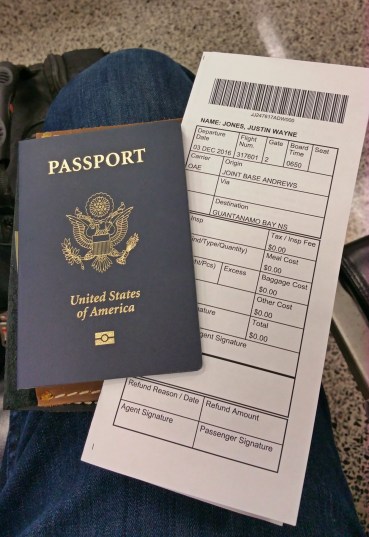
My passport and Gitmo flight boarding pass.

I arrived at Andrews Air Force Base, just outside of Washington, DC, at 5:00 a.m. for my flight to Cuba, which is supposed to depart at 8:00 a.m. I checked in for my flight, presenting my passport, my Military Orders, and my APACS (which I explain in an earlier blog). It looks like the flight is on schedule this morning.

I met my fellow NGO observers from different human rights groups (NGOs), and we are almost ready to board our plane to take off for Guantanamo Bay, Cuba from Andrews Air Force Base (which is the home of Air Force 1). We were told that the travel will be about 3 hours and 15 minutes.

img_8120

My boarding pass for Gitmo, & my yellow Guantanamo Bay Fair Trial Manual: Excerpts.

I have my boarding pass in hand (see the photo) and my yellow Guantanamo Bay Fair Trial Manual: Excerpts copies of which I distributed to the other observers.

I took a few photos at Andrews this morning. I will post additional photos and substantive posts when I arrive at Guantanamo Bay. Because I am having trouble with wifi at Andrews, I am asking Professor Edwards (the Indiana program founding director) if he will post this Andrews Post for me.

Sheila Willard (J.D. Candidate, ’18)

NGO Monitor, U.S. Military Commission Observation Project (MCOP)

Program in International Human Rights Law

Indiana University McKinney School of Law

(Posted by G. Edwards on behalf of S. Willard)

img_8127

My Overnight in D.C. On My Way to Guantanamo bay

I am a 2L at Indiana University McKinney School of Law and am traveling to Guantanamo Bay, Cuba on mission representing the Indiana University Program on International Human Rights Law (PIHRL) Military Commission Observation Project (MCOP) at the hearings in the case against Abd al Hadi al Iraqi.  My Ft. Meade experience and my Guantanamo Bay pre-departure post may be found here.

Flight and Hotel Information

I had an uneventful 1.5-hour flight from Indianapolis, Indiana to Ronald Reagan Washington National Airport in Washington, D.C. and have checked into my hotel. The Uber ride from the airport to the Quality Inn took around 30 minutes and cost a little less than a dollar per minute. A shared van or Uber could have been cheaper, but I preferred to quickly settle in to the hotel for the night. I am staying at the Quality Inn in Camp Springs, MD, which is just across the street from Joint Base Andrews. The hotel is humble and unassuming, and the rooms are large and very clean. There are three stories in the hotel building, and a room may be rented for as little as $81 per night.

quality-inn-camp-springs-md

Quality Inn on Allentown Road in Camp Springs, MD

There are several restaurants advertised at the front desk that deliver lunch and dinner straight to your hotel room. I ordered dinner from Pizza Boli’s. They have a website you can order from, but I called their number to place the order. My combined lunch/dinner was here in less than half an hour and the food was hot and of good quality.

Arrival Requirement

I traveled to D.C. the night before my scheduled flight to Guantanamo Bay, because I am required to arrive at Andrews by 5:00AM tomorrow (Sunday) morning, and the Pentagon graciously arranged a pick-up for me from the hotel at 4:45AM. The flight to Guantanamo Bay is scheduled to depart from Andrews at 8:20AM.

hotel-room

Hotel room at Quality Inn in Camp Springs, MD.

Preparing for Tomorrow

Tonight, I am preparing for departure from Andrews by re-reading an informative email I received from the Pentagon, and going over my Orders (sheila-willard_orders_redacted) and APACS (Aircraft and Personnel Automated Clearance System) (sheila-willard_apacs_redacted). These documents were sent to me by my Pentagon contact.

I am excited to meet my fellow NGO observers tomorrow morning and pass out a copy of the Manual Excerpt, a comprehensive guide for preparing to observe Guantanamo Bay proceedings. Hopefully we will have time to introduce ourselves, our organizations, and share more about our missions and perhaps receive feedback for the MCOP’s Manual, a 500-page, 2-volume resource for all things Guantanamo drafted by Professor Edwards and the PIHRL at Indiana, the Manual Excerpts, a reduced version of the Manual with highlights, such as what a fair trial looks like, the roles and responsibilities of an NGO observer, and background info on Guantanamo military commissions, and Know Before You Go Guide, a 76-page guide that speaks directly to NGO observers and is helpful in preparing for a successful mission, and may also be found in both the Manual and Manual Excerpts.

Sheila Willard (J.D. Candidate, ’18)

NGO Monitor, U.S. Military Commission Observation Project (MCOP)

Program in International Human Rights Law

Indiana University McKinney School of Law

Preparing for my mission to Guantanamo Bay, Cuba

I was nominated by the Military Commission Observation Project (MCOP) of the Indiana University McKinney School of Law and confirmed by the Pentagon to travel to Guantanamo Bay, Cuba to monitor military commission hearings in the case against Abd al Hadi al Iraqi, who has requested to be called Nashwan al Tamir, from 9 – 14 January 2017.  Hadi is an alleged senior member of al-Qaeda responsible for war crimes.

My earlier monitoring at Ft. Meade 

Last month I traveled to Ft. Meade, Maryland to monitor military commission hearings in the Guantanamo case against the 5 alleged masterminds of he 9/11 attack on the World Trade Center and Pentagon. The hearings were held at Guantanamo, but broadcast live into a secure facility at Ft. Meade.

screen-shot-2017-01-04-at-7-21-12-pm

Standing at the entrance to the Visitor Center at Ft. Meade, MD after a long day of observation.

Experiencing the hearings first-hand through live feed at Ft. Meade was intriguing in the sense that it seemed surreal.  Watching the alleged 9/11 masterminds as one would any defendant on trial was incredibly interesting, considering that until then, the news was my only source of information regarding these men.  Seeing Khalid Sheikh Mohammed’s red beard, and hearing the defendants speak in their native language, followed directly by broken English tinged with what appeared to be annoyance made these larger than life figures come to life.

My Guantanamo Bay travel nomination

When I monitored at Ft. Meade, I was excited, and had an enlightening experience.

But when I was nominated to travel to Guantanamo Bay, I could not believe my eyes, or my fortune.  The nomination email came from the program on the night before my first final exam of the fall semester, and I couldn’t wait to finish finals so that I could focus on preparing for my mission.  Having had the experience at Ft. Meade and now gaining the experience of witnessing the hearings first-hand at Guantanamo Bay will enable me to contribute to Indiana’s project in a better, more informed way.

I was truly honored to represent Indiana at Ft. Meade, and am truly honored to represent Indiana at Guantanamo Bay.

My Background

My journey to this precise moment has been a long, eventful one.

My mother and father came to the United States in the late 1970’s to escape a military regime in Argentina.  They ended up in Texas, where I would be born.  When I was at the age of 3 months, my mother returned to Argentina with me in tow to finalize her Visa paperwork, and we were unable to return to the U.S. because the lawyer had not completed the paperwork properly.  I was raised for 3 years in Argentina, while my mother and father tried desperately to reunite.  Eventually, my mother and I were able to return to the U.S. and the family was reunited.

I moved from Texas to Indiana a couple of decades later to join my husband who is a native Hoosier.  Indiana has given me so many incredible opportunities that I never imagined!

screen-shot-2017-01-04-at-7-39-21-pm

Indiana -> Andrews Air Force Base -> Guantanamo Bay, Cuba

Paperwork

The nomination to travel to Guantanamo arrived in the middle of law school finals, but I was determined to see the requirements through.

The Pentagon sent me an e-mail containing 4 documents to complete and return in just a couple of days.  The documents required by the Pentagon are 1) Hold Harmless Agreement, 2) Invitational Travel Worksheet, 3) Navy Base Access Pass Registration, and 4) NGO Ground Rules, along with a biography and picture.

I completed the paperwork using templates provided by Professor Edwards, since lawyers and Administrators at Indiana University have specific requirements as to how Indiana University affiliates must complete the paperwork.

I submitted my completed draft paperwork to Professor Edwards who sent it back to me once for revisions.  I believe that he wanted to make certain that the completed paperwork met Indiana University requirements so that Indiana officials would endorse the paperwork, and he wanted to make certain that the paperwork met the Pentagon’s standards.  The Pentagon has rejected paperwork that was not completed properly, so a second pair of eyes was necessary to make certain I was sending accurate, completed paperwork.

Professor Edwards tracked the documents through the appropriate IU channels for approval.  Once I received the stamped endorsed documents from IU, I forwarded these to my Pentagon contact, who quickly approved them the same day. 

Preparation: The Game Plan

As I prepare for the holidays with my family visiting from Argentina and Texas, I am also preparing for my mission to Guantanamo. I am paying careful attention to a 76-page document titled “What Human Rights Non-Governmental Organization (NGO) Observers and Others May Want to Know Before Traveling to Guantanamo Bay, Cuba”. The guide may be downloaded by visiting this link (includes 76 pages, 2 Appendices).  This document, of which Professor George Edwards is the principal author, provides all of the information necessary to successfully prepare for and complete a mission to Guantanamo.  Without this guide, preparing for my mission would be near impossible.  I have communicated with previous IU McKinney observers Justin Jones and Aline Fagundes, but having a script to fill in the rest of the details that one may forget has been invaluable in my preparation.

[The Know Before You Go  guide (76 pages, 2 Appendices) may be found as a standalone document, or, it is included in the Excerpts (158 pages, Know Before You Go starts on page 75 of the Excerpts), which is a digest of the full and complete Manual (over 500 pages).]

I have also been reading other people’s accounts of travel to Cuba on the Gitmo Observer blog (Justin Jones’ and Aline Fagundes’ account of their mission to Guantanamo), and will continue reading where I left off from my trip to Fort Meade, Maryland in October, where I observed the hearings in the case against Khalid Shaik Mohammed.

I will also begin to prepare my travel arrangements to Andrews Air Force Base in Maryland, where I will depart to Guantanamo Bay.

Sheila Willard (J.D. Candidate, ’18)

NGO Monitor, U.S. Military Commission Observation Project (MCOP)

Program in International Human Rights Law

Indiana University McKinney School of Law

Are you going to Guantanamo? New Manual Excerpts for NGO Observers & Others

asdf

Click this link for the full Manual — over 500 pages. Below you can download the Manual Excerpts!

If you’re going to Guantanamo Bay in January 2017, you might be interested in our new Guantanamo Bay Fair Trial Manual: Excerpts that offers insights into:

  • what the right to a fair trial is and how a fair trial should look
  • how to assess whether a fair trial is being afforded to all Guantanamo stakeholders
  • roles & responsibilities of independent Observers sent to monitor Guantanamo hearings
  • background info on Guantanamo the military commissions
  • a schematic of the courtroom (so you can know who is who)
  • and a 76 page “Know Before You Go To Guantanamo” insert that will tell you what to expect on your flight to Cuba, the ferry ride across Guantanamo Bay from the landing strip to your Quonset Hut accommodations, base security, food (which can be quite good!), beach, boating, and of course the courtroom, the hearings, and briefings by the prosecution and defense.

In the past, the Gitmo Observer (of Indiana University McKinney School of Law) distributed Manual Excerpts to Observers after we arrived at Andrews Air Force on the morning of our flight to Cuba (or distributed at Ft. Meade, Maryland, for Observers monitoring live by secure video-link from Cuba). Observers said they wish they had had it earlier.

So, we started to e-mail the Manual Excerpts to Observers as soon as we were sent e-mail addresses of Observers scheduled to travel, and we would receive those e-mails 3 – 6 days before the scheduled departure. Observers said that they wish they had it even earlier than that, that 3 – 6 days in advance wasn’t enough time.

So now we are posting the Manual Excerpts on this site, for access by anyone interested, whether or note traveling to Guantanamo Bay (or Ft. Meade or elsewhere), but especially for those traveling to Guantanamo Bay to monitor 3 weeks of January 2017 hearings. Ideally, about 40 independent observers would travel to Gitmo this month, to fill all the slots allocated to observers.

The Defense Department has stated that it favors strong and robust transparency. Having full complements of Observers for each hearing week would help promote transparency, human rights, and the rule of law for all military commission stakeholders (with stakeholders including the defense, the prosecution, victims and their families, witnesses, the media, observers, observer escorts / minders, the public, the U.S. soldiers and others who operate the detention facilities, the military commission court staff, and others).

Here are the Excerpts! Please let us know if you have any suggestions for improving our Excerpts, our full Guantanamo Bay Fair Trial Manual (over 500 pages in 2 volumes!) and our Know Before You Go To Guantanamo Guide (76 pages). Send to GitmoObserver@yahoo.com

[office src=”https://onedrive.live.com/embed?cid=AA02978A4AC8C787&resid=AA02978A4AC8C787%21170&authkey=AHjg1WC29jVzNPY&em=2″ width=”876″ height=”688″]

What you may want to know before traveling to Guantanamo Bay’s war crimes court

omc-legal-signDid you receive a rare Pentagon invitation to travel to Guantanamo Bay for war crimes hearings?

If so, are you searching for info on how to prepare for a Guantanamo trip, what to pack, will your U.S. mobile phone work, what about internet access, how is flying on a military plane from Andrews Air Force Base different from flying civilian, do you need your passport, can you meet detainees and see the prisons camps, will you have the resources needed to accomplish your Guantanamo mission / goals?

Each new Guantanamo traveler has these and other questions, which are answered in this revised and expanded Know Before You Go to Guantanamo Guide (downloadable below).

In 24 Chapters (76 pages, 2 Appendices), the Guide speaks directly to non-governmental organization (NGO) observers, who play a specific, valuable role at Guantanamo Bay. The Guide anticipates new observers’ concerns, and addresses them methodically and comprehensively, and helps observers prepare for their missions. The Guide may be helpful for anyone traveling to Guantanamo hearings, including media, court staff, witnesses, foreign government representatives, etc.

The Guide notes that monitors (also to as “non-governmental organization observers” or “NGO observers”) have the responsibility to attend, observe, analyze, review and critique Guantanamo Bay Military Commission (war crimes) hearings. This requires substantive preparation before traveling to Guantanamo, full schedules on the ground there, and follow-up upon return to the U.S.

Monitors (and others) must eat, sleep and exercise at Guantanamo and the Guide informs about that, and about Guantanamo tourist attractions, souvenirs, and entertainment such as outdoor movies.

Here is the Guide:

[office src=”https://onedrive.live.com/embed?cid=AA02978A4AC8C787&resid=AA02978A4AC8C787%21169&authkey=AMjLhfMMvM4a6xE&em=2″ width=”876″ height=”688″]

Pentagon’s observation / monitoring program

The Pentagon has been permitting NGO observers to travel to Guantanamo Bay, Cuba to monitor cases against men charged with heinous crimes concerning the 9/11 World Trade Center and Pentagon attack, the 2000 bombing of the U.S.S. Cole off the coast of Yemen, and other incidents.

The monitors, who must be U.S. citizens, include representatives of human rights groups, lawyers, judges, law professors and law students, and the non-legal community members.

The Pentagon has stated that it invites monitors to promote transparency — for monitors to be the eyes and ears into Guantanamo to the outside world. Monitors attend, observe, analyze, critique and report on the substance of the war crimes hearings themselves and on the process involved in the proceedings.

Monitors assess how transparent the proceedings are, and examine whether the monitors are given the access to the personnel, proceedings, resources they need to perform their assigned tasks.

Monitors tend to travel for one week at a time, departing the U.S. on a weekend and returning the following weekend, with hearing days scheduled Monday – Friday of that week.

We hope that the Know Before You Go to Guantanamo Bay Guide is helpful to you as you prepare for your mission!
Good luck!
PS:  If you have any comments / suggestions / tips to be included in the next iteration of the Guide, please let us know in a comment below. Or, please send an e-mail to us at GitmoObserver@yahoo.com.
Thank you in advance!

I’m heading back to Guantanamo Bay, Cuba today 

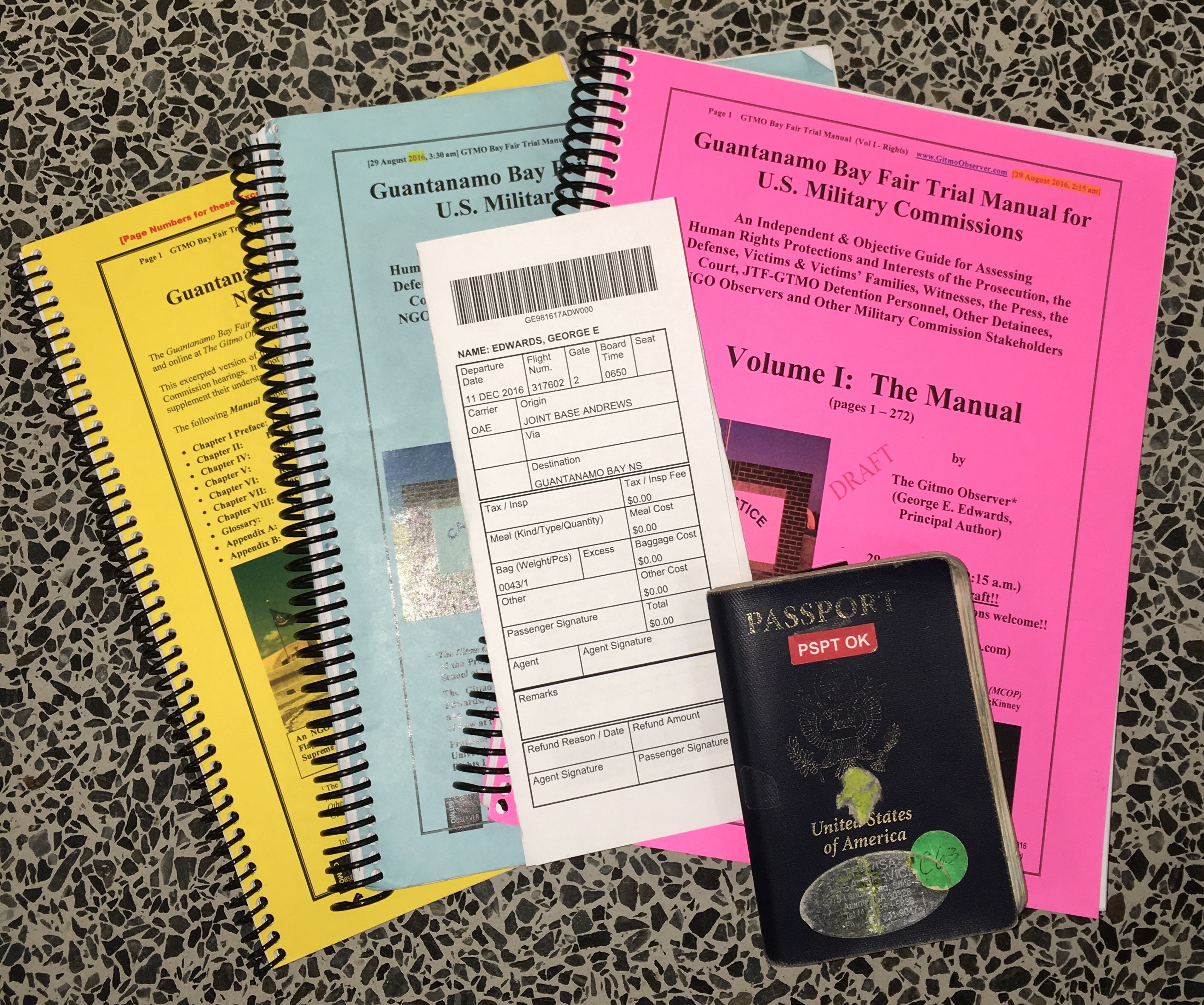
My Guantanamo Bay flight boarding passport and passport, and my Guantanamo Bay Fair Trial Manuals.


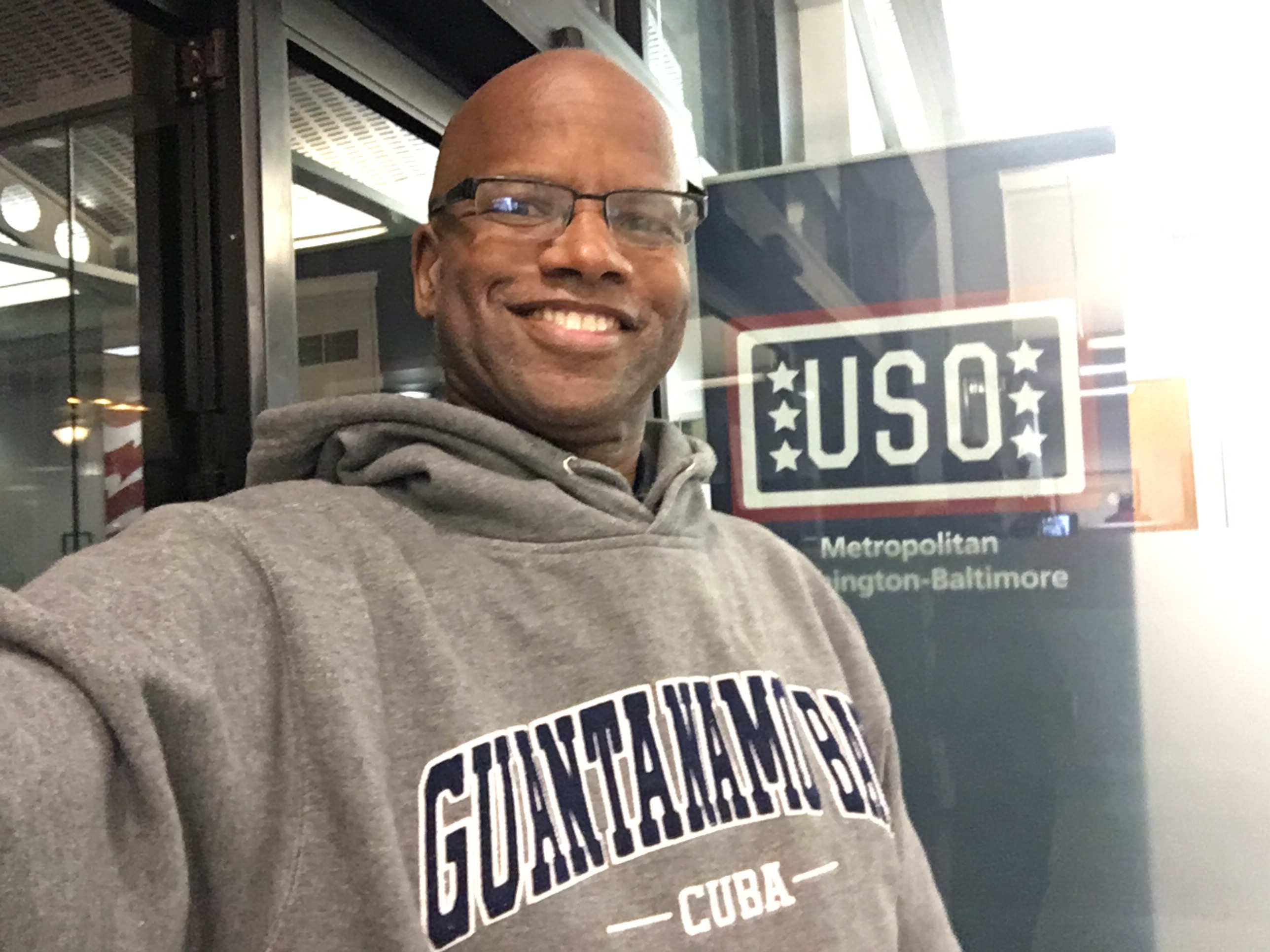
It’s 3:59 a.m. and I just arrived at Andrews Air Force Base for my 5th or 6th trip to Cuba since the 2016 summer, and my second trip to Guantanamo Bay since the November Presidential Election. 

4:15 a.m. Sunday at Andrews Air Force Base.


This time I’m monitoring hearings in the US Military Commission against al Nashiri, who allegedly masterminded the 2000 attack on the USS Cole off the coast of Yemen, killing and wounding dozens of US sailors. He is charged with a series of war crimes and faces the death penalty. 

The Andrews USO area.


My job as a human rights law monitor (or observer) is to attend, observe, analyze, critique and report on these pre-trial hearings. We are interested in whether the rights and interests of all military commmission shareholders are being afforded to them. “Stakeholders” include the defendants, and also include the victims and their families, the media, the prosecution, witnesses, the US and international communities, among others.

This should be an interesting week. We have 5 days of pre-trial hearings scheduled. The issues are plentiful, with some being novel. 

As I’m sitting here at Andrews, I’m observing al Nashiri’s lawyers enter the terminal, members of the prosecution team, human  rights group (NGO) representatives, IT staff, trial judiciary staff, and others, all waiting for our 8:00 a.m. flight. 

Why arrive at 4:00 a.m. for an 8:00 a.m. flight? Well, because we were instructed to do so. That’s it. 

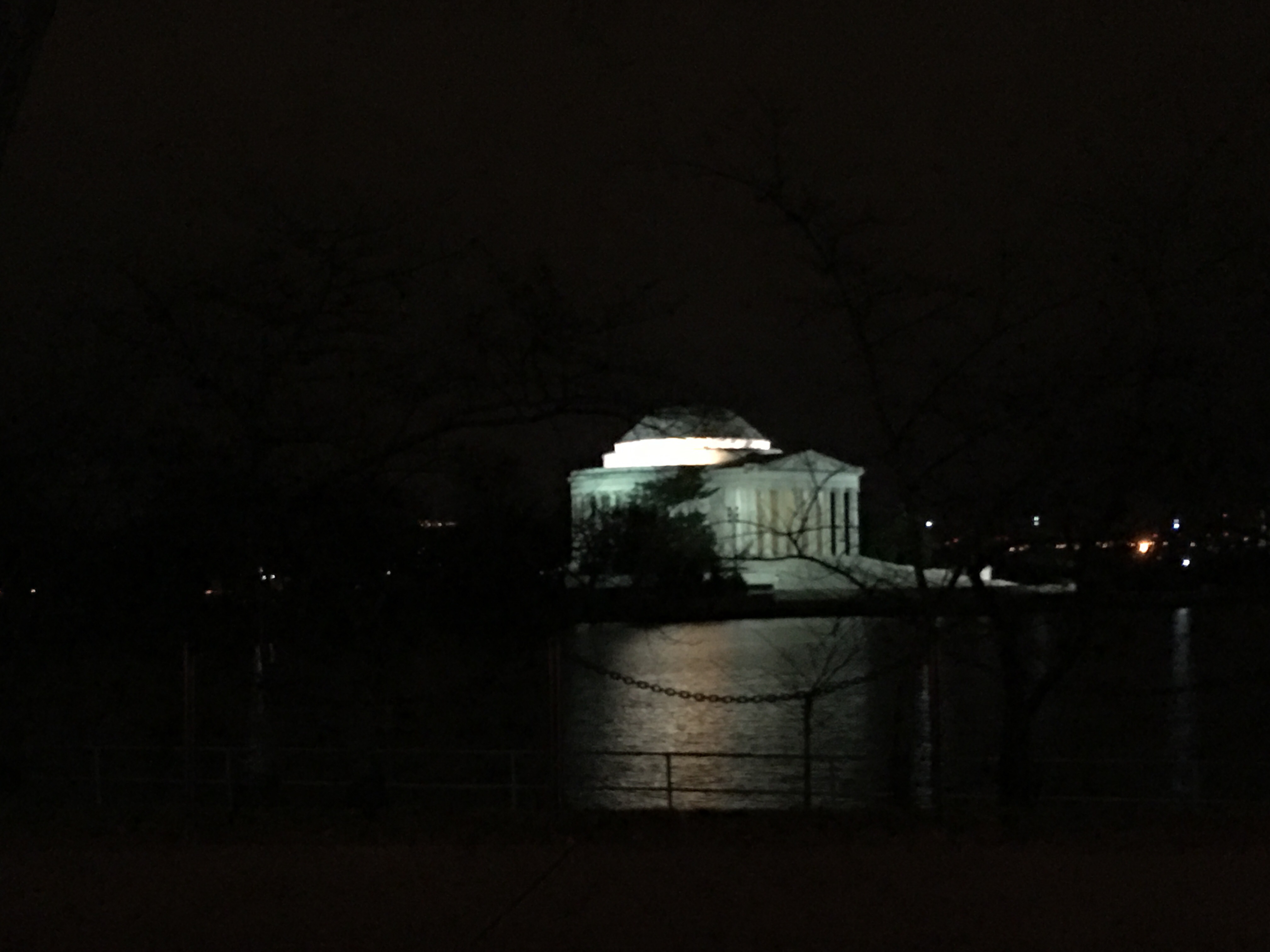
Jefferson Memorial–3:45 a.m.–while driving to Andrews Air Force base.


George Edwards

Yemeni Detainee asks Obama Administration to release him from Guantanamo

gtmo-prb-6-december-2016-mohammad-ahmad-abdallah-al-ansi

al Ansi in a Department of Defense photo.

Today, after 14 years imprisonment at Guantanamo Bay, Cuba, a Yemeni detainee named Mohammad Ahmad Abdallah al Ansi asked the U.S. Government to transfer him from Cuba to a third country. If released, 58 detainees would remain at Guantanamo, down from a record high of 780 detainees.

This parole board like hearing is called a Periodic Review Board (PRB), and was convened pursuant to President Obama’s 2011 Executive Order calling for PRBs to ascertain whether detainees pose a continuing threat to the national security of the U.S. If a detainee does not pose such a threat, he may be repatriated to his home country or transferred to a third country. It is unknown whether the next President will rescind this Executive Order and cease Period Reviews, and whether any of the 5 dozen remaining detainees will be released after January 2017.

President Obama’s 2011 Executive Order calls for three types of PRBs: (a) an Initial PRB for all detainees, involving a hearing at which the detainee may appear and speak on his own behalf; (b) a file PRB, held 6 months after a detainee is denied release following an initial PRB and which detainees are prohibited from attending; and (c) a full PRB, held if after a file review the Board finds that the detainee is a “continuing” risk to US national security.

Al Ansi, who is also known as prisoner number YM – 029, had his initial PRB in February 2016, a file PRB in September 2016, and a full PRB today. This article discusses the initial, file and full reviews.

al Ansi’s initial PRB

At al Ansi’s initial PRB on 23 February 2016, he appeared in person. On 23 March 2016, a month after the initial PRB, the Board made its final determination as follows:

The Periodic Review Board, by consensus, determined that continued law of war detention of the detainee remains necessary to protect against a continuing significant threat to the security of the United States.

In making this determination, the Board considered the significant derogatory information regarding the detainee’s past activities in Afghanistan. Further, the Board noted the detainee’s lack of candor resulting in an inability to assess the detainee’s credibility and therefore his future intentions.

The Board looks forward to reviewing the detainee’s file in six months and encourages the detainee to continue to be compliant, continue taking advantage of educational opportunities and continue working with the doctors to maintain his health. The Board encourages the detainee to be increasingly forthcoming in communications with the Board.

al Ansi’s file review PRB

After his initial PRB, al Ansi had a file review PRB, which he was not permitted to appear, with a Board determination based only on his written “file”.  His file review was held on 13 or 14 September 2016 (according to http://www.prs.mil), and on 14 September 2016 (according to the written file review final determination) the Board ruled as follows:

MEMORANDUM FOR THE RECORD

SUBJECT: Periodic Review Board File Review – Muhammad Ahmad Abdalla al-Ansi (YM- 029)

On 14 September 2016, the PRB conducted a file review for Muhammad Ahmad Abdalla al­ Ansi (YM-029) in accordance with Executive Order (E.O.) 13567, “Periodic Review of Individuals detained at Guantanamo Bay Naval Station Pursuant to the Authorization for Use of Military Force.”  The PRB previously conducted a full review of the detainee and on 23 March 2016 determined that continued detention was necessary to protect against a continuing significant threat to the security of the United States.  After reviewing relevant new information related to the detainee as well as information considered during the full review, the Board, by consensus, determined that a significant question is raised as to whether the detainee’s continued detention is warranted and therefore an additional full review should be conducted in accordance with section 3(c) of E.0.  13567.

I watched al Ansi's PRB broadcast live from Guantanamo Bay into a nondescript Pentagon conference room this morning, with a handful of human rights advocates and one member of the media.

I watched al Ansi’s PRB broadcast live from Guantanamo Bay into a nondescript Pentagon conference room this morning, with a handful of human rights advocates and one member of the media.

al Ansi’s Full PRB

Today’s PRB (6 December 2016) as Ansi had a “full” PRB review.

Today’s full PRB, like all the other PRBs, was held at Guantanamo Bay. Today’s session was broadcast by live close circuit TV (CCTV) to a secure location at the Pentagon for viewing by non-governmental organizations and the media.

I observed the hearing in a modest Pentagon conference room, joined by representatives of non-governmental organizations (Judicial Watch, Heritage Foundation, ACLU, and Human Rights First) and the media (Courthouse News). When we watched these proceedings piped in from Guantanamo, we also had 2 to 3 military or civilian escorts or technicians in the room with us, but I will not reveal further information about the identities, ranks or affiliations of these individuals (all of whom are always very friendly and nice!).

Members of the PRB Board – which comprises one representative each from the Departments of Homeland Security, State, Justice and Defense; the Joint Chiefs of Staff; and the Office of the Director of National Security – were not physically at Guantanamo Bay, but watched the proceedings from the D.C. area, presumably from their respective offices.

It is unclear when the Board is expected to make a final determination on this full PRB, and whether that determination will be made before the Obama Administration ends on 20 January 2017.

Some of the words spoken during the hearing were in Arabic, and were spoken by an on-camera interpreter.

An off camera voice, presumably from but not necessarily from Guantanamo, advised in English on the nature of the hearing, the format, and the short agenda.

Another off camera voice read aloud the government’s “unclassified summary statement”, in English, of behavior that al Ansi allegedly engaged in, both before he arrived at Guantanamo and after he arrived.

After the government’s unclassified summary statement, the personal representative read an opening statement in English.

Then, al Ansi’s private counsel read a statement, also in English.

After the statements, an off camera voice asked if anyone had any questions. There were none.

The unclassified portion of hearing ended roughly 15 minutes after it started. Observers were invited to leave the conference room, since Observers are not permitted to observe classified portions of the PRB hearings.

Who is Mohammad Ahmad Abdallah al Ansi?

He is 40 or 41 years of age, born in Yemen. The government paints a picture of him as an avowed war criminal member of al Qaeda, as being loyal to Osama bin Laden, and as a person slated for an aborted hijacking in Asia meant to coincide with 9/11. The government has kept al Ansi in prison at Guantanamo Bay for over 14 years, and has on multiple occasions affirmatively ruled that he posed a threat to the national security of the U.S. Indeed, this same PRB ruled twice this year (February and September 2016) that al Ansi should not be released.

al Ansi’s personal representative and private counsel painted a different picture of al Ansi. The private counsel spoke about al Ansi’s suitability for release, and what he might do constructively upon release. Though the personal representative did not directly speak to the issue of whether he thought al Ansi posed a continuing threat to U.S. national security, the personal representative did not speak against release.

Today’s hearing itself

Today’s full PRB hearing commenced about 9:06 and ended 15 minutes later at about 9:21.

al Ansi sat at the head of a small white rectangular table that appeared to be in a Guantanamo Bay “trailer” (and not in a Guantanamo Bay courtroom). On the long side of the table to his left sat his personal representative in a U.S. military uniform. Directly across from him, to al Ansi right, sat the linguist. Next to the linguist was the private counsel, sitting closest to the camera.

Throughout much of the hearing, al Ansi, who was dressed in white non-descript attire, sat with his elbows resting on the table, hunched a little forward, flipping through documents in front of him, possibly reading through the documents. It was impossible for us to see on the screen what the nature was of the pages in front of al Ansi, or in what language the pages were written. At times he would rest his forearms on the table, with his hand clasped, eyes cast downward.

Government’s unclassified statement

An off-camera woman’s voice read aloud the Government’s “unclassified statement” in which the Pentagon contended that al-Ansi

traveled to Afghanistan in 1999, where he joined al-Qa’ida, swore bayat to Usama Bin Ladin, and served as Bin Ladin’s bodyguard. Judging from other detainee statements and corroborating information [al-Ansi] may have been selected to participate in an aborted hijacking plot in Asia intended to coincide with the 9/11 attacks. He was captured by Pakistani authorities after the battle of Tora Bora in 2001. [al-Ansi] has been mostly compliant with the detention staff at Guantanamo, and his last disciplinary infraction was in June 2014. He has not expressed support for extremist causes or maintained contact with terrorists at large.”

Private Counsel Arguments supporting al Ansi’s request for transfer

al-Ansi’s was represented at this PRB by private counsel Beth Jacob who is a partner at the New York law firm Kelley Drye & Warren, where she represents generic pharmaceutical companies.  Before she joined Kelley Drye & Warren, she represented the Port Authority of New York & New Jersey in litigation arising out of the 9/11 attacks, representing 9/11 victims who sought compensation. She had previously been an assistant district attorney i n New York, prosecuting fraud and official corruption.

She only began representing al Ansi since after his initial PRB ruling finding that he continued to pose a threat to national security of the United States.

She pointed out that al Ansi showed her some of the artwork created at Guantanamo Bay, and she showed it to a New York-based artist, who “was struck by his ability and innate talent , as she has written in her letter to this Board”.

In arguing that al Ansi should be released from Guantanamo Bay, she noted that the New York artist and Reprieve said that. “Mr. al Ansi’s art will stand him in good stead if he is deemed transferrable” for several reasons, including: (a) ‘it will give him something to do and a means of expression, in the first days and weeks after his transfer”; (b) “he will be part of the community of artists, which will provide stability and social contacts; and (c) “there i s the possibility of earnings from his art.” She went further to state that “Mr. al Ansi is planning for more practical ways to make a living – he told me he would like a construction job, and among the many classes that he is taking here at GTMO is one about small business.”

In support of her arguments supporting al Ansi’s transfer, his private counsel argued that his: “family still has resources which they are completely willing to use to help their brother start a new life after Guantanamo , as shown by the statements the family submitted to the first board and this panel. His family will be a stabilizing force when he is transferred.

Further, she argued that his health situation supported transfer, though the details of his health situation were not revealed, as a portion of her letter was redacted. She wrote:

The second factor [supporting transfer] is his health. [Redacted] [Redacted] [Redacted] [Redacted] He knows that managing these chronic conditions takes much time, effort and attention, and that he must follow a strict diet and exercise regimen , in addition to his medications.

She argued that if released, he will also have support of the Carter Center, founded by President Carter, and Reprieve’s Life After Guantanamo project, which has helped over three dozen former detainees.

Personal Representative Statement

al Ansi’s personal representative, who was a military officer in fatigues, read a simple, prepared 1-page statement that noted that

al-Ansi has intensely participated in the PRB process”,  has “maintained a record of perfect attendance for meetings with his Personal Representative (PR) and Private Counsel (PC) despite the constant change in schedulling”, and that his “professional manner throughout all engagements with his PC and PR has not wavered.

The personal representative noted that:

He continues to enthusiastically maintain his compliant behavior with the Joint Task Force (JTF) Guard Force and continues to engage with the JTF Medical Staff in order to deal with chronic health issues.  In addition, Mr. Al-Ansi has not ceased to passionately take advantage of the educational opportunities to include courses in Mathematics , Science, English, Spanish, Life Skills, Computers, Art, and recently started the Arab British Academy for higher education studies.  Since July of 2016, he has created an additional 150 quality works of art.  Seven additional works of art are included in his case submission.  Recently, he has enrolled i n Small Project Management , Business Administration, Accounting and Ledgers classes.

Unlike other personal representatives in other cases, this Personal Representative did not say whether or not he believed that al Ansi is or is not a threat to the security of the United States”.

By George Edwards,

Professor of Law, Indiana University McKinney School of Law

Faculty Director (Founding), Guantanamo Bay Periodic Review Board (PRB) Project

Faculty Director (Founding), U.S. Military Commission Observation Project

Arrival at Guantanamo Bay to Monitor the 9/11 Pre-trial Hearings

I have been nominated and confirmed to monitor the 9/11 pre-trial hearings against the five alleged masterminds of the 9/11 attack on the World Trade Center and the Pentagon. The hearings are scheduled to take place at the Guantanamo Naval Station, at Guantanamo Bay, Cuba from December 5-9. I am participating as an affiliate of the Indiana University McKinney School of Law Program in International Human Rights Law (PIHRL), which is a non-governmental organization (NGO). You can see my previous blog posts regarding this mission here and here.

Arriving at Guantanamo Bay

I left Joint Base Andrews (JBA) at 8:00a on Saturday, December 3rd, my pre-departure blog post can be seen here. I flew over on a Boeing 767-200ER operated by Omni Air International. As an NGO observer, there was no cost to me for the flight. The flight was about half full and had approximately 110 passengers. I previously heard that the plane is usually divided into sections for different stakeholders. However, there was never any mention of sitting in a specific area and it appeared that everyone sat wherever they wanted to. It may have been different because the flight was so empty.

After arriving on base at about noon, the NGOs gathered in a group with our escort. There are eight NGO observers in my group, including myself. Our mission is to be the eyes and ears for the outside world. We are responsible for attending, observing, analyzing, critiquing, and reporting our experiences at the pre-trial hearings and Guantanamo Bay in general. We have an escort that helps us move around the base. Our escort also facilitates various needs that we have throughout our time at GTMO. The escort also ensures that we get to court and other places on time. This was our escort’s first time working as an NGO escort, although the escort has been to Guantanamo Bay multiple times.

After departing the plane, the NGOs went into a building where military personnel checked our passports and paperwork. The military personnel inspected our paperwork then sent us to a lobby in the building. Our escort made a phone call to see if we had a vehicle coming to pick us up. After about fifteen minutes, two vans arrived to take us and our luggage to Camp Justice. The main portion of the Naval Base is across Guantanamo Bay from the airport where the plane arrived. I, along with the other seven NGOs, were taken across Guantanamo Bay via ferry. It took about 20 minutes to get across Guantanamo Bay.

Arriving at Camp Justicedsc_0068After exiting the ferry, we were then driven to Camp Justice and had an opportunity to unpack and settle in. The accommodations have been surprisingly comfortable. We have had access to free internet (via Ethernet cord) in the MWR (morale, welfare, and recreation) tent, which is only 50 feet from the housing tents.

After we settled into camp, we were taken to have our badges made. We also received a short briefing from the head of security. A lot of the discussion focused on where we were allowed to take pictures. Within the Expeditionary Legal Center (ELC), we were informed that we could only take pictures in three areas. The head of security provided us a map that showed the areas that we could take pictures. I folded the map and took it with me when we were finished with the security briefing. After I walked outside the head of security came out and told me that he needed the map back. Without the map it was unclear where pictures were allowed to be taken in the ELC. The general rule at GTMO is to not take any pictures of structures that are inside a fence. Some areas also have signs that say “no photography.”dsc_0112

Around the island

Since we arrived on Saturday, and hearings do not start until Monday, we had the weekend to explore the base with our escort. On Saturday, we had a meeting lined up with the defense team for al Baluchi. The meeting was a great opportunity to speak with the defense team in an informal setting. They were very candid in their responses, and they answered all of the questions asked. It was nice to get their perspective, but I will reserve any judgment until I have had an opportunity to listen to the prosecution and see the hearings this week.

On Sunday, we went on a driving tour of the base. We started by drivindsc_0036g to Camp X-Ray. I had requested a foot tour of Camp X-Ray but our escort said that it takes at least a month to get approval to do a foot tour. We stopped on the road and were able to look at the camp. It was probably 150 yards from the road and was very overgrown with weeds and trees. We were not allowed to take photographs of Camp X-Ray. We were then taken to Windmill Hill, which provided excellent views of the island. We could also see the detention facilities from there. There were no pictures allowed there either. Next, we drove by Radio GTMO, which was closed. We then drove to Cable beach. Finally, we made our way back to Camp Justice.

A portion of our group then decided to go to the beach. We were informed that Girl Scout Beach would be the best beach for swimming. Hurricane

dsc_0009

Justin at Girl Scout Beach

Matthew caused some damage to the stairs that lead down to the beach, but it had been repaired recently. The beach was nice but sandals or beach shoes would have been helpful because it is very rocky. The water temperature was great and the water was very clear.img_4973


Part of the group finished the day at O’Kelly’s Irish Pub and the other half of our group watched Hacksaw Ridge at the Lyceum outdoor movie theater. I was happy to see that the base had many of the same amenities as home, although, it often creates a strange dichotomy. One minute you are driving by a football field and McDonalds, then the next minute you are driving by buildings and tents surrounds by fencing and razor wire.

The base also had a lot of holiday activities and decorations. There was a Christmas parade on Sunday, with decorated floats. The NEX (similar to a supermarket) had a bunch of decorated Christmas trees outside. Near the marina, there was a very large decorated tree and a bunch of outdoor Christmas decorations. When we are traveling through the base, it very much felt like any other town.

20161204_180951

Justin and two other NGOs.

I look forward to posting about the upcoming pre-trial hearings.

DSC_0035.JPG

dsc_0006

Justin at Girl Scout Beach


dsc_0034

Iguana at Girl Scout Beach

dsc_0003

Justin’s room at Camp Justice

dsc_0024

Girl Scout Beach

dsc_0021

Girl Scout Beach

dsc_0022

Girl Scout Beach

dsc_0011

Justin W. Jones (J.D. Candidate, ’18)
NGO Monitor, U.S. Military Commission Observation Project (MCOP)
Program in International Human Rights Law
Indiana University McKinney School of Law

Awaiting Departure to Guantanamo Bay, Cuba

I am now at Joint Base Andrews Naval Air Facility Washington, known as JBA – Joint Base

dsc_0002

Reading the Guantanamo Bay Fair Trial Manual the night before departure.

Andrews – awaiting my departure at 08:00. I was picked up, along with three other NGO Observers, at 04:00, at a hotel just outside of JBA. The check-in process was quick and very similar to checking into a civilian airport.

gitmo1

Boarding ticket

We are fly to Guantanamo Bay to monitor hearings in the case against Khalid Shaik Mohammad and four other alleged masterminds of the September 11 attack on the World Trade Center and the Pentagon. The flight is scheduled to depart at 08:00. The original departure time was 10:00. I heard that the flight was moved up two hours because the pilot would have been over hours for the day if the flight departed at 10:00.

The hearings are scheduled to run from December 5 – 9. I will be returning to JBA on December 1o.

I have met the other NGO’s Observers and distributed excerpts from the Guantanamo Bay Fair Trial Manual.

I will be departing soon, and my next post will be from Cuba.

Justin W. Jones (J.D. Candidate, ’18)
NGO Monitor, U.S. Military Commission Observation Project (MCOP)
Program in International Human Rights Law
Indiana University McKinney School of Law

Preparing to travel to Guantanamo Bay to monitor 9/11 hearings

I was selected to travel to Guantanamo Bay, Cuba to monitor the U.S. Military Commission in the case against the alleged masterminds of 9/11. I was approached just over a week ago by Professor Edwards when he was inquiring into my availability to travel to Guantanamo Bay either the first or second week of December. He informed me that there was no guarantee of nomination or acceptance, but I was very excited to even have the possibility of traveling to Guantanamo Bay to monitor the 9/11 hearings. I quickly responded that I was available to monitor the hearing during the first week of December. Less than 24 hours later I was on a video conference with Professor Edwards regarding my interest in traveling to Guantanamo Bay to monitor the 9/11 pre-trial hearing. I was nominated by the Program a few hours later and my information was sent to the Pentagon for selection approval. To my surprise, less than three hours after being nominated by the Program, I received the following email from the Office of Military Commissions (OMC) – Convening Authority:

Good afternoon Justin,

You have been CONFIRMED to observe the December 5-9 9/11 military commission in-person at Guantanamo Bay, Cuba. We are scheduled to depart Andrews Air Force Base at 1000 on Saturday, December 3, 2016, and will return on Saturday, December 10, 2016, around 1330.

I was very excited to have received the confirmation, and I was incredibly surprised that it occurred so quickly. I was concerned that the process might be slowed down by the upcoming holiday, so I was very happy to have received the confirmation the same day.

The Logistics

On the evening of December 2nd, I will be arriving at Ronald Reagan Washington National Airport, Arlington, VA. That night I will be staying at a hotel at Joint Base Andrews in Maryland. Joint Base Andrews was formed when Andrews Air Force base and Naval Air Facility Washington merged in 2009. I am scheduled to deparusbaset Joint Base Andrews at 10:00 a.m. on Saturday, December 3rd. I plan to arrive at Guantanamo Bay from December 3rd until December 10th. Travel plans have frequently changed during other NGOs’ missions, so I am trying to book refundable tickets in case anything changes in the next week. I currently do not have any information on the type of plane or the estimated time of arrival in Guantanamo Bay.

Paperwork

In the email that I received from the OMC – Convening Authority, I was informed that I would need to complete and return four documents: (1) a hold harmless agreement, (2) an invitational travel worksheet, (3) a Department of Navy base access pass registration, and (4) the NGO ground rules. Aline Fagundes was kind enough to provide me with copies of

photo-oct-13-4-04-43-pm

Aline at Guantanamo Bay

her paperwork so that I could use them as a guide to properly fill out my forms. The forms are generally self-explanatory; however, there are some parts of the forms that would be difficult to accurately fill out without having a sample. I am currently working on creating a pdf with sample forms and instructions for completing the four documents required by the OMC.

I did run into an issue with sending the documents back to the OMC. I sent the four documents as .pdf attachments. Three of them went through fine, but the OMC told me that one of the documents was too dark. I opened the document up and it looked great on my end. I resent the document but again the OMC stated that the document was too dark. I rescanned the document into individual pictures (not .pdf). Then I sent the document in two individual attachments, with one page in each attachment. This time the OMC was able to clearly read the document. I used the same scanner both times and both times the document was clear and legible on my end.

NOTE: If the OMC is having issues reading your document, try to send the document in .jpeg format instead of .pdf.

Preparing for the Hearing

                I still have a lot of work to do in the next week. First, I will

manual

Guantanamo Bay Fair Trial Manual

continue to review the Guantanamo Bay Fair Trial Manual. I will also be checking mc.mil to review the pleadings and filing that are currently available. Hopefully, by early next week, mc.mil will have more up-to-date postings. I will also be speaking with Aline because she was the last IU Affiliate to attend a 9/11 hearing. I was at Ft. Meade in October to observe the al Nashiri pre-trial hearing, see the blog post here, but I am not up-to-date on the 9/11 hearings yet.


20161019_130554

Justin at Ft. Meade

Conclusion

I am honored to have been selected to travel to Guantanamo Bay to monitor the 9/11 hearing. I look forward to documenting my experience and providing my analysis of the proceedings.

Justin W. Jones, J.D. Candidate (2018)
NGO Monitor, U.S. Military Commission Observation Project (MCOP)
Program in International Human Rights Law
Indiana University Robert H. McKinney School of Law

Arriving at Guantanamo Bay for Hadi hearing. 

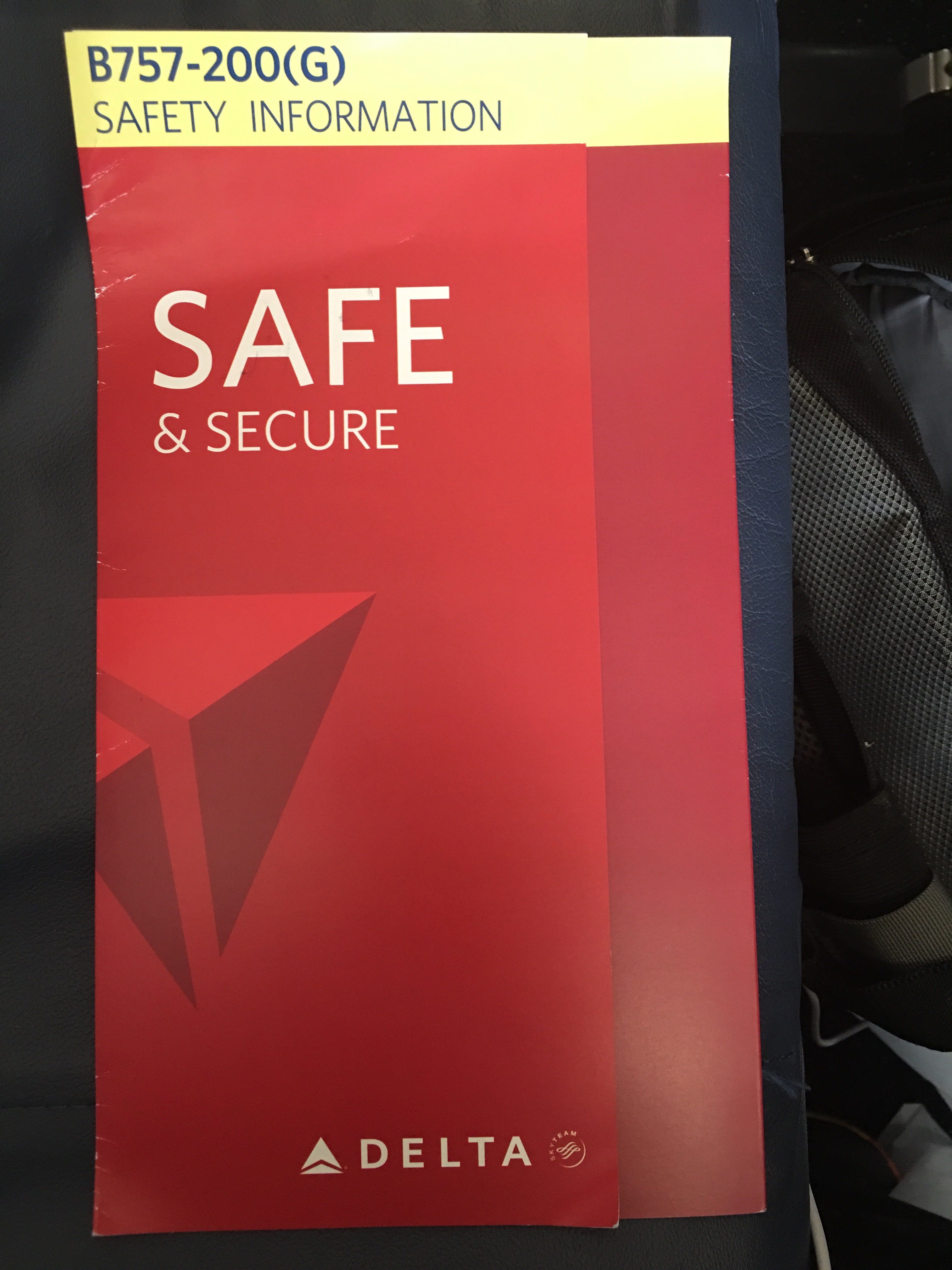
I flew from Andrews Air Force base to Guantanamo Bay, Cuba on a Delta Airlines 757 chartered by the Department of Defense to ferry over 100 people involved with the Military Commission case against Hadi al Iraqi.

I am with a team of 11 representatives of non-governmental organization fouls (NGOs) who are monitoring these criminal proceedings. 

Today’s business on the ground was primarily getting a security briefing, picking up our Military Commission badges, learning our likely program of courtroom and other activities for the week, dinner at O’Kelly’s Irish pub, and playing Taboo. 

Our first hearings are in the morning. 

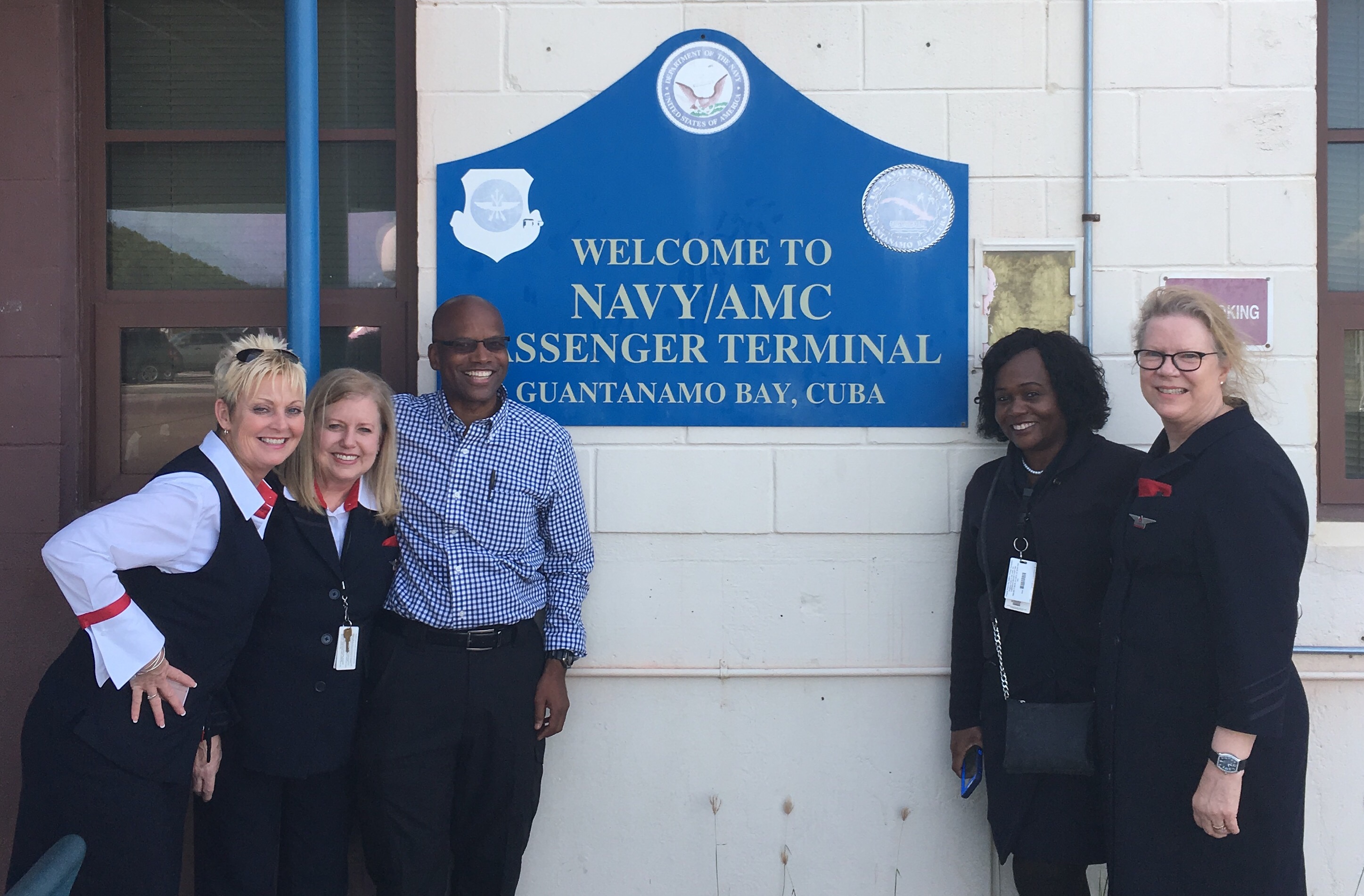
Members of the Delta cabin crew joined me for photos at the Guantanamo Bay Air Station. 

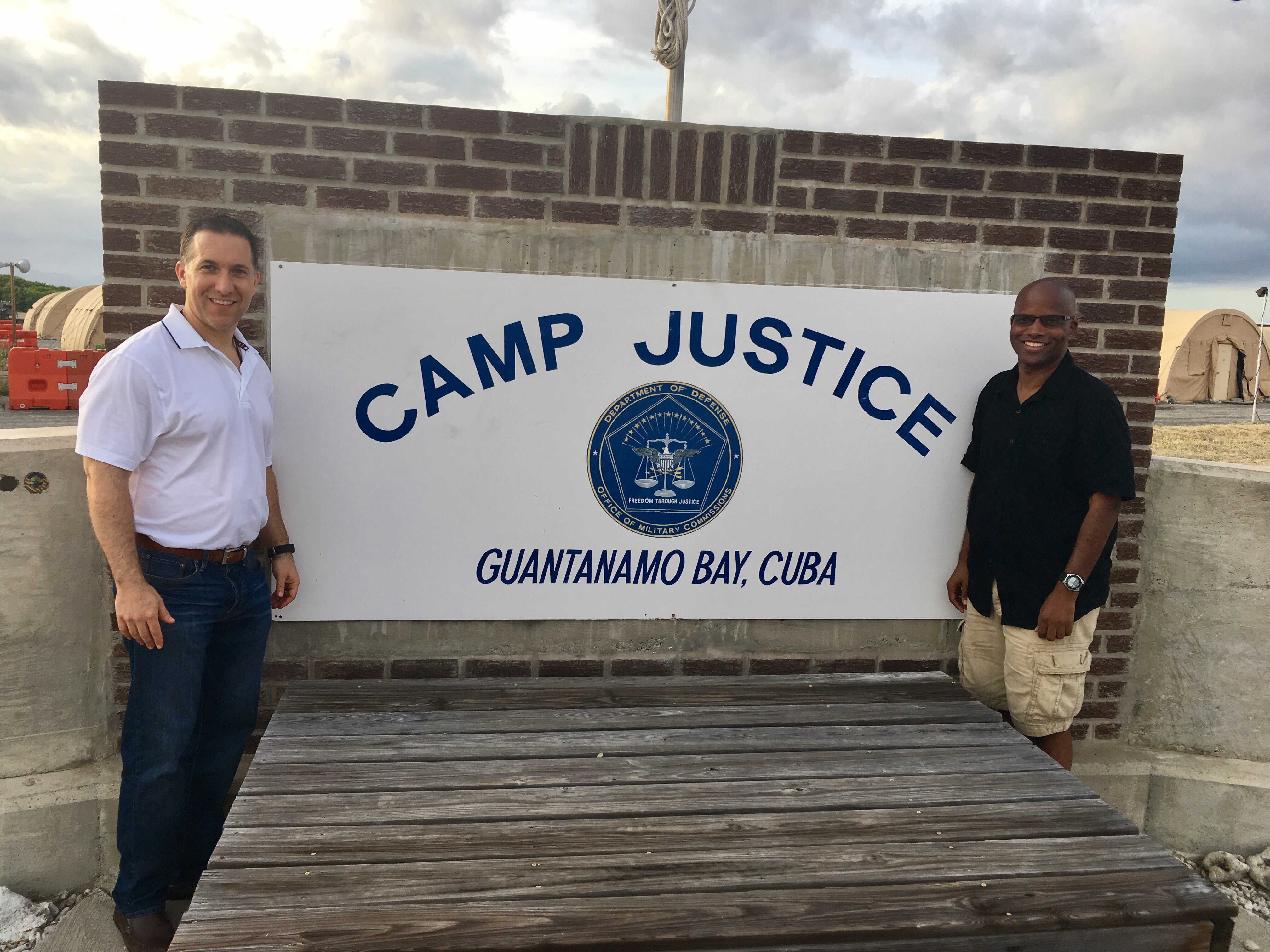
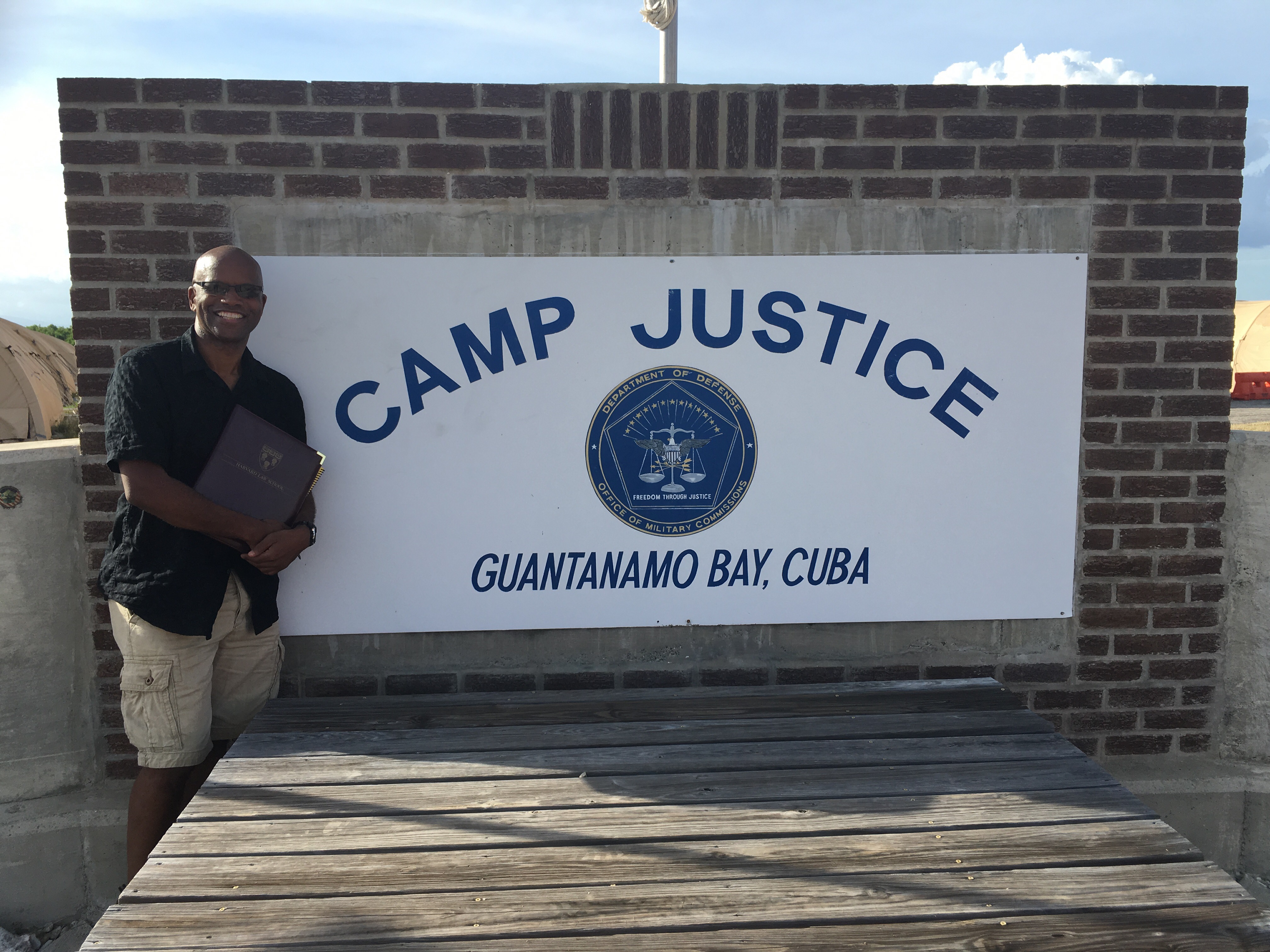
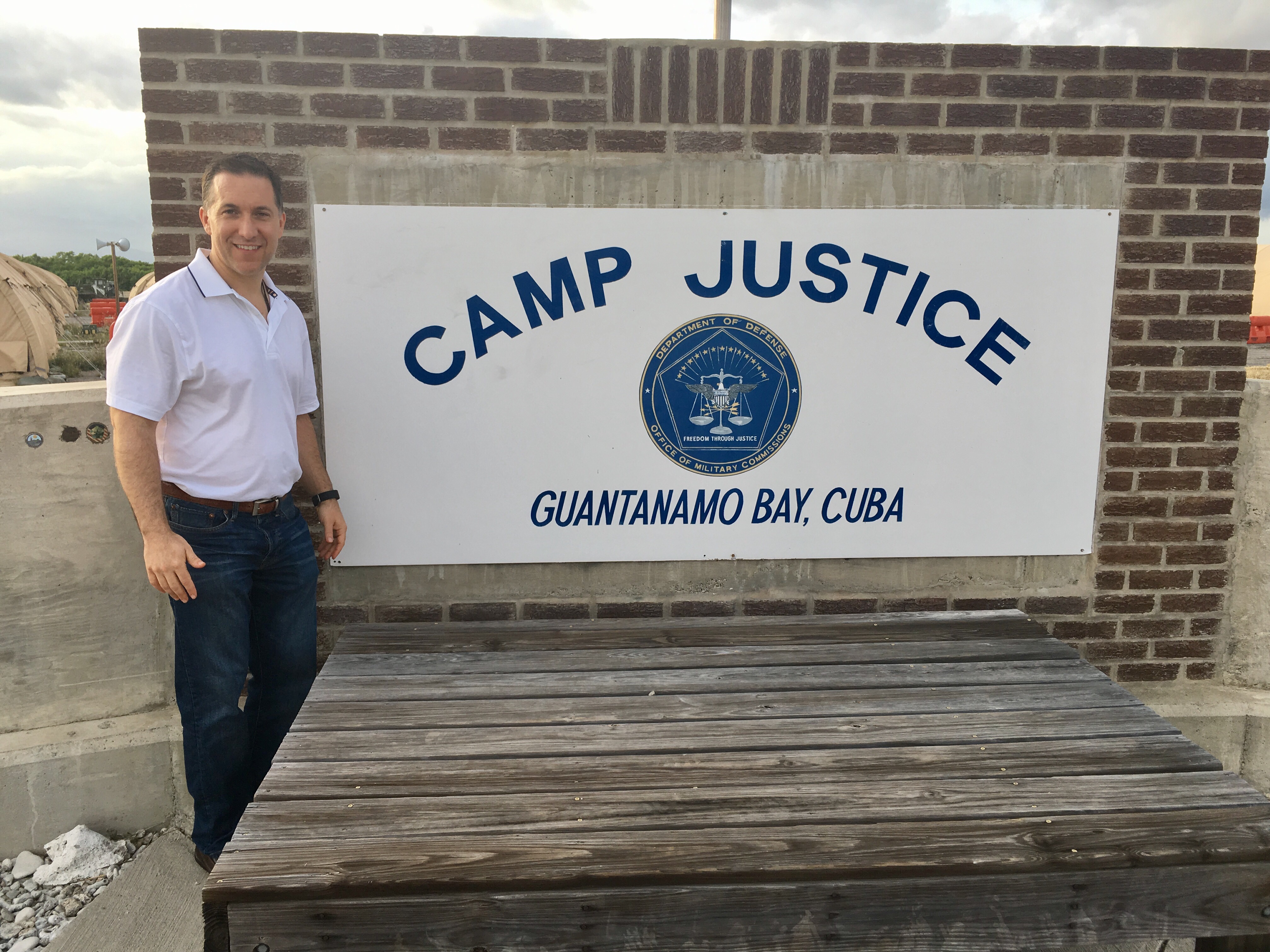
A couple of the NGOs took photos at Camp Justice, where we are living in tents for the next several days. 

My First Trip to Guantanamo Bay, Cuba Post Trump’s Election 

At Andrews Air Force Base this morning

Usually in my pre-departure blogs before I travel to Guantánamo Bay, Cuba, I focus on the specific detainee whose hearings I am traveling to monitor. This time it is a little bit different.

I’m sitting at Andrews Air Force Base waiting for a plane to Cuba for hearings in the case of Hadi al Iraqi, who is alleged to be a high level member of al Qaeda, liaison between Al Qaeda Iraq and the Taliban, and responsible for deaths of multiple individuals perpetrated in the context of armed conflict.

This is my first trip to Guantánamo Bay under a new administration elect. There are dozens of us here at Andres, sitting and waiting. Everyone is involved with the Military Commission hearings–the prosecution, defense counsel, media, NGOs, court room staff, tech staff, and many others.

How many are asking themselves now whether the new administration will move towards closing Guantánamo Bay, move towards keeping it open, or move towards increasing the numbers of detainees at Guantanamo?

Will members of ISIS or Daesh be sent to Guantanamo? Will “enhanced interrogation” continue at the levels deemed acceptable by the Obama administration, or will it be increased beyond that–at levels deemed by the Obama administration to be unlawful? Will this enhanced interrogation, if it is reinstituted, be conducted at Guantánamo Bay or conducted elsewhere before individuals are taking to Guantanamo Bay?

Will there be additional prosecutions of detainees who have bee at Guantanamo up to 15 years? If so, will there be charges that carry the death penalty?

We should have answers to these and other questions soon enough–if not before 20 January 2017, then certainly soon after.

With NGO colleague Lyn who was with me in September for Hadi hearings st Gitmo

My Experience: Monitoring Guantanamo Bay War Crimes Hearings

I Monitored Guantanamo Bay War Crimes Hearings Broadcast Live at Ft. Meade, Maryland.

Guantanamo Bay war crimes hearings are broadcast via CCTV live from Cuba to Ft. Meade, an army base in Maryland. I traveled from Indiana to Ft. Meade, Maryland to monitor Guantanamo Bay pre-trial hearings in the case against Khalid Shaik Mohammed and the 4 other alleged masterminds of the 9/11 attacks on the World Trade Center and Pentagon.

I arrived at Washington-Dulles International Airport on Sunday, 9 October 2016 for hearings scheduled to begin the next day. Monday, October 10, Columbus Day. We learned that the hearings would start a day later, on Tuesday, October 11, so I decided to use Monday to tour Washington D.C. Unfortunately, while at Ft. Meade I missed my husband’s bar admission ceremony on Tuesday morning in Indianapolis. Thankfully, he had encouraged me to attend the hearing, as he understood that it was a very special opportunity.

Local Transportation and Venturing into D.C.

I booked a Super Shuttle – a shared van cheaper than a taxi — to take me to Ft. Meade. Since I opted for the cheaper option, it took about 2 hours to reach the military base. The van dropped off 3 other passengers on the way. The Ft. Meade Visitor Center was closed when I arrived. I was thankful that fellow Indiana University McKinney School of Law students Katherine Forbes was waiting at the gate to escort me onto the base. Katherine is a member of the military, and has an ID card (Department of Defense CAC – Common Access Card) that permits her to enter the base and escort others onto the base. I was not going to be able to pick up my Ft. Meade access badge until Tuesday morning, just before the hearings began. We had dinner and went to our hotel for the evening.

The next morning, Columbus Day, Katherine dropped me off at Odenton train station (the MARC station), about an 8-minute drive from Ft. Meade. The train ride into D.C. was very reasonably priced, and only took about 40 minutes from Odenton Station to Union Station. Union Station is located half a mile from the Capitol building and the Supreme Court. From there, I used Uber to get around and spent the day wandering around the city and walking from landmark to landmark. I made it back to Ft. Meade by 7PM, and had dinner with Katherine before continuing to prepare for the next day’s hearing.

The Hotel

Katherine is in the Indiana National Guard, so we were able to stay at the Candlewood Hotel located inside Ft. Meade. The hotel was built only 3 years ago, and was very clean and well-appointed. Our room had a kitchen, including a dishwasher, full size refrigerator, microwave, and coffeemaker. The cabinets were stocked with silverware, dishes, and glasses. Every morning, the hotel offers a complimentary continental breakfast.

hotel%20entrance

Entrance to the Candlewood Hotel located inside the base at Ft. Meade.

Visitor Center

On Tuesday morning, Katherine and I drove to the Visitor Center and met up with Faisel Sadat, an Egyptian international LL.M. student at IU McKinney. He needed to be escorted onto the base, and Katherine was able to do that. Faisel and I were each issued a day pass onto the base.


me%20with%20my%20ft%20meade%20pass

After successfully picking up my day pass to access the base.

Badge Issue

Originally, we were under the impression that our Ft. Meade badges would be valid for one year from the day of pick-up. Unfortunately, there must have been a misunderstanding, because we were only issued a one-day pass. We were able to get back onto the base with no problem, and made our way to the hearing located at the McGill Training Center.

driving%20up%20to%20ft%20meade%20entrance

Driving up to the Ft. Meade control station after picking up our badges from the Visitor Center.

The Courtroom – Viewing from McGill Training Center

The room in which the hearing was broadcast was a large training/educational room in the McGill Training Center. There were several rows of desks with 2-3 chairs per long desk. In the back of the classroom, there was a cubby box of around 20 individual cubbies to place your phone in, which could be locked with a key. Personal communication devices are not allowed during the transmission of the court proceedings. Apart from the IU McKinney attendees, there was one gentleman present who works for a federal law enforcement agency, another gentleman I did not meet, and a lady whom I also did not meet.

The section of the courtroom at Guantanamo Bay that was visible at any given moment depended on who was speaking and which camera was panning at that moment. There was a camera that showed most of the courtroom, with the defendants, their counsel, and the prosecution visible at once, a view of the judge when he spoke, a view of the witnesses who testified seated next to the judge, and live feed from witnesses who transmitted their testimony from a location just outside of Washington, DC.

From the perspective of the judge looking into the courtroom, the 5 defendants were seated on the right, each at a separate table.

Each defense team was split according to the defendant, and divided into 5 small groups, seated in the 5 rows. Seated at the 6th and final table on the defense side were lawyers for one of the defendants who did not want his lawyers to sit next to him at his table. Each defendant was wearing a headdress, and Khalid Sheik Mohammed was the most recognizable in his

The prosecution sat at a series of tables to the left of the judge.

The Hearing

The hearing started at 9:00 AM with Military Commission Judge Army Colonel James L. Pohl addressing each defendant, inquiring whether they understood their rights to waive attendance at the hearing. Each of the five defendants was required to be present to hear their rights, but, Ramzi bin al Shibh was not present when court opened.

The judge addressed al Shibh’s counsel, requesting that he convince al Shibh to voluntarily be present at the hearing, otherwise, he would be involuntarily brought in.  He called for a 15 minute recess for bin al Shibh’s counsel to speak with him. When the court reconvened, al Shibh had joined his defense at the table.

bin al Shibh stated on the record that he boycotted the legal proceedings, and in an act of protest, refused to acknowledge his right to waive attendance. The judge asked him several times to acknowledge his rights, but al Shibh refused. Eventually, the judge asked for al Shibh to be escorted away, and we found out through Aline Fagundes, a McKinney LL.M. student who was present in the observer gallery of the courtroom, that al Shibh was removed, while

The four other defendants — Khalid Sheik Mohammed, Walid bin Attash, Ammar al Baluchi, and Mustafa al Hawsawi — acknowledged their rights in Arabic. Each defendant had an interpreter seated next to him to who helped facilitate conversations between the defendants and their defense team members. There was an off camera interpreter who interpreted on-the-record communications in the courtroom.

Motions

The hearing proceeded with the following motions/issues addressed:

  1. Defense raised al Baluchi’s motion to compel declassification of classified documents.
  2. Regarding the seizure of a certain document containing defense notes from the defendant, four witnesses were put on the stand to testify:
    • “Captain L”
    • “Captain B”
    • “Assistant Watch Commander 1482”
    • “Major (?)”
  1. Regarding the modification of a protective order, Learned Counsel James Connell III asked the judge to require the modification of the order in question, and not allow the creation of a new order as a matter of simplification.

Lunch

The courtroom recessed at 12:45 PM for lunch, and the group of observers made our way to lunch on the base, to discuss what he had experienced so far, and ask for clarification from Professor Edwards on procedural questions.

The 6 IU McKinney Observers went to the Food Court. We chose different restaurants, got our food, then all sat together to talk about what transpired that morning in court. We talked about the proceedings up to that point, and discussed why the hearings were taking as long as they are, in general.

I learned from that defense’s counsel appear to work as hard for their clients as any defense counsel would, notwithstanding what criminal actions the client may have allegedly been involved in or how much evidence may exist of the client’s involvement.

We then took group photographs before returning for post-lunch proceedings.

Afternoon Hearing

 The court reconvened at 2:00 PM.

The first motion presented after lunch concerned classified material. The defense argued that documents received from the prosecution were highly redacted and in some cases, unable to be read other than a few words. It was a concern to the defense that the redactions were causing discovery issues, and that redactions were being applied arbitrarily and in a disingenuous manner, to intentionally interfere with defense’s preparation. The hearing continued until 4:00 PM on the topic of redaction, until Judge Pohl called for the hearing to be continued the following day.

Post-Hearing

After the courtroom was dismissed for the day, I had a chance to speak with one of the other Observers who seemed to work for the government and who has been to Guantanamo Bay on many occasions. It was interesting to speak with someone who appears to have sound knowledge about the Military Commissions.

A little later, I was dropped off at the Visitor Center where Super Shuttle was picking me up to take me back to the airport. While at the Visitor Center, I ran into Professor Edwards, and we discussed the hearing, and my background and interests. He was at the Visitor Center to discuss the issue of several observers being given one-day passes instead of a year-long access card. The person in charge told Professor Edwards that they would look into the problem. After discussing the issue, Professor Edwards and I took several pictures outside of the Visitor Center that may be helpful to a future observer in finding where to go upon arrival at Ft. Meade.

img_0642

Enjoying a nice chat with Professor Edwards at the Visitor Center while waiting for my shuttle back to Dulles airport.

From Ft. Meade to Dulles, and Home Again, Reflection

This time, I was the only person picked up by the shuttle, so the drive to Dulles only took about an hour, even in evening rush hour traffic. The plane ride back home was quick and uneventful. I look forward to observing again in the future.

This opportunity afforded me a valuable glimpse into the proceedings that are ongoing in Guantanamo Bay. The fact that I am one of not many people to actually be able to witness the proceedings feels very special, and something I will remember for the rest of my life.

I knew that the hearings would have the normal U.S. court proceeding structure, but the realization did not occur to me until that morning that I would have the rare opportunity to hear the “9/11 Five” speak live. Seeing the defendants and hearing them speak both Arabic and English really brought a very human moment to an occurrence in history that seemed surreal to me, having happened when I was a young girl.

I urge anyone with an interest to apply as an observer. The opportunity is very unique, and not something many people can say they have ever experienced from the vantage of the IU McKinney Military Commission Observation Project.

Sheila Willard, J.D. Candidate 2018

NGO Monitor, U.S. Military Commission Observation Project (MCOP)

Program in International Human Rights Law

Indiana University Robert H. McKinney School of Law

Fall Break Trip to Meade for KSM hearings

A Long Awaited Trip to Fort Meade

Over fall break I had the opportunity to travel to Fort Meade, Maryland to view the pretrial hearings of alleged terrorist Khalid Sheikh Mohammed (KSM). KSM is alleged to be involved in the September 11, 2001 terrorist attacks as well as other terrorist activities. Mohammed is currently being held in Guantánamo Bay, and while the hearings take place in Cuba, approved NGO observers can view the hearings via secure link from Fort Meade military base. I’ve been involved with the Military Commission Observation Project for almost a year now and this is the first time I’ve had an opportunity to view a hearing. This spring I was scheduled to attend the hearing of Abdul Hadi al Iraqi, who is alleged to be involved in attacks and terrorist plots in Afghanistan and Pakistan, however that hearing was postponed just before departure.

As an NGO observer it’s important to stay up to date on the hearing schedule because it changes frequently and sometimes with little notice. The KSM hearings were originally scheduled for Monday through Friday of Fall Break however we received word from Professor Edwards that the hearings most likely would not be held on Monday and the earliest start would be Tuesday. I arrived on Tuesday morning after an all-night drive from Indiana. After checking in at the Fort Meade visitor Center, I proceeded to the building on the military base where the hearings were streamed. I didn’t realize how large Fort Meade is. It has its own shopping mall with food court and hundreds of families live on the base, which is home to divisions of several government agencies.

Court is in Session

The court room was not at all what I expected. I was imagining a traditional looking court room and was playing off some stereotypes from the 1992 thriller “A Few Good Men”, however the court room was a simple room and full of books on rolling carts. Also I expected to see one camera angle for the duration of the hearings, however the court has several cameras for several camera angles and the feed switches camera angles depending on who is speaking in the courtroom. A few times during the hearing we had to pause because of problems with the translator’s equipment, which is apparently a reoccurring problem. This matter is further confounded by the fact that KSM speaks English and was educated in the United States. The main issue being discussed while I was at the hearing had to do with contents of KSM’s legal bin. Detainees have their own legal bin, which is a physical bin, and when they do any work in preparation for trial they are instructed to place this work in their legal bin so that it is not reviewed by unauthorized parties. Further any paper with writing or any material done in anticipation of trial is supposed to be stamped with a detainee specific stamp and number.

Topics for Consideration

Problematically KSM is not supplied with pre-stamped paper. His attorneys allege that material from his legal bin was reviewed during cell searches. The facts seem to support this claim and we heard testimony from several people with relevant knowledge of the incidents. It really seemed to come down to the fact that while the material was in the legal bin, it wasn’t stamped with the proper stamp and number. Those who gave testimony and who had relevant knowledge of the matter claim that when the cell was searched and the materials in question were discovered, a translator was summoned and that the translator recognized that the writing, which was in Arabic, was done in anticipation of legal proceedings. While, practically, a translator might be qualified to make this determination, procedurally, this is inappropriate because the translator shouldn’t be functioning in a legal capacity. Further, if the writing was done in anticipation of legal proceedings then the contents of that material should be limited to only KSM and his attorneys. These incidents threaten KSM’s attorney-client privilege, because unauthorized parties are reviewing legal material. However, one can also see why it might be problematic to provide KSM with pre-stamped paper to be used for legal purposes without knowing what he’s going to write on it and that it actually will be used for legal purposes.

The court went on to consider other motions and the subject of classified material became a forefront issue. Specifically, there were a lot of pages of classified material that the defendant’s attorney would like to have further access to. During the hearings in Fort Meade the live stream sometimes shows a document rather than a camera angle. During the hearing I attended, several documents were presented with sections of the documents blocked out, not visible, because the materials were considered classified. One of the problems that the court struggled with is what to do with this situation. The judge at one point, in an aside, plundered aloud whether he should be the one to review the documents which he himself claimed not to have access to. It was also briefly considered that it might be appropriate for KSM’s attorneys to have access to some of the classified material, while withholding it from the detainee himself. Of course this also presents challenges because KSM’s attorneys might be acting on information that KSM is not privy to himself.

A Word to Future Observers

As is often the case in legal proceedings, the Military Commission Observation Project pretrial hearings are often plagued with cancellation, delays, and other incidents that can affect the hearing schedules. In fact, when I went to Fort Meade over fall break there was concern that Hurricane Matthew could delay the hearing, but nonessential evacuated personnel were returned to Guantánamo Bay before that hearing was set to take place and the hearings preceded on Tuesday, one day later than previously scheduled. And the Abdul Hadi al Iraqi pretrial hearings in January were postponed as a result of a motion for continuance.

I drove out to Fort Meade and next time I’ll consider flying, but if I do fly I’ll be sure to purchase travel insurance in case something unexpected happens with the hearing that I’m scheduled to attend. Getting onto base at Fort Meade is easier than I expected. I submitted the proper paperwork to Professor Edwards prior to departure and didn’t have any problems when I got to the Fort Meade Visitor Center. However, after you’ve been cleared by the Visitor Center, make sure you attempt to enter the base through gate that is convenient to get to the viewing building and see the hearing. I learned the hard way that if you put the building location in your GPS, your turn by turn navigation might lead you into Fort Meade installation by a gate other than the one that is the most convenient for you. In the end I was fine however I entered Fort Mead military installation through an NSA drop off entrance. While I was allowed entrance to Fort Meade through the NSA entrance I was subject to additional security screening. This happened on the second day when I attempted to return for the hearings. On the first day I followed Prof. Edwards instructions, went in through the most convenient gate, and didn’t have any problems.