Uncategorized

It’s a Small World – by Hattie Harman

Preliminary Preparations

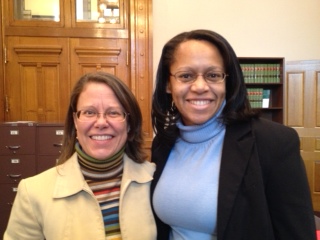
Hattie Harman and Traci Cosby -- Both going to Cuba this month

Hattie Harman and Traci Cosby — Both going to Cuba this month

As I read Chuck Dunlap’s blog posts this week, I find myself looking more and more forward to my upcoming trip to Guantanamo for the next round of hearings (Nov. 17-19, 2014). Chuck is an Indiana University McKinney School of Law graduate who works at the Indiana Bar Foundation, and he is at Guantanamo Bay this week monitoring the hearings in the case of al Nashiri, who allegedly masterminded the 2000 attack on the USS Cole that killed 17 sailors off the coast of Yemen.

I will be monitoring a different case, that of Hadi al Iraqi, who was alleged to have run al Qaeda’s army in Afghanistan, was arraigned this past summer, and his pre-trial hearings are at an early stage.

Yesterday I received instructions from the Pentagon to help me prepare for my mission, including information about the logistics of eating, sleeping, and – most importantly – viewing the proceedings.  Reading Chuck’s posts and seeing his photos makes it seem more real all the time!

And I have been especially fortunate this past week to have had short conversation with Indiana Supreme Court Justice Steven David about the Naval Station itself and his experiences there.  Justice David, is his position as an Army Colonel, previously served as chief defense counsel. Of course, our conversation was quite limited due to the nature of the subject but it was nonetheless very helpful and exciting to meet with someone who has had his “boots on the ground” at Guantanamo.

Two Views of Cuba

Although I won’t be leaving for Cuba for another week, my good friend and co-worker Traci Cosby is leaving tomorrow for Havana. Traci will be part of a delegation from the American Bar Association Section of Dispute Resolution spending several days in Havana meeting Cuban dignitaries and learning about the Cuban legal system.

ABA itinHow strange it is that two friends and close co-workers would end up – entirely independently – traveling to Cuba in the same month!  Obviously, Traci’s and my experiences of Cuba will be very different.  But I look forward to swapping stories with her when we both return.

Day 2 at GITMO – Al Nashiri Hearings – Tues., 4 November 2014 – Charles Dunlap

NGO Boat tour of Guantanamo Bay

NGO Boat tour of Guantanamo Bay

Hearings delayed

We arrived at GTMO on Monday, but hearings did not begin until Wednesday.  So had some time today (Tuesday) to get some logistical tasks done and have some tours. We began by having breakfast at the base commissary.  All you can eat buffet for $2.55, not bad.  We then all came back to get our credentials that will get us access to the courtroom for the hearings.  Obviously there is a high level of security but the credentialing process was very smooth.  The level of security in the area really ramps up on days of hearings when the defendant is brought to this side of the base from the detention facility located several miles away.

NGO's "exploring" the bay (aka "fact finding mission")

NGO’s “exploring” the bay (aka “fact finding mission”)

Boat tour of Guantanamo Bay

Once we completed the credentialing process, we went to one of the docks to get a boat for a tour of the Bay. We were divided on to 2 different pontoon boats with some military personnel who took us around to various parts of the bay.  It certainly wasn’t a difficult assignment for any of us as the pictures will

Site of abandoned and  demolished base hospital from WWII era

Site of abandoned and demolished base hospital from WWII era

show.

Dinner; It’s a small  military base

After returning from the boat trip and getting cleaned up we went to dinner as a group at the Irish Pub on the island. To further demonstrate what a small place this is, the Chief Prosecutor General Mark Martins and his team were also having dinner there at the same restaurant, and sate at the table next to us.  This can actually be a challenging issue (especially for the judge) since many stakeholders, including the victims’ families, fly down to GTMO together, use the same gym and facilities and restaurants, which can lead to potential issues of ex parte communication, among others.

Call it a day

After dinner we all went back to our tents to retire and get ready for the first day of hearings the next day which I will report on and post tomorrow.

Base Commander's House

GTMO Base Commander’s House

Sea-life at GITMO

Sea-life at GITMO

Meeting with Chief Prosecutor – Part II – Wednesday

The NGO Lounge at GITMO where NGO's have a place to work (without Wi Fi though)

The “NGO Lounge” at GITMO where NGO’s have a place to work (without Wi Fi though)

More on the NGO meeting with the Chief Prosecutor General Martins

To conclude a summary of our meeting with General Martins, Chief Prosecutor for the Military Commissions, here are several other topics we discussed in our meeting:

No Miranda warnings required

• One of the primary differences with the Military Commissions and traditional Article III Courts are the different standards regarding Miranda Rights and the admission of hearsay evidence. Generally the standards for admission of hearsay evidence and evidence gathered without first issuing a Miranda warning is less strict. Gen. Martins stressed that due to the nature of the environment where the evidence is collected (often in a theatre of war) there are not always trained law enforcement personnel available and therefore the standard should be different than in a traditional civilian law enforcement/Court setting. That being said, he reiterated that even though the standards may be “lower” there is still a threshold that must be met and not just anything can be admitted. There is still a need for the prosecution to prove that the evidence being proffered is reliable through a “totally of the circumstances” analysis and the defense has an opportunity to counter that through cross examination etc. which is all set forth in the MCA of 2009.

Timetable for al Nashiri trial

• One specific question from the group was when he thought the actual trial would begin for Al-Nashiri. Gen. Martins indicated that he anticipated that at the current pace and posture of the case, the trial could begin in the fall of 2015.

Evidence generated from “enhanced interrogation”?

• In addition, he also noted that for the government’s case it will use no testimony generated from any enhanced interrogation procedures.

Declassifying information

• Gen. Martins also indicated that the government is under an obligation to declassify as much information as possible under the MCROE 505 and that they have been striving to meet that obligation. He also pointed to the volume of materials and direct resources and documents from the proceedings that are available for anyone to ready and review on the internet, and that they strive to make the entire process extremely open and public as the MCA requires.

Listening device disguised as smoke detector in attorney / client meeting room; FBI investigating defense team members

Some of the aL-Nashiri hearing NGO Observers at a table outside our tents.  They stopped letting NGOs have wifi access at this location.

Some of the aL-Nashiri hearing NGO Observers at a table outside our tents. They stopped letting NGOs have wifi access at this location.

• In response to a question from the group, Gen. Martins discussed some of the particularly troublesome issue that some observers of the process have mentioned concerning the revelations of a listening device concealed in a smoke detector in a room where attorneys met and conferred with their clients at GITMO, as well as the FBI interviewing members of the defense team and having nondisclosure statements about the interviews so other members of the defense team would not know of the interviews occurring. The FBI issue is currently being litigated in the 911 case and Gen. Martins has walled himself off from that case so he wasn’t able to comment very much on that other to say that it was a legitimate issue from both sides and the judge is currently hearing arguments on it. Regarding the smoke detector issue, he indicated that the facts presented showed that the room was a multi-purpose room used for other detainee procedures where surveillance was necessary and the listening devices were not operative during the attorney client meetings.

ISIS / ISIL — Captured taken to GTMO?

• An additional question raised by the group concerned the current conflict with ISIS/ISIL in the middle-east and whether or not in the event any of their members were captured, would they potentially be transferred to GITMO to face a military commission. The General responded that it is an open question (and theoretical at this point) on how that would be handled. There are several issues associated with that question that all have to do with the limited jurisdiction of the military commissions based on the MCA of 2009. You would need to explore if they are affiliated with Al Qaeda, are they foreign nationals, are they unlawful enemy belligerents etc.

Future Updates

I will also be posting future updates from the subsequent day’s activities of this trip.

Arrival at GTMO for al Nashir hearings – 3 November 2014 – Charles Dunlap

My Plane from Andrews Air Force Base to GTMOMy Trip to Guantanamo Bay

Today, Monday, 3 November 2014, has been an eventful day.

The day began by arriving at Andrews Air Force Base at 7:00 a.m. to be escorted through the gate to the air terminal.  After checking in and being issued my ticket I waited in the terminal until all the other NGO’s had assembled.  While we were waiting (several hours) we introduced ourselves to each other.  There are 10 NGO’s representing a variety of organizations from around the country who are participating.

Copy of Guantanamo Bay Fair Trial Manual.

Copy of Guantanamo Bay Fair Trial Manual.

I also took the opportunity to pass out copies of the Guantanamo Bay Fair Trail Manual for U.S. Military Commissions that Prof. George Edwards and his Indian a University McKinney School of Law students have been working on.  The Manual was much appreciated by everyone, and will be very useful for all the NGO’s during the hearings.

The only other delay in getting ready to depart was a brief diversion outside while the Secret Service swept the terminal in preparation for Vice President Biden’s departure on a different plane.

Our flight to Cuba; Landing at GTMO

The flight to Cuba was uneventful. The charter flight was about 3 hours long (It would have been closer to 2 hr. 15 min. if Cuba permitted us to fly over the island).

Once we landed at Guantanamo Bay we unloaded and waited to go through document check in.  From there everyone boarded vans to drive down to the dock to catch the ferry across the bay to the main part of the base.  From there we were driven to Camp Justice which is a tent city that has been set up on the old WWII vintage runway that is no longer in use.  We had some time to get settled into our bunks, fortunately while each tent sleeps 8 there were only 4 men and 2 male tents so we had plenty of room with just 2 per tent.

IMG_1307

Arriving at Camp Justice — Our tent city home for the week.

After getting settled in, we made a trip to the base NEX to stock up on supplies. The NEX is pretty much like a small town Walmart and has all of the essentials.  After that trip we headed back to our tents again and then rendezvoused shortly thereafter for our meeting with General Martins who is the lead prosecutor for the Military Commissions.

Meeting with General Mark Martins, Chief Prosecutor

I will post a blog that discusses this meeting in more detail, but I was extremely impressed with Gen. Martins and the few members of his team that he had with him.  We had over an hour and a half with him and we were able to ask him pretty much anything we wanted.  Even with some of the more challenging questions that were asked, he answered directly and faced some of the particularly challenging issues head on.  Again, I will have a separate post covering this meeting.

IMG_1298

Some of the tents in Camp Justice. It is built on an abandoned WW II air strip.

A Jamaican Dinner; Day’s End; Tomorrow

After our meeting with Gen. Martins we all loaded into the van for a short ride to the Jamaican Jerk Chicken restaurant. The food was great and we enjoyed the very pleasant evening weather.  From there it was back to Camp Justice for a few conversations among the group about our day so far and our meeting with Gen. Martins.

IMG_1286

My bed in my Camp Justice tent.

Based on the current itinerary, we are scheduled to reconvene for breakfast tomorrow (Tues.) get our credentials, possibly have a boat tour around the base and work on some of our various projects.

What About WiFi?

I have to say that the internet issue is as bad as I had been warned it was.  It seems like everywhere we go everyone is checking their phones and computers to see if we have stumbled on a Wi-Fi signal that we can access.  When we are lucky enough to get a signal the speed is extremely slow.

Hopefully, I’ll be able to post this sometime tomorrow (Tuesday)!

Headed to Gitmo – Chuck Dunlap

Chuck Dunlap's Boarding Pass - Andrews Air Force Base to GTMO - 3 November 2014

Chuck Dunlap’s Boarding Pass for his flight from Andrews Air Force Base to GTMO – 3 November 2014

Chuck Dunlap arrived at Andrews Air Force Base around 6:00 on the morning of Monday, 3 November 2014 for his flight to Guantanamo Bay, Cuba to monitor the U.S. Military Commission hearings in the case of al Nashiri, an alleged mastermind of the 2000 suicide bombing of the U.S.S. Cole off the coast of Yemen.

Mr. Dunlap had difficulty posting a post this morning, so we are re-posting his Andrews’ photos. He will post again upon his arrival at GTMO later today.

Chuck Dunlap's Plane - AAFB to GTMO

At Andrews Air Force Base. This is the chartered plane that will take Chuck Dunlap from Andrews to GTMO today.

This morning, Mr. Dunlap reported “We had a brief delay waiting for VP Biden’s plane to leave.” So, they were expected to arrive at Guantanamo Bay later than expected.

Indiana Lawyer Lectures Before Guantanamo Bay Mission

Chuck Dunlap - Lecture - Indiana University McKinney School of Law - 31 October 2014

Chuck Dunlap lectures in Professor George Edwards’ International Criminal Law class. Students in the class have conducted research on fair trial rights to incorporate into the Guantanamo Bay Fair Trial Manual.

Days before his mission to the Guantanamo Bay Naval Station (GTMO), Charles (Chuck) Dunlap lectured about the Military Commission hearings he will monitor at the remote military outpost on behalf of the Military Commission Observation Project (MCOP) of the Indiana University McKinney School of Law. Mr. Dunlap is scheduled to observe pre-trial hearings in the case against Abd al-Rahim al Nashiri, who is alleged to be a mastermind of the 2000 suicide attack on the U.S.S. Cole off the coast of Yemen. The attack killed 17 U.S. sailors and wounded several dozen.

The Military Commission Observation Program has been sending Indiana McKinney School of Law to monitor hearings at Guantanamo Bay and at Ft. Meade, Maryland, where the GTMO hearings are simultaneously video-cast on secure lines. The MCOP mission is for IU McKinney students, faculty, staff and graduates to attend, observer, analyze, critique, and report on pre-trial hearings and trials.

Guantanamo Bay Fair Trial Manual

MCOP monitors are expected to use the Guantanamo Bay Fair Trial Manual as a tool to help them ascertain whether they believe that all Guantanamo Bay Stakeholders are receiving a fair trail. the Manual lists dozens of fair trial rights that are to be afforded to the prosecution, victims and victims families, the defendants, the press, security and other personnel who work with the prisoners and with the court, the U.S. public, and others.

Chuck Dunnlap & George Edwards - 31 October 2014 - With Guantanamo Bay Fair Trial Manual Draft - Stacks

Professor Edwards and Mr. Dunlap and stack of Guantanamo Bay Fair Trial Manuals Mr. Dunlap will carry to Guantanamo Bay for NGO Observers to use in assessing fair trial rights. Copies of the draft Manual can be downloaded from www.GitmoObserver.com.

IU McKinney Law Students Assist in Fair Trial Project

IU McKinney law students enrolled in Professor George Edwards’ International Criminal Law class have been conducting legal research that is being incorporated into the Guantanamo Bay Fair Trial Manuals. Mr. Duncan met with students in the class, lectured on issues to be raised during the al Nashiri hearings during his mission, and discussed with the students their research. Each student in the class has been assigned one or more specific fair trial rights to explore, and the students are examining the international law and domestic U.S. law that define the rights in the Guantanamo Bay context.

Mr. Dunlap traveled to Ft. Meade several months ago to monitor Guantanamo Bay hearings. The MCOP, which is also known as The Gitmo Observer, is part of the Indiana University McKinney School of Law Program in International Human Rights Law. Professor Edwards is the founder of the Program in International Human Rights Law, and the MCOP / Gitmo Observer.

GUANTANAMO BAY TRIP PREPERATION – AL NASHIRI HEARINGS By Chuck Dunlap

I was honored to be selected last week to serve as an observer for the Al Nashiri (USS Cole Bombings) hearings at Guantanamo Bay, Cuba the week of Nov. 3-7. I have previously participated in the Program in International Human Rights Law and its U.S. Military Commission Observation Project at IU McKinney Law School in mid-June, 2014.  At that time, I observed the hearings of Khalid Shaikh Mohammad and the other accused 9-11 co-conspirators via a secured video link at Ft. Meade in Maryland.  This June trip was after an earlier scheduled hearing I was planning on attending was canceled at the last minute due to a schedule change by the presiding judge.  Since then, and based on what has happened to other participants in this program, one thing I fully count on is last minute schedule changes.  For that reason, I’m trying not to get my hopes up to high about observing the hearings until I am actually on the plane headed to Cuba.

Plans for Future Blogging

The overall mission of the IU McKinney School of Law’s Program in International Human Rights Law and the U.S. Military Commission Observation Project is to “Observe, Analyze, Critique, and Publish materials on the hearings.” As I prepare for the trip I will be posting several bog entries about various aspects of this assignment including the preparation process, preliminary research, work on the Fair Trial Manual, and of course the actual hearings.  From what I hear, due to the lack of Wi-Fi and internet access at the base (at least for NGO’s and journalists) much of my reporting of my observations from the actual hearings may be more post-visit than actually during the week of my visit. (more…)

Stakeholders may vary across Guantanamo Bay proceedings – Hattie Harman

My upcoming mission to Guantanamo Bay

Late last week I was honored to learn I have been nominated by Indiana’s Military Commission Observation Project (MCOP) and approved by the Office of Military Commissions to travel to Guantanamo Bay to observe the November 17-21 pretrial hearings in the case against Hadi al Iraqi.   I had the good fortune to travel to Fort Meade in April of this year to observe via secure video link a set of hearings in the case against Khalid Shaikh Mohammad (KSM) and his co-conspirators in the planning and execution of the 9/11 attacks.   I am very much looking forward to observing more hearings in person at Guantanamo Bay.

Guantanamo Bay Fair Trial Manual

In preparation for my upcoming trip to GTMO I have begun studying MCOP’s indispensible Guantanamo Bay Fair Trial Manual.  The Fair Trial Manual focuses on assisting observers in assessing whether the rights of all stakeholders in the Military Commission proceedings are adequately protected. And while one frequently thinks of the right to a “fair trial” as belonging only to the accused person, I recognize now that this is too narrow an understanding of the concept. As the Fair Trial Manual makes apparent, a somewhat disparate set of individuals and organizations have an interest in the outcome of Military Commission proceedings, and, concomitantly, in their fairness. Just as in traditional criminal trials, the crime victims and their families have an interest in a fair proceeding with a just outcome. A conviction which is later reversed due to a faulty proceeding serves no one, including (and perhaps especially) the victims. (more…)

How Can the President Close Guantanamo Bay? by Clarence B. Leatherbury

Senate Bill 2410 - Carl Levein - To Authorize Military Activities for 2015On June 24, 2007, while on the Presidential campaign trail, Illinois Senator Barack Obama stated to a crowd in Texas, “We’re going to close Guantanamo. And we’re going to restore habeas corpus.” Now President Barack Obama is trying to honor that promise.

One way President Barack Obama could close Guantanamo Bay is by vetoing the annual defense spending bill. The 113th Congress drafted Senate Bill 2410, known as the “Carl Levin National Defense Authorization Act” for Fiscal Year 2015. The National Defense Authorization Act includes a provision which prohibits the President of the United States from transferring the remaining 149 detainees to the U.S.

The provision reads:

SEC. 1031.LIMITATION ON THE TRANSFER OR RELEASE OF INDIVIDUALS DETAINED AT UNITED STATES NATIONAL STATION, GUANTANAMO BAY, CUBA.
(a) In General- Except as provided in subsection (b), none of the funds authorized to be appropriated by this Act for fiscal year 2015 may be used to transfer, release, or assist in the transfer or release to or within the United States, its territories, or possessions of Khalid Sheikh Mohammed or any other detainee who–
(1) is not a United States citizen or a member of the Armed Forces of the United States; and
(2) is or was held on or after January 20, 2009, at United States Naval Station, Guantanamo Bay, Cuba, by the Department of Defense.
(b) Transfer for Detention and Trial- The Secretary of Defense may transfer a detainee described in subsection (a) to the United States for detention pursuant to the Authorization for Use of Military Force (Public Law 107-40), trial, and incarceration if the Secretary–
(1) determines that the transfer is in the national security interest of the United States;
(2) determines that appropriate actions have been taken, or will be taken, to address any risk to public safety that could arise in connection with detention and trial in the United States; and
(3) notifies the appropriate committees of Congress not later than 30 days before the date of the proposed transfer.

Veto?

If President Barack Obama vetoed the legislation though, Congress could override the veto with a two-thirds vote of both houses, whereupon the legislation would become law. (more…)

Cancellation of October Hearings and Related Fair Trial Concerns (Luke Purdy)

On September 29 I was notified by the Pentagon that the October hearings for Al Nashiri had been cancelled. Consequently, I was unable to travel to Guantanamo Bay for the hearings scheduled between October 7-10. The Pentagon did not provide an explanation for the cancellation. Al Nashiri’s next court hearing at Guantanamo Bay is not scheduled until the week of November 3rd of this year.

The delay in the case against Al Nashiri raises potential concerns for the defendant’s right to trial without undue delay, as set forth in the International Covenant on Civil and Political Rights (ICCPR), as well as other international human rights documents like the Body of Principles on Detention, and the International Criminal Court Statute. The ICCPR, in Article 14(3)(c), guarantees all persons charged of criminal offenses the right “to be tried without undue delay.” In addition, Article 9(3) states that

Anyone arrested or detained on a criminal charge shall be brought promptly before a judge or other officer authorized by law to exercise judicial power and shall be entitled to trial within a reasonable time or to release. It shall not be the general rule that persons awaiting trial shall be detained in custody, but release may be subject to guarantees to appear for trial, at any other stage of the judicial proceedings, and, should occasion arise, for execution of the judgement.

One should note that Al Nashiri has been detained since November 2002 for his alleged role in the 2000 bombing of the USS Cole, and that charges against him have been pending since 2008, though they were dropped dropped for three years until the Government reinstated them in 2011, the defendant remaining in custody throughout the intervening period. (more…)

My First Afternoon at Guantanamo Bay (Jeff Papa)

Jeff Papa - At Camp Justice - GTMO - 14 September 2014

“Camp Justice” is the name of the barracks-like Tent City where NGOs are housed at Guantanamo Bay. Immediately to my left, out of the camera’s view, is the court house complex.

  Andrews Air Force Base – Early Sunday Morning

The military instructed us to arrive at Andrews Air Force Base no later than 0630 this morning for our 10 am flight to Guantanamo Bay, Cuba.

There was some confusion since the address given for the Andrews Visitor Center was apparently wrong. Several of the nine Non-Governmental Organization (NGO) representatives traveling with us arrived at the Andrews main gate, and got turned back. One of our escorts arrived at 6:30 and transported us to the air terminal on the base.

Flying to Guantanamo

As those familiar with the GTMO process know, the planes to Guantanamo contain many different categories of participants, including the presiding officers, defense counsel, prosecution, victims’ family members, NGO representatives, and the media. Today was no different. We met several of these people, including Carol Rosenburg of the Miami Herald who routinely covers GITMO proceedings (she mentioned Indiana’s own Justice Steve David, who served here previously).

The flight to Guantanamo was a little over three hours. The weather on arrival was perfect – blue sky and temperatures in the 80s.

This is my bed for the next few days at Guantanamo Bay. They keep the tents very cold to discourage insects, banana rats and iguanas.

This is my bed for the next few days at Guantanamo Bay. They keep the tents very cold to discourage bugs, banana rats and iguanas.

We took a ferry from the airfield across the bay to the main base area and were escorted to our quarters – barracks-like tents kept ice cold to discourage bugs, banana rats and iguanas from intruding.

No more WiFi.

Unfortunately, a change in access now prevents non-military persons (like the NGOs) from accessing WiFi in the area where our tents are. No mainland U.S. wireless carriers function here. We also have no access to Cuban carriers.

We received photo identification badges that give us access to the courtroom. We then visited the Navy Exchange store for supplies. Still no WiFi was available.

We finally found a restaurant with extremely slow WiFi some distance away – but too slow to upload or download much more than email (thus no photos with this posting, at least not today).

front cover - Guantanamo Bay Fair Trial Checklist

Front cover of Guantanamo Bay Fair Trial Checklist. It has been well-received at Guantanamo Bay.

 Sunday Afternoon Business

Prosecution and defense counsel met with the judge this afternoon to review the schedule for this week’s hearing. It is rumored that tomorrow’s hearing may start late as defense counsel is transitioning and the accused, Hadi al Iraqi, has not yet met the incoming counsel.

Guantanamo Bay Fair Trial Checklist a “Must Have”

The newest draft of the Guantanamo Bay Fair Trial Checklist prepared by Professor George Edwards and his law students at the Indiana University McKinney School of Law has been well-received by the other NGO representatives (a very diverse group). I believe the Checklist is quickly becoming the “must have” guide for NGOs observing GITMO proceedings.

NB:  Update just in… Hearings will not begin until 1300 hours tomorrow (Monday afternoon, instead of 9:00 in the morning as scheduled). And a few photos made it through the slow internet connection.

Jeff Papa - Camp Justice Sign - long one -- GTMO -- 14 September 2014

Another view of the front of Camp Justice.


Preparing to Travel to Guantanamo Bay (Jeff Papa)

front cover - Guantanamo Bay Fair Trial ChecklistIntroduction

I am scheduled to travel to Guantanamo Bay, Cuba for pre-trial hearings beginning Monday, 15 September 2014. I have reviewed many documents related to the case I will monitor – against alleged senior al Qaeda in Iraq official named Hadi al Iraqi, who is said to have been a liaison with the Taliban. Hadi al Iraqi’s charge sheet is posted here on the Gitmo Observer website, where other basic Military Commission documents can be found.

My role is as an “NGO Observer”, sent to monitor the proceedings and determine for myself whether, based on the law and my observations of facts, I believe that stakeholders are receiving a fair trial. My most important tool for preparing for this mission is the newly launched Guantanamo Bay Fair Trial Checklist, which provides a framework for me to conduct monitoring.

The Guantanamo Bay Fair Trial Checklist

I have read and re-read the Guantanamo Bay Fair Trial Checklist, which is an innovative document created by Professor George Edwards, the Founding Director of the Program in International Human Rights Law (PIHRL) of the Indiana University McKinney School of Law. Edwards is also the founder of The Gitmo Observer – also known as the U.S. Military Commission Observation Project (MCOP) of the PIHRL.

Volume I of the Checklist identifies a list of right for stakeholders during pre-trial hearings. While this document will be further developed by PIHRL students at the McKinney Law School, the current version includes a comprehensive list of rights for victims, victim’s families, the accused, the prosecution, the press, and witnesses. The Checklist is very easy to use, and should be utilized by any observer of commission proceedings, whether they want to quickly learn basic facts or want to study in great detail a particular hearing.

The Checklist contains sources of domestic U.S. and international law for reference, and provides easy to understand, but comprehensive, checklists for each possible right, as well as general background information. If you review available background information about a particular hearing you will monitor, and then reading through this Checklist step by step, you will gain a very deep understanding of the issues involved, as well as the likely legal arguments, strengths and weaknesses of each party’s position.

An Objective / Neutral Source

The Checklist provides an objective, neutral framework for analyzing the commission proceedings. The Checklist will become the standard document for those new to commission observation, as well as for seasoned experts.

Checklist Volume 1

Volume I of the Checklist  covers pre-trial hearing stage issues, as that is the current stage of the most Guantanamo Bay proceedings today. But many of the Checklist considerations are entirely relevant to other phases (pre-hearing, trial & judgment, and post-trial/post-judgment). Future Volumes of the Checklist are planned to cover these remaining phases in a comprehensive manner.

In the 2014 summer, I traveled to Ft. Meade, Maryland to observe a different Military Commission hearing. I did not have the benefit of the Checklist , which had not yet been created. I read many documents for the earlier proceeding. I wish I had had the Checklist then. In preparing for my hearings at Guantanamo Bay next week, I appreciate that the Checklist is well-organized and clarifies the issues in my mind, and provides a very logical flow regarding what issues are likely to arise in a particular proceeding.

This Checklist  will become the standard for reviewing commission proceedings. Following the Checklist through its stages is easy to follow, and ensures that all issues are covered. The references to source law and rights within the document is also extremely helpful.

The full name of the Checklist  is  the Guantanamo Bay Fair Trial Checklist for U.S. Military Commission Participants and Observers: A Guide for Assessing Human Rights Protections for the Prosecution and the Defense, Victims and Victims’ Families, Witnesses, the Press, NGO Observers, and Other Military Commission Stakeholders.

A copy of the current draft of this excellent resource can be found at http://gitmoobserver.com/2014/08/12/guantanamo-bay-fair-trial-checklist-launches/

Indiana University McKinney Law Students Assist Guantanamo Bay Stakeholders

Guantanamo Bay -- Indiana McKinney Law School - The Gitmo Observer - Proposed Rights Project - Autumn 2014 - George Edwards (1)

Handout on Indiana McKinney Law Gitmo Observer Research Project

Indiana McKinney Law Student Guantanamo Bay Gitmo Observer Project

During the Autumn 2014 semester, Indiana University McKinney School of Law students will research domestic and international rights to be afforded to stakeholders in the U.S. Military Commissions being held at Guantanamo Bay, Cuba. The research will be published as part of the Guantanamo Bay Fair Trial Checklist.

Professor George Edwards, who has incorporated this project in his International Criminal Law class stated: “The Indiana McKinney law students in my class will help all Guantanamo Bay stakeholders understand what their rights are. We care about the rights of victims and victims’ families, rights of the prosecution, rights of the media, rights of defense and prosecution, and rights of other stakeholders. International and domestic law provide that all stakeholders are entitled to the right to a fair trial at Guantanamo”.

The project is being conducted by The Gitmo Observer, which is the name given to the Military Commissions Observation Project (MCOP) of the Program in International Human Rights Law (PIHRL) of Indiana University McKinney School of Law.

Guantanamo Bay Fair Trial Checklist

The Gitmo Observer will provide a resource (e.g., The Guantanamo Bay Fair Trial Checklist) to assist all Guantanamo Bay stakeholders, particularly those seeking to ascertain whether fair trial rights are being afforded to all. Gitmo Observer representative travel to Guantanamo Bay will facilitate research and contact with different stakeholders who may use Gitmo Observer materials for informational, (more…)

9/11 Hearing Monday 11 August 2014 – Fort Meade (Matt Kubacki)

Be glad this is on a typed blog, no way anyone could read the notes I took from the hearing.

Be glad this is on a typed blog, no way anyone could read the notes I took from the hearing.

At Ft. Meade for a 9-11 case hearing

Yesterday I was able to visit Fort Meade and observe the 9/11 hearings taking place in Guantanamo Bay.  The Judge, Army Colonel James L. Pohl, had decided that the only matter to be heard was an “emergency” motion by the Government on the severance of Ramzi bin al Shibh (“bin al Shibh”) from the other four defendants (including Khalid Shaik Mohammed).  bin al Shibh was the only defendant in the room that morning and the camera only had a quick shot of him at the very beginning of the hearing.  It was interesting to see him sitting there having what looked like a very casual conversation with someone, knowing in my mind that he is facing capital charges.

The hearing opens

The hearing started with Judge Pohl giving a brief synopsis on bin al Shibh and his case, concluding that the court, sua sponte, decided to sever bin al Shibh from the rest without any argument from the Government or Defense (what I took to be a somewhat rare move).  Judge Pohl ended his opening by stating that the hearing would ONLY focus on the severance matters, but that any conversation regarding bin al Shibh’s mental competency should be on procedural matters NOT substantive (reiterating this multiple times).  Judge Pohl then opened the floor to the Government in what was much like an appellate oral argument (due to the fact that both sides did not have an opportunity to brief arguments on the matter).

The government argues

The Government argued that the issue of severance in this setting should be analogized with the Federal Rules which would allow severance if the defendant raises and claims that he is facing unrelated charges from his co-defendants, .  The Government took the time to stress that this is NOT the case with bin al Shibh; He did NOT raise a motion to sever and Government took great measures to NOT bring certain charges in order to maintain a joint trial of all the defendants.

The Government next addressed any concerns of delay if Judge Pohl were to not sever bin al Shibh, specifically any speedy trial concerns, noting that reasonableness is the key factor (as it is with EVERYTHING in criminal law).  The Government started the speedy trial discussion noting that bin al Shibh has not raised any speedy trial concerns, rather it was a separate defendant, and that when we are discussing joint defendant’s the speedy trial clock is “unitary” between them (ie it must be reasonable among all of them).  Simple prejudice, the Government noted, is the last resort for a court to grant severance, due to a preference for joint trials.  The Government argued (per U.S. vs. Vasquez) that the standard and burden for prejudice is very high, requiring compelling prejudice, which places this matter in a unique situation as bin al Shibh has NOT raised any speedy trial concerns (begging the question how he could meet his burden?).  The Government  concluded this discussion that the court should ONLY look at the delays attributed to them and consider whether they are “reasonable” in 1. Length and 2. Reason, and whether 3. The Defendant has asserted this right, and, finally, 4. Whether there is any prejudice to the Defendant’s speedy trial right (compelling prejudice).

Judge Pohl interrupted to make clear that the Government’s position is (which the Government agreed that it was) “We can move along with a joint trial by addressing bin al Shibh’s unique issues first and then move along with the trial.”  The Government noted that supporting Federal case law, though not directly controlling in the Military context, would support this position that the ten-month delay in deciding bin al Shibh’s unique issues is not unreasonable or prejudicial (with caselaw holding that delays of much longer (2 years) are “reasonable” within the speedy trial context), that there is still much discovery to be done, and that not trial date or deadlines for motions have been set.  Because of this, the Government finished, there is not prejudice to bin al Shibh or the defense team, and their actions of not raising these concerns are much more indicative that no prejudice exists.

The defense argues

The Defense took the podium next to address the matters, though much shorter than the Government.  Defense counsel started with his concern that he was not given 14-days to response to the “emergency” motion filed by the Government (noting that Judge Pohl had specifically stated that there would be no “emergency” motions without such response).  Judge Pohl stated that he would allow him the full 14-days to respond, but wanted to know whether he had any position on the matter presently.  The Defense stated that it was difficult for them to have a position, so Judge Pohl posited whether if he were to vacate the severance order today, allow bin al Shibh the full 14-days to fully brief the issue, move on to other matters and then return to the severance issue later would be prejudicial.  The Defense stated that it would be very prejudicial due to the fact that the Judge issued a severance order and then, in a quasi-appeal, decides that it was pseudo-clear error to have done so.

The Defense finished with what I believed to be the reason Judge Pohl decided to NOT have any hearings today (Tuesday August 12): bin al Shibh is in a unique position as it relates to the other defendants with his 292, 909 (mental competency) and 152 (living conditions issue) matters pending.  Specifically, if no severance or should the court wish to wait deciding the matter, these matters need to be cleared up before the court can even consider anything else as bin al Shibh MUST be present at these matters to voice an argument.  It is these upcoming and pending issues that the court MUST consider in deciding whether to grant or deny a severance (arguing that in this context the “severance” matter is much broader than in a Court of Appeals).

Recess

After a brief delay in denying the Government from responding with separate counsel (Gen. Martins attempted to speak), the Judge Pohl concluded that he would not hear matters on Tuesday.

My experience

The entire experience was fantastic, although it was a shame that today’s hearings were cancelled as this was to be my last day.  The proceedings did seem to be “fair” from a purely objective standpoint, granted my view was ONLY on the bin al Shibh severance matters (thus I could see how a trial or other matters might not seem as fair as they should be).  It will be interesting to see how Judge Pohl decides the severance and how the remaining matters with bin al Shibh are address (ie expeditiously or over time).  I hope to be able to go back to Fort Meade or Guantanamo soon to watch move and recommend to anyone interested that they take the time to do so as well.

This will be right after you turn onto Llewellyn Ave.

This will be right after you turn onto Llewellyn Ave.

Ft. Meade logistics


To those going to Fort Meade in the future, I recommend finding a hotel near the base and to leave early to get to the base.  The hotel I stayed at was 3 miles awa

ut I was only able to get in through the entrance on Annapolis Rd (175) and Clark Rd.  You will go through a quick ID and vehicle check, then stay on Clark until it T’s into Cooper Rd, Turn left on Cooper until it T’s into Llewellyn Ave., Turn left and the Post Theater will be on your right.
 

Initial Thoughts-Julie Riche

Next week I will have the opportunity to observe some of the hearings for Khalid Shaik Mohammad as well as several co-defendants in their trial for the September 11th attacks. As a law student about to enter my final year of law school, I am interested in observing the hearings and seeing how the law is applied in this situation.


Patriotism runs strong in my family and military hometown of Pensacola, Florida. I remember 9-11 as the day the skies were eerily quiet in my hometown, as Pensacola is the home of the Blue Angels. Classic behavior for a military town, my neighborhood gathered together to line the streets with American flags in honor of one of our own, a fallen Marine who died in Iraq in 2005 at just 27 years old. Further, I clerked for a Florida state judge last summer, who impressed on me a greater appreciation for loyalty, devotion, and nationalism. He exemplifies the American spirit of serving one’s country both as a soldier defending America overseas in Kuwait and Iraq and as a legal public servant in the capacity of judge. I am aware that my background and local interactions with the people in my hometown have molded and shaped my perspective.


I have found my legal experiences outside the classroom have had a profound and lasting impact on me more than an academic lecture. I look forward to witnessing the hearings and gaining perspective of American jurisprudence.

Initial Thoughts on Abd al Hadi al Iraqi Hearing (GTMO) – Jeff Papa

Abd al Hadi al Iraqi

Abd al Hadi al Iraqi – The Defendant

In September 2014, I am scheduled to travel to Guantanamo Bay, Cuba to observe proceedings related to charges against Abd al Hadi al Iraqi.  Military Commission charges against Hadi allege that he was a senior member of al Qaeda and liaison to the Taliban and Al Qaeda in Iraq, and that he led insurgency efforts in Afghanistan and Pakistan.

These alleged activities included supporting and directing attacks against U.S. and coalition forces, utilizing illegal means, such as attacks on civilians, using perfidy, and firing on medical personnel during efforts to evacuate casualties. He also stands accusedof denying quarter by directing that coalition forces should not be taken alive.

Following his activities in Afghanistan and Pakistan, he is also alleged to have traveled to Iraq for the purpose of helping to lead al Qaeda in Iraq.  The maximum sentence for these charges, if convicted, could be confinement for life. (Dept. Defense News Release 426-13, 10 June 2013).

A recent article by Carol Rosenberg in the Miami Herald (Iraqi Appears in Guantanamo Court on War Crimes Charges, 18 June 2013) states that Hadi was captured in Turkey in 2006, and was held by the CIA until 2007, when he was transferred to Guantanamo. Rosenberg’s article describes a long career for Hadi, including service in the Iraqi Army during the 1980-88 war with (more…)

INITIAL THOUGHTS – AL NASHIRI – 7 AUGUST 2014 – JASON SPRINKLE (GTMO)

My name is Jason Sprinkle and I will begin my third and final year at the Indiana University Robert H. McKinney School of Law this month. I applied to attend the criminal hearings of Abd al-Rahim al-Nashiri in Guantanamo Bay as a participant in the Military Commission Observation Project (MCOP) in April 2014 but was not selected. I was delighted to be notified that I was selected to attend the hearings this September.

My personal background does not include military service and none of my close relatives have served. It was not until I began law school that I seriously began to consider a legal career with our armed forces. I have participated in initial interviews with the Army, Air Force, Navy, and Marine JAG C0rps for entry into the direct appointment programs of each branch. During my second year of law school, I trained for over six months with the Marine Corps officer candidate pool in Indianapolis. I have never experienced such a challenging and rewarding period of personal growth. I pushed myself to my mental and physical limits and gained a profoundly deep respect for the men and women who serve our country. I eventually obtained a perfect score on the Physical Fitness Test and gained invaluable knowledge and skills. Although I narrowly missed selection for Officer Candidate School this spring, I will continue to pursue a legal career with our armed forces and will submit my applications to the other branches this fall.

My sincere interest in pursuing a long-term career with the JAG Corps stems in part from my commitment to the preservation of human rights. I believe that all participants in our justice system deserve a fair trial, whether that be in civilian or military court. I feel that the JAG officers serving our armed forces are best suited to preserve the integrity of our military justice system for both victims and defendants. I hope that my observation of the proceedings in September will reveal that these ideals remain intact within our military courts.

I am currently traveling out west with family. In fact, I typed this first blog post as I gazed out at a gorgeous sunset here in Glacier National Park. Given my remote location and lack of accessibility to a printer/scanner, I had many difficulties in completing the required forms for both Indiana University and the Military Commission Observation Project (thank goodness the lobby of our lodge here in Montana has free wifi). I fully understand that civilian travel to Guantanamo Bay for such a serious purpose requires the utmost attention to detail for security reasons and I sincerely appreciate the guidance and patience of the Office of Military Commissions  NGO Escort Team.

Immediately after being notified of my selection to attend the hearings of Abd al-Rahim al-Nashiri, I began to conduct light research of the facts surrounding his capture and detention. Before I became involved with the MCOP I was vaguely aware of the defendant’s name and the bombing of the USS Cole in 2000. However, it was not until I began my research that I became aware of the fact that the defendant has been detained since 2002.

I enter this experience with very little knowledge of Guantanamo Bay nor the legal proceedings that occur there. I have several mentors who have served in Guantanamo Bay in both legal and non-legal capacities. However, our discussions of their experiences have never included any specifics of the military justice system or al-Nashiri’s case. Therefore, I will do my very best to observe the proceedings with as little bias as possible. I strive to conduct a thorough and unprejudiced observation of the hearings and I take this responsibility very seriously.

Our unit is scheduled to depart Andrews Air Force Base on the morning of Monday September 7 and return on Saturday September 13. Although it will be exactly one month before I depart, I very much look forward to sharing my future experience here with The Gitmo Observer. Please stay tuned for future photograph and blog postings.


Want to Attend Guantanamo Military Commission Hearings?

Guantanamo Bay Guard Detention Center

Affiliates of Indiana University McKinney School of Law are eligible to be considered for possible travel to Guantanamo Bay, Cuba to observe and monitor U.S. Military Commission hearings.

The IU McKinney Military Commission Observation Project (MCOP) goes inside the courtroom in Cuba, and serves as eyes and ears to the outside world about these critically important trials. The MCOP offers participants a unique opportunity to contribute to the promotion and protection of human rights of all involved, including the defendants, the victims and their families, the prosecution, the press, and other stakeholders.

MCOP participants fly to Guantanamo Bay, Cuba for the hearings, or travel to Ft. Meade, Maryland to witness the hearings via secure, live video-link.

For information about upcoming hearings and eligibility to participate in the MCOP, please click this link.

For stories of MCOP participants who have traveled to Guantanamo Bay & Ft. Meade, please visit www.GitmoObserver.com.

For twitter, please follow @GitmoObserver.